Welcome to CENFACS’ Online Diary!
10 June 2026
Post No. 460

The Week’s Contents
• Matching Organisation-Investor via a Clean Cooking Project – Activity 3 (08 to 14/06/2026): Matching Organisation’s Distribution and Adoption with Investor’s Implementation and Behaviour Change
• Coming This Summer 2026: FACS Issue No. 92 to Be Titled as African Charity Bookkeeping and Accounting for Poverty Reduction in Africa
• Execution of CEDM (Creative Economic Development Month) 2026 Sub-themes: The Second Codes (from Week Beginning Monday 08/06/2026)
… And much more!

Key Messages
• Matching Organisation-Investor via a Clean Cooking Project – Activity 3 (08 to 14/06/2026): Matching Organisation’s Distribution and Adoption with Investor’s Implementation and Behaviour Change
After a long negotiation, both African Charity Investee (ACI)/Africa-based Sister Charitable Organisation (ASCO) and Not-for-profit (NFP) Impact Investor agreed on the key points of Activity 2. They scored enough points in the Second Activity of the Matching Organisation-Investor via a Clean Cooking Project (CCP). They would like to continue their talks and move to the third round of negotiations, which is Activity 3.
This third round of talks consists of agreeing on the contents of Distribution and Adoption (D&A) to be presented by ACI/ASCO with NFP Impact Investor‘s proposals for Implementation and Behaviour Change (I&BC). Both the D&A and I&BC need to be informative and comprehensive enough in order to expect any progress in the matching talks.
Concerning ACI’s/ASCO’s D&A, it is worth mentioning two elements to be clarified during the negotiations: a) Targeted financing b) Community engagement.
As part of targeted financing, there will be a need to provide subsidies or micro-finance options to help households (since the majority of CCP beneficiaries are poor households) manage the upfront costs of the stoves and cylinders.
In terms of community engagement, ACI/ASCO can argue that it will implement grassroots education, cooking demonstration, and peer-to-peer training (to be mostly led by women) to drive lasting behavioural adoption.
Regarding NFP Impact Investor’s I&BC, the focus should be on appliance distribution and end-user education on safe technology use, maintenance and recipe adjustments. The impact lens could be achieving sustained, daily adoption. Because behaviour change is difficult but not impossible, NFP Impact Investor may prefer fund peer-to-peer advocacy and education to prevent stoves from failing into disuse.
Both ACI/ASCO and N-f-p Impact Investor would like to reach an agreement through D&A and I&BC. To reach an agreement, each side of this Activity 3 needs to clarify what they are offering in the negotiation to meet the matching terms and conditions.
If this Activity 3 is successful, they will move to the next activity – Activity 4. Where the two (i.e., investee and investor) need support, CENFACS will work with each party to fill the gap.
More about Activity 3 can be found under the Main Development section of this post.

• Coming This Summer 2026: FACS Issue No. 92 to Be Titled as African Charity Bookkeeping and Accounting for Poverty Reduction in Africa
Charity bookkeeping and accounting are foundational to poverty reduction in Africa. Charity Bookkeeping and Accounting for Poverty Reduction in Africa (CB&A4PRiA), in particular, involves the specific, financial tracking and reporting African Charities use to manage resources and prove their impact. CB&A4PRiA helps ensure that international grants and donations are strictly spent on systemic issues such as poverty, hunger, food insecurity, epidemics, etc. Besides proving their impact, CB&A4PRiA empowers Small and Medium-sized Charities to secure financing and prevent business model and charity failures, and help governments efficiently track social spending, ensure tax transparency, and optimize public resources for vital infrastructure and social programmes.
African Charities can approach bookkeeping by blending standardized financial controls with grassroots, tech-enabled solutions. To drive poverty reduction, they need to treat bookkeeping as an empowerment tool that builds trust, unlocks donor funding, and directly supports the financial literacy of the communities they serve.
However, evidence shows that bookkeeping and accounting for charities in Africa primarily serve as an instrument to ensure organisational legitimacy, attract foreign donor funding and navigate the complex statutory reporting requirements and mechanisms. Because of that, there is a need to prioritize the link between African Charity Bookkeeping and Accounting on one part and poverty reduction on the other. In this respect, the 92nd Issue of FACS aims at advocating to make African Charity Bookkeeping and Accounting direct drivers of poverty reduction in Africa.
The 92nd Issue of FACS is thus about how African Charities can approach bookkeeping and accounting in order to deliver their mission, particularly but not exclusively their poverty reduction mission. The Issue will also look at how they leverage technology (mobile tech), like mobile phone banking and digital platforms to reduce administrative costs. The Issue further covers transparency matters, in particular how African Charities heavily rely on standardized accounting to manage donor funds and try to prove the impact of their poverty alleviation work with stakeholders.
The 92nd Issue of FACS will refer to key bookkeeping and accounting theories by investing the relationship between bookkeeping, accounting and poverty reduction in Africa. Their relationship is rooted in multiple complementary frameworks ranging from grassroots economic development to macro-level public policy. These key theories explain how tracking numbers empowers individuals, improves institutional governance, and helps shape equitable societies. Among these theories are the Resource-based View of Micro-enterprises, Financial Inclusion and Behavioural Theories, Public Financial Management and Institutional Theory, and Critical and Dialogical Accounting.
Bookkeeping and Accounting for Poverty Reduction moves beyond traditional statements to track multidimensional impacts. It combines financial stewardship metrics with socio-economic performance indicators such as the Multidimensional Poverty Index, Poverty Depth, and Community Return on Investment. The 92nd Issue will integrate the metrics for poverty-focused bookkeeping and accounting. In particular, it will include the following metrics:
σ Core Poverty and Human Development Metrics, which include Multinational Poverty Index, Headcount Index and Poverty Gap, Deep Poverty and Severity Index, Household Resource and Cost Adjustments;
σ Financial and Resource Allocation Metrics consisting of Programme Expense Percentage, Marginal Contribution Indicator, Spending Effectiveness, etc;
σ Social Impact and SROI (Social Return on Investment) Metrics comprising of SROI and Output vs Outcome.
The 92nd Issue is a more than just a story of strict fund accounting, absolute transparency, rigorous grant compliance, segregation between restricted and unrestricted funds, tracking poverty relief programme expenses, demonstration of measurable impact to maintain donor trust and regulatory compliance, recording and reporting the fair market value of non-cash contributions (in-kind donations). It is also a narrative of environmental impacts seized by integrating carbon and natural capital accounting into Africa’s standard bookkeeping and accounting for charities.
This integration involves measuring the ecological footprint of poverty reduction projects (e.g., energy access or agricultural development), assigning financial or physical values to environmental changes, and tracking sustainability metrics alongside financial Key Performance Indicators (KPIs) to align poverty reduction with the United Nations Sustainable Development Goals. The 92nd Issue will therefore highlight key strategies for this integration like tracking environmental KPIs, adopting ecosystem and carbon accounting, performing cost-benefit analysis for the planet, and leveraging sustainable procurement.
In short, the 92nd Issue will indicate that the best bookkeeping and accounting are for African Charities, the more they can help them build strong financial foundations and better accomplish their mission. It will also inform readers that these bookkeeping and accounting will be meaningful and insightful if they respond to the needs of the poor in Africa.
To read more about this new Issue, please keep checking on CENFACS incoming posts this Summer 2026. To reserve a paper copy of this 92nd Issue of FACS, please contact CENFACS with your mailing details.

• Execution of CEDM (Creative Economic Development Month) 2026 Sub-themes: The Second Codes for Energy Crisis Mitigation and Poverty Reduction (from Week Beginning Monday 08/06/2026)
Our work on Coding for Energy Poverty Reduction and Energy for All continues. It carries on with CEDM Working Weeks and Plan that focus on energy categories/thematic topics and their corresponding second codes for each sub-theme, as given below.

• • 1st Sub-theme (1ST): Energy Crisis Mitigation
Under this 1ST, we have two categories: Creation Category (CC) and Innovation Category). Each of these categories include codes that are needed to mitigate energy crisis.
• • • Creation Category (CC): Improving Home Energy Efficiency
The codes for this second category include
σ Insulation and retrofitting
They are about physical home improvements such as wall/loft insulation, draft-proofing and double-glazing.
σ Green subsidies
These are financial incentives provided by governments or organisations to encourage environmentally friendly practices, technologies and industries. They make renewable tech accessible to low-income earners.
σ Micro-efficiency kits
They are bundles of small, targeted tools and appliances designed to help households and small businesses drastically reduce daily energy consumption. These affordable, entry-level kits empower users to cut utility bills and emissions without needing complex structural upgrades.
• • • Innovation Category (IC): Energy Efficiency and Building Upgrades
The Codes in this category focus on physical housing adaptations. They are as follows:
σ Retrofitting and home insulation
These are simple upgrades (loft and cavity wall insulation) targeted specifically at poorly insulated homes in low-income neighbourhoods. They improve the insulation of low-income, heat-leaking housing stock.
σ Distribution of micro-efficiency kits
It is the giving of toolkits containing practical DIY tools (like thermal leak detectors, plug-in energy monitors, and radiator foil) to help you identify problem areas, track appliance energy use and reduce utility bills.
σ Transitions to cheap, clean heating
It is the process of moving to installation of affordable, efficient and low-carbon hating systems.


Note relating to Table 1: WBM = Week Beginning Monday, C = Creation; I = Innovation
• • 2nd Sub-theme (2ST): Energy Poverty Reduction
Under this 2ST, we have two categories: Creation Category (CC) and Innovation Category) as well. Each of these categories include codes that are needed to reduce long-term energy poverty.
• • • Creation Category (CC): Direct Financial Support and Market Regulation
These codes represent mechanism designed to relieve the direct financial burden on poor consumers. They involve
σ Subsidies and grants
They are non-refundable government grants that help poor households reduce out-of-pocket energy expenses.
σ Bill mitigation
It is an assistance to navigate utility debt, negotiate payment plans and apply for entitled social welfare benefits to increase total disposable household income
σ Income maximization
It is about optimizing financial returns for renewable energy generators and securing essential welfare and financial aid for vulnerable households to combat fuel poverty.
• • • Innovation Category (IC): Governance and Policy Innovation Measures
These codes cover regulatory, financial and organisational frameworks. Codes are
σ Sustainable partnerships
These are collaborative alliances between businesses, governments, not-for-profit organisations and communities. They are designed to tackle environmental and social challenges while driving shared value.
σ Innovative financing
It encompasses non-traditional funding mechanisms designed to overcome the high upfront cost of clean energy, energy efficiency, and sustainability projects.
σ Normative framework
It is the comprehensive system of laws, policies, ethical standards, and regulations governing the energy sector.
σ Energy communities
They are the legal entities where citizens and local authorities generate and manage their own sustainable, affordable power to bypass high retail costs.
Etc.


Note relating to Table 2: WBM = Week Beginning Monday, C = Creation; I = Innovation
Those who would like to engage with the CEDM 2026 can choose amongst the above-mentioned codes and contact CENFACS.
These codes make up the second execution of our CEDM 2026 Working Weeks and Plan.
For those who may be interested in any of the second codes of each sub-theme of this plan, they can contact CENFACS.
For those would like to learn more about CEDM 2026, they can also communicate with CENFACS.

Extra Messages
• Business Education Programme for Low-income Families to Reduce Poverty – In Focus from 08/06/2026: Income-generating Activities (IGAs), Micro-enterprises and Entrepreneurship Projects
• Advisory Clinics for Holiday Budgets Relating to Alternative Activities
• Creative Economic Development Activity of the Week: Construct and Post an E-card or a P-card

• Business Education Programme for Low-income Families to Reduce Poverty – In Focus from 08/06/2026: Income-generating Activities (IGAs), Micro-enterprises and Entrepreneurship Projects
Last week, we introduced Business Education Programme for Low-income Families to Reduce Poverty (BEP4LIFs). This week, we are working on the first topic of BEP4LIFs, which is Income-generating Activities (IGAs), Micro-enterprises (MEs) and Entrepreneurship Projects (EPs). Perhaps the best way of starting this new topic is to explain its concepts, the difference between them and how we can work with the community on IGAs, MEs and EPs.
• • What Are IGAs, MEs and EPs?
• • • IGAs
The website ‘wallstreetmojo.com’ (1) explains that
“Income-generating activities are ventures that actively create revenue streams … Income-generating activities are actions that create revenue for individuals or businesses. Households and communities can also pursue these activities for financial stability and economic freedom”.
The website ‘wallstreetmojo.com’ adds that
“Income-generating activities include finding opportunities, creating plans to derive income from these opportunities, implementing the plans, and generating profit… From an economic perspective, income generation can enhance community self-reliance, reducing the risk of crippling debt and poverty”.
During this week, we are looking at IGAs and the different methods of generating income that are suitable for those who will work with us on their IGA projects.
• • • MEs
The definition of MEs we have selected here comes from Business Case Studies (2) which argues that
“A micro-enterprise is typically defined as a business that employs fewer than ten people and has an annual turnover or balance sheet total that does not exceed a specified threshold, often at around £1 million in the UK”.
Business Case Studies also adds that
“Characteristics of micro-enterprises include flexibility, innovation, and a focus on local markets and community needs”.
This week, we are exploring some examples of MEs as well as ME projects for those who would like to embark on MEs.
• • • EPs
To understand EPs, let us explain entrepreneurship. According to ‘esmt.berlin’ (3),
“Entrepreneurship is the process of designing, launching, and managing a new business or venture. It typically involves innovation, risk-taking, and the goal of achieving financial and social value. While often associated with startups, entrepreneurship spams a broad range of activities – from launching a tech company to founding a non-profit or transforming internal business units”.
This definition will be used when approaching EPs with low-income families. We shall as well look at some examples and forms of entrepreneurship which include digital, sustainable, and inclusive entrepreneurships.
There are similarities and differences between IGAs, MEs and EPs.
• • Similarities and Dissimilarities between IGAs, MEs and EPs
The three concepts (IGAs, MEs and EPs) generate revenue or income. However, there are differences between them in terms of scale, purpose and risk.
IGAs focus on immediate survival, basic sustenance, poverty alleviation, and immediate stability.
MEs are small, established businesses operating in familiar markets. The goal for MEs is on self-employment and establishing a sustainable local business.
EPs are characterized by high-growth, scalability, and market innovation. The goal is innovation, exponential growth, and market expansion.
For those who are looking forward to setting up a new venture, we can work with them, look at in depth any of these concepts (IGAs, MEs and EPs) with them, assess their venture idea or needs, and identify the matching concept for their ideas or project proposals.
• • Working with Families Making Our Community on IGAs, MEs and EPs
By blending our charitable objects with sustainable economic development, we can work with beneficiaries to help them build financial independence. It means we can together find ways of structuring and implementing IGAs, MEs and EPs, ways which can include the following:
σ Capacity Building and Training
Under this way or strategy, we shall
~ Run Business Skills Development for Low-income Families through e-workshops on core concepts like bookkeeping, pricing, marketing and inventory management
~ Signpost our members to Vocational Training Organizations that teach trade/business skills.
σ Guidance on Financial Support
Since BEP4LIFs is not designed to provide funding, we shall direct or guide those who are looking for funding for their potential venture to funders specialized in their chosen types of IGAs, MEs and EPs.
σ Matching Service and Support Networks
It involves matching beneficiaries with local business leaders for one-to-one coaching or support.
σ Market Access and Scaling
The plan is here to connect beneficiaries to local markets and encourage them to work together to scale.
Those who have any queries or enquiries to make about the topic of IGAs, MEs and EPs, they can talk to CENFACS.
Those who may be interested in or willing to support Business Education Programme for Low-income Families to Reduce Poverty, they should not hesitate to contact CENFACS.

• Advisory Clinics for Holiday Budgets Relating to Alternative Activities
As we are heading into the summer holiday season, we are holding holiday budget sessions or clinics for alternative activities for those who need them. These sessions or clinics are part of CENFACS’ service offered under financial advice, guidance and information about funding for holiday (i.e., Finance 4 Holiday) and restricted holiday budget.
These advisory clinics for holiday budgets relating to alternative activities are free, personalized financial consultation designed to help potential beneficiaries plan cost-effective vacations or manage staycations. They help them map out their expenses and suggest low-cost, high-value alternative activities.
To introduce these clinic activities, let us explain holiday budget clinics for alternative activities, the process behind these activities, and ways of working with clinic applicants.
• • What Are Holiday Budget Clinics for Alternative Activities (HBC4AAs)?
HBC4AAs are customized sessions of consultation for those with holiday budgeting needs for alternative activities and who want special advice on the matter of making, revising and executing a holiday budget for alternative activities.
• • Process Relating to These Clinic Activities
These clinics and advisory services operate through the following process:
σ Expense auditing: Advisors will review your current holiday savings to prevent you from going into debt. They help you prioritize essential costs (like transport and food) before allocating leftover funds for treats.
σ Recommending alternative activities: Instead of costly excursions (like theme parks or expensive dining), they suggest free or low-cost local alternatives.
σ Local focus: Suggestions will be made about free resources that can be found locally.
σ Financial and debt counselling: If your budget is severely stretched because of debt, you can get free regulated debt advice to ensure your time off does not impact your essential living costs.
We can suggest a list of free or low-cost or budget-friendly alternatives to match your need of holiday with alternative activities.
• • How CENFACS Can Work with HBC4AAs Applicants
Through HBC4AAs , we can offer the following three free-of-charge sessional services:
a) Budget set-up session
Under this sessional task, we can work with the applicants to create their holiday budget with alternative activities.
b) Budget verification or clean-up session
If you have already done your budget, you want us to verify it.
c) Full budget session
If you want us to write it from scratch, verify and advise you including on how to use online budget planner or calculator as well as Generative Artificial Intelligence to ask for help.
To arrange for a holiday budget session for alternative acivities, you need to book an appointment.

• Creative Economic Development Activity of the Week: Construct and Post an E-card or a P-card
One can construct and post paper (p) cards or electronic (e) cards or objects as expressions or ways of dealing with drought to resonate the World Day to Combat Desertification and Drought (4) on 17/06/2026. The theme for 2026 Desertification and Drought Day is: “Rangelands: Recognize. Respect. Restore”.
• • Constructing and Posting an e-Card for the Annual Desertification and Drought Day (17 June 2026)
It is a good way to echo this year’s message: “Rangelands: Recognize. Respect. Restore”. You can create a digital card using design tools like Canva or Adobe Express and post it to social media to highlight the importance of these vital and overlooked ecosystems.
• • • How to break down the message
To echo the campaign’s call-to-action structure, you can structure your e-card or accompanying caption around three key pillars: Recognize, Respect and Restore.
• • • How to construct your e-card
You can follow these basic steps:
a) Choose a template by using Canva or Adobe Express
b) Incorporate official assets (Access official campaign imagery and translated resource toolkits from the official website of World Day to Combat Desertification and Drought)
c) Add text
d) Include Hashtag.
• • Constructing and Posting a p-Card for the Annual Desertification and Drought Day (17 June 2026)
Constructing and posting this paper card is a hands-on way to echo the United Nations’ theme: “Rangelands: Recognize. Respect. Restore”. It is a physical, artistic commitment to raising awareness about fragile rangeland ecosystems and the indigenous pastoralists who steward them.
• • • What it means to echo the message
Your p-card is a physical medium to spread the campaign’s core pillars: “Recognize. Respect. Restore”.
• • • How to construct and post your p-card
• • • • Constructing your p-card
You can follow these essential steps:
a) Use recycled or hand-made seed papers for your DIY paper craft
b) Use design platforms like ‘PosterMyWall’ to craft an eco-friendly graphic for your digital design
c) Emblazon the front or inside of the card with the official message: “Rangelands: Recognize. Respect. Restore”.
• • • • Posting your p-card
There are many ways of posting your well-crafted p-card, ways which include the following:
a) Mail or hand-deliver your p-cards to the public to spur local environmental action
b) Share it digitally with policymakers, community leaders, schools, etc. to spur local environmental action
c) Photograph your handmade card and post it to social media using the official campaign hashtags like
#DesertificationAndDroughtDay
#Rangelands
etc.
So, those who wish and want can design and post an e-card, p-card, e-object or p-object to feature the theme of “Rangelands: Recognize. Respect. Restore” linked to the World Day to Combat Desertification and Drought.
To support and or enquire about Art and Design for Poverty Relief and Sustainable Development, please contact CENFACS.

Message in French (Message en français)
• Objectif du Mois et Activité/Tâche 6 du Projet Annuel « Alternatives (A) »
Notre objectif du mois est axé sur la recherche de créations et d’innovations qui contribuent réellement à réduire, voire à éradiquer, la pauvreté. L’activité/tâche 6 du projet annuel « Alternatives (A) » consiste à créer et à innover pour proposer des solutions alternatives aux personnes en situation de pauvreté. Ces deux objectifs sont complémentaires.
Examinons-les plus en détail.
• • Objectif du Mois : Identifier les Créations et Innovations qui Réduisent ou Éradiquent réellement la Pauvreté
On peut expliquer ces créations and innovations et dire ce que nous attendons de donateurs/rices.
• • • Explication des créations et innovations qui réduisent ou éradiquent réellement la pauvreté
Toutes les créations ne peuvent pas mener à la réduction de la pauvreté. Cependant, il est possible de rechercher et d’identifier celles qui ont contribué ou peuvent contribuer à la réduire. Parmi ces créations, on peut citer la croissance économique, la création de richesse, la création d’emplois, l’intégration économique, etc., autant d’éléments qui peuvent réduire la pauvreté dans des conditions vérifiables.
Par exemple, British International Investment (5) note que
« Certains pays ont transformé la croissance en réduction de la pauvreté, d’autres non. »
L’organisme britannique British International Investment affirme également que :
« La croissance, quel que soit le secteur d’activité, contribue à réduire la pauvreté si les liens économiques avec les moyens de subsistance des populations défavorisées sont suffisamment étroits. La croissance ne parvient pas à réduire la pauvreté lorsque ces liens sont faibles et que les gouvernements n’utilisent pas les recettes pour stimuler l’activité économique ou financer des programmes de lutte contre la pauvreté.»
De même, toutes les innovations ne permettent pas de réduire la pauvreté. Certaines, en revanche, peuvent y contribuer. Par exemple, TechnoServe (6) a recensé cinq innovations technologiques majeures qui se sont révélées particulièrement prometteuses en matière de réduction de la pauvreté. Ce sont les suivantes:
1) Les technologies géospatiales (imagerie satellitaire, GPS et systèmes d’information géographique) sont devenues un atout majeur pour le développement agricole et la lutte contre la pauvreté.
2) L’intelligence artificielle et l’apprentissage automatique sont des outils puissants dans la lutte contre la pauvreté.
3) La fintech (technologie financière) contribue à réduire les inégalités et à fournir des services financiers essentiels aux populations et communautés pauvres et mal desservies.
4) L’apprentissage à distance (conjugué à la démocratisation des smartphones dans les pays en développement) a contribué à briser le cycle de la pauvreté.
5) La traçabilité de la chaîne d’approvisionnement (c’est-à-dire la capacité de suivre les produits, les matériaux ou les composants tout au long de la chaîne, en établissant un historique précis de leur origine, de leur localisation actuelle et de leur destination) est essentielle.
Ainsi, en juin 2026, nous allons rechercher et identifier ces créations et innovations qui permettent réellement de réduire, voire d’éradiquer, la pauvreté, et de faciliter l’accès à ces solutions pour ceux ou celles qui en ont besoin. Tel est notre objectif pour le mois de juin 2026.
• • • Ce que nous attendons de nos donateurs/rices concernant l’Objectif du Mois
Après avoir sélectionné l’Objectif du mois, nous concentrons nos efforts et notre engagement sur cet objectif en veillant à l’appliquer concrètement dans notre vie quotidienne. Nous attendons également de nos donateurs qu’ils s’investissent dans l’Objectif du Mois en travaillant à sa réalisation et en soutenant les personnes susceptibles de souffrir du type de pauvreté lié à cet Objectif du mois (par exemple, juin 2026).
Pour plus d’informations sur l’Objectif du Mois, sa procédure de sélection, les moyens de le soutenir et comment y contribuer, veuillez contacter CENFACS.
• • Activité/Tâche 6 du projet « Alternatives (A) » : Créer et Innover des Solutions pour les Personnes en Situation de Pauvreté
On ne peut inventer quelque chose de totalement nouveau sans d’abord envisager différentes possibilités, et la qualité de la création finale dépend directement de la variété et de l’ingéniosité des alternatives explorées. Il est donc nécessaire de créer et d’innover.
• • • Qu’est-ce que créer et innover des solutions ?
Créer des solutions pour réduire la pauvreté signifie s’éloigner des programmes sociaux traditionnels, centralisés et conditionnels, au profit de solutions systémiques, localisées et participatives. Ces stratégies privilégient l’autonomisation des familles en matière de mobilité économique et s’appuient sur l’innovation communautaire pour renforcer leur résilience à long terme.
De même, il est possible d’innover en matière de solutions pour réduire la pauvreté. Il existe un lien entre la création et l’innovation de solutions.
• • • Relation entre création, innovation et alternatives
Les innovations sont des solutions mises en œuvre avec succès qui créent de la valeur ajoutée, tandis que les alternatives sont les différentes options ou solutions de substitution potentielles permettant d’atteindre un objectif. Leur relation s’inscrit dans une boucle dynamique : les alternatives constituent la matière première de l’innovation, et les innovations réussies génèrent à leur tour de nouvelles alternatives pour les utilisateurs/rices, notamment ceux ou celles vivant dans la pauvreté.
Ainsi, l’activité/tâche 6 du projet « Alternatives (A) » porte sur la création et l’innovation d’alternatives pour les personnes en difficulté afin de réduire la pauvreté.
Les personnes souhaitant entreprendre cette activité/tâche peuvent le faire. Celles qui ont besoin d’aide avant de se lancer peuvent contacter le CENFACS.
Pour toute autre question concernant le projet « A » et le thème de cette année, veuillez également contacter le CENFACS.


Main Development
• Matching Organisation-Investor via a Clean Cooking Project – Activity 3 (08 to 14/06/2026): Matching Organisation’s Distribution and Adoption with Investor’s Implementation and Behaviour Change
This third round of talks consists of agreeing on the contents of Distribution and Adoption (D&A) to be presented by ACI/ASCO with NFP Impact Investor‘s proposals for Implementation and Behaviour Change (I&BC). Both the D&A and I&BC need to be informative and comprehensive enough in order to expect any progress in the matching talks.
Concerning ACI’s/ASCO’s D&A, it is worth mentioning two elements to be clarified during the negotiations: a) Targeted financing b) Community engagement.
As part of targeted financing, there will be a need to provide subsidies or micro-finance options to help households (since the majority of CCP beneficiaries are poor households) manage the upfront costs of the stoves and cylinders.
In terms of community engagement, ACI/ASCO can argue that it will implement grassroots education, cooking demonstration, and peer-to-peer training (to be mostly led by women) to drive lasting behavioural adoption.
Regarding NFP Impact Investor’s I&BC, the focus should be on appliance distribution and end-user education on safe technology use, maintenance and recipe adjustments. The impact lens could be achieving sustained, daily adoption. Because behaviour change is difficult but not impossible, NFP Impact Investor may prefer fund peer-to-peer advocacy and education to prevent stoves from failing into disuse.
To continue these matching talks, we have summarized them around the following points:
σ Activity 3 Matching Concepts
σ Negotiating Points between ASCO and Not-for-profit Impact Investor
σ Reaching a Negotiated Agreement
σ The Match or Fit Test.
Let us provide some highlights about each of these points.
• • Activity 3 Matching Concepts
There are four concepts that need some clarification, concepts which are distribution, adoption, implementation, and behaviour change. Let us briefly explain each of these concepts.
• • • Distribution
Distribution can be approached in many ways. Oxford Quick Reference (7) provides many definitions of distribution. One of these definitions which can be used in the context of this matching programme is:
“Distribution is the allocation of goods to consumers by means of wholesalers and retailers” (p. 198)
Another interpretation of distribution comes from Ahley Taylor (8) who argues that
“Distribution is a set of activities that move finished goods from producers to end users through a network of intermediaries, assets, and processes”.
Ashley Taylor adds that
“There are two intertwined views of distribution: the logistics view that focuses on physical movement and the marketing view which focuses on channels”.
• • • Adoption
Oxford Dictionary of Business and Management (op. cit.) considers adoption as the last stage of the adoption process, which it defines as
“The mental and behavioural stages through which an individual passes before making a purchase or placing an order. The stages are: awareness, interest, evaluation, and finally the adoption of the product or service” (p. 18)
Looking at adoption from the perspective of project management, the website ‘certifyera.com’ (9) notes that
“Adoption in project management refers to the process through which stakeholders, including end users, team members, and other key participants, embrace, integrate, and effectively utilize the outcomes, deliverables, or changes introduced by a project”.
Normally, adoption occurs during the transition and operation phase in the project lifecycle, often called the post-project or benefits realisation phase. When considering adoption and benefits realisation as a post-project phase, what happens is the project shifts from building to operating and sustaining.
However, there are others who think that adoption is a continuous process rather than a one-time event. Taking this line of reasoning, the website ‘contentsquare.com’ (10) contends that
“Product adoption, also known as user adoption, is the process by which people learn about your product or app and start using it to accomplish their goals”.
• • • Implementation
The definition of implementation used here comes from ‘techtarget.com’ (11), which states that
“Implementation is the execution or practice of a plan, a method or any design, idea, model, specification, standard or policy for doing something. A such, implementation is the action that must follow any preliminary thinking for something to actually happen”.
• • • Behaviour change
According to ‘thedecisionlab.com’ (12),
“Simply put, behaviour change is when a person changes their actions, either temporarily or permanently, relative to their past actions. While this can happen in a positive or negative direction, behaviour change as a field typically refers to organized and focused efforts that might help people change their behaviour in a good way”.
The above-explained concepts will be used in the negotiations and checked if they reflect the arguments from each side of this matching programme.
• • Negotiating Points between ASCO and Not-for-profit Impact Investor
In terms of distribution, ACI/ASCO needs to align these two views of distribution so that channel promises are achievable by logistics capabilities. Also, ACI/ASCO is required to explain its distribution models (which could be direct, indirect or hybrid distribution).
Additionally, ACI/ASCO can argue that it will use distribution metrics and KPIs such as service metrics that capture the customer promise, inventory metrics that reveal efficiency and risk, cost and productivity metrics that show scalability.
Regarding adoption, ACI/ASCO can argue that it will use key success metrics to track, to measure product adoption, such as conversion rate, time to value, and frequency of purchases.
Concerning implementation, ACI/ASCO needs to show that it has a coherent implementation plan (that is, a set of steps to be followed to achieve the CCP objectives it has defined). Its implementation plan should have a goal, objectives, success criteria, resource plan, scope statement, risk analysis, timeline, roles and responsibilities.
With respect to behaviour change, NFP Impact Investor will use the above-mentioned definition to find out how the introduction of clean cooking by ACI/ASCO will affect or change the behaviour of CCP beneficiaries. In this respect, NFP Impact Investor may want to know how ACI/ASCO will employ communication, community engagement and data-driven insights to connect with CCP beneficiaries to create change that lasts.
The two sides (ASCO and the NFP Impact Investor) need to reach a negotiated agreement on the contents of Distribution and Adoption (D&A) for the former and Implementation and Behaviour Change (I&BC) for the latter. It means they need to align their positions.
• • Reaching a Negotiated Agreement
To successfully align ACI’s/ASCO’s on-the-ground distribution with NFP Impact Investor’s behavioural change and implementation goals, both parties must shift from traditional models to results-based financing (RBF), outcome contracts, and co-designed community interventions.
Because adoption often falls short of sustained daily usage, the NFP Impact Investor and ACI/ASCO must establish shared accountability by following specific actionable frameworks which include the following:
a) Structure outcome-based financing models
b) Leverage carbon finance to subsidize upfront costs
c) Co-design ‘behaviour change’ interventions
d) Integrate financial solutions for the end-user
d) Standardize impact measurement.
Let us summarize each of these points framing the prospects for reaching an agreement between the two parties on Distribution and Adoption for the first party and Implementation and Behavioural Change for the second party.
a) Structuring of Outcome-based Financing Models
Instead of funding mere distribution (e.g., handing out cookstoves), it could be better to tie a portion of the NFP Impact Investor’s financial disbursement to verified behavioural metrics. This option may require the following actions:
σ Define shared KPIs: It involves agreeing on specific metrics beyond sales, such as daily active used (measured via smart metrics), reduction in traditional biomass use, and indoor air quality improvements.
σ Milestone payments: It consists of structuring the investment so that the capital is released as adoption milestones are reached, reducing the risk for the NFP Impact Investor and encouraging ACI/ASCO to focus on user education over just volume.
b) Leverage Carbon Finance to Subsidize Upfront Costs
It is worth using anticipated carbon credit revenues to bridge the gap between high implementation costs and consumer affordability. This implies two considerations as follows:
a) Having long-term offtake agreements: ACI/ASCO and NFP Impact Investor can agree to long-term carbon credit offtake agreements, allowing ACI/ASCO to confidently distribute stoves with deeply subsidized or free trials, driving long-term adoption.
b) Including quality assurance: Both parties must commit to transparency and integrity in carbon credit verification, ensuring that the behavioural shift claimed genuinely occurs.
c) Co-design ‘Behaviour Change’ Interventions
Adoption requires more than just dropping off new tech. The NFP Impact Investor and ACI/ASCO should design engagement strategies. They can agree to employ trusted community members to demonstrate the technology and provide ongoing support. They can as well agree to build agile feedback loops where ACI/ASCO can share localized, qualitative data (e.g., cultural cooking habits, specific pain points) with the NFP Impact Investor, allowing the latter to refine their behaviour theories.
d) Integration of Financial Solutions for the End-user
Behavioural resistance is often linked to the perceived risk of changing cooking habits or upfront fuel costs. Because of that, there is a need to integrate financial solutions for end-users. Amongst these solutions, we can mention these below:
σ Partnering with local microfinance institutions or mobile money operators to offer flexible, pay-as-you-go financing (Pay-As-You-Go and Fintech)
σ Directing NFP Impact Investor capital towards subsidizing the first few months of clean fuel (e.g., LPG or electricity) to break the habit of using free or gathered biomass (Fuel Provision Subsidies).
e) Standardization of Impact Measurement
Both ACI/ASCO and NFP Impact Investor must agree on how they will track and evaluate success to ensure neither party is engaging in impact wasting. This means they need to have alignment metrics.
e.1) Alignment Metrics
Alignment metrics in the context of ACI’s/ASCO’s Distribution and Adoption and NFP Impact Investor’s Implementation and Behaviour Change help prevent fuel stacking (using traditional solid fuels alongside clean ones) and ensures sustainable impact.
Alignment metrics include distribution and implementation metrics, adoption and behaviour change metrics, and joint outcome and impact metrics. These metrics can be summarized as follows.
σ Distribution and Implementation Metrics (Investor/Charity Supply Alignment)
These metrics track how effectively ACI/ASCO will roll out the technology to targeted low-income households. The metrics fall under this category are:
~ Effective Reach (e.g., the number of stoves delivered)
~ Supply Chain Efficiency
~ Affordability and Financial Inclusion (e.g., Pay-As-You-Cook)
σ Adoption and Behaviour Change Metrics (Charity/Investor Impact Alignment)
These metrics confirm if the technology is actually utilized and if households permanently alter their cooking habits. They include the following ones:
~ Daily Clean Cooking Index (i.e., the percentage of meals prepared with clean technologies)
~ Reduction in Traditional Fuel Consumption (e.g., charcoal, wood or kerosene)
~ Frequency of Usage of the Clean Stove
~ User Satisfaction and Capability.
σ Joint Outcome and Impact Metrics (Investor/Investee Verification)
These metrics measure the overarching developmental and climate changes that investors require, often tied to Result-Based Financing (RBF) or carbon credit programmes. Amongst these metrics are the following ones:
~ Health Co-benefits (measured in terms of reduced exposure to household air pollution)
~ Gender and Time Use (i.e., Increased ‘Quality Time’ freed up for women and girls by eliminating wood-gathering and time-intensive traditional cooking)
~ Environmental/Carbon Impact (e.g., tons of avoided CO2 emissions).
The above-mentioned metrics will be the measures to be used to reach an agreement between ACI’s/ASCO’s D&A and NFP Impact Investor’s I&BC.
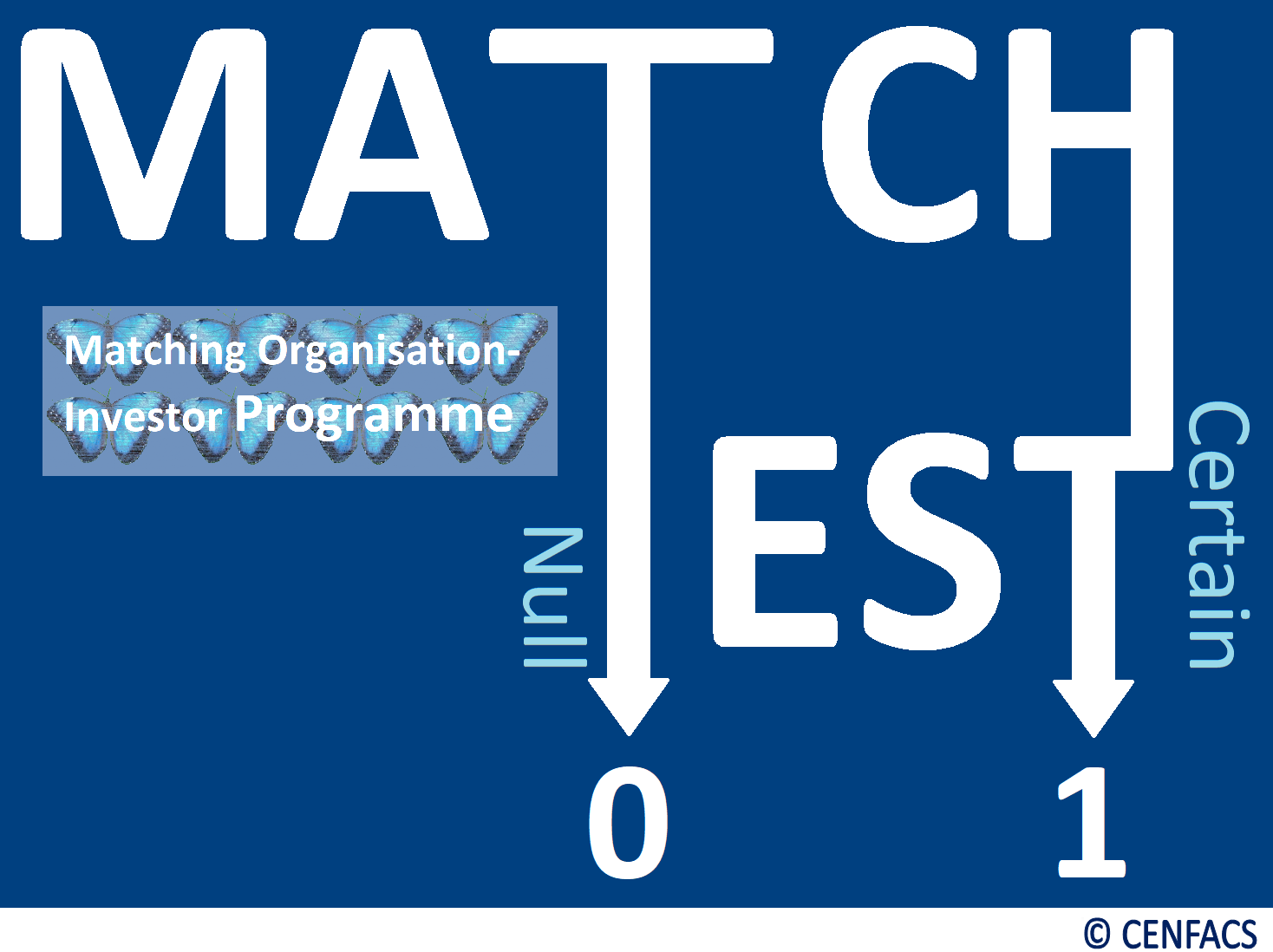
If there is a disagreement between ASCO and NFP Impact Investor, this could open up the possibility for a match/fit test. The match/fit test can be carried out to try to help the two sides of the matching process. The match/fit test can also be undertaken if there is a disagreement on any of aspects of CCP.
• • The Match or Fit Test Service
As part of the match or fit test, the contents of ACI/ASCO’s D&A Stage must be matched with NFP Impact Investor’s view on I&BC. The match test (or matched sampling) will help to increase the accuracy and statistical efficiency of the study of the CCP by carefully selecting subjects for comparison. The purpose here will be to increase the statistical efficiency of the study on CCP by controlling for confounding variables when forming a sample.
The fit test will assist in determining how well the observed sample data matches a specified theoretical distribution. The fit test will check if the data collected fits a model or an assumed population distribution. So, the purpose of the fit test is to validate or invalidate the statistical model by checking if the sample data follows an expected distribution.
The match can be perfect or close (that is, when every unit is paired with an equivalent unit) in order to reach an agreement. If there is a huge or glaring difference between the two (i.e., between what the NFP Impact Investor’s approach to D&A Stage and what ACI/ASCOC is saying about its D&A Stage, between what the investor would like the D&A Stage to indicate and what ASCO’s D&A Stage is really saying), the probability or chance of having an agreement at this Third round of negotiations could be null or uncertain.
• • • Impact Advice to ASCO and Guidance to NFP Impact Investor
Where there could be a disagreement, CENFACS can impact advise ACI/ASCO to improve the contents of its D&A Stage. CENFACS can as well guide NFP Impact Investors to work out their expectations in terms of D&A Phase to a format that can be agreeable by potential ASCOs.
CENFACS’ impact advice for ASCOs and guidance on impact investing for NFP Impact Investor, which are impartial, will help each of them (i.e., investee and investor) to make informed decisions and to reduce or avoid the likelihood of any significant losses or misunderstandings or mismatches.
• • • The Rule of the Matching Game
The rule of the game is the more impact investors are attracted by ACI’s or ASCOs’ D&A Stage the better for ACIs or ASCOs. It means that ACI’s or ASCOs’ process must pass the attractiveness test (that is, the evaluation of market’s appeal). Likewise, the more ACIs or ASCOs can successfully respond to impact investors’ level of enquiries and queries about the CCP the better for investors. In this respect, the matching game needs to be a win-win one to benefit both players (i.e., investee and investor).
The above is the Third Activity of the Matching Organisation-Investor via CCP.
Those potential organisations seeking investment to set up a CCP and NFP Impact Investors looking for organisations that are interested in their giving, they can contact CENFACS to be their matchmaker to find their perfect investee or investor.
• • • CENFACS as a Matchmaker
As a Matchmaker, CENFACS can streamline your search process, save time, money and resources to help you find the perfect match in the world of impact investing.
CENFACS platform will help facilitate the matching process between investees and investors. By leveraging the power of AI tools, CENFACS’ Matching Organisation-Investor Programme can streamline the search process for funding opportunities, connecting African charities and impact investors/funders.
Briefly speaking, CENFACS can work with matching applicants and use AI to match organizations with the right impact investors, filtering profiles based on development stages, sectors, and aims.
In this matching process, CENFACS can arrange the match or fit test for them. They can have their fit test carried out by CENFACS’ Hub for Testing Hypotheses.
• • • CENFACS’ Hub for Testing Hypotheses
The Hub can help use analysis tools to test assumptions and determine how likely something is within a given standard of accuracy. The Hub, which can serve as a learning or reference place for those who would like to understand and apply statistical hypothesis testing, can assist to
√ clean, merge and prepare micro-data sources for testing, modelling and analysis
√ conduct data management and administration
√ carry out regression analysis, estimate and test hypotheses
√ interpret and analyse patterns or trends or insights in data or results.
In this respect, CENFACS’ H-tests Hub is knowledge repository designed to demystify the process of using data to make informed decisions and move beyond intuition and guesswork.
For instance, in the context of this Activity 3, it is possible to evaluate or test hypothesses whether ACI’s/ASCO’s D&A plans align with NFP Impact Investor’s I&BC.
• • • • Testing the relationship between ACI’s/ASCO’s Distribution and Adoption and NFP Impact Investor’s Implementation and Behaviour Change
In clean cooking projects, the relationship between ACI’s/ASCO’s on-the-ground distribution and adoption on one part and NFP Impact Investor’s implementation and behaviour change on the other part is governed by Results-Based Financing (RBF) hypotheses. These test whether tying NFP Impact Investor capital to verifiable end-user adoption drives long-term social and climate benefits.
Amongst the hypotheses can be tested, we can mention two examples of them: the Behavioural Control Hypthesis and the Financial Sustainability and Viability Hypothesis. Let us spell out these hypotheses.
a) The Behavioural Control Hypothesis
This hypothesis can be formulated as follows:
‘Tying NFP Impact Investor funding to sustained use forces ACI/ASCO to invest in intensive, local user training and after-sales support’
b) The Financial Sustainability and Viability Hypothesis
This second hypothesis can be expressed in this manner:
‘Blended finance or viability gap funds enable ACI/ASCO to scale its distribution networks to reach remote populations without risking total financial collapse’.
The above-mentioned hypotheses and other ones can be tested. Their results can contribute to the Matching Organisation-Investor via CCP.
Those who would like to apply hypothesis testing in fields of economic development or to deal with poverty reduction, they are welcome to use CENFACS’ H-tests Hub.
For any queries and/or enquiries about this Third stage (or phase) activity of Matching Organisation-Investor via CCP, please do not hesitate to contact CENFACS.
_________
• References
(1) https://www.wallstreetmojo.com/income-generating-activities (accessed in June 2026)
(2) https://businesscasestudies.co.uk/what-is-micro-enterprise/ (accessed in June 2026)
(3) https://esmt.berlin/knowledge/what-is-entrepreneurship (accessed in June 2026)
(4) https://www.un.org/en/observances/desertification-day (accessed in June 2026)
(5) https://assets.bii.co.uk/wp-content/uploads/2024/05/22082549/When-growth-does-and-does-not-reduce-poverty.pdf (accessed in June 2026)
(6) https://www.technoserve.org/blog/technology-fighting-global-poverty-key-innovations/ (accessed in June 2026)
(7) Oxford Quick Reference (2016), A Dictionary of Business and Management, Sixth Ed., Jonathan Law (Market House Books Ltd), Oxford University Press (available online at www.oxfordreference.com)
(8) https://www.cleverence.com/articles/business-blogs/what-is-distribution-4827/ (accessed in June 2026)
(9) https://certifyera.com/terms/adoption-in-project-management (accessed in June 2026)
(10) https://contentsquare.com/guides/product-adoption/ (accessed in June 2026)
(11) https://www.techtarget.com/searchcustomerexperience/definition/implementation (accessed in June 2026)
(12) https://thedecisionlab.com/guide/what-is-behaviour-change (accessed in June 2026)
_________
• Help CENFACS Keep the Poverty Relief Work Going This Year
We do our work on a very small budget and on a voluntary basis. Making a donation will show us you value our work and support CENFACS’ work, which is currently offered as a free service.
One could also consider a recurring donation to CENFACS in the future.
Additionally, we would like to inform you that planned gifting is always an option for giving at CENFACS. Likewise, CENFACS accepts matching gifts from companies running a gift-matching programme.
Donate to support CENFACS!
FOR ONLY £1, YOU CAN SUPPORT CENFACS AND CENFACS’ NOBLE AND BEAUTIFUL CAUSES OF POVERTY REDUCTION.
JUST GO TO: Support Causes – (cenfacs.org.uk)
Thank you for visiting CENFACS website and reading this post.
Thank you as well to those who made or make comments about our weekly posts.
We look forward to receiving your regular visits and continuing support until the end of 2026 and beyond.
With many thanks.