Welcome to CENFACS’ Online Diary!
15 July 2026
Post No. 465


The Week’s Contents
• Happiness, Healthiness and Wellness Projects for Children, Young People and Families This Summer 2026
• July 2026 All-in-one Impact Feedback and Assessment (Activity Level 2): Impact Assessment and Metrics for CENFACS’ Innovation to Secure Future Progress
• Data Insight and Analytics for CENFACS’ Embedding Long-term Resilience
… And much more!


Key Messages
• Happiness, Healthiness and Wellness Projects for Children, Young People and Families This Summer 2026
The cost-of-living pressures, extreme temperatures and the struggle that many households are having to meet their basic needs continue to pose an enormous challenge to the plan of many poor children, young people and families (CYPFs) to have a decent, affordable, happy, healthy, and balanced Summer holiday. Despite this challenge, there are still openings and opportunities available within the community and voluntary sectors to work together with these poor CYPFs so that they can navigate their way to have a happy, healthy, and balanced Summer break. These opportunities and possibilities include CENFACS’ Happiness, Healthiness and Wellness Projects.
CENFACS’ Happiness, Healthiness and Wellness Projects may not be the panacea for their problems; however they could be a step forward to pulling together with these CYPFs and support them to enjoy some forms of happiness, healthiness and wellness during this Summer season. The projects can make a world of difference by helping to alleviate poverty linked to the lack of happiness, healthiness and wellness. They can assist in reducing gaps in happiness, healthiness and wellness within our community while building trust and positive social connections to sustain happiness, healthiness and wellness. But what is happiness; what is healthiness; what is wellness?
• • Explaining Happiness, Healthiness and Wellness
• • • Happiness
There are many ways of explaining happiness. According to ‘sloww.co’ (1), happiness is about solving the following (in)equation:
Happiness ≥ Events – Expectations
From this (in)equation, this website explains that
“The way we link about the events of our life and compare them to realistic expectations is what makes us happy or unhappy”.
Authentically, Martin Seligman (2) explains happiness by using this formula:
H = S + C + V
H stands for your enduring level of happiness;
S is your genetic happiness set range or set point, and constitutes 50%
C is the circumstances in your life, which constitutes 10%
V represents factors under your voluntary control, making up 40%.
Authors like Neil Pasricha and Mo Gawdat (3) popularized the Happiness Equation as a foundational self-help concept. Its core premise states this:
Happiness = Result / Expectations
or alternatively
Happiness = Enjoyment + Money + Satisfaction
John F. Helliwell at al. (4) go further in their annual World Happiness Reports including the latest one of this year by re-providing six factors of happiness, which are
income (or log GDP per capita), healthy life expectancy, social support or having someone to count on in times of trouble, having a sense of freedom to make key life decisions, generosity, and the absence of (or freedom from) corruption.
These factors are included in the design of CENFACS’ Happiness Projects 2026.
• • • Healthiness
There are many ways of explaining and measuring healthiness. For example, ‘healthicine.org’ (5) speaks about individual measures of healthiness which include personal healthiness, nutritional healthiness, mental healthiness, etc. The same ‘healthicine.org’ tells us that each individual healthiness can be measured on a scale and shows it as deficient, normal, optimal or excessive. Deficient and excessive are both unhealthy.
One can use ‘calculatory’ system healthiness to find out if they are healthy or unhealthy. They can refer the Body Mass Index (6) calculator to discover if their weight is healthy or not. The
The Body Mass Index (BMI) calculates whether their weight is appropriate for their weight using the formula:
BMI = Weight (kg) / Height (m)²
They can as well refer to the metrics of calorie counting (7) to track what they eat and count calories.
These explanations and measures about healthiness have been included in the design of CENFACS’ Healthiness Projects 2026.
• • • Wellness
The definition of wellness used here comes from the Global Wellness Institute (GWI). According to GWI (8),
“Wellness is the active pursuit of activities, choices and lifestyles that lead to a state of holistic health”.
From GWI’s perspective, wellness is associated with an active process of being aware and making choices that lead toward an outcome of optimal holistic health and wellbeing. Still for GWI, most models of wellness include at least six dimensions: physical, mental, emotional, spiritual, social and environmental.
In the crafting of CENFACS’ Wellness Projects 2026, we have considered the above-mentioned six dimensions of wellness and formula.
The basic formula for Wellness is
Wellness = (Healthy Nutrition) + (Physical Fitness) + (Stress Management)
• • Happiness, Healthiness and Wellness Projects (or 6.3 Programme)
Happiness, Healthiness and Wellness Projects (or 6.3 Programme), which make the second part of our Summer Programme 2026, are structured initiatives designed to improve beneficiaries’ or the CENFACS Community’s overall quality of life. They focus on promoting positive mental health, physical fitness, emotional resilience, and lifestyle improvements; helping participants to actively thrive rather than merely avoiding illness.
These projects are interconnected, as empirical data shows that actively practising wellness directly boosts happiness, which in turn leads to proven physical health benefits like stronger immunity and lower cardiovascular risks.
6.3 Programme is made of 6 Summer initiatives to support 3 types of beneficiaries. These projects are the result of arbitration and discussions with the members of the CENFACS Community; particularly poor children, young people and families making this community.
• • Features of Happiness, Healthiness and Wellness Projects 2026
There are three features about this year’s Happiness, Healthiness and Wellness Projects which are:
a) The link between CENFACS’ services and life satisfaction of CENFACS’ members
b) The distribution of life satisfaction amongst CENFACS’ members
c) The Social media trackers in CENFACS’ community happiness, healthiness and wellness.
These features are highlighted in the Main Development section of this post. Under this Main Development section of this post you can also find the list of Happiness, Healthiness and Wellness Projects making our Summer Programme or Programme 6.3. Their contents will be unveiled as we move on and implement them during this Summertime.
For those who would like to have detailed or further information about each of the projects or the full 2026 version of this second part of our Summer Programme (that is Happiness, Healthiness and Wellness Projects), they can contact CENFACS.

• July 2026 All-in-one Impact Feedback and Assessment (Activity Level 2): Impact Assessment and Metrics for CENFACS’ Innovation to Secure Future Progress
Our work on this year’s All-in-one Impact Feedback and Assessment has moved to Activity Level 2. The latter is about assessing the changes that may have occurred as result of the application of CENFACS’ Embedding Long-term Resilience through Innovation to Secure Future Progress.
To deal with this assessment of the impact and the metrics, we are here focusing on Innovation to Drive or Secure Future Progress.
To start this assessment of the impact and the metrics to be used, it is better to explain some key terms (i.e., impact assessment, and metrics) and how CENFACS’ impact assessment relates to those terms.
• • Explaining Key Terms (i.e., Innovation to Drive Progress, Impact Assessment and Metrics)
• • • Innovation to Drive Change (I2DC)
Literature review on innovation suggests that I2DC is the translation of creative ideas into tangible, impactful solutions that significantly improve human well-being, efficiency, and capabilities. It is not just about invention, but about applying new knowledge to solve complex societal problems, elevate productivity, and adapt to shifting environments.
In I2DC, the relationship between innovation and progress is the catalyst for evolution in almost every aspect of society. It breaks down into three key pillars:
a) Economic and industrial growth b) Enhancing human quality of life c) Problem-solving and well-being.
Like other organisations, charities do innovate.
• • • • Charity innovation
For a charity, innovation means adopting new ideas, technologies, or business models to increase social impact, scale services, and diversify fundraising. Because charities operate with constrained resources, innovation is essential to minimize the value of every donation and adapt to changing community needs.
Key pillars for charity innovation revolve around service delivery, fundraising mechanisms, operational efficiency and data-driven decisions.
Charity innovation can drive progress by
σ Enhancing engagement (e.g., using viral social media campaigns)
σ Building resilience (e.g., diversifying income streams)
σ Addressing root causes (e.g., innovations that tackle systemic, structural issues).
• • • All-in-one Impact assessment
Let us first define impact assessment.
• • • • What is an impact assessment?
The definition retained here for impact assessment comes from Chadwick and Glasson in 2017. Their view was quoted by David Streatfield and Sharon Markless (9) who argue the following:
“An impact assessment is an assessment that is frequently conducted to assess impacts or any consequences for any development projects, policies and programmes (Chadwick and Glasson, 2017). This assessment is essential in order to ensure 1) the development projects are being managed efficiently; 2) the policies and programmes are beneficial to stakeholders; and 3) the verified impacts are promoted to related stakeholders (Streatfield and Markless, 2009)”.
Using this definition, we are going to assess the impact of the work of CENFACS’ Innovation Process to Drive Progress. In other words, we are going to conduct an impact measurement. To carry out this impact assessment, we need to have an impact measurement strategy together with an impact dashboard which will enable to tell the story of this work through charts and visuals. In addition, our impact assessment will be an all-in-one.
• • • • All-in-one impact assessment
Literature review on impact assessments indicates that an “all-in-one” impact assessment – often referred to as an Integrated Impact Assessment (IIA) or Combined Impact Assessment (CIA) – is a unified, holistic evaluation tool used by organizations to analyze how proposed policies, business changes, or projects will affect their communities, economies, and the environment.
Rather than running multiple separate tests, an IIA streamlines the process into a single framework and serves several key purposes. An “all-in-one” approach consolidates the following specialized assessments into one comprehensive report:
σ Equality and Diversity: It assesses how poverty reduction work affects different categories of individuals)
σ Health and Wellbeing: It evaluates mental and physical health impacts, identifying and mitigating health inequalities
σ Socio-economic and Poverty: It analyses the impact on poverty, employment opportunities, and vulnerable income groups
σ Environment and Sustainability: It appraises the proposal’s effect on carbon emissions, climate change goals, and local ecosystems
σ Human and Children’s Rights: It ensures that the policy aligns with fundamental human rights and children’s welfare mandates.
In the context of charities, an “all-in-one” impact assessment is a comprehension framework that measures both the social, economic and environmental changes a charity creates, as well as the internal risks, operational efficiency, and policy compliance of the charity itself. It evaluates both what the charity does and how well it does it.
We are going to adopt an integrated approach (integrated impact assessment) which combines various impact assessments into a single one or a comprehensive process. Through this process, we shall consider the potential effects of a proposal or project on different aspects like equality, human rights, children’s rights, socio-economic disadvantage, and the environment.
In short, this all-in-one impact assessment will provide a framework for making more responsible and effective decisions by considering the diverse range of potential impacts a proposal or project might have.
• • • All-in-one impact assessment metrics and indicators
Let us start with metrics and indicators.
• • • • Impact metrics and indicators
According to ‘kissmetrics.io’ (10),
“Anything that can be objectively measured in numeric form counts as metric”.
Metrics are therefore specific measurable values that track performance or progress against goals.
Knowing what metrics are, it is possible to explain impact metrics. The website ‘socialimpactsolutions.com’ (11) explains it by arguing that
“Impact metrics are a set of measures that help you evaluate the effectiveness of your organisation’s activities, programmes, and projects. They allow you to determine whether or not a project has achieved its desired results”.
We are as well going to use impact indicators. The website ‘sopact.com’ (12) explains that
“An impact indicator is a measurable variable or metric used to assess the progress and effectiveness of an organisation’s activities in achieving its intended impact”.
In the context of impact measurement process and framework of CENFACS’ Innovation to Drive Progress, actionable impact indicators and management will be employed.
Since we are dealing with all-in-one impact assessment, we are going to use an all-in-one impact assessment metrics system.
• • • • All-in-one impact assessment metrics system
Such system would integrate various indicators to comprehensively evaluate the effects of our intervention or initiative across different dimensions. This approach will combine social, environmental, and financial performance metrics to provide a holistic view of impact. In practical parlance, we shall identify relevant indicators, measure performance against those indicators, and analyse the data to understand the overall impact.
For the impact assessment of the above-mentioned CENFACS’ Innovating to Secure Future Progress, we can use the following all-in-one impact assessment metrics:
~ Output metrics (e.g., the number of households signposted to specialist advice service)
σ Outcome metrics (e.g., the quality of life improvement for households with financial resilience skills after following the project of Financial Controls and Monitoring 2026)
σ Reach metrics (e.g., the number of individuals or households affected by the Data Storytelling and Communication Skills for Households)
σ Equity metrics (e.g., how our Campaign to End Poverty Induced by Rising Costs of Living impacted different members of CENFACS Community).
When applying the above-mentioned metrics, we shall ensure that these metrics align with the theory of change we are using, the mission and vision of CENFACS.
• • What Do Theories Say about Impact Assessment?
Intrac (13) summarises some of the positions around impact assessment by giving two definitions (from the Organisation for Economic Cooperation and Development and Roche) of impact within social development, which are as follows: an impact is
“The positive and negative, primary and secondary, long-term effects produced by a development intervention, directly or indirectly, intended or unintended” (Organisation for Economic Cooperation and Development, 2010)
“Lasting or significant change – positive or negative, intended or not – in people’s lives brought about by an action or a series of actions” (Roche, 1999)
• • How We are Going to Apply these Definitions
We are going to use both definitions in these ways:
(a) Roche’s definition will help to capture short-term and meaningful changes in terms of life-changing benefits such as savings made on energy and food consumption to manage the cost-of-living crisis. We can as well include humanitarian appeals we made (e.g. Having Poverty with and for the Unprotected Children in Africa) to deal with the lack or less protection for children in Africa.
(b) The OECD (Organisation for Economic Cooperation and Development) definition will enable to include long-term changes in CENFACS’ capacity and system of poverty reduction (e.g. the hybrid advisory service that we set up as a result of cost-of-living pressures will continue in the future, particularly during this challenging and changing time of overlapping multiple crises like trade tensions and geo-political uncertainties).
• • The Impact Assessment of Innovation to Drive/Secure Future Progress
The impact assessment will evaluate how new programmes/projects or technologies created intended changes to our members and beneficiaries and would help secure future progress. Our impact assessment uses a mix of quantitative metrics (e.g., number of pilots) and qualitative indicators (e.g., beneficiary feedback) to measure whether innovations we brought in the last financial year are made or are actually making any difference.
Also, innovation involves trial, risk, and futureproofing, a standard charity outcome framework can fall short. Because of that, measuring it effectively requires evaluating both innovation capacity (the tools to create solutions) and innovation impact (the results of those solutions).
• • Key Metrics for Innovation
To measure progress, we shall look at five key areas, which are Research Budget Ratio, Pilot Programme Frequency, Experimental Success Rate, Volunteer Innovation Training Hours, and Data Infrastructure.
Let us summarize these metrics.
σ Research Budget Ratio
It is the percentage of total operating expenses dedicated to Research and Development (R&D). When we are going to produce our financial statements for 2025-2026, it will be interesting to know how much was allocated to R&D in terms of budget.
σ Pilot Programme Frequency
It is the number of new interventions, services, or tech prototypes launched over a specific period (here during the financial year 2025-2026).
σ Experimental Success Rate
It describes the percentage of pilot programmes that yield positive enough results to justify full implementation, or conversely, how quickly unviable are/were phased out.
σ Volunteer Innovation Training Hours
This metrics provides the time invested in training volunteers (since CENFACS is a volunteer-based organisation) on new agile frameworks, data collection, or design-thinking.
σ Data Infrastructure Quality
This is about qualitative and quantitative assessments regarding whether CENFACS has the system in place to capture real-time beneficiary data.
Having these metrics in mind or in place, the next step will be to assess the impact.
• • Assessing the Impact
To assess it, we shall define a theory of change (outlining our innovation inputs) and how it can lead us to long-term impact, use quantitative to capture the depth of the innovation’s impact, establish feedback loops to see if innovation is meeting goals, and adjust as necessary.
To conclude, we are still carrying out impact assessment or assessing change on an on-going basis (or impact monitoring) while doing another impact assessment or assessing actual change for some of our 2025-2026 programmes and projects that have reached the end of their lives. This impact assessment will be carried out until the 31st of July 2026.
The results of these impact assessments will be published in our end-of-year 2025-2026 accounts and other impact reporting documents in due course.

• Data Insight and Analytics for CENFACS’ Embedding Long-term Resilience
From 15 to 31 July 2026, we will be looking at the patterns and other meaningful information gathered from the analysis of data about the work of CENFACS’ Embedding Long-term Resilience through Innovation to Secure/Drive Progress; while we are conducting an impact assessment of the same work. In short, we are working to find out, interpret and communicate patterns in data in a meaningful way to CENFACS’ work relating to Embedding Long-term Resilience. This exercise will help to know what data (that is, raw, unorganised facts and figures) found will be telling us. Before going any further, let us briefly explain the key terms relating to Data Insight and Analytics for CENFACS’ Embedding Long-term Resilience.
• • Explanation of Key Terms
The key terms are Embedding Long-term Resilience, and Data Insight and Metrics.
• • • What Is Embedding Long-term Resilience (ELTR)?
It emerges from the literature on embedding resilience that ELTR is the practice of integrating adaptive, risk-aware strategies directly into an organization’s core operations, culture, and decision-making processes. Rather than treating crisis-preparedness as an afterthought, this approach permanently builds the capacity to survive, adapt, and grow in the face of climate shocks, economic volatility, and supply-chain disruption.
For a charity, ELTR means integrating adaptive strategies and sustainable practices into its core operations. It ensures the charity can survive economic shifts, leadership changes, or surging community demand without losing sight of its mission.
The above-named definition help to elucidate what we mean by ELTR.
• • • Defining Data Insight and Analytics Metrics
Research suggests that data insight and analytics metrics means, for a charity, transforming raw information (like donor habits or service usage) into actionable intelligence. By embedding this capability, charities build long-term resilience through proactive funding, optimized operations, and clear, provable impact – turning uncertain times into opportunities to adapt and thrive. Data-driven resilience has pillars that help drive long-term organizational health.
• • Key pillars of data-driven resilience
Among these pillars, it is worth mentioning the following: the evidence of the impact, financial and operational fitness, donor and supporter engagement, and proactive external awareness.
Let us briefly explain them.
σ Evidencing impact
Data analytics helps provide concrete evidence of effectiveness. To build this evidence, we need to use interactive dashboards and longitudinal tracking.
σ Financial and operational fitness
This involves forecasting needs, reducing administrative overhead, and proactively managing funds. In other words, we shall conduct predictive analytics and optimize resources.
σ Donor and supporter engagement
This includes analyzing donor information (like demographics, transaction history, and channel engagement) and segmenting our audiences to deliver personalized and compelling outreach through targeted campaigns.
σ Proactive external awareness
It is about connecting internal data with external datasets to help map unmet local needs and adapt our service delivery before a crisis hits.
• • Establishing a foundational strategy
To build resilience, it requires building a foundational strategy. To enable us to build it, we shall conduct a data audit, establish data governance, seek support if we need it, and evaluate the current state of CENFACS in terms of baseline strengths and areas for improvement.
• • Use of metrics and frameworks to deal with data insight and analytics
We are going to use metrics and frameworks to deal with data insight and analytics. This use will help know how users interacted with our services, particularly in the context of Embedding Long-term Resilience through Innovation to Secure or Drive Progress.
Data insight metrics will help to understand users’ journey to poverty reduction, to equitable and inclusive community/society.
For example, we can compare the lifetime value of volunteer and compare it to the cost of hiring a volunteer.
Another example is that we can apply referral metrics to track users recommending our services to their friends and families or relatives. We can also employ email campaign performance to discover patterns in data from those who responded to CENFACS’ Embedding Long-term Resilience through Innovation to Secure/Drive Progress.
We can as well collect fundraising analytics metrics to improve our fundraising capacity in finding funding for the different projects or activities making CENFACS’ Embedding Long-term Resilience through Innovation to Secure/Drive Progress.
For instance, we can utilize the following fundraising analytics metrics:
σ Donation Volume Donor Lifetime Value
σ Preferred Giving Methods
σ Contacted Conversion Rate
σ Donation Acquisition Cost
σ Social Return on Investment, etc.
These metrics will enable to analyse and get insights into how we managed to attract donors/funders to our noble and beautiful cause of poverty reduction.
To enable to get the above-named metrics, it requires engagement.
• • Engaging with the Analytics and Insight Activity
We are continuing to ask supporters and users as well as Africa-based Sister Organisations to engage with us in responding and reacting to our poverty relief work in their own words, voices, infographics and numbers.
They can
σ Rate
σ Provide a statement
σ Give information graphics (such as charts, graphs, images, etc.) about these programmes and projects.
The data collected via their responses will be processed and analysed to see if there is a meaningful pattern in them.
If anyone has data (a collection of facts or figures) or information regarding the advice service we provided via for example the advice sessions we ran or resources we produced to help the community to Embed Long-term Resilience through Innovation to Secure/Drive Progress; this is the opportunity to share their data or information with us.
To share data with us and or engage with this Data Insight and Analytics Activity Level 2, please contact CENFACS.

Extra Messages
• Specific Implementation of Analytics and Impact Activities – In focus from Wednesday 15/07/2026: Programme and Impact Measurement, Reserves Policy, and Team Building and Volunteerism
• Coming This July 2026: Summer Festival of Thoughts and Actions with a Focus on Disruptions to Poverty Reduction Efforts
• The Application of Data and Insight Skills to Manage Your Household – Session/Application 2: Smart Energy Management and Cost Reduction (from Wednesday 15/07/2026)

• Specific Implementation of Analytics and Impact Activities – In focus from Wednesday 15/07/2026: Programme and Impact Measurement, Reserves Policy, and Team Building and Volunteerism
We are as carrying on with the specific implementation of analytics and impact activities. From this Wednesday, we are undertaking the activities below.
• • Programme and Impact Measurement for Various Data Types Activity
Under this sub-activity, we shall deal with beneficiary analysis, outcome measurement, and data-driven decision making. Let us summarise the contents of this sub-activity.
σ Beneficiary analysis
It is the understanding of the characteristics and needs of beneficiaries and how programmes were tailored to meet their needs as well as how to measure the effectiveness of these programmes.
σ Outcome measurement
We are tracking key performance indicators related to programme goals, and outcomes to assess the impact of CENFACS activities.
σ Data-driven decision making
We shall use data insights to refine programme strategies, allocated resources effectively, and maximise the positive impact of CENFACS.
In short, measuring programme or impact requires tracking a mix of quantitative metrics (like services delivered or cost per outcome) and qualitative indicators (such as beneficiary feedback and behavioural shifts). To effectively do this, we may map our goals using a theory of change, tracking performance across four key areas: inputs, outputs, outcomes, and impact.
• • Reserves Policy for Financial Analysis Activity
We are going to look at CENFACS’ policy of keeping money aside as reserve to protect itself against drops in income or allow it to take advantage of new opportunities, as stated by ‘gov.uk’ (14). Reserves are the funds a charity keeps in reserve (15). We shall assess the level of free reserves (unrestricted funds not tied up in fixed assets or designated for specific future projects) and their adequacy.
To be more specific, we shall calculate CENFACS Reserves-to-Expenditure Ratio (Months of Cover) as shown in the formula below.
Months of Cover =
(Free Reserves/Total Annual Operating Expenditure) x 12
The aim is to cover 3 to 6 months or better 9 to 12 months.
Briefly, we shall review CENFACS’ reserves policy and financial resilience.
• • Team Building and Volunteerism for Impact Activity
Basically, we shall analyse CENFACS’ team building activities and volunteer opportunities. In other words, we shall find out the types of activities that CENFACS undertook to build its team. We shall as well analyse how CENFACS provided opportunities for the members of the public to donate their time and skills to support CENFACS’ work and poverty reduction cause.
This involves measuring the success of team building by combining engagement scores with operational collaboration metrics (like cycle times, unprompted cross-functional help) and retention rates. It also includes measuring the success of volunteerism as a team-building tool. In this respect, we are going to track participation rates and skill development, while using activity surveys to quantify team cohesion, communication, and overall culture within CENFACS.
In short, as part of implementing analytics and impact activities, we are going to conduct the above-mentioned three specific activities for this week, while dealing with the broad aspects of Analytics and Impact Month 2026.


• Coming This July 2026: Summer Festival of Thoughts and Actions with a Focus on Disruptions to Poverty Reduction Efforts
The 18th Edition of our Summer Festival of Thoughts and Actions, which will start from Wednesday the 22nd of July 2026 as scheduled, will focus on Disruptors to Poverty Reduction Efforts.
To introduce the theme of this 18th Edition, let us briefly explain disruptors to poverty reduction, categorize disrupting periods and highlight key disruptors.
• • What Is a Disruptor to Poverty Reduction?
Economic development literature describes a disruptor to poverty reduction as any systemic, environmental, or economic event that derails efforts to permanently lift people out of poverty. It is understood that these disruptions – such as climate change, extreme macroeconomic shocks, or technological displacement – reverse hard-won development gains and plunge vulnerable populations back into hardship.
• • Categorizing Disruption Periods
Global institutions like the World Bank (16) categorize the period since 2016 as a time when longstanding poverty reduction trends stalled due to four primary overlapping crises. The World Bank and economic research organisations cite four overarching, interconnected crises that have driven a lost decade of poverty reduction since 2016. These crises are as follows:
1) The COVID-19 Pandemic (2020-2022)
It caused massive job losses in the informal sector, reversing years of progress and dragging tens of millions of non-poor Africans back into extreme poverty.
2) Global Supply Chain Disruptions and Inflation (2022-Present)
The Russo-Ukrainian war and Middle Eastern conflicts severely disrupted global grain and fertilizer markets. This is without forgetting the current crisis in the Strait of Hormuz.
3) Climate-related Disasters
Recurrent droughts (in East and Southern Africa) and devastative floods have repeatedly destroyed agricultural livelihoods.
4) Regional Conflicts and Fragility
Escalating conflicts, violence, and political instability in places like the Democratic Republic of Congo, Sudan, Sahel, and the Horn of Africa have derailed localized poverty reduction efforts.
Experts on disruption matter believe that because of the compound shocks, the global extreme poverty rate stands at approximately 10% with the goal to eradicate extreme poverty by 2030 currently deemed well off back by the United Nations. Experts also argue that these compounding disruptions have caused severe material deprivation to surge to its highest levels in 25 years, with the extreme poverty rate in Africa sitting stubbornly around 38%.
The above-mentioned four disruptors are among the key ones we will be dealing with during our Summer Festival 2026.
• • Highlight of the 7 Key Disruptors
When analyzing hurdles to poverty reduction in Africa, economic and development literature frequently categorizes these obstacles into 7 critical sub-themes. These areas directly disrupt progress by stalling economic growth, exacerbating inequality, or destroying fragile livelihoods across the continent. The 7 primary sub-themes that disrupt poverty reduction efforts in Africa include:
1) Conflict and fragility
2) Climate change and environmental degradation
3) Inadequate infrastructure and power outages
4) Economic shocks and inflation
5) Institutional inadequacies and corruption
6) Persistent gender and social inequalities
7) The learning crisis and skills mismatch.
These selected (negative) disruptors will be part of CENFACS’ Summer 2026 Festival.
However, our Festival will not only deal with the above-mentioned negative disruptors (that is, events having detrimental effects on poverty reduction efforts), but also with game-changers or innovators countering these negative disruptors. In other words, the Festival will as well treat positive disruptors (that is, innovative and game-changing solutions that actively combat poverty) on its last day (that is, 28/07/2026).
The following headlines summarise the organisation of the festival:
∝ Making any contributions in the form of thoughts and/or comments
∝ Event guide and programme
∝ Supporting the 7DDJ2026 (Seven Days of Development in July 2026) event.
Let us explain what the above-named headings contain.
• • Making any Contributions in the Form of Thoughts and/or Comments
For those who will be making any contributions in the form of thoughts and/or comments, it will be good to stick to the daily themes as planned. Likewise, it makes easy for the good running of the festival to be short and precise in making thoughts or comments.
This will allow capture the impact they are making. In this way, this will as well enable us to meet the Festival aim and get the difference that it will make to the lives of those who are looking for positive disruptors.
THINK • ACT • SHARE • ADD VALUE • SPREAD
• • Event Guide and Programme
The following is the make-up of Summer 2026 Festival.
• • • 7DDJ2026 Registration: FREE!
The entry to the 7DDJ2026 is FREE.
For those who are busy and who can remotely, directly respond to the daily themes from their technological devices (e.g. laptop, desktop PC, tablet, phone, etc.) without having to attend any online sessions, there is no need to register.
For those who will have the opportunity to join our online sessions (or video conference), they may be notified about the days and times these sessions may happen. They will need to sign into their Google accounts to join if everything remains the same.
• • • Daily Themes
Daily Themes (DTs) provide a daily opening thought or starting point of the broad topic/issue of Disruptions to Poverty Reduction Efforts. Each DT will last all day and the only day it is planned.
• • • Responses to 7DDJ2026 Contributors
Each respondent will receive a reply to their contribution in the form of either an acknowledgement of their participation or a reaction expressed as an argument to their responses or even both. Also, they will be entitled to receive the summary report on this summerly event.
• • • Lead Thoughts
Lead thoughts, which will be introduced on the day of festival, are a general idea on the thought of the day. There are designed to lead to or generate more thoughts, potential research paths or investigative grounds that can be further explored to shade some lights to our Summer Thoughts and Actions. They are not an end for themselves.
MAKE YOUR IDEAS AND COMMENTS COUNT!
• • • 7 Daily themes
Day 1: Armed conflicts, fragility and instability
Day 2: Climate Change and environmental degradation
Day 3: Economic shocks and inflation
Day 4: Pandemics and health emergencies
Day 5: Inadequate infrastructure and power outages
Day 6: Persistent gender and social inequalities
Day 7: Positive disruptors to poverty reduction.
• • Supporting the 7DDJ2026 event
• • • 7 Ways of supporting 7DDJ2026
You could…
√ Post your thoughts, comments and views on any themes and topics of the event directly to CENFACS
√ Pass the message onto interested persons
√ Feedback on previous 7DDJF events
√ Promote the event around you and/or by using other means available to you and at your convenience
√ Help us re-cover the expenses of the event specifically and/or the running cost of CENFACS’ work generally
√ Support CENFACS on a regular basis to enable us to continue our work
√ Support our new initiative about Positive Disruptors to Improve Poverty Reduction Efforts.
• • • 7 Ways of proceeding with your wish
Please choose below the kind of support you want to provide and let us know
√ Promote the event
√ Feedback CENFACS on previous events
√ Circulate the news about the event
√ Help in the recovery of 7DDJ 2026 expenses
√ Fund CENFACS for its deserving work, noble and beautiful cause of poverty reduction
√ Provide helpful and supportive comments or views
√ Support CENFACS in your own way.
Please mail your intent to support and or support to CENFACS
Closing date for reply: 07/08/2026
Please read the above event supporting information and mail us your comments and views (on the themes of your interest) to facs@cenfacs.org.uk.
For further details about our Seven Days of Development in July or Summer 2026 Festival, please contact CENFACS.
Thank you for your continued support.
With best wishes and full of inspiration and creativity throughout our dedicated days of Festival of Thoughts and Actions on Disruptions to Poverty Reduction Efforts.
The 7DDJ2026 Events Team,
Thank you.

• The Application of Data Insight and Analytics Skills to Manage Your Household – Session/Application 2: Smart Energy Management and Cost Reduction (from Wednesday 15/07/2026)
In this second application, we are going to deal with the following areas of managing and organising task: Appliance-level Analytics, Anomaly Detection, Usage Adjustment, and Resources.
Let us summarise each of these tasks.
σ Appliance-level Analytics
It is about connecting smart home devices and smart meters to track electricity, gas, and water usage in real time.
σ Anomaly Detection
It involves analyzing usage logs to identify ‘vampire devices’ or faulty appliances that are quietly spiking your utility bills.
σ Usage Adjustment
It encompasses using data to adjust thermostat temperatures or shift heavy appliance usage (like running the dishwasher) to off-peak, cheaper energy hours.
σ Resources
It is about centralizing your data collection with open-source automation platforms like Home Assistant to visualize your hourly and monthly consumption metrics.
Those members of our community who will be interested in Session/Application 2 as well as all support about The Application of Data Insight and Analytics Skills to Manage Your Household, they should not hesitate to contact CENFACS.

Message in French (Message en français)
• L’État des Lieux (de Juillet 2025 à Juin 2026) des Appels à l’Action en Faveur de Causes Humanitaires en Afrique Lancés par le CENFACS
La situation actuelle des appels à l’aide humanitaire se caractérise par une hyper-priorisation et un fossé de financement considérable entre les besoins croissants en Afrique et les ressources disponibles.
En effet, les campagnes de mobilisation de fonds et les initiatives d’aide humanitaire que nous avons élaborées pour la période 2025-2026 privilégient la réponse aux conflits qui s’intensifient (notamment dans la région du Sahel Central), aux catastrophes climatiques, ainsi qu’aux enjeux liés à l’éducation, aux déplacements internes, à la santé (comme l’épidémie d’Ebola en République Démocratique du Congo), à l’insécurité alimentaire sévère (au Mali, par exemple) et aux liens entre les populations humaines et la préservation de la nature.
Ces appels portent sur une aide vitale, la résilience face aux chocs et aux crises, les soins de santé d’urgence, etc. Ils s’inscrivent dans le cadre du bilan d’impact global pour la période 2025-2026, que nous avons demandé à nos organisations sœurs basées en Afrique de fournir leur avis.
Ces appels sont les suivants :
1) Agir dans l’intérêt de l’éducation des enfants
2) Soutenir les enfants aux besoins éducatifs variés et les victimes de crises sans issue en Afrique
3) Les personnes déplacées internes du Sahel Central ont besoin de votre soutien
4) Les populations du Mali frappées par une grave crise humanitaire ont besoin de votre action positive dès maintenant : pouvez-vous aider ?
5) Mettre fin à la détresse des enfants en Afrique
6) Appel à l’aide : épidémie d’Ebola
7) Appels pour l’aide humanitaire et la préservation de la nature – Automne 2025
8) En Afrique, des personnes en situation de grande précarité souhaitent reconstruire et renouveler leur vie : pouvez-vous aider ?
Pour en savoir plus sur cet État, veuillez contacter CENFACS.


Main Development
• Happiness, Healthiness and Wellness Projects for Children, Young People and Families This Summer 2026
To approach Happiness, Healthiness and Wellness Projects, it is better to understand them, to know the different factors that determine happiness, healthiness and wellness; and to deliver them. Thus, the following headings will ease their approach:
∝ Understanding CENFACS’ Happiness, Healthiness and Wellness Projects
∝ Determining Factors or Indicators of Happiness, Healthiness and Wellness
∝ Statistics about Happiness, Healthiness and Wellness
∝ Relationships between Happiness, Healthiness and Wellness
∝ Features of Happiness, Healthiness and Wellness Projects in 2026
∝ Delivering Healthiness, Healthiness and Wellness with 6 Projects for 3 Beneficiaries.
Let us now look at what is inside these headings.
• • Understanding CENFACS’ Happiness, Healthiness and Wellness Projects
As said in the first key message, the cost-of-living pressures, extreme temperatures and the struggle for low-income households to meet their basic needs continue to pose an enormous challenge to the plan of many poor children, young people and families (CYPFs) to have a decent, affordable, happy, healthy and balanced Summer holiday. In these conditions and circumstances, happiness, healthiness and wellness may not mean anything for them.
Despite that, it is possible to find health relief, happy fulfilment and good wellbeing while still dealing with these impacts and effects, this Summer 2026. It is possible to make the conditions of being physically, mentally, socially and environmentally sound better this Summer.
To make these conditions sound better and create meaningful Summer for them, we have planned six happiness, healthiness and wellness enhancing initiatives. This Summer, we are going to focus on ways or activities of finding this health relief, happy fulfilment and good wellbeing. In other words, our centre of interest is on what will keep children, young people and families happy (or unhappy), healthy (or unhealthy) and well (or ill) over Summer under the debilitating conditions of the pressures of all kinds (like the high costs of living, changing climate and geo-economic tensions with changing trade tariffs).
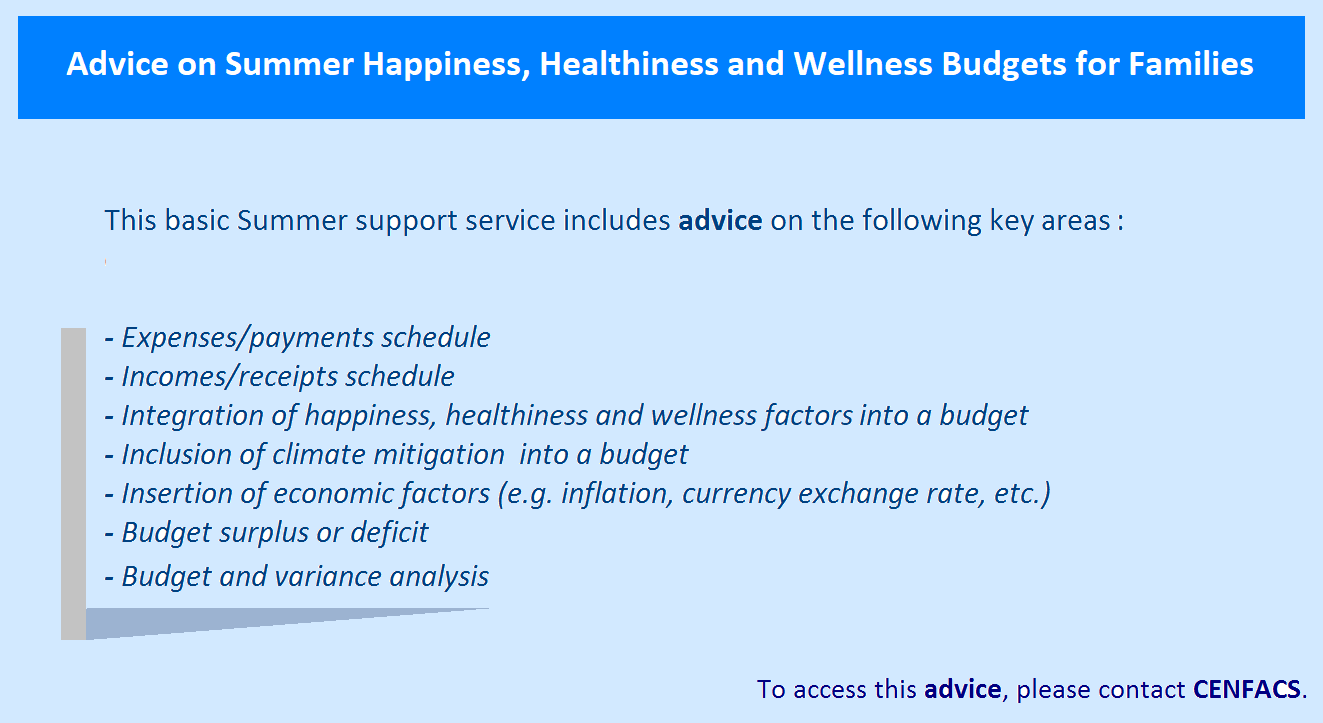
In order to keep them happy, healthy and well, there is a need to budget and deliver Happiness, Healthiness and Wellness Projects.
• • • What Are Happiness, Healthiness and Wellness Projects?
CENFACS’ Happiness Projects are poverty-relieving responses to bring joy while reducing misery for poor children, young people and families over the summer period and beyond it. They are also specific initiatives designed to boost mental health, foster community connection, and teach emotional resilience.
CENFACS’ Healthiness Projects are poverty-relieving responses to bring freedoms from diseases (including epidemics, virus like COVID-19) while reducing misery for poor children, young people and families over the summer period and beyond it. They are as well initiatives aimed at protecting, improving, or advancing the physical, mental, or emotional health of a community. These initiatives empower marginalized or vulnerable CYPFs by addressing the root causes of poor health like nutrition, social isolation, and healthcare access.
CENFACS’ Wellness Projects are a set of impactful and cost-effective activities that help improve health and well-being outcome; in doing so reducing poverty linked to poor wellness over the summer period and beyond it. They are designed to improve the physical, mental, or emotional health of a vulnerable community or CENFACS’ own volunteers. These projects provide holistic support such as trauma-informed counselling, nutrition, education, community gardening, and fitness activities.
Happiness, Healthiness and Wellness Projects are therefore structured initiatives designed to improve CYPFs’ overall quality of life. They focus on promoting positive mental health, physical fitness, emotional resilience, and lifestyle improvements, helping participants actively thrive rather than merely avoiding illness.
• • • The Difference between Happiness, Healthiness and Wellness Projects
A Happiness Project focuses on joy and life satisfaction. The core focus is cultivating joy, positive emotions, and life satisfaction without necessarily changing your external circumstances.
A Healthiness Project targets physical vitality and disease management. The core focus is physical fitness, disease prevention, and vitality.
A Wellness Project takes a holistic lifestyle-based approach to balance your physical, mental, and social well-being. The core focus is holistic, sustainable lifestyle design that harmonizes the body, mind, and spirit.
• • Determining Factors or Indicators of Happiness, Healthiness and Wellness
The underlying principles or philosophy behind these life evaluation projects are in line with the main factors or indicators that define happiness as both a social and personal concept as explained in successive World Happiness Reports edited by Helliwell et al. (17).
• • • Happiness as both a social and personal concept
Helliwell et al. (op. cit.) distinguish the social foundations of happiness from personal happiness, although the two are complementary. They argue that the science of measuring and understanding subjective well-being and happiness indicates that to be happy, one needs to meet the following six key variables or predictors that explain happiness differences among countries and group ages, which include:
income (Gross Domestic Product per capita), healthy life expectancy at birth, social support (having someone to count on in times of trouble), generosity, freedom to make life choices and trust (perceptions of corruption).
For example, Helliwell et al. (18) argued in their 2020 World Happiness Report that
“Sub-Saharan Africa is not only the areas in the world with low happiness scores, but also a region in which happiness differences between the city and countryside are most pronounced in favour of city life” (p. 40)
The report went on in explaining that African countries with most pronounced urban-rural differences in life evaluation included: Angola, Congo Brazzaville, Benin, Central African Republic, South Africa, Gambia, Niger, Liberia and Egypt.
In their World Happiness Report 2021, Helliwell at al. (19) noted that
“Life expectancy has much improved in Sub-Saharan Africa… Life expectancy has become much more equal, and has increased in Sub-Saharan Africa for seven years” (p. 194)
In their World Happiness Report 2023, Helliwell at al. (op. cit.) explained that
“Happiness gaps globally have been fairly stable overtime, although there are growing gaps in many African countries” (p. 3)
After studying the level of happiness between age groups, Helliwell at al. (20) contend that
“Since 2006-2010, there has been the biggest increase in the inequality of Sub-Saharan Africa… But, life satisfaction has increased among the young in Sub-Saharan Africa” (p. 6)
When talking about key determinants of happiness and misery, they again argue that happiness is caused by factors such as income, employment, health and family life.
In their 2025 World Happiness Report, Helliwell at al. (21) notes that
“Togo was the least happy country in 2013 and has since risen twenty places, with an average life evaluation almost 14 points higher now than then” (p. 20)
This shows that countries can improve in terms of happiness.
• • • Happiness is about ending poverty and misery
CENFACS Happiness Projects address the issues encapsulated inside the above variables and factors while keeping in mind first the needs of the CENFACS Community. This is because we think the way to keep people happier is to reduce as much as possible poverty and misery among them. Happiness is about ending poverty and misery.
At this time of record-high costs of living, to be happy could mean having the means and resources to meet these high costs of food, energy, fuel, transport, accommodation, etc. Those who are unable to meet these high costs, prices and bills will obviously be unhappy.
As the concept of changing climate is part of our happiness projects, happiness is finally about ending poverty and misery amongst children, young people and families in an era of changing climate. Soaring temperatures during this Summer can only mean more fresh water, foods with higher water content, Summer appropriate clothing, air-conditioned environment and other resources to deal with the heat. They could also signify a possibility of high threats and damages to health.
Those who would not have the means to manage these temperatures would not be happy or healthy or even feel well. To get happiness, they need to find ways of keeping themselves cool while carrying on their life as a normal in a heatwave.
• • • Healthiness is about ending poor health conditions
CENFACS Healthiness Projects address the issues included in the above-mentioned variables and factors, particularly healthy life expectancy in this Summer 2026. These projects will help to keep in mind the needs of the CENFACS Community in terms of healthiness; that is in terms of how their bodies, minds and spirits would be healthy or unhealthy. If they are unhealthy, then there is a need to work with them to become healthy.
For instance, the World Health Organisation (22) states that
“Amongst the six WHO regions, the highest mortality rate was found in the African Region (46.7 per 100000 population) and the South-East Asian Region (29.6 per 100000 population) in 2019. These two regions alone accounted for 79% of the total global deaths due to unsafe WASH (water, sanitation and hygiene) services”.
Keeping people healthier is about reducing as much as possible health and climate poverty and misery among them. Healthiness is about ending health poverty and misery. Healthiness is finally about ending poor health and poor living environment amongst children, young people and families in an era of polycrises.
• • • Wellness is about ending poor choices and lifestyles leading to poor health
CENFACS Wellness Projects support healthy eating, physical activities, personal care and hygiene, good housing conditions, community care, etc. They are associated with an active process of keeping their users to be aware of and making healthy choices that lead toward an outcome of optimal holistic health and wellbeing, as the Global Wellness Institute (op. cit.) would think.
• • Statistics about Happiness, Healthiness and Wellness
Without elaborating on complex statistics about Happiness, Healthiness and Wellness; let us give some quantitative data about Happiness, Healthiness and Wellness in Africa.
The website ‘africabriefing.com’ (23) refers to the World Happiness Report 2026 in arguing that the top 10 happiest countries in Africa in 2026 are:
1. Mauritius (5.739 score) (73rd globally)
2. Libya (5.731 score) (89th globally)
3. Algeria (5.714 score) (83rd globally)
4. Mozambique (5.336 score)
5. Gabon (5.167 score)
6. Ivory Coast (5.148 score)
7. Cameroon (5.083 score)
8. South Africa (5.009 score)
9. Niger (4.940 score)
10. Tunisia (4.798 score).
Concerning healthiness, the website ‘mohacafrica.org’ (24), states that
“In 2026, Africa’s overall healthiness reflects significant progress but persistent challenges. Life expectancy sits at 64.9 years, reflecting a 10-year gain since 2000. The crude death rate is roughly 7.4 per 1,000 people. Universal health coverage remains a hurdle, as only 48% of the population can access essential health services”.
Regarding wellness, ‘globalwellnessinstitute.org’ (25), argues that
“In 2026, Africa’s wellness and healthcare landscapes are defined by expanding infrastructure and a rapidly growing wellness tourism market while only 48% of the population accesses essential health services, commercial wellness is booming driven by preventative healthcare, holistic botanical products, and multidimensional treats”.
Although the above-mentioned statistics are basic, they nevertheless give some indication about Happiness, Healthiness and Wellness in Africa.
• • Relationships between Happiness, Healthiness and Wellness
There are links between happiness, healthiness and wellness. The Global Wellness Institute (26) argues that
“There is a strong correlation between wellness, happiness and health. This is because spending in wellness has strong correlations with happiness and health outcomes”.
Happiness, healthiness and wellness are interconnected and influence each. Happiness can promote healthier habits, which in turn contribute to overall well-being. Conversely, good health and wellness practices can positively impact a person’s happiness and emotional state.
Happiness, Healthiness and Wellness Projects are too interconnected, as empirical data shows that actively practising wellness directly boosts happiness, which in turn leads to proven physical health benefits like stronger immunity and lower cardiovascular risks.
During this Summer, we shall be working on this correlation and develop a strategy to apply it on the delivery of Happiness, Healthiness and Wellness Projects. In other words, we will be trying to work with CYPFs so that they can be happy, healthy and feel well in whatever they will plan to do during this Summer.
Since 2026 has been dedicated as CENFACS Year of Alternatives, we are going to add to the above-mentioned correlation, the link between Alternatives and “Happiness, Healthiness and Wellness”. This link centres on empowerment, autonomy, and decision fatigue. Indeed, having the ability to choose lifestyle or health alternatives directly influences psychological satisfaction and long-term wellbeing, though an overabundance of options can actually undermine it.
• • Features of Happiness, Healthiness and Wellness Projects in 2026
There are three features linked this year’s Happiness, Healthiness and Wellness Projects which are the link between CENFACS’ services and life satisfaction of CENFACS’ members, the distribution of life satisfaction amongst CENFACS’ members, and social media trackers in CENFACS’ community happiness, healthiness and wellness.
• • • The link between CENFACS’ services and life satisfaction of CENFACS’ members
This year’s our Happiness Season is also about our service capacity (or ability to deliver support services to the community) and how this capacity could help to avoid poverty or worsening of poverty and misery within our community. This service capacity can correlate or be linked to the average life satisfaction of our community members.
• • • The distribution of life satisfaction amongst CENFACS’ members
This year’s our Happiness Season is further about working with our community members to find out whether or not average life satisfaction is high or equally distributed amongst them.
• • • Social media trackers in CENFACS’ community happiness and healthiness
This year’s our Happiness Season is as well about tracking changes in happiness (life evaluations) using social media trackers. It is about using social media data as way of measuring levels of happiness and/or misery among our community members.
The three characteristics have been considered in the design of this year’s Happiness, Healthiness and Wellness Projects.

• • Delivering Happiness and Healthiness with 6 Projects for 3 Beneficiaries
6 Projects to bring Happiness, Healthiness and Wellness to 3 beneficiaries: Poor Children, Young People and Families
After the last school term, Summer is a holiday season of the year during which most of the schools are closed and families with small children and young people in much needed help are forced to stay with them and or use this time of the year to take holiday. The usual routine of educational/academic establishments with their recreational activities is scaled down.
This Summer could be painful as many CYPFs will continue to face up skyrocketing prices of food, energy, transport, accommodation, etc. The cost of running Summer will be excessively high for many CYPFs. This is let alone the fact that many of them who are poor may not afford to travel, even inside the country, and to go for holiday. Yet, these CYPFs are in need of seasonal and recreational activities and programmes for improving their well-being, healthiness and happiness.
There are ways of ensuring that summer stays an interesting and enjoyable period for Multi-dimensionally Poor Children, Young People and Families. There are things that can be done to make summertime a season of Happiness, Wellness, Peace, Vulnerability-free, Healthiness, Protection and Sustainability.
There should be projects that can help them to adapt and mitigate the adverse effects of the lingering impacts of the high costs of living, extreme temperatures and the damaging effects from the inability to meet life-sustaining basic needs. There should be projects that can help them to adapt and mitigate the adverse effects of climate change.
• • • Summer 2026 Happiness, Healthiness and Wellness Projects
The following CENFACS suite of summer 2026 initiatives can help in achieving some joyful, healthful and helpful summer plans, goals and outcomes in the context of rising cost-of-living pressures.
CENFACS Happiness, Healthiness and Wellness Projects include:
1) ‘Holiday with Relief’ Resource (this year’s focus is on a Holiday with Alternative Activities)
This year, the resource deals with holiday with alternative activities. These are family holidays offering unique experiences and activities beyond traditional beaches or amusement parks. Such holidays can include adventure trips, educational experiences, and local excursions tailored to different interests and age groups. They offer families the opportunity to strengthen bonds, acquire new skills, and create unforgettable memories in a more enriching and educational way.
Holiday with Alternative Activities refers to an unconventional, off-the-beaten-path trip focused on experiential learning, immersive cultural exchange, or active outdoor pursuits rather than standard resort relaxation.
2) Narrowing Gaps in Happiness Inequalities
Narrowing Gaps helps reduce the extent to which happiness levels vary across individuals or members of our community, through strengthening social trust, addressing economic disparities, ensuring equitable access to resources, and promoting fairness and inclusion.
It also refers to closing the wellbeing gap – the difference in life satisfaction and mental health between a society’s happiest and most miserable citizens. It shifts the focus from purely economic inequality to an individual’s actual quality of life, aiming to alleviate societal misery.
3) Summer Harmony with Nature
Harmony with Nature emphasizes a balanced relationship where human activities are aligned with the well-being of the planet and its ecosystems.
It is the practice of aligning human lifestyles, mental well-being, and architectural designs with the active, cyclical rhythm of the summer season. It emphasizes rco-centric living, recognizing that humans are interconnected with the environment rather than separate from it.
4) True Balance in Happiness, Healthiness and Wellness
True Balance includes cultivating healthy habits, finding joy in daily life, and nurturing meaningful relationships by finding the right proportions for happiness, healthiness and wellness.
True Balance is not an even split of time, but a dynamic equilibrium where your daily habits align with your core value. It is the harmonious integration of happiness (joy and purpose), healthiness (mental and emotional resilience), achieved by actively meeting your personal needs without neglecting your responsibilities.
5) Networking for Protection and Safeguarding at the Time of Rising Cost-of-living Pressures
Networking for Protection and Safeguarding involves implementing measures to safeguard children and deploying efforts to protect vulnerable adults from harm.
It involves multi-agency approach and connects local authorities, housing associations, charities, and community groups to share resources, identify vulnerable people, and provide vital support before households reach breaking point.
6) Community Care, Health Responsibility and Wellness Enhancing Activities
Community Care promotes independence and wellbeing, while Health Responsibility helps individuals to manage their own well-being through better lifestyle choices and preventative measures, and Wellness Enhancing Activities are about the practice of activities that improve their physical and mental health.
So, Community Care, Health Responsibility and Wellness Enhancing Activities form a holistic framework where local communities and individuals partner with health systems to maintain well-being. It shifts the focus from purely clinical treatment to empowering people to live independentlyand actively cultivate their overall health.
There is a link between these six initiatives.
For example, knowing the food and energy that one needs during the Summertime can help to narrow gap in inequalities relating to happiness, healthiness and wellness. Likewise, the way in which one consumes food and energy can help build harmonious relationships with the nature, network for protection and safeguarding, and act in a responsible way in the interest of their own happiness, community wellness and public healthiness.
These projects are the combination of skills, knowledge, resources, tools, tactics, fixers, enhancements, boosters, tasters, trackers and tricks for the relief from poverty induced by the rising cost-of-living pressures and poverty due to the lack of happiness, healthiness and wellness.
In the preparation of our Summer 2025 programme for CYPFs, we have considered the continuing happiness, healthiness and wellness issues from the lingering impacts of the global tariff crisis, extreme temperatures and the damaging effects from the inability to meet life-sustaining basic needs.
All the six Happiness, Healthiness and Wellness Projects will be safe; just as they take into account the happiness, healthiness and wellness effects in relation to changing climate and the rising cost-of-living pressures. They will help CYPFs to shield themselves from services inflation and the legacies of recent crises that can prevent them from enjoying a decent and desirable Summer holiday.
They will be delivered to help improve life evaluations while taking actions to enhance the same life in the context and under the constraint of the lingering impacts of any potential crisis/issue, extreme temperatures and the damaging effects from the inability to meet life-sustaining basic needs.
In this way, Summer can be a season of Happiness, Healthiness and Wellness; NOT of Misery for un-served and under-served children, young people and families who are at the same time victims of the adverse and far-reaching lingering impacts of the poly-crises, extreme temperatures and the damaging effects from the inability to meet life-sustaining basic needs.
They are the victims of adverse and far-reaching lingering effects of poly-crises. The global tariff crisis and other geo-economic crises are directly or indirectly impacting on them.
They are also trapped in the cost-of-living pressures. The latter has taken them economically and healthily in hostage by affecting the way they dress, eat, house, educate, eat, warm their home, entertain, enjoy, care for their health and body, look after their homes, and above all the way they pass their Summer holiday.
They are finally suffering from the consequences of changing climate, which is transforming the way they consume, produce and entertain themselves.
For details about CENFACS Happiness, Healthiness and Wellness Projects 2026 and to access them, please contact CENFACS.
_________
• References
(1) https://www.sloww.co/mo-gawdat-happiness-equation/ (accessed in July 2023)
(2) https://medium.com/happiness-india-projectft/happiness-formula-h-s-c-v-99a285294f50 (accessed in July 2025)
(3) https://www.panmacmillan.com/blogs/lifestyle-wellbeing/mo-gawdat-equation-for-happiness-google-xp (accessed in July 2026)
(4) Helliwell, J. F., Layard, R. , Sachs, J. D., De Neve, J.-E., Aknin, L. B., & Wang, S. (Eds.), (2023), World Happiness Report 2023, New York: Sustainable Development Solution Network (http://worldhappiness.report/)
(5) healthicine.org/wordpress/healthiness-unhealthiness-wellness-illness/ (accessed in July 2023)
(6) https://www.nhs.uk/live-well/healthy-weight/bmi-calculator/ (accessed in July 2023)
(7) https://www.nhs.uk/better-health/lose-weight/calorie-counting/ (accessed in July 2023)
(8) https://globalwellnessinstitute.org/what-is-wellness/ (accessed in July 2024)
(9) Streatfield, D. & Markless, S. (2009). What is Impact Assessment and Why is it important? Performance Measurement and Metrics. 10.134-141. 10.1108/14678040911005473 (accessed in July 2024)
(10) https://www.kissmetrics.io/blog/metrics-vs-analytics/# (accessed in July 2024)
(11) https://www.socialimpactsolutions.com/what-are-impact-metrics/ (accessed in July 2024)
(12) https://www.sopact.com/perspectives/impact-indicators (accessed in July 2024)
(13) https://www.intrac.org/wpcms/wp-content/uploads/2017/01/Impact-Assessment.pdf (accessed July 2023)
(14) https://www.gov.uk/guidance/charity-financial-reserves (accessed in July 2025)
(15) https://www.gov.uk/government/publications/charities-and-reserves-cc19 (accessed in July 2025)
(16) https://blogs.worldbank.org/en/opendata/the-polycrisis-behind-a-lost-decade-of-poverty-reduction (accessed in July 2026)
(17) Helliwell, J., Layard, R., Sachs, J. (2017, 2018 & 2019), World Happiness Reports (2017, 2018 & 2019), New York: Sustainable Development Solutions Network
(18) Helliwell, J., Layard, R., Sachs, J. & De Neve J. E. (2020), World Happiness Report (2020), New York: Sustainable Development Solutions Network
(19) Helliwell, J. F., Layard, R., Sachs, J. and De Neve, J.-E., eds. 2021, World Happiness Report 2021, New York, Sustainable Development Solutions Networkhttp://worldhappiness.report/ (accessed July 2023)
(20) Helliwell, J. F., Layard, R., Sachs, J. D., De Neve, J.-E., Aknin, L. B., & Wang, S. (Eds.). (2024). World Happiness Report 2024. University of Oxford: Wellbeing Research Centre
(21) Helliwell, J.F., Layard, R., Sachs, J.D., De Neve, J.-E., Aknin, L.B. & Wang, S. (Eds.) . (2025). World Happiness Report 2025. University of Oxford: Wellbeing Research Centre (www.worldhappinessreport)
(22) World Health Statistics 2025: Monitoring health for the SDGs, Sustainable Development Goals, Geneva: World Health Organisation; 2025. Licence: CC BY-NC-SA 3.0 IGO
(23) https://africabriefing.com/mauritius-tops-africa-happiness-rankings-as-gap-persists (accessed in July 2026)
(24) https://mohacafrica.org/mortality-rate-in-africa (accessed in July 2026)
(25) https://globalwellnessinstitute.org/global-wellness-institute-blog/2026/04/03/africa-wellness-institute-trends-for-2026/ (accessed in July 2026)
(26) https://globalwellnessinstitute.org/industry-research/2023-health-happiness-and-the-wellness-economy-an-empirical-analysis/ (accessed in July 2024)
_________
• Help CENFACS Keep the Poverty Relief Work Going This Year
We do our work on a very small budget and on a voluntary basis. Making a donation will show us you value our work and support CENFACS’ work, which is currently offered as a free service.
One could also consider a recurring donation to CENFACS in the future.
Additionally, we would like to inform you that planned gifting is always an option for giving at CENFACS. Likewise, CENFACS accepts matching gifts from companies running a gift-matching programme.
Donate to support CENFACS!
FOR ONLY £1, YOU CAN SUPPORT CENFACS AND CENFACS’ NOBLE AND BEAUTIFUL CAUSES OF POVERTY REDUCTION.
JUST GO TO: Support Causes – (cenfacs.org.uk)
Thank you for visiting CENFACS website and reading this post.
Thank you as well to those who made or make comments about our weekly posts.
We look forward to receiving your regular visits and continuing support until the end of 2026 and beyond.
With many thanks.