Welcome to CENFACS’ Online Diary!
29 July 2026
Post No. 467

The Week’s Contents
• All Poor, Poor Children, Young Carers and Families Would Be Truly Grateful for Your Backing
• Happiness, Healthiness and Wellness Journal – Creative Activity No. 2: Create Your Double-entry Journal of Summer Generosity (Journal A) and Triple Bottom Line (Journal B)
• Advice on Happiness, Healthiness and Wellness Budgets for Families
… And much more!

Key Messages
• All Poor, Poor Children, Young Carers and Families Would Be Truly Grateful for Your Backing
All poor, children who need networking to protect them, undervalued young carers and poor families with children trying to tackle poverty via sports in Africa; they all need your donations and gifts. They are calling for your assistance as the following data and facts speak for them.
• • Data and Facts Speaking for All poor, Unprotected Children, Undervalued Young Carers and Those Lacking Opportunity to Practise Sports
Regarding holiday gifting, the website ‘afripoli.org’ (1) indicates – when dealing with macro-level retention – that
“Studies analyzing local tourism value chains estimate that only about 20% to 45% of total tourist spending actually remains in developing destination economies, rather than flowing to foreign-owned booking platforms or resorts”.
When analyzing pro-poor distribution, the same ‘afripoli.org’ contends that
“Micro-studies indicate that direct discretionary spending by travelers trickles down to lower-income individuals primarily via craft markets, food supply chains, and local guiding services”.
In terms of crisis protection and funding pressures, the website ‘globalprotectioncluster.org’ (2) argues that
“73.3% of humanitarian partner organisations reported budget cuts negatively impacting protection programming in West and Central Africa by mid-2026”.
Also, ‘africa.businessinsider.com’ (3) states that
“Six of the world’s ten most crisis-affected countries on global watchlists are located in Africa, driven by localized conflict and severe climate shifts”.
Likewise, ‘humanitarian-action.info’ (4) notes that
“To deliver essential lifesaving aid and protection, $5.1 billion is required [for West and Central Africa]. However, funding shortfalls have forced the response to shrink and tough choices are being made about where to focus efforts and who can be supported”.
Concerning poverty and informality, the website ‘business.uonbi.ac.ke’ (5),
“Over 96%of employed young people aged 15-17 work in informal jobs, where heavy care duties accelerate premature school-to-work transactions and limit upward mobility”.
As to young caregiving in Africa, ‘researchgate.net’ (6) highlights for Sub-Saharan Africa that
“Over half of young carers in lower-resource settings engage in part-time work, farming or other survival tasks alongside missing family members”.
Similarly, ‘mastercardfdn.org’ (7) says that
“Unpaid care disproportionately keeps young women out of the workforce, with 28% of non-working young women in Sub-Saharan Africa citing care responsibilities as their primary barrier (compared to just 3% of young men)”.
Many of the impoverished youth and women in Africa are unable to participate in the paid labour market.
The above figures highlight the problems children, young people and women face in African Union in terms of child protection, learning and transition to work.
With respect to grassroots sport for development, it suffers from critical structural and funding barriers. S4D (Sport for Development) programmes heavily reliant on international donors face severe constraints due to significant global aid cuts and shifting geopolitical funding priorities. This is despite ‘olympics.com’ (8) points out that
“International Olympic Committee initiatives have directly supported over 643,000 young Africans since 2022, using sports to deliver life skills and social inclusion”.
To emphasize these critical structural barriers to sports development, the website ‘afd.fr’ (9) argues that
“Roughly 81% of school-aged adolescents across developing regions fail to meet minimum physical activity baseling”.
Likewise, ‘sportanddev.org’ (10) states that
“Grassroots development continues to suffer from poor facility maintenance and an absolute shortage of basic athletic environments (e.g., training grounds, community hubs) in low-income zones”.
Yet, there is a need to help and invest in poor children and youngsters (aged between 5 and 18) to take the opportunities of the sports sector to reduce poverty and enhance sustainable development in Africa.
Furthermore, there are poor families in Africa seeking for sports to make a difference in the life of their children. Yet, there are costs (including those of specialist equipment and sportswear) that are prohibiting these poor to play the sports that will help them escape from poverty. These poor children and youth have no access to sports and sustainable development opportunities to help them escape from poverty. Yet, “identifying and nurturing young athletic talent is crucial for effective sports development”, argues ‘africanleadershipmagazine.co.uk” (11).
All poor, unprotected children, undervalued young carers and those poor suffering from the lack of opportunities in sport development and sustainable development; they all are asking for support to reduce and or end the type of poverty they are experiencing.
• • Supporting All poor, Unprotected Children, Undervalued Young Carers and Those Lacking Opportunity to Practise Sports
∝ You can help
∝∝ reduce the trends, inequities and drivers of poverty in early childhood in Africa
∝∝ provide sufficient dietary intake of essential nutrients to these children
∝∝ children and families trapped in a cycle of poverty and deprivation in Africa this Summer.
∝ You can support these poorest children and adolescents, who are looking to get physically active, to live a happier, healthier and well fulfilling lives through sports. You can help these children and adolescents to reduce poverty due to the lack of sports development and improve their physical and emotional well-being.
∝ You can back the young unpaid carers (that is, children and young persons under 18 who provide or intend to provide care, assistance, or support to another family member) of Africa to meet their needs of education, social care, health, wellbeing and pensions. In doing so, your support will help improve their living conditions while eradicating poverty amongst them.
To support them, one may need to know what they are exactly requesting.
• • Summaries of the Requests from All poor, Unprotected Children, Undervalued Young Carers and Those Lacking Opportunity to Practise Sports
Their requests are summarised inside the 2026 Edition of CENFACS’ Summer Humanitarian Appeal Projects.
The projects making this appeal include the following:
√ End Childhood Distress in Africa
√ All Gifts for All Poor
√ International Networking and Protection against Crises
√ Iconic Young Carer
√ ELCLASSICO International.
Except End Childhood Distress in Africa, the other four projects have been highlighted under the Main Development section of this post. The highlight about End Childhood Distress in Africa can be found at cenfacs.org.uk/supporting-us/
The above five projects require donation or funding or influence.
The fundraising and influencing campaign for them will end by 23 September 2026.
To support and or enquire about these humanitarian relief appeal projects, please contact CENFACS.

• Happiness, Healthiness and Wellness Journal, Creative Activity No. 2: Create Your Double-entry Journal of Summer Generosity (Journal A) and Triple Bottom Line (Journal B)
Like last Summer, this Summer is tough for many ordinary people and families since higher costs of living can only make things difficult for them. Many of these poor people and families are looking for unselfish help and support or simply generosity.
Generosity is one of the six predictors of happiness and healthiness. One can create a journal about what they are giving (or gave) or are receiving (or received) unselfishly. Before creating this journal, it is better to understand Summer generosity.
• • What Is Summer Generosity?
Summer generosity can involve being kind, giving, and sharing during the summer months. It could also be about giving your time, effort, and emotional support. It is the practice of sharing time, kindness, or resource during the warmer months to help others.
It is indeed about actively seizing opportunities to help others and make a positive impact, whether it is through donating to a good cause, volunteering time, or simply offering a helping hand. It also focuses on filling support gaps for charities (like CENFACS) when regular donations drop or performing simple everyday acts of kindness. It finally involves doing something positive to the environment, particularly but not limited to reducing consumption waste.
This sort of ways of helping others or receiving from others can get unnoticed. Perhaps, one way of remembering them is to write a journal or better a double-entry journal.
• • Creating a Double-entry Journal of Summer Generosity and Triple Bottom Line
• • • Creating a Single Journal of Summer Generosity
For those who would manage to receive this generous support; they can create a journal for the things, organisations and people who have been unselfishly supportive to their happiness, healthiness and wellness during this Summer 2026.
For those who would give or be kind or even sharing with others; they can as well journal their experience of Acts of Giving or Kindness or Sharing.
However, this journal could be incomplete if one does not include Triple Bottom Line in their journal. This inclusion will transform their journal into a double-entry one.
• • • Adding the Triple Bottom Line (TBL) to Your Journal of Summer Generosity
Including the TBL framework in your journal of Summer Generosity means tracking three core elements: people, the planet, and economic value. To facilitate this inclusion, it is better to structure your daily or weekly journal entries around these three pillars to measure how your acts of giving affect human wellbeing, environmental health, and resource sustainability.
• • • • Structuring Your Journal Entries
This structure will be at three levels: people, planet, and prosperity.
σ People (Social Impact)
The tips on the People matter is as follows:
~ Write down who you helped such as volunteering at a local food bank or supporting a neighbourhood
~ Note how the interaction made you and the recipient feel.
σ Planet (Environmental Impact)
The advice here is to proceed with the following:
~ Record eco-friendly choices tied to your generosity, like planting a community garden or picking up litter at a park
~ Track resource use, such as avoiding single-use plastics during outdoor charity events.
σ Prosperity (Economic/Value Sustainability)
There are two tips for prosperity, which are:
~ Log the financial or material resources you shared, such as exact donation amounts or items given
~ Reflect on how you can sustain your generosity without depleting your own personal energy or budget.
• • Recording Your Thoughts, Feelings and Experiences
Both receivers and givers can record their thoughts, feelings and experiences in relation to the generous support they have received or given. They can share with the community their experience of happy and healthy generous support, as well as of the inclusion of TBL into this support. This can be recorded in their double-entry journal and be shared by the end of Summer 2026.
To share the contents of their happiness, healthiness and wellness double-entry journal relating to philanthropic support and the inclusion of TBL in it as well as help build a better Summer holiday experience; they can contact CENFACS.
• Advice on Happiness, Healthiness and Wellness Budgets for Families
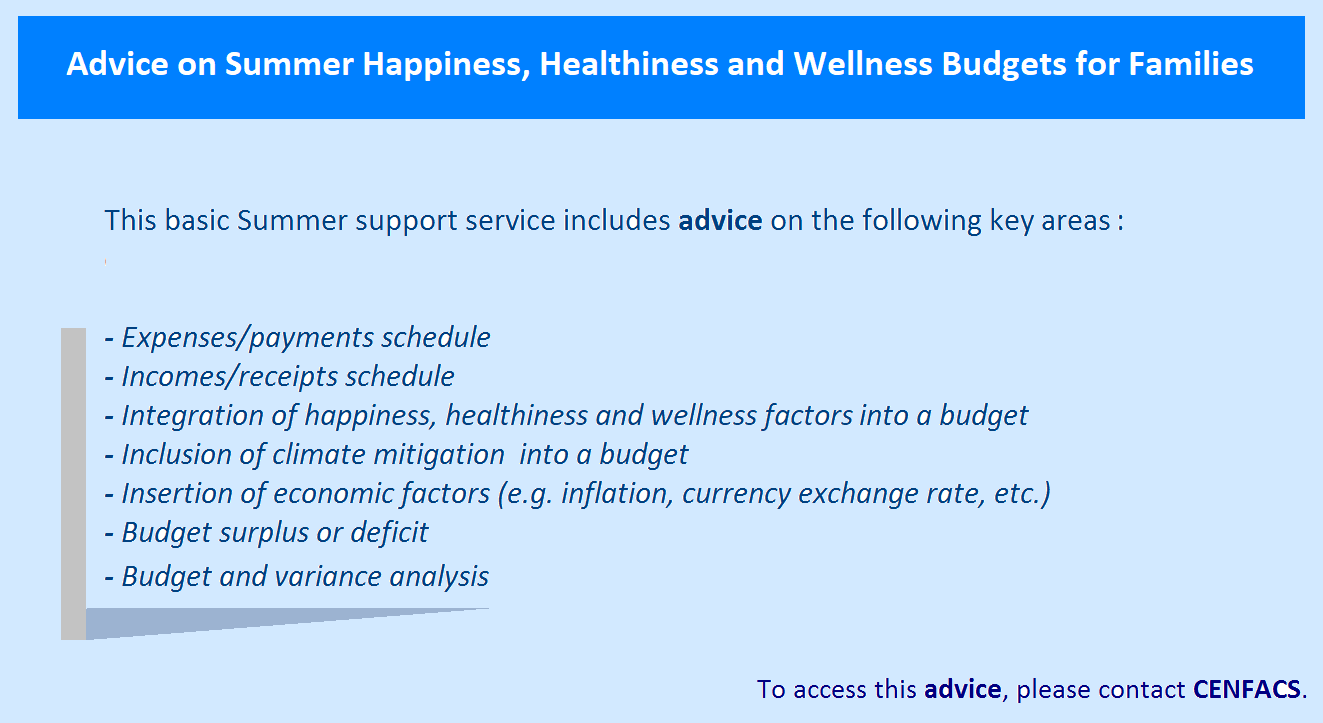
This area of support to families continues for those who are looking for it. The support covers each of the budget separately and/or all the budgets as whole, as explained below.
• • Advice on Happiness Budget for Families
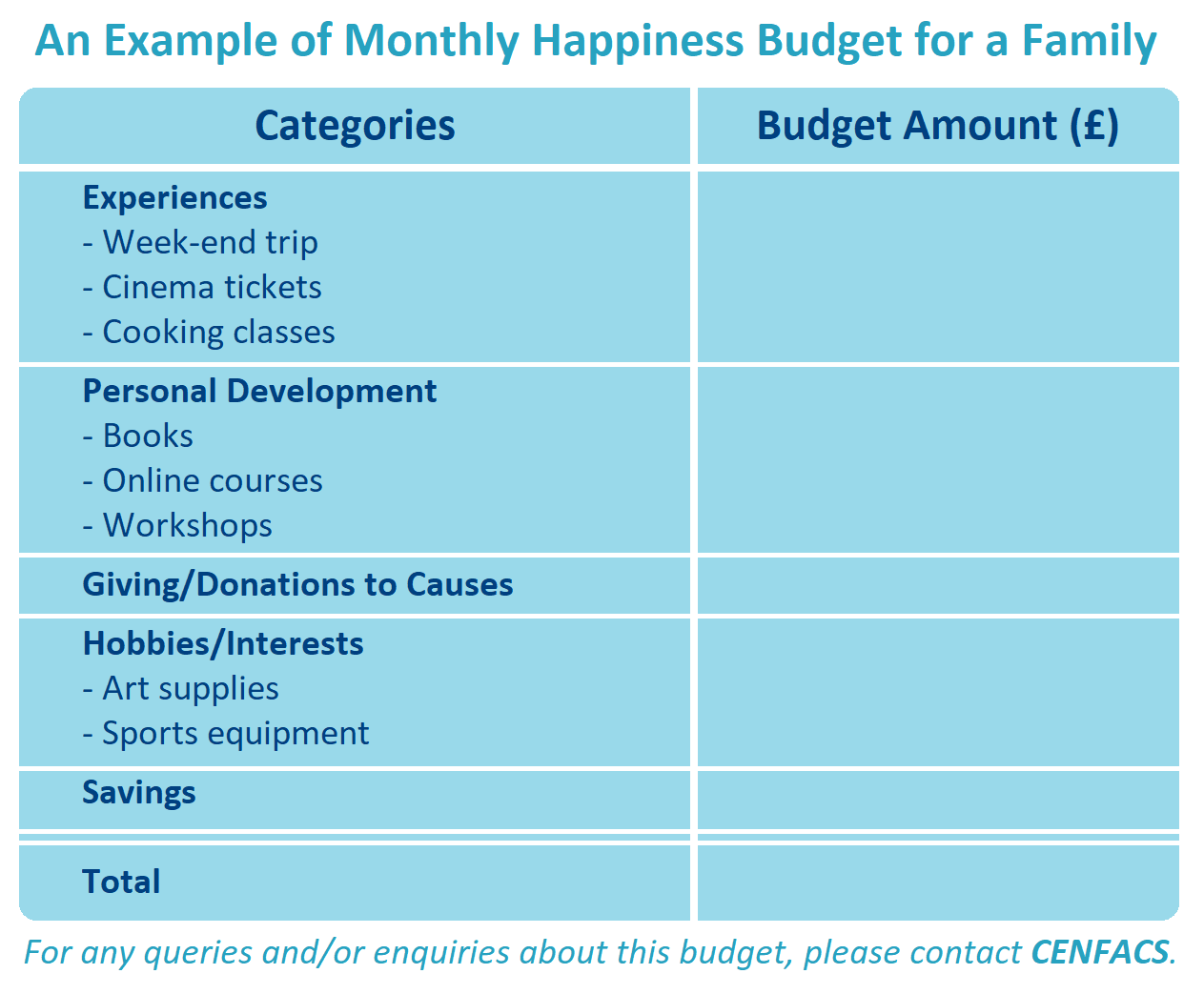
It is about making suggestions to family applicants and working with them about their personal allocation for activities and purchases that bring joy and enhance their well-being. It means helping them to allocate their funds towards experiences and purchases that bring personal joy and satisfaction while respecting the budget rule of 50/30/20 (that is, 50% for needs, 30% for wants, and 20% for savings and debt repayment).
• • Advice on Healthiness Budget for Families
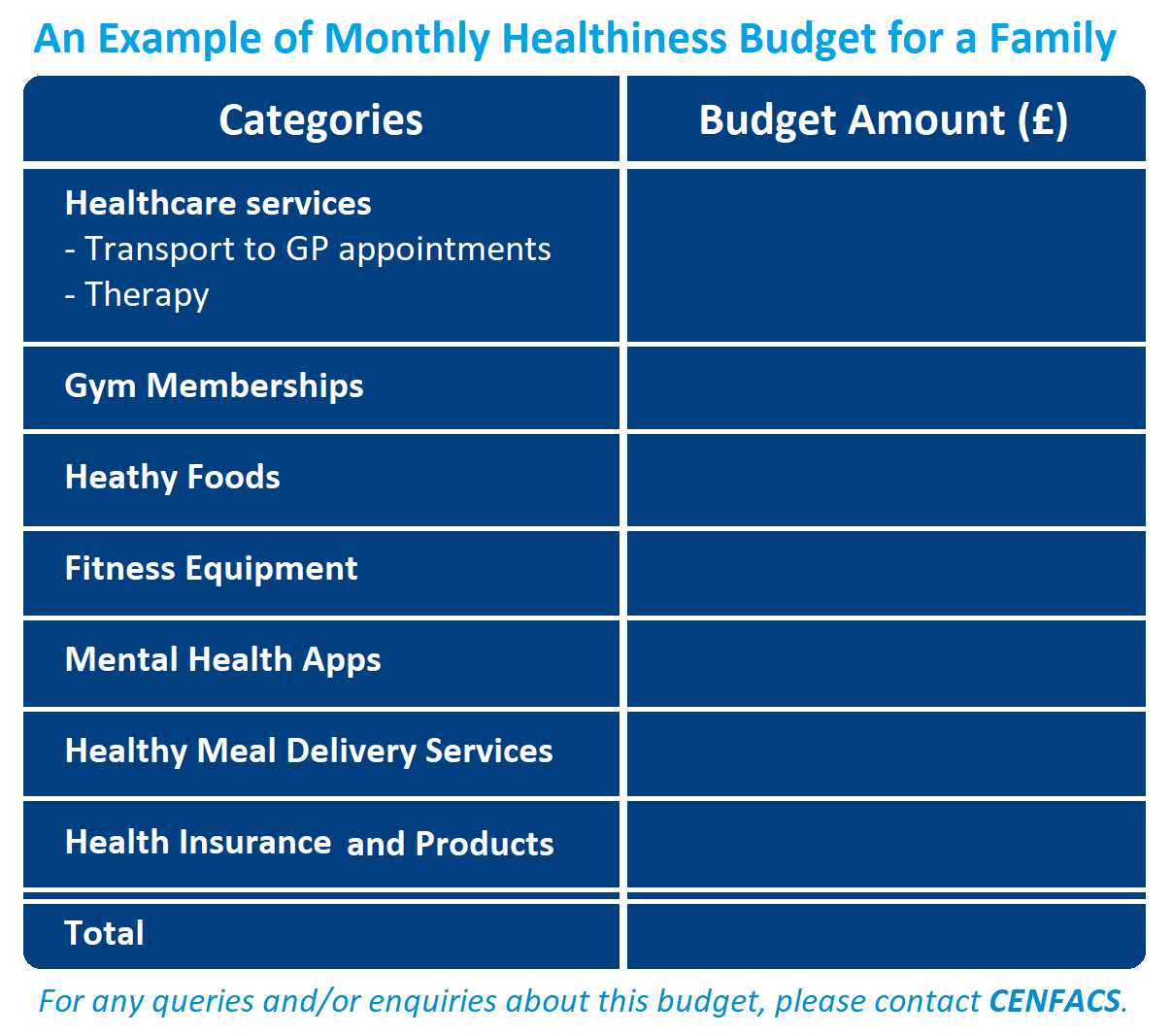
It is about providing opinions to family applicants and working with them to direct their resources towards maintaining or improving their physical and mental health through healthcare, fitness and healthy food. Such advice would include health-related costs (like funds for physiotherapy and home care support, funds for healthcare services, etc.) directly linked to families’ health needs and of their members.
Again, the advice will respect the budget rule of 50/30/20.
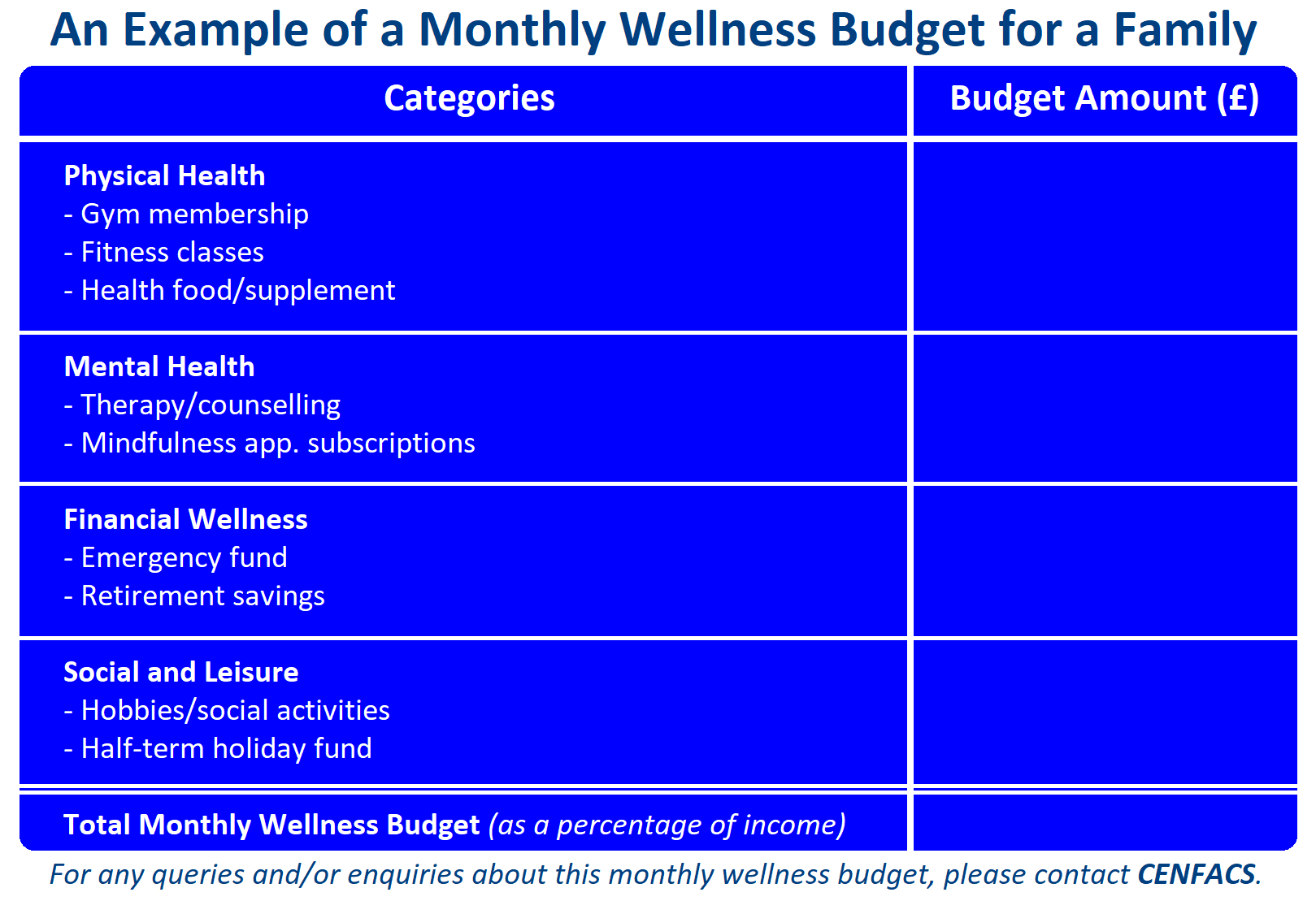
• • Advice on Wellness Budget for Families
It is about working with families on how they can dedicate a portion of their finances for activities, resources, and services that support their physical, mental, and emotional well-being. It is also about working with them so that they can make self-care and personal development a consistent and planned part of their life, just like other financial and family priorities.
This advice is also given by following the budget rule of 50/30/20.
• • Advice on Happiness, Healthiness and Wellness Budgets for Families
It is about integrating or putting the three types of advice under one umbrella for those families needing them as whole or a package. Under the one umbrella, we can advise on items to include in Happiness, Healthiness and Wellness Budgets.
σ Happiness Budget: It involves discretionary expenses or wants relating to mindful spending, prioritising experiences over things, and balancing saving with present enjoyment (e.g., budget posts like experiences, personal development, giving or donations to causes, hobbies and interests, savings, etc.);
σ Healthiness Budget: It considers funding needs for healthcare and support to meet specific health needs (such as Personal Health Budget with the National Health Service, funding for healthcare services therapy, equipment and personal care);
σ Wellness Budget: It states discretionary expenses allowing families and their members to choose activities that align with their personal preferences and goals (for instance, gym memberships, healthy food purchases, stress management programme, hobbies, healthy cooking classes, mindfulness app subscription, etc.)
Like for any budget, there is a need to employ some measurement or metrics to deal with Happiness, Healthiness and Wellness Budgets.
σ Key Financial Metrics to Be Used during Advice Sessions
When advising households or families on Happiness, Healthiness and Wellness Budgets, we shall use key financial metrics such as discretionary income allocation, the debt-to-income ratio, and emergency liquidity reserves. These indicators measure financial wellness, stress capacity, and the safe margin available for health investments.
To be more specific, we shall use metrics relating to budget, health, project impact and tracking.
σ σ Metrics linked to budget and health
They include the following:
~ Discretionary Health/Wellness Percentage: This metric shows the net monthly income (e.g., 30% to 50% of household operational income) assigned to preventive health, exercise, and mental well-being
~ Debt-to-income Ratio: It indicates how severe financial stress can directly undermine mental and physical health
~ Liquidity/Emergency Fund Ratio: This tracks a family’s ability to absorb sudden financial or health shocks without borrowing.
σ σ Indicators expressing project impact and tracking
We can mention these two ones below.
~ Net Disposable Margin: It gauges true capacity for lifestyle changes
~ Financial Strain Index: It shows a family’s confidence in managing day-to-day bills and future expenses.
In short, the support on Happiness, Healthiness and Wellness Budgets for Families covers both expenses/expenditures (outgoings) and income/receipts (incomings). The advice also includes economic factors such as inflation, currency exchange rate, interest rate, changes in statutory policies, etc. It further considers climate mitigation factors. It finally puts emphasis on areas of happiness, healthiness and wellness to care for when building budgets for holidaying.
There are online tools, apps and accounting platforms that provide lessons and examples about family budgets. However, many of them do not provide specific advice on happiness, healthiness and wellness budgets.
For those who are familiar with these tools and platforms, they can use their contents.
For those who are unfamiliar with these free available online resources and/or looking for specific information about happiness, healthiness and wellness budgets; they can refer to CENFACS’ line of financial advisory support.
To learn or seek support on how to create and sustainably manage holiday budget that includes Happiness, Healthiness and Wellness; please contact CENFACS.

Extra Messages
• Completion of Work on Data Analytics and Impact for Programmes, Projects and Activities for Financial Year 2025-2026
• Report on Half-year Actions and Results about 2026 Run, Play and Vote to Reduce Poverty and the Integration of Triple Value Initiatives
• The Application of Data and Insight Skills to Manage Your Household – Session/Application 4: Time and Task Management (from Wednesday 29/07/2026)

• Completion of Work on Data Analytics and Impact for Programmes, Projects and Activities for Financial Year 2025-2026
We are continuing to measure outcomes, assessing value, and finalizing the performance reporting for the financial year 2025-2026. We are as well reviewing results against goals, analyzing spending efficiency, and documenting any lessons to be learnt to guide future planning within CENFACS. This implies evaluating tasks, reporting and strategically closing out the books.
In terms of evaluation tasks, we are collecting final performance numbers, participation metrics, and financial expenditure records from the past year. We are as well evaluating cost-effectiveness of our work, resource usage, and budget adherence.
Regarding reporting and strategic close-out, we are synthesizing findings by producing dashboards, impact summaries and evaluation reports. We are also capturing lessons by documenting what worked well and what did not. At the end of this process, we shall inform future plans by using final analytics. This will enable to set realistic targets, budgets, and strategies for the new financial year and cycle.
We hope to finish our 2025-2026 Data Analytics and Impact Work by the 31st of July 2026, as planned. For those who have not yet told us what they think about the 2025-2026 Programmes, Projects and Activities they can say it by the end of this month.
We would very much appreciate if they could provide us their feedback…
(a) via e-mail, text, phone, web comments or reviews
(b) in their own words, numbers, voices and information graphics (info-graphics).
They can briefly explain the way in which the 2025-2026 programmes, projects and activities have affected them or the people they recommended to use them or their organisation or sister organisation.
We would very much appreciate if their feedback could be specific, timely, respectful and aligned with CENFACS‘ mission, goals and values.
They could rate (by using numbers or percentages or ratios) these programmes/projects/activities or provide a statement (by using words) or even give a chart or table (as information graphics). They can as well record their voice and run a video or short film. This is aptly up to them.
Please remember, we can only help reduce poverty and do the changes we all want if you tell us what you think; not us only telling you what we do.
Please consider our request for an independent feedback/opinion (that is an assessment) and for your testimonial support.
Please use the end of July 2026 to reach us with your say if you have not done it so far. Thank you!

• Report on Half-year Actions and Results about 2026 Run, Play and Vote to Reduce Poverty and the Integration of Triple Value Initiatives
Our All Year Round Projects (Run, Play and Vote) for this year are now beyond six months. Through e-workshops, we have provided some guidance and help about them. And we are still available to work together with those who need some help. Those who started them in January 2026 should be half-way through with them or have completed them.
These activities can be run in hybrid manner; that is in-person or virtual depending on the circumstances of participants.
Since we have already crossed the middle of the year, half-year actions and results about these recreational activities are now sought from those who are practising them. If anyone has some results or stories of their actions, it will be good to start sharing them now. There are four ways you can share or report, which are:
a) Report on your project actions
b) Report on your project progress (or status)
c) Report on your project analytics
d) Report on your project results or achievements.
Let us summarize these reports.
• • Report on Your All-Year-Round Project Actions
It is about providing information on completed tasks, upcoming tasks, current issues, and any changes in schedule or budget. Your project actions report will highlight when your project started, what was completed and discovered, where you stand with it, and what is happening on a regular basis.
• • Report on Your All-Year-Round Project Progress or Status
Your project progress report (or project status) will summarise the current state of project outlining completed tasks, ongoing activities and upcoming assignments. You can share with CENFACS a snapshot of the project’s work, tracking progress against established goals and highlighting any potential issues or risks encountered so far.
In brief, you can share your project summary or overview of the current status, progress summary, ongoing activities, issues and risks, performance metrics, timeline and schedule.
• • Report on Your All-Year-Round Project Analytics
Your project analytics report will provide the analysis of data from various sources to identify trends, issues, and opportunities for improvement. Your project analytics report will show the tracking of progress against goals, the effective management of resources, and the decisions made throughout the project cycle.
In short, you can share your project resource utilisation, timeline and progress, risk assessment, performance analysis, and actionable insights.
• • Report on Your All-Year-Round Project Results or Achievements
Your project results report will summarise the achievements, outcomes, and overall success of your project. You can share with CENFACS the details of your project performance, including progress, challenges and solutions, lessons learned, recommendations, impact assessment, and future outlook.
In short, your half-year report on all-year-round projects will be a mid-year check-in covering ongoing goals, key milestones, and initial results. It will show what work finished in the first six months and what comes next. It will contain
~ a short review of the past six months and main wins
~ progress updates on continuous tasks and active goals
~ numbers, metrics and early impacts reached so far
~ plans and targets for the final six months of the year.
It could be a good idea to include in your report any integration of the Triple Value Initiatives you made into these projects.
Please do not hesitate to report on your actions, analytics, progress, and results to CENFACS. Contacting CENFACS to report is a further opportunity to spot any problems with them or to start to celebrate your hard work with them before their deadline of 23 December 2026.

• The Application of Data and Insight Skills to Manage Your Household – Session/Application 4: Time and Task Management (from Wednesday 29/07/2026)
In this fourth application, we are dealing with two items of household management: time and task. To approach them, let explain what they mean and highlight how CENFACS can work with the community on these two areas (that is, time and task management).
• • Explaining Time and Task Management
Let us start with the management. In Oxford Dictionary of Business and Management (12), the word ‘management’ is explained as
“The running of an organization or part of it” (p. 374)
From this perspective, management can be applied to households.
To manage a household, one needs time and tasks. To manage time, one is required to possess time management skills and strategy. Time management involves applying some key elements to it. According to ‘timecamps.com’ (13),
“The five key principles of time management – prioritize, plan, prepare, pace, and persist – work together to create an effective approach to managing time”.
Concerning task management, the website ‘coursera.org’ (14) explains that
“Task management is the process of effectively and efficiently tracking, managing, and executing the lifecycle of a task or many tasks with a project, from inception to execution”.
The same ‘coursera.com’ argues that the purpose of task management is to improve the decision-making, communication, efficiency, and effectiveness of a task or project. There are benefits, tools and skills that households and their managers need to manage tasks.
Most households, including those making the CENFACS Community manage time and tasks. Some do them better. Others may struggle. Those that struggle with time and task management they need to know that there is always help.
• • Working with Households on Time and Task Management by Using Data and Insight Skills
It involves tracking daily routines, identifying bottlenecks, and building personalized action plans. In practical terms, it means we can work with households in the following ways:
σ Helping household members track where hours go over a typical week using simple paper or digital logs (time-use logs)
σ Analyzing the logs to spot repetitive friction points, such as conflicting chores or rushed mornings (identification of bottlenecks)
σ Establishing clear numbers on task completion rates and stress levels before introducing changes (baseline metrics)
Etc.
Those members of our community who will be interested in Session/Application 4 as well as any support about The Application of Data and Insight Skills to Manage Your Household, they should not hesitate to contact CENFACS.
• • Last Words about the Application of Data and Insight Skills to Manage Your Household
The last words about this application are about the lessons that can be learned from it. It would be fair to argue that using data in your home teaches you three main things: tracking daily habits, setting clear spending limits, and spotting hidden waste. It may be a little difficult to learn and understand how to use data in household context, but mastering data and insight skills and of course the four applications we highlighted this month will help households save money and time. These four applications have been as follows:
σ Personal Finance and Budget Optimization
σ Smart Energy Management and Cost Reduction
σ Prediction of Inventory and Grocery Management
σ Time and Task Management.
Also, the Application of Data and Insight Skills to Manage Your Household is just an iceberg of set of initiatives we planned to work with households during this year (2026). There is still more to come in terms of data and insight skills we can share together. Those who would like to be part of our plan on data learning skills set, they should not hesitate to contact CENFACS and get ready to take household data skills learning journey with us after this Summer holiday.
Please keep checking on our weekly posts for the next available household data skills learning opportunities. Likewise, we are still available for any queries, enquiries and assistance you may want from us regarding the areas of data and insight skills for households we cover. We hope you will be able to join us in at the next level of our data and insight skills plan/programme.
Message in English-French (Message en Anglais-Français)
• Holiday Budget Deficit for Households (HBD4Hs)
HBD4Hs is part of support we are providing to households for those of them may experience HBD this Summer 2026. To understand HBD4Hs, let us explain it, provide the causes of holiday shortfalls and their impact, deal with indicators/metrics telling households they are in deficit, and highlighting ways of covering HBD.
• • What Is a Holiday Budget Deficit (HBD)?
HBD is a shortfall that happens when the total cost of a trip (or seasonal holiday spending) is higher than the money saved or allocated for it, forcing families to overspend, use credit cards, or dip into funds meant for essential living costs.
There are situations that cause this to happen.
• • Causes of Holiday Shortfalls
They include the following:
σ Underestimating daily expenses: This can happen when hidden costs (like airport transfers, local taxes, or daily food inflation) are forgotten;
σ Increased daily spending: This involves spending significantly more per day on a trip than you would during a normal week at home;
σ Lack of dedicated savings: It is about relying on unsecured borrowing or overdrafts rather than planning ahead your holiday with a fixed amount.
In other words, there are contributing factors to the HBD, which include:
σ Unplanned ancillary costs, involving expenses like currency conversion fees, local transport, airport parking, and unexpected resort add-ons;
σ Pre-trip versus on-trip disconnect, that is the delay interval between incurring costs and reviewing statements, which prevents real-time mid-holiday budget corrections.
Like any deficit, HBD has an impact.
• • Holiday Budget Deficit Impacts
A HBD has some impacts on household life. Amongst the impacts are the following ones:
σ Debt accumulation: This can occur when carrying high-interest credit card balances long after the trip ends;
σ Compromised essentials: HBD can compromise the necessities of life if it leads households to struggle to pay subsequent bills, rent or buy groceries due to depleted cash flow.
Households can avoid HBD.
• • Strategies for Avoiding HBD
Households can avoid a HBD by setting a firm spending cap, starting a dedicated savings pot early and building a cash buffer for unexpected costs. Let us look at some of these strategies.
• • • Planning and saving
This strategy consists of setting a hard limit, automating savings, and booking early or off-peak.
σ Setting a hard limit: It is about writing down every expected travel cost, lodging, food, and activities without crossing the total number set.
σ Automating savings: It involves using direct debit or standing order to put money into a separate savings account right after payday.
σ Booking early or off-peak: It encompasses securing travel and accommodation far in advance or choose off-peak dates to drastically lower base prices.
• • • Management costs on location
This strategy includes adding a percent buffer, packing smart essentials, and avoiding high interest debt.
σ Adding a 10 to 15% buffer: It is about setting aside extra money specifically for hidden fees, emergency transport or price spikes at tourist spots.
σ Packing smart essentials: It involves bringing refillable bottles, chargers, and sun cream from home as you are not forced to overpay at airports or service stations.
σ Avoiding high interest debt: It is better to refrain from using or get trapped into ‘buy now, pay later’ schemes or credit cards unless you can pay the balance off immediately.
• • HBD Metrics
These metrics measure the gap between planned travel funds and actual expenditures, typically evaluated through percentage overspend, variance magnitude, and reliance on debt financing.
Key metrics include Budget Variance Percentage, Absolute Cost Overrun, Credit and Debt Utilization, and Opportunity Cost/Daily Burn Rate Ratio.
• • Techniques for Covering an Existing HBD
They include the following ones:
σ Auditing actual spending
σ Pausing non-essential costs
σ Restructuring any debt led by holiday.
To fix the shortfall quickly, it is better to prioritize essential bills, shift balances to lower rate options, and increase short-term cash flow. This can involve two techniques:
a) Immediate assessment and triage by listing every expense, protecting essentials and stopping new debt;
b) Expense reduction and repayment by cutting discretionary spending, exploring 0% balance transfers, and contacting creditors early.
The above is just some of the areas of HDB we wanted to share with some of members who may be interested in them.
For those who would like to dive deep into HBD matters or have any issues to raise about HBD, they should not hesitate to contact CENFACS to our usual contact details which are on this website. Equally, those want us to look at their holiday budget, they can communicate with CENFACS.
• Déficit Budgétaire Lié aux Vacances pour les Ménages (DBLVM)
Le dispositif DBLVM s’inscrit dans le cadre du soutien que nous apportons aux ménages susceptibles de connaître un déficit budgétaire lié aux vacances (DBLV) au cours de l’été 2026. Pour bien comprendre le concept de DBLVM, nous allons l’expliquer, présenter les causes et les conséquences de ce manque à gagner budgétaire, aborder les indicateurs permettant aux ménages de repérer une telle situation de déficit, et enfin mettre en lumière les moyens de combler ce manque.
• • Qu’est-ce qu’un déficit budgétaire lié aux vacances ?
Ce déficit survient lorsque le coût total d’un voyage (ou les dépenses saisonnières liées aux vacances) dépasse les sommes épargnées ou allouées à cet effet, contraignant les familles à dépenser au-delà de leurs moyens, à recourir au crédit ou à puiser dans les fonds destinés aux dépenses courantes essentielles.
Il existe des situations qui provoquent cela.
• • Causes du déficit budgétaire lié aux vacances
Parmi ces causes, on peut citer :
σ La sous-estimation des dépenses quotidiennes : cela peut se produire lorsque des coûts cachés (tels que les transferts aéroport, les taxes locales ou la hausse du coût de l’alimentation sur place) sont oubliés ;
σ L’augmentation des dépenses quotidiennes : il s’agit de dépenser nettement plus par jour lors d’un voyage que durant une semaine ordinaire à la maison ;
σ L’absence d’épargne dédiée : cela revient à dépendre d’emprunts non garantis ou de découverts bancaires plutôt que de planifier ses vacances en fonction d’un budget défini à l’avance.
En d’autres termes, certains facteurs contribuent à ce déficit, notamment :
σ Les frais annexes imprévus : dépenses telles que les frais de change, les transports locaux, le stationnement à l’aéroport et les suppléments inattendus sur le lieu de séjour ;
σ Le décalage entre les dépenses engagées et leur suivi : l’intervalle de temps entre le moment où l’on dépense et celui où l’on consulte ses relevés empêche tout ajustement budgétaire en temps réel pendant les vacances.
• • Conséquences du dépassement du budget des vacances
Un dépassement du budget des vacances a des répercussions sur la vie des ménages. En voici quelques exemples :
σ Accumulation de dettes : cela peut se produire lorsque l’on conserve des soldes de cartes de crédit à taux d’intérêt élevé bien après la fin du voyage ;
σ Mise en péril des besoins essentiels : le dépassement budgétaire peut compromettre les nécessités de la vie courante si, faute de liquidités suffisantes, les ménages peinent à régler leurs factures ultérieures, leur loyer ou leurs courses alimentaires.
Les ménages peuvent éviter de dépasser leur budget de vacances.
• • • Stratégies pour éviter le dépassement du budget des vacances
Les ménages peuvent éviter ce dépassement en fixant un plafond de dépenses strict, en commençant tôt à constituer une épargne dédiée et en prévoyant une réserve de liquidités pour les imprévus. Examinons certaines de ces stratégies.
• • • • Planification et épargne
Cette stratégie consiste à fixer une limite ferme, à automatiser l’épargne et à effectuer des réservations à l’avance ou hors saison.
σ Fixer une limite ferme : il s’agit de lister toutes les dépenses prévues (transport, hébergement, repas, activités) sans dépasser le montant total fixé.
σ Automatiser l’épargne : cela implique d’utiliser le prélèvement automatique ou un virement permanent pour verser de l’argent sur un compte d’épargne distinct juste après la réception du salaire.
σ Réserver à l’avance ou hors saison : cela consiste à réserver le transport et l’hébergement longtemps à l’avance ou à choisir des dates hors période de pointe afin de réduire considérablement les tarifs de base.
• • • Gestion des dépenses sur place
Cette stratégie consiste à prévoir une marge de sécurité, à emporter des articles essentiels judicieux et à éviter de s’endetter à des taux d’intérêt élevés.
σ Prévoir une marge de sécurité de 10 à 15 % : Il s’agit de mettre de côté des fonds supplémentaires spécifiquement pour couvrir les frais imprévus, les transports d’urgence ou les hausses de prix dans les zones touristiques.
σ Emporter des articles essentiels judicieux : Cela implique d’apporter de chez soi des bouteilles réutilisables, des chargeurs et de la crème solaire, afin d’éviter de payer le prix fort dans les aéroports ou les stations-service.
σ Éviter l’endettement à taux élevé : Il vaut mieux s’abstenir de recourir aux formules de type « acheter maintenant, payer plus tard » ou aux cartes de crédit, à moins de pouvoir rembourser le solde immédiatement.
• • Indicateurs DBLVM
Ces indicateurs mesurent l’écart entre le budget de voyage prévu et les dépenses réelles ; ils sont généralement évalués en fonction du pourcentage de dépassement, de l’ampleur de l’écart et du recours au financement par la dette.
Les indicateurs clés comprennent le pourcentage d’écart budgétaire, le dépassement de coût absolu, le taux d’utilisation du crédit et de la dette, ainsi que le ratio coût d’opportunité/taux de consommation quotidienne des fonds.
• • Techniques pour gérer un budget vacances existant
Elles comprennent notamment :
σ L’examen des dépenses réelles
σ La suspension des dépenses non essentielles
σ La restructuration de toute dette liée aux vacances.
Pour combler rapidement le déficit, il est préférable de donner la priorité aux factures essentielles, de transférer les soldes vers des options à taux plus bas et d’augmenter les liquidités à court terme. Cela peut passer par deux méthodes :
a) Une évaluation et un tri immédiats : lister toutes les dépenses, protéger les postes essentiels et cesser de s’endetter davantage ;
b) La réduction des dépenses et le remboursement : diminuer les dépenses discrétionnaires, envisager des transferts de solde à 0 % et contacter les créanciers sans attendre.
Ce qui précède ne constitue qu’un aperçu des aspects de la gestion du budget vacances que nous souhaitions partager avec les membres intéressés.
Les personnes désireuses d’approfondir le sujet ou de nous faire part de questions à ce propos sont invitées à contacter le CENFACS via les coordonnées habituelles indiquées sur ce site. De même, celles qui souhaitent que nous examinions leur budget vacances peuvent prendre contact avec le CENFACS.


Main Development
• All Poor, Poor Children, Young Carers and Families Would Be Truly Grateful for Your Backing
The following Summer 2026 Humanitarian Appeal Projects summarise the needs of All Poor, Poor Children, Young Carers and Families who need your donation or funding or even influence:
∝ All Gifts for All Poor
∝ International Networking and Protection against Crises
∝ Iconic Young Carer
∝ ELCLASSICO International.
Let us briefly summarise these projects and the request of each potential beneficiaries relating to them.
• • Summer 2026 Humanitarian Appeal Projects
They are as highlighted below.
• • • All Gifts for All Poor (AG4AP)
• • • • What is AG4AP?
AG4AP, which stands for All Gifts for All Poor, is the holiday makers’ and travellers’ free and voluntary contribution to poverty relief in Africa via CENFACS. It is a noble cause which consists of appealing to indiscriminately give a gift to the poor people in Africa, who are currently affected by multiple overlapping crises (such as the lingering effects of the conflicts, changing climate and the cost-of-living crisis).
The feature of this appeal is that donations or funding are done without making any distinctions between the poor.
• • • • How you can support AG4AP
Donors or funders can support this project by giving a holiday gift or treat in kind or money to support those poor people suffering from these crises (e.g., the lingering effects of the conflicts, changing climate and the cost-of-living crisis). A holiday treat is a perfect way to add a layer of happiness, healthiness and wellness to the poor.
For example, a donor or funder holidaying (or will be holidaying) in coastal areas of Africa can donate £7 or any amount of money they can afford to urban and peri-urban coastal poor who are dependent on ecosystem services and who are exposed to health risks resulting from inadequate sanitation and pollution.
This amount can contribute to the improvement of their sanitation and help fight against polluting agents.
• • • • Who and what your support will help
Their gift will enable an urban and peri-urban coastal poor family to reduce the probability of catching diseases linked to poor sanitation; in doing so the family will improve its health and hygiene while surviving against the above mentioned effects.
• • • International Networking and Protection against Crises (INPC)
• • • • What is INPC?
INPC is designed to help and support vulnerably poor children to escape from HARMS, THREATS, ATTACKS, EXTREMISM, RADICALISATION and RISKS of any forms of exploitation, neglect and abuse in all contexts in Africa. At this time of the polycrises, threats and risks are higher than ever before. These threats and risks are even life-threatening and destroying in places of war like in the African Sahel or the north-eastern areas of the Democratic Republic of Congo. One can think of the human rights violations against children and women in the conflicting north-eastern areas of the Democratic Republic of Congo.
To win the fight against the forces of exploitation and destruction of children and over the dangers children in Africa and elsewhere are facing, it requires winning the battle of communication via a reliable flow of information and connections.
Likewise, the fight against the polycrises requires an international collaboration and exchange of information between all those who are working on poverty reduction and sustainable development. This international networking has three functions: protection, safeguarding and security.
a) The international networking for crisis protection helps to build resilience, mitigate the impact of crises, and prevent future catastrophes.
b) The international networking for safeguarding against crises enables information sharing, resource mobilisation, and coordinated responses.
c) The international networking for security against crises aims to enhance resilience, share information, and coordinate efforts to mitigate the impact of crises, conflicts, or cyberattacks.
Furthermore, if defence against harms, danger and threats from COVID-19 was done globally; the fight against the polycrises can also be conducted worldwide.
• • • • How you can support INPC
You can support this appeal by helping in networking and protection equipment or gift of communication to enable Africa-based Sister Organisations to speak loud and better access information about the polycrises to protect people and communities. particularly vulnerably poor and unprotected children.
For example, a donor or funder can give £10 fund rapid response coordination, share critical early warnings across borders, and support frontline local partners. They can also contribute to the cost of running internet and mobile solutions to work remotely and collaborate with Africa-based Sister Organisations as way of exchange life-saving information, and tools on child protection. Donor or funder can as well donate technologies to protect children.
• • • • Who and what your support will help
It will help to raise awareness and take action against the forces of exploitation and destruction of children and young generation. It can as well help children who need social protection, particularly those who receive no child or family cash or tax credit benefits and those who are forced to live on or below £3.65 a day (at 2017 purchasing parity power).
• • • Iconic Young Carer (IYC)
• • • • What is IYC?
IYC, which is a deserving cause that supports poor children and young people who prematurely become Africa’s unpaid caregivers and labourers because of poverty, aims at improving the quality of life of young caregivers and labourers by responding to their basic needs and human rights.
These young caregivers and labourers support their family members or friends or those in need, despite facing significant challenges and adversity. In times of the lingering effects of conflicts, extreme weather and the polycrises; young carers have been forced to take caregiving and labouring role side by side with adults. They are often doing it for free and without any financial help.
Yet, caring responsibilities can have a significant impact on a young person’s physical and mental health, as well as their education and social life. These young carers deserve support. They need access to practical, emotional, and educational support to help them.
So, supporting these young carers could mean mitigating the lingering effects of conflicts, changing climate and polycrises on them. Your support can help preserve the lives of future generations.
• • • • How you can support IYC
You can donate whatever you can to support these iconic young carers to end these effects.
For example, a donor or funder can provide material or £5 to buy distance learning materials to help these young carers to access e-reading and digital books or to buy new books (including the cost of shipping) to support these young carers in need and suffering from digital divide.
• • • • Who and what your support will help
Your donation will help to pay for the educational and development costs of these poor children who miss school opportunities and prematurely become young caregivers and labourers. It will also assist in tackling any health issues (like emotional issue) they experience due to their premature caregiving roles and responsibilities.
• • • ELCLASSICO International (EI)
• • • • What is EI?
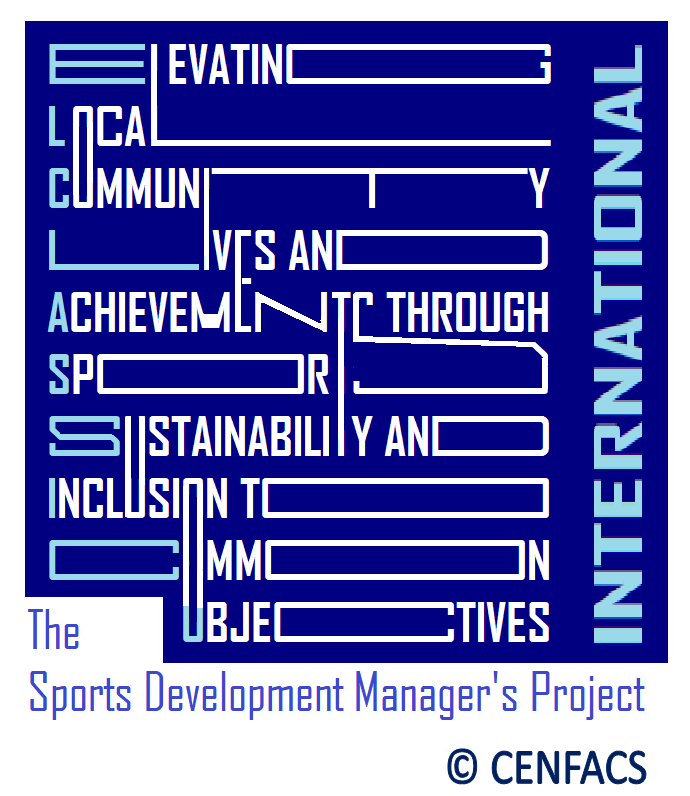
ELCLASSICO (which stands for Elevating Local Community Lives and Achievements through Sports, Sustainability and Inclusion to Common Objectives) is a CENFACS combined Sports Development, Child Protection and Sustainable Development initiative that aims at reducing child and youth poverty, while protecting children and bringing a better change to impoverished people, communities, children, young people and future generations in Africa. It is international as it involves more than one nation in Africa.
ELCLASSICO is also the Sports Development Manager’s Project, which focuses on the function and role of the Sports Development and International Managers, local elements of sustainability and aspects of Sports Development to deliver the poverty reduction outcomes in the African context and within the framework of reference of the future world of sustainable development we all want.
To organise any sports development activity and sustainability activity for children, these activities must be safe and child protected. It means that in the preparation of these activities, some health (e.g. health hazards and risks) and child protection tests and checks must be conducted. They also need to be sustainable, that is meeting the United Nations Sustainable Development Goals. So, integrating health and safety rules as well as various dimensions of sustainable development will help to protect these activities and everybody involves in them.
• • • • How you can support EI
You can support EI to reduce poverty for families whose children would like to engage with sports and sustainable development activities. You support will enable the three aspects of this project to stick together; aspects which are: child protection, physical and sustainability aspects.
For example, a donor or funder can give £10. £5 can directly fund essential equipment (e.g., balls), support local coaching sessions, and improve community facilities. The other £5 can help provide food packages to feed a family of five to seven. The food package will enable any of children benefiting from it to take part in sports development as ELCLASSICO International helps to tackle child poverty through sports development, child protection and sustainable development activities.
• • • • Who and what your support will help
Your giving will have a triple effect:
√ Protection of children, young people and their families
√ Sensitisation about climate change and environmental issues
√ Support of their development through sporting activities and other events.
• • Donation or Giving in Kind or Your Influence Regarding These Four Summer 2026 Humanitarian Relief Appeal Projects
Those who would like to support the above-mentioned beneficiaries can donate money and / or give in kind or their influence.
• • • Money donation
There is no limit in terms of minimum and maximum amount to donate, despite the examples of amount we have given above.
You can donate and or support the way it suits you and your affordability.
CENFACS will accept any amount to be given or donated.
• • • Giving in kind
For those who would like to make a donation in kind, it will be a good idea to check with us that what they are giving will help to meet the above stated needs. This will help to save time, money and the environment for both sides. Also, any donation in kind must be safe and health proof.
• • • Donating your influence
You can donate your influence to reduce or end poverty in Africa in the context of this Summer humanitarian relief campaign.
To donate influence, please contact influential persons (or those having the keys) to reduce or end poverty experienced by All poor, Children in Need of Protection, Unpaid Young Carers and Poor Families with Children Trying to Tackle Poverty via Sports in Africa.
You can as well influence the things or factors that determine poverty and hardships experienced by the above-mentioned poor.
Thank you in anticipation for your willingness to make helpful difference to All Poor, Unprotected Poor children, Unpaid Young Carers and Families Tackling Poverty via Sports at this challenging time of the lingering effects of the polycrises, changing climate and the cost-of-living crisis.
For more details about ways of supporting the above initiatives and other ones, please contact CENFACS.
Please remember, the fundraising campaign about the above-mentioned projects will end by 23 September 2026.
CENFACS will accept any support given during and beyond the duration of this campaign.
Please do not wait to donate as the needs are pressing and urgent NOW.
We look forward to your generous support to make helpful difference for the All Poor, Poor Children, Young Carers and Families in need in Africa
Thank you for your generosity.
_________
• References
(1) https://afripoli.org/consuming-africa-the-impact-of-tourism-on-local-african-economies (accessed in July 2026)
(2) https: //globalprotectioncluster.org/sites/default/files/2026-07/wca_rpwg_sustaining_protection_under_pressure_regional_snapshot_july_2026.pdf (accessed in July 2026)
(3) https://africa.businessinsider.com/local/lifestyle/global-watchlist-2026-six-of-the-worlds-top-10-crisis-affected-countries-are-in/dlc43xq (accessed in July 2026)
(4) https://humanitarian-action.info/article/west-and-central-africa-4 (accessed in July 2026)
(5) https://business.uonbi.ac.ke/sites/default/files/Africa%20Youth%20Employment%20Outlook%202026_alt_version%20090226%20(2).pdf (accessed in July 2026)
(6) https://www.researchgate.net/publication/41572739_Young_Caregivers_in_the_context_of_the_HIVAIDSpandemic_in-Sub_Saharan_Africa (accessed in July 2026)
(7) https://mastercardfdn.org/en/our-research/africa-youth-employment-outlook-2026 (accessed in July 2026)
(8) https://www.olympics.com/ioc/news/idsd-2026-sport-as-a-catalyst-education-and-employment-across-africa (accessed in July 2026)
(9) https://www.afd.fr/en/news/africa-forward-sport-driven-youth-and-entrepreneurship (accessed in July 2026)
(10) https://www.sportanddev.org/latest/news/role-sports-youth-employment-gender-equality-and-economic-growth-cameroon (accessed in July 2026)
(11) https://www.africanleadershipmagazine.co.uk/unlocking-africas-youth-potential-in-sports/ (accessed in July 2025)
(12) Oxford Quick Reference (2016), Oxford Dictionary of Business and Management, Sixth Edition, Ed. Jonathan Law (Market House Books Ltd), Oxford University Press, UK
(13) https://www.timecamps.com/blog/what-is-time-management (accessed in July 2026)
(14) https://www.coursera.org/articles/task-management (accessed in July 2026)
_________
• Help CENFACS Keep the Poverty Relief Work Going This Year
We do our work on a very small budget and on a voluntary basis. Making a donation will show us you value our work and support CENFACS’ work, which is currently offered as a free service.
One could also consider a recurring donation to CENFACS in the future.
Additionally, we would like to inform you that planned gifting is always an option for giving at CENFACS. Likewise, CENFACS accepts matching gifts from companies running a gift-matching programme.
Donate to support CENFACS!
FOR ONLY £1, YOU CAN SUPPORT CENFACS AND CENFACS’ NOBLE AND BEAUTIFUL CAUSES OF POVERTY REDUCTION.
JUST GO TO: Support Causes – (cenfacs.org.uk)
Thank you for visiting CENFACS website and reading this post.
Thank you as well to those who made or make comments about our weekly posts.
We look forward to receiving your regular visits and continuing support until the end of 2026 and beyond.
With many thanks.