Welcome to CENFACS’ Online Diary!
24 June 2026
Post No. 462

The Week’s Contents
• Season of Happiness 2026
• Matching Organisation-Investor via a Clean Cooking Project – Activity 5 (22/06 to 28/06/2026): Matching Organisation’s Impact Scaling with Investor’s Results-based Financing and Impact Evaluation
• End Childhood Distress in Africa
… And much more!

Key Messages
• Season of Happiness 2026
The Season of Happiness within CENFACS starts with Summer Season. During the Season of Happiness 2026, we shall work with users to help them find out what can satisfy their lives during this Summer. Our work with them will be about implementing existing initiatives while developing new ones that can make them feel happy or satisfy their lives. These initiatives have values which underpin our Season of Happiness or Summer of Happiness.
• • The Five Values of CENFACS’ Season of Happiness or Summer of Happiness
Our Season of Happiness or Summer of Happiness will be about the following five values or utilities:
1) How the CENFACS Community can spread happiness between its members to narrow the gap in happiness inequalities (value of spreading happiness)
2) How best to help those in most need within the CENFACS Community to feel happy, to achieve successful outcomes this Summer (value of sharing happiness)
3) How to create and innovate happiness-enhancing activities and projects to reduce poverty linked to the lack of happiness (creative and innovative value of happiness)
4) How to be kind and care about those members of the CENFACS Community who are in most need of care (care value of happiness)
5) How to undertake internet activities (like communications, news and content creation) to bring or increase life satisfactions among the members of the CENFACS Community (internet or digital value of happiness).
The above-mentioned values are those that will lead our Season of Happiness or Summer of Happiness. Let us pick up the online or digital value of happiness that can be brought by internet activities, particular communications, news and content creation.
• • Happiness and Internet Activities for the Season of Happiness or Summer of Happiness
The fifth value of Season of Happiness or Summer of Happiness comes from J. F. Helliwell et al. (1) who found that communications, news and content creation as internet activities are associated with higher life satisfactions. During this Season of Happiness, we shall capitalize on the positive emotions that can be brought by communications, news and content creation.
We shall as well continue to work on the three main indicators to measure subjective wellbeing: life evaluations, positive emotions and negative emotions. Likewise, we shall carry on with the six variables of life evaluations: log Gross Domestic Product per capita, healthy life expectancy, social support (having someone to count on), freedom to make life choices, generosity, and perceptions of corruption. Helliwell et al. (op. cit.) argue that these six variables help explain life evaluations and estimate equations for national averages of positive and negative affect.
Since our campaign for the Season of Happiness 2026 is also about working with the community, the following summarizes the way the work with them will be about.
• • Working with the CENFACS Community to Find and/or Sustain Happiness This Summer 2026
Although happiness is about the interplay between gene and environment, it is possible to work with the members of CENFACS Community to find happiness cure, become happy and feel well. It is possible to help them overcome inequalities in happiness and achieve well-being. It is equally feasible to share meals with them so that they can become or stay happy.
To do that, we are going to consider what the field of happiness science tells us. We shall as well approach happiness as both an independent and interdependent concept. In other words, happiness could be a personal or subjective experience for any member of our community. Happiness can also be a collective participation for any of these members as belonging to a community, the CENFACS Community. It is in this interaction between happiness as individual practice and happiness as collective experience that they can find their true balance or harmony or even resilience.
To sum up, during this 2026 Season of Happiness we are going to work with our users so that they can have aspects of their life in balance and feel at peace with their life despite the feeble economic revival.
The above is the way in which we would like to approach our 2026 Season of Happiness or Summer of Happiness.
Under the Main Development section of this post, we have provided further details including the projects and programmes making the 2026 Season of Happiness.

• Matching Organisation-Investor via a Clean Cooking Project – Activity 5 (22/06 to 28/06/2026): Matching Organisation’s Impact Scaling with Investor’s Results-based Financing and Impact Evaluation
The last episode of our 5-week Matching Organisation-Investor via a Clean Cooking Project is about Matching Organisation’s Impact Scaling with Investor’s Results-based Financing and Impact Evaluation.
Indeed, there have been some alignments between Monitoring and Verification (MV) presented by African Charity Investee/Africa-based Sister Organisation (ACI/ASCO) and Not-for-profit (NFP) Impact Investor’s view on Monitoring, Verification and Co-benefits. Also, there have been some tests on Monitoring, Verification and Co-benefits. The Clean Cooking Project (CCP) has passed the test on the majority of these metrics.
The positive results from alignments and tests on metrics have opened way to the fifth and last round of the matching talks. In this Activity 5, ACI/ASCO will negotiate the contents of its Impact Scaling (IS). As to the Not-for-profit (NFP) Impact Investor, he/she has the task to agree or disagree with these contents and offers its propositions on Results-based Financing and Impact Evaluation (RBF&IE).
To approach this last part of the matching talks, we have organised our notes as follows:
σ Activity 5 Matching Concepts
σ African Charity Investee’s/Africa-based Sister Charitable Organisation’s Impact Scaling
σ Not-for-profit Impact Investor’s Results-based Financing and Impact Evaluation
σ Reaching a Negotiated Agreement
σ The Match or Fit Test
σ Concluding Note on Matching Organisation-Investor via a Clean Cooking Project.
Let us uncover each of these headings.

• • Activity 5 Matching Concepts
There are three main concepts forming this Activity 5. These concepts are impact scaling, results-based financing and impact evaluation. Let us explain them.
• • • Impact scaling
The website ‘impactdots.com’ (2) explains impact scaling as
“Scaling impact involves increasing the reach and effectiveness of your organisation’s efforts to address a specific problem or achieve a particular goal … Whether your mission is to provide clean drinking water to remote communities, revolutionize the tech industry, or promote sustainable agriculture, scaling impact can help you make a more significant difference”.
The website ‘impactdots.com’ (op. cit.) adds that
“Scaling impact is not just about expanding your operations. It is about doing so with the intent of creating a more profound and lasting effect. It is about leveraging your resources, knowledge, and influence to bring about positive change on a large scale. This might involve reaching more people, entering new markets, or diversifying your services”.
Depending on early indicators of CCP success, market demand and resources availability, ACI/ASCO needs to indicate to the NFP Impact Investor when it will consider scaling. ACI/ASCO is also required to explain its strategies for scaling impact; strategies that can be diversification or geographic expansion or technology integration or even strategic partnerships.
ACI/ASCO can as well include metrics as a way of measuring impact. It can include both quantitative metrics (such as the number of beneficiaries) and qualitative metrics (e.g., stories of women or households without clean cooking facilities).
NFP Impact Investor may want to know if ACI/ASCO will use scale accelerator or any other tools like routes to scale framework. Scale accelerator is, according to ‘springimpact.org’ (3),
“A tailored programme that helps mission driven organizations to scale their impact and change more lives”.
The routes to scale framework as a tool is considered by ‘socialfinance.org.uk’ (4) as
“A useful strategic tool in planning efforts towards impact at scale”.
• • • Results-based Financing
Donovan Escalante and Carla Orrego (5) explain that
“Results-based Financing centers on the idea that payment should be linked to results and not to the process of obtaining them” (p. 7)
They refer to the RBF (Results-based Financing) mechanism from Global Partnership for Results-Based Approaches (6) which includes funder, implementing agency, service provider and independent verifier. In this mechanism, the funder is the capital provider, the implementing agency is the incentivized agent, and the independent verifier is the entity that validates the project results. In brief, RBF is a mechanism that links financial rewards to results.
• • • Impact evaluation
Impact evaluation can be approached in various ways. The website ‘evalcommunity.com’ (7) argues that
“Impact evaluation is a type of evaluation that assesses the long-term effects of a programme, policy, or intervention, on its intended beneficiaries. It involves examining whether the programme has achieved its intended outcomes and whether any unintended consequences have occurred”.
Similarly, the website ‘betterevaluation.org’ (8) explains that
“An impact evaluation provides information about the impacts produced by an intervention”.
The website ‘whatworksgrowth.org’ (9) adds that
“Impact evaluation examines whether a policy had an impact on specific outcome. This is known as causal impact or causality – as it aims to establish that the intervention is the cause of the outcome”.
With regard to these definitions of impact evaluation, NFP Impact Investor may want ACI/ASCO to assess the long-term effects of CCP and to determine whether or not CCP will achieve its intended outcomes. He/she is also keen to know the types of impact evaluation that ACI/ASCO will carry out (e.g., randomized control, trials, quasi-experimental designs, difference-in-difference, case studies, and surveys).
• • African Charity Investee/Africa-based Sister Charitable Organisation’s Impact Scaling
ACI/ASCO can focus on transition and expansion as well as policy integration.
Concerning transition and expansion, ACI/ASCO can argue that there will shift from improved biomass stoves to fully clean cooking solutions (e-cooking; biogas).
Regarding policy integration, ACI/ASCO can explain that there will be alignment of CCP outcomes with national policies, the United Nations’ Sustainable Development Goals (SDG 7), and local climate action plans to achieve universal access.
• • Not-for-profit Impact Investor’s Results-based Financing and Impact Evaluation
The focus here will be to monetize verified impacts often by issuing carbon credits or Development Impact Bonds to ensure the CCP’s long-term operational viability.
The impact lens will be about evaluating systemic, sustainable change rather than simply mobilizing goods. NFP Impact Investor may recycle returned capital into the next phase of the project or transfer it to outcome buyers.

• • Reaching a Negotiated Agreement
The two sides (ACI/ASCO and the NFP Impact Investor) need to reach a negotiated agreement on the contents of Impact Scaling (IS) for the former and Results-based Financing and Impact Evaluation (RBF&IE) for the latter. It means they need to align their positions and the tools/metrics they are using.
• • • Aligning their positions
This alignment requires bridging the gap between mission-driven qualitative impact and strict metric-driven verification. This can be achieved by harmonizing ACI’s/ASCO’s theory of change with NFP Impact Investor‘s financial triggers, creating a standardized pathway to scale.
Key strategies for alignment will include the ones given below.
σ Implementing smart metering and digital tracking
RBF requires robust, verifiable data. Investees like ACI/ASCO can install Internet of Things sensor or smart meters on clean cooking devices (e.g., electric pressure cookers, metered biogas). This shifts the monitoring from manual surveys to automated data collection, satisfying investor demands for high-integrity continuous monitoring.
σ Adopting standardized impact methodologies
It is about aligning qualitative health and gender impacts with globally recognized frameworks. Utilizing methodologies like Gold Standard allows for the monetization of co-benefits (like women’s economic empowerment and health) alongside greenhouse gas (GHC) reductions.
σ Securing catalytic capital and blended finance
Some ACIs/ASCOs can struggle with cash flow if they only receive payments after results are verified. To bridge this gap, it is better to engage with impact investors who blend RBF disbursements with upfront catalytic grants and technical assistance for market setup.
σ Tie returns to verified outcomes (outcome bonds)
It is better to structure the investment so that a portion of the financial return is linked to specific social or environmental Internationally Transferred Mitigation Outcomes, similar to structures used by the World Bank. This assures the NFP Impact Investor that capital is actively de-risked and tied to measurable climate impacts
• • • Alignment metrics
ACI/ASCO and NFP Impact Investor can use alignment metrics to unlock working capital for clean cooking enterprises and trigger financial payouts upon verified delivery of agreed benefits.
They can use the following metrics:
σ Impact Scaling Metrics (Enterprises)
These metrics measure the scale, market penetration, and adoption rate of clean cooking solutions amongst African households. Among these metrics are:
~ Number of cookstoves distributed/sold
~ Active user rates
~ Tier of cooking solutions
~ Geographic or demographic penetration.
σ Results-based Financing (RBF) Metrics
These establish the pricing, output milestones, and disbursement conditions for the capital deployed. Examples of these metrics are:
~ Cost per unit/output (£/stove)
~ Total disbursable outcomes (£/impact credit)
~ Repayment and interest metrices.
σ Impact Evaluation Metrics (Co-benefits and Verification)
These form the basis of the impact evaluation and rely on third-party verification to avoid over-reporting. They include the following:
~ Climate impact metrics (e.g., tCO2eAverted, Fuel savings)
~ Health and gender metrics (e.g., Averted disability-adjusted life years, Women’s quality time/time poverty, Household economic savings, etc.).
By proceeding in the above-stated manner they can reach an agreement. If there is a disagreement between ASCO and NFP Impact Investor, this could open up the possibility for a match/fit test. The match/fit test can be carried out to try to help the two sides of the matching process. The match/fit test can also be undertaken if there is a disagreement on any of aspects of CCP.
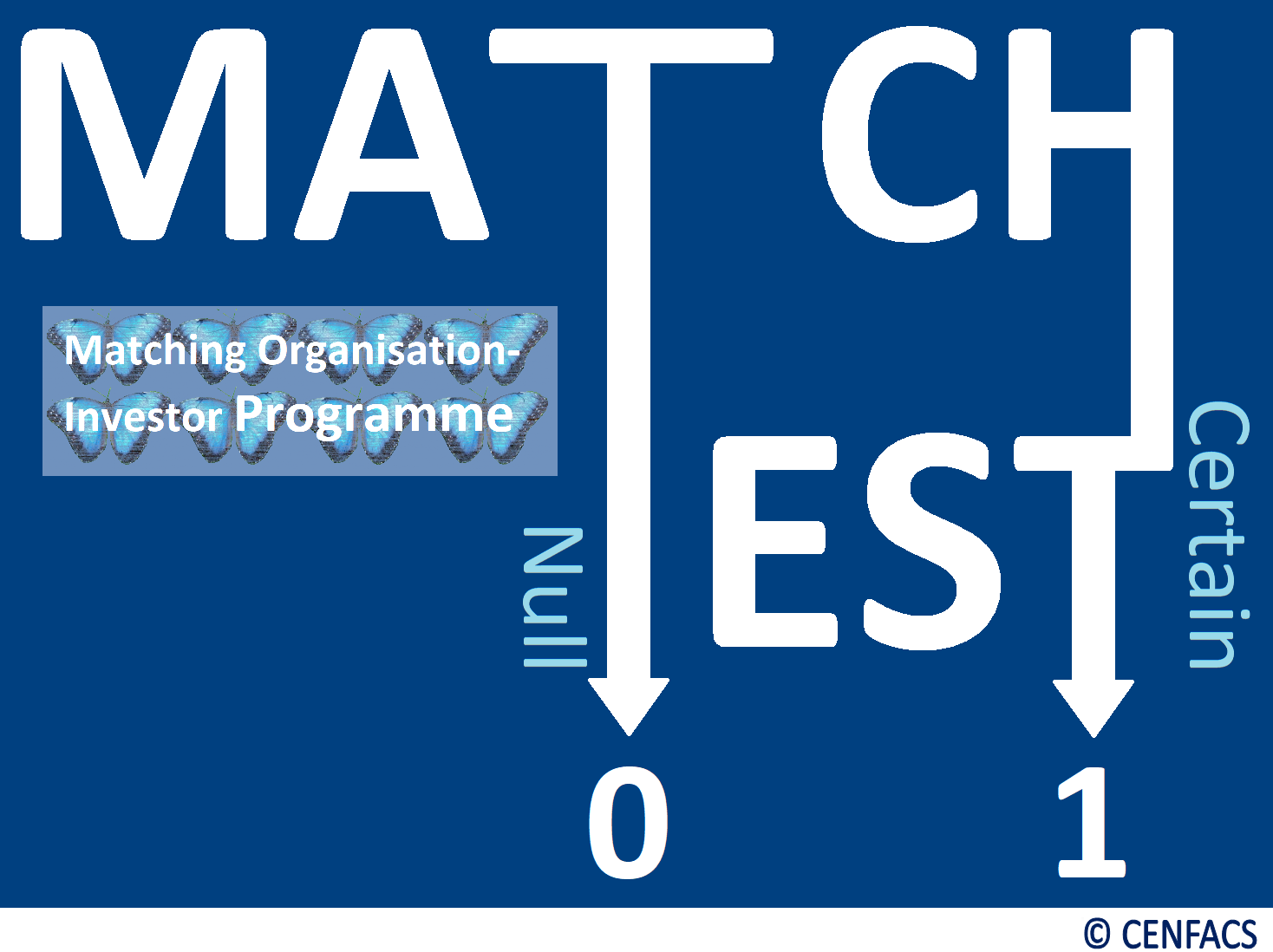
• • The Match or Fit Test Service
As part of the match or fit test, the contents of ACI/ASCO’s IS Stage must be matched with NFP Impact Investor’s view on RBF&IE. The match test (or matched sampling) will help to increase the accuracy and statistical efficiency of the study of the CCP by carefully selecting subjects for comparison. The purpose here will be to increase the statistical efficiency of the study on CCP by controlling for confounding variables when forming a sample.
The fit test will assist in determining how well the observed sample data matches a specified theoretical distribution. The fit test will check if the data collected fits a model or an assumed population distribution. So, the purpose of the fit test is to validate or invalidate the statistical model by checking if the sample data follows an expected distribution.
The match can be perfect or close (that is, when every unit is paired with an equivalent unit) in order to reach an agreement. If there is a huge or glaring difference between the two (i.e., between what the NFP Impact Investor’s approach to IS Stage and what ACI/ASCOC is saying about its IS Stage, between what the investor would like the IS Stage to indicate and what ASCO’s IS Stage is really saying), the probability or chance of having an agreement at this Fifth round of negotiations could be null or uncertain.
• • • Impact Advice to ASCO and Guidance to NFP Impact Investor
Where there could be a disagreement, CENFACS can impact advise ACI/ASCO to improve the contents of its IS Stage. CENFACS can as well guide NFP Impact Investors to work out their expectations in terms of RBF&IE Phase to a format that can be agreeable by potential ASCOs.
CENFACS’ impact advice for ASCOs and guidance on impact investing for NFP Impact Investor, which are impartial, will help each of them (i.e., investee and investor) to make informed decisions and to reduce or avoid the likelihood of any significant losses or misunderstandings or mismatches.
• • • The Rule of the Matching Game
The rule of the game is the more impact investors are attracted by ACI’s or ASCOs’ IS Stage the better for ACIs or ASCOs. It means that ACI’s or ASCOs’ process must pass the attractiveness test (that is, the evaluation of market’s appeal). Likewise, the more ACIs or ASCOs can successfully respond to impact investors’ level of enquiries and queries about the CCP the better for investors. In this respect, the matching game needs to be a win-win one to benefit both players (i.e., investee and investor).
The above is the Fifth Activity of the Matching Organisation-Investor via CCP.
Those potential organisations seeking investment to set up a CCP and NFP Impact Investors looking for organisations that are interested in their giving, they can contact CENFACS to be their matchmaker to find their perfect investee or investor.
• • • CENFACS as a Matchmaker
As a Matchmaker, CENFACS can streamline your search process, save time, money and resources to help you find the perfect match in the world of impact investing.
CENFACS platform will help facilitate the matching process between investees and investors. By leveraging the power of AI tools, CENFACS’ Matching Organisation-Investor Programme can streamline the search process for funding opportunities, connecting African charities and impact investors/funders.
Briefly speaking, CENFACS can work with matching applicants and use AI to match organizations with the right impact investors, filtering profiles based on development stages, sectors, and aims.
In this matching process, CENFACS can arrange the match or fit test for them. They can have their fit test carried out by CENFACS’ Hub for Testing Hypotheses.
• • • CENFACS’ Hub for Testing Hypotheses
The Hub can help use analysis tools to test assumptions and determine how likely something is within a given standard of accuracy. The Hub, which can serve as a learning or reference place for those who would like to understand and apply statistical hypothesis testing, can assist to
√ clean, merge and prepare micro-data sources for testing, modelling and analysis
√ conduct data management and administration
√ carry out regression analysis, estimate and test hypotheses
√ interpret and analyse patterns or trends or insights in data or results.
In this respect, CENFACS’ H-tests Hub is knowledge repository designed to demystify the process of using data to make informed decisions and move beyond intuition and guesswork.
For instance, in the context of this Activity 5, it is possible to evaluate or test hypotheses whether ACI’s/ASCO’s IS plans align with NFP Impact Investor’s RBF&IE.
• • • • Hypotheses Testing around the agreement between ACI’s/ASCO’s IS and NFP Impact Investor’s RBF&IE
These hypotheses revolve around the following areas: Financial and Impact Additionality, Monetizing C0-benefits, Verification and Cost Risk Transfer, and Real-time Adaptability.
If consideration is given to the hypothesis Monetizing Co-benefits, it can be hypothesized that agreements typically assume that health improvements, gender empowerment, and avoided deforestation can be quantified, verified, and eventually monetized. This requires ACI/ASCO to generate robust, auditable field data to prove these specific developmental impacts to investors.
Likewise, if focus is on Financial and Impact Additionality, it can be hypothesized that outcome-based finance incentivizes ACI/ASCO to distribute high-tier, verified stoves to marginalized populations, rather than just urban centres, because they are compensated based on pre-agreed social and health outcomes.
The above-mentioned hypotheses and other ones can be tested. Their results can contribute to the Matching Organisation-Investor via CCP.
Those who would like to apply hypothesis testing in fields of economic development or to deal with poverty reduction, they are welcome to use CENFACS’ H-tests Hub.
For any queries and/or enquiries about this Fifth stage (or phase) activity of Matching Organisation-Investor via CCP, please do not hesitate to contact CENFACS.
• • Concluding Note on Matching Organisation-Investor via a Clean Cooking Project
ACIs/ASCOs used the lifecycle thinking tool or model, which is made up with five steps as follows: 1) Feasibility and Design 2) Manufacturing and Sourcing 3) Distribution and Adoption 4) Monitoring and Verification 5) Impact Scaling.
NFP Impact Investors referred to models of a clean cooking project lifecycle that prioritizes social equity, health, gender empowerment, and verifiable climate metrics over pure financial returns. The 5 essential stages of clean cooking projects they used are 1) Market Assessment and Strategy Design 2) Incubation and Upfront Capital Allocation 3) Implementation and Behaviour Change 4) Monitoring, Verification and Co-benefits 5) Results-based Financing and Impact Evaluation.
However, there could be more than five stages in any clean cooking project lifecycle.
Regarding the match probability, this can be high or average or low depending on how much ASCOs’ needs meet Not-for-profit Impact Investors’ interests. The metrics and hypotheses used in this process helped to bridge the two parties’ needs and interested respectively.
CENFACS is still available to work with ASCOs that are looking for Impact Advice and Not-for-profit Impact Investors who need Guidance with Impact so that the former can find the investment they are looking for and the latter the organisation to invest in, and both of them can realise their respective Summer dreams.
To work together to make your matching dream come true by finding your ideal investee or investor, please contact CENFACS.

• End Childhood Distress in Africa
Childhood distress in Africa encompasses the severe psychological, emotional, and behavioural trauma experienced by minors in Africa. It is primarily driven by systemic issues like extreme poverty, armed conflicts, diseases (such as Ebola) and widespread adverse childhood experiences.
• • Conditions for Children in Africa during Summer 2026
The conditions for children in Africa during Summer 2026 remain deeply concerning, with millions needing emergency distress relief due to protracted conflicts, climate shocks, and disease outbreaks. There is a need to scale up integrated, community-based responses to deliver lifesaving support to these children.
Statistics on childhood distress in Africa highlight severe challenges driven by conflict, climate shocks, and extreme poverty. Millions of children face profound emotional and physical adversity, with estimates (9) indicating a near 50% prevalence of Post-traumatic Stress Disorder (PTSD) among adolescents in conflict-affected regions like East Africa.
• • Key Statistical Insights
They include the following areas: conflict and displacement, climate-driven adversity, mental health distress.
Concerning conflict and displacement, millions of children in hotspots like Sudan and the Democratic Republic of Congo (DRC) require life-saving assistance since they are enduring trauma from violence and displacement. Across Africa, conflict and violence have driven mass internal displacement, stripping children of community safety and routine. According to UNICEF (10),
“Millions of children in Sudan require lifesaving assistance, protection and the restoration of essential services”.
Regarding climate-driven adversity, Oxford Global Health (11) argues that
“Drought linked to 46% increase in sexual violence among adolescents in Southern Africa… 51% increase in emotional violence in areas affected by drought”.
According to Global Government Forum (12),
“Climate change disrupts education of 130 million children in Africa”.
In terms of mental health distress, the British Medical Journal (13) published the results or study on Post-trauma Stress Disorder (PTSD) among children and adolescents affected by armed conflicts in East Africa. These results or study indicate that
“The pooled prevalence of PTSD among children and adolescents in East Africa was 47.8%“.
This study concludes that the prevalence of PTSD among children and adolescents in East Africa is high. Factors heavily associated with the distress include witnessing violence and experiencing war-related trauma.
Yet, it is possible to end childhood distress in Africa.
You can help provide immediate relief, psychological support, and medical aid to vulnerable children facing conflict, displacement, famine and disease.
You donation towards childhood distress in Africa can save and rebuild young lives by addressing the immediate and long-term impacts of conflict, climate shocks and displacement in Africa.
• • Key Distress Relief Priorities
Your donation will help to
σ Prioritize disease prevention through the treatment of malnutrition and the prevention of diseases like cholera, Ebola, measles, malaria, etc.
σ Scale up clean water access and sanitation to deal with inadequate WASH (Water, Sanitation, and Hygiene) infrastructure
σ Relieve children from psychological distress and protect them from exploitation, especially in Sudan, the Democratic Republic of Congo and the Sahel where millions of children are facing conflict or displacement
σ Restore learning environments and education in conflict zones where thousands of schools are either destroyed or occupied.
• • Donation Impacts
There is no single correct donation size to end distress for children in Africa. However, your donation can provide specific, life-saving interventions like therapeutic food or vaccinations. If you choose to contribute monthly, a monthly contribution can also create long-term stability and education for these children in need.
• • Examples of Donations
A £20 donation can cover essential emergency food or high-protein therapeutic biscuits to treat malnourished children’s basic needs and food
A £9 donation can provide 100 children with a hot porridge meal, encouraging them to attend school instead of becoming child soldier
A £15 a month can sponsor a child to receive an education school uniform, shoes, and a daily meal
A £17 a month can help provide hundreds of children with access to clean, safe drinking water, preventing life-threatening diseases.
Supporting this appeal means helping childhood in Africa to minimise and mitigate the impacts of distress on them. Your support will help to fund the life-saving humanitarian needs of these children as well as to cover emerging and urgent needs.
Your assistance is required to respond to childhood distress signals.
One can think of a child or young person without any dreams and expectations, what will be his/her future, especially in spaces (like eastern part of the Democratic Republic of Congo) where there is enduring deterioration of security conditions in conflict-affected areas and where funding has been cut.
Can you help this child? Yes or No
If you say yes; then you can help children…
√ whose their humanitarian programmes have been impacted by aid cuts
√ who need lifesaving humanitarian assistance
√ surviving hunger, conflict and natural disasters
√ without access to safe drinking water, food, healthcare and education
√ vulnerable to malnutrition, disease and poverty
√ forced into early work or marriage
√ associated with armed forces and groups
√ vulnerable to abuse, neglect, exploitation, and violence
√ experiencing trauma and distress
√ facing war, starvation and poverty
√ experiencing life-threatening malnutrition
etc.
Your support will help these children…
√ dream for and expect a better life and future
√ overcome aid cuts and life events that could become a structural constraint and handicap for them
√ victims of endless insecurity that creates lifelong adverse impacts on them and young people
√ have their lives not being reduced back below the poverty line
√ not become the lost generation of lack of support
√ benefit from anti-sexual and gender-based violence programmes for survivors amongst them
√ stay healthy and protected from diseases
√ have or rediscover hopes and expectations
etc.
Your support is badly needed to relieve millions of children from emergency distress due to protracted conflicts, climate shocks, and disease outbreaks in Africa.
Please End Childhood Distress in Africa.
To support, please contact CENFACS on this website.

Extra Messages
• Execution of the Fourth Energy Crisis Mitigation and Poverty Reduction Codes for CEDM (Creative Economic Development Month) 2026 Sub-themes (from Week Beginning Monday 22/06/2026)
• Business Education Programme for Low-income Families to Reduce Poverty – In Focus from 22/06/2026: Workforce and Vocational Up-skilling Projects
• Creative Arts, Crafts and Design-based Development Project –
In Focus: Unknown, Unreported and Unnamed Artists, Craft Persons and Designers of Poverty Relief and Sustainable Development with the Example of Young Creators and Innovators

• Execution of the Fourth Energy Crisis Mitigation and Poverty Reduction Codes for CEDM (Creative Economic Development Month) 2026 Sub-themes (from Week Beginning Monday 22/06/2026)
The Fourth Energy Crisis Mitigation and Poverty Reduction Codes for CEDM 2026 Sub-themes will be executed under the following headings:
σ What Are the Fourth Energy Crisis Mitigation and Poverty Reduction Codes for CEDM 2026?
σ Unveiling Creations and Innovations for CEDM (Creative Economic Development Month) 2026 Sub-themes and Corresponding Fourth Codes
σ Working with the Community and Africa-based Sister Organisations on The Fourth Codes.
Let us uncover each of these headings.

• • What Are the Fourth Energy Crisis Mitigation and Poverty Reduction Codes for CEDM 2026?
The Fourth Codes for CEDM (Creative Economic Development Month) 2026 Sub-themes refer to a set of rules or principles allowing for action on creative economic development during June 2026. They help in delivering the activities planned for the CEDM 2026. They also identify the fourth level of sub-themes for CEDM 2026. These codes are summarised in the table below.

• • Unveiling Creations and Innovations for CEDM (Creative Economic Development Month) 2026 Sub-themes and Corresponding Fourth Codes
• • • Creations and Innovations to Mitigate the Impacts of Energy Crisis (for Sub-theme 1)
• • • • Creations to Mitigate the Impacts of Energy Crisis (CMIEC)
For the Fourth Codes of CEDM 2026, these creations are those related to Energy Advice and Behavioural Changes.
a) What are Creations relating to Energy Advice and Behavioural Changes?
a.1) What are Creations relating to Energy Advice?
To understand these creations, it is better to explain energy advice. Energy advice is a free, impartial guidance that helps households and businesses reduce their energy bills, improve home efficiency and manage energy debt. It covers practical tips on lowering usage, matching tariffs, and applying for grants or government assistance.
Creations linked to energy advice are the act of bringing something new into the existing energy advice or the resulting object of the energy advice process.
a.2) What are Creations relating to Behavioural Changes?
To explain these creations, let us start with the meaning of behavioural changes. Behavioural change refers to the intentional modification of everyday habits, operational practices and human decisions to reduce wasteful energy consumption.
The creations linked to them are acts of bringing something new to reduce wasteful energy consumption.
b) Corresponding Codes for Creations relating to Energy Advice and Behavioural Changes
The corresponding codes for this fourth category include
σ Energy literacy
It refers to the understanding of how energy works in your daily life and the broader world.
σ Smart meter rollout
It is a nationwide, government-led initiative to replace traditional, analogue gas and electricity meters with digital smart meters.
σ Demand response
It is a programme that incentivizes energy users to shift or reduce their electricity consumption during periods of high grid demand.
• • • • Innovations to Mitigate the Impacts of Energy Crisis (IMIEC)
For the Fourth Codes of CEDM 2026, these innovations are relating to Consumer Engagement, Education and Justice.
a) What are Innovations linked to Consumer Engagement, Education and Justice?
To approach these innovations, let us explain consumer engagement, education and justice.
Consumer engagement refers to the active participation of households and businesses in the energy market. It involves understanding energy bills, comparing tariffs, switching suppliers, adopting smart technologies, and adjusting usage to reduce costs and support the power grid.
Energy education is the process of teaching individuals about how energy is generated, consumed and conserved.
Energy justice is the ethical principle that access to clean, affordable, and reliable energy is a basic human right. It seeks to remedy historical inequalities, ensuring burdens and benefits of energy systems are fairly shared across all.
b) Corresponding Codes for Innovations linked to Consumer Engagement, Education and Justice
They include
σ Energy democracy
It is a social and political movement that seeks to shift control of the energy sector away from centralized corporate monopolies and into the hands of local communities.
σ Energy literacy
It is an individual’s understanding of how energy works in the world and daily life. It combines knowledge of energy systems awareness of personal consumption and the ability to make informed decisions that reduce costs, improve efficiency and support environmental sustainability.
σ Energy counselling (or energy psychotherapy)
It is an integrative therapeutic approach that combines traditional talk therapy with somatic and energy-based techniques. It aims to help clients release trauma and deep-seated emotional blocks that are physically stored in the body’s nervous and subtle energy systems.
σ Bill interpretation service
It is a specialized service designed to help consumers and businesses understand complex utility bills. It translates confusing metrics (like kWh usage and standing charges), verifies the mathematical accuracy of charges and identifies potential billing errors to ensure your are not overpaying.
σ Smart meter reading
It is the digital measurement of your home’s gas or electricity consumption, captured automatically by smart meter ad sent directly to your energy supplier.
• • • Creations and Innovations to Tackle Long-term Energy Poverty (for Sub-theme 2)
• • • • Creations to Tackle Energy Poverty (CTLTEP)
For the Fourth Codes of CEDM 2026, these creations are those related to Measurement and Tracking Indicators.
a) What are Creations relating to Measurement and Tracking Indicators?
They are those involving metrics used to quantify, analyze, and optimize energy consumption over time.
b) Corresponding Codes for Creations relating to Measurement and Tracking Indicators
These fourth codes include
σ MPE (Minimum Energy Efficiency Standards), LILEE (Low Income Low Energy Efficiency) Indicator
LILEE is the official metric used by the UK Government to measure fuel poverty.
σ Expenditure-based code
It refers to standardized classification system like the Compendium of Physical Activities, which assigns specific 5-digit codes to line activities based on their metabolic rate, or it refers to algorithms and software written to estimate calories burn using wearable device data.
σ Hidden energy poverty
It occurs when households deliberately under-consume energy – such as limiting heating or air conditioning – to avoid high utility bills. Because their spending looks artificially low, they are missing by conventional metrics that define poverty by high energy bills.
• • • • Innovations to Tackle Energy Poverty (ITLTEP)
For the Fourth Codes of CEDM 2026, these innovations are those related to Digital Financing and Pay-As-You-Go.
a) What are Innovations relating to Digital Financing and Pay-As-You-Go?
To understand these innovations, it is better to explain both digital financing and pay-as-you-go.
Energy digital financing refers to the use of digital technologies – such as mobile money, artificial intelligence, and blockchain – to facilitate, manage, and fund energy projects and consumer services. It primarily drives the transaction to renewable energy by streamlining investments and enabling pay-as-you-go (PAYG) consumer models.
Pay-as-you-go (often called a prepayment meter) means you pay for your gas and electricity before you use it. You purchase credit in advance using an app, online account or physical top-up card. As you consume energy, your credit balance decreases.
Innovations relating to Digital Financing and Pay-As-You-Go will be the practical implementation of new or improved ideas or products or processes that add measurable value to energy digital financing and pay-as-you-go.
b) Corresponding Codes for Innovations relating to Digital Financing and Pay-As-You-Go
These fourth codes include
σ Energy social tariff
It is a proposed or heavily discounted energy deal designed to help low-income households and vulnerable consumers afford their gas and electricity. The concept protects those in fuel poverty by capping or lowering the unit rate or standing charge for qualifying individuals.
σ Cash transfer
It is a direct financial payment or voucher provided by governments or organisations to help individuals or households manage their financial burden of high energy costs.
σ Equitable policy design
It is framework that ensures the benefits and burdens of the energy system – particularly during the transition to clean energy -are fairly distributed. It actively mitigates disproportionate environmental and financial impacts on historically marginalized and low-income communities.
• • Working with the Community and Africa-based Sister Organisations (ASOs) on These Fourth Codes
Concerning the work with our community members, it involves delivering direct frontline support, establishing community-led energy initiatives, and advocating for systemic policy changes for them like social tariffs.
It also encompasses the following:
σ Providing direct energy and money advice: Helping our members understand their energy costs. CENFACS energy advisors or volunteers can assist with matters such as tariff switching, securing fuel vouchers, navigating hardship energy funds, and other energy issues.
σ Campaigning and ‘lived experience’ advocacy: It is about mobilizing or encouraging our members to share their stories of fuel poverty to influence solutions to energy poverty.
σ Signposting our members to health and housing services if members are energy poor.
Regarding our work with ASOs, it is about
σ Supporting the rules that govern the Fourth Codes
σ Interacting with ASOs on CEDM 2026 matters
σ Helping them to prepare their own action on the Fourth Codes and CEDM 2026
σ Improving their user experience about the Fourth Codes and CEDM matters
σ Assisting them to develop appropriate strategy to act in various situations of the Fourth Codes and CEDM
Etc.
Those members of our community and ASOs willing to work with us on the Fourth Codes, they are welcome to contact CENFACS.
The above is the fourth execution of our CEDM 2026 Working Weeks and Plan.
For those who may be interested in any of the Fourth Codes of each sub-theme of this plan, they can contact CENFACS.
For those who would like to learn more about CEDM 2026, they can also communicate with CENFACS.

• • Concluding Remarks about 2026 CEDM
During this month, we have been working to form responses from nothing and bring them into existence to deal with the 2026 CEDM sub-themes. Equally, we have been trying to introduce new ideas or methods as well as make changes to what has been tried and tested to deliver these kinds of sub-themes.
We have explored the kinds of creation and innovation the CENFACS Community (and alike our Africa-based Sister Organisations) need in order to find ways of “Embedding long-term resilience through innovation to secure future progress”.
We hope that those who have engaged with us throughout this process would have found from some of the creations and innovations or simply ideas we put together forward so far how useful they could be. Those who have their creations and innovations on this matter and would like to share them with us and the community, they should not hesitate to contact us and the community on this matter. They should seize this week’s opportunity to PRESENT THEIR OWN CREATIONS AND/OR INNOVATIONS FOR POVERTY REDUCTION AND SUSTAINABLE DEVELOPMENT. They can pitch, demonstrate or showcase their creations or innovations and explain how they can improve livelihoods (for instance, to mitigate energy crisis and reduce long-term energy poverty).
To present your creation or innovation, or to enter this competition, please contact CENFACS.

• Business Education Programme for Low-income Families to Reduce Poverty – In Focus from 22/06/2026: Workforce and Vocational Up-skilling Projects
This week, we are working on Workforce and Vocational Up-skilling Projects (W&VUPs) for those low-income families planning or wanting to set up an income-generating activity or micro-enterprise or even entrepreneurship project. To start W&VUPs, let us explain them, contextualize them and highlight ways of working with the community on them.
• • Explaining Workforce and Upskilling
• • • Workforce
The definition used here for workforce comes from ‘pockethrms.com’ (14), which states that
“Workforce is used to denote a section of the populace that is either employer in work or are available for work. Although it is traditionally used to denote the populace of a geographical location such as a city or nation, it might also be used to denote the workers in a particular industry or company”.
Understanding workforce is helpful for those families wanting or planning to have some workers or to be workers themselves. Understanding workforce may not enough unless one also knows workforce development.
The website ‘nawdp.org’ (15) explains workforce development by arguing that
“Workforce development is a comprehensive approach to preparing individuals for success in the labour market while ensuring that businesses have access to the talent they need to grow and thrive. It brings together education, training support services, and employment strategies to strengthen local economies and empower communities”.
• • • Vocational Upskilling
Let us start with the adjective vocational. In the context of this business education programme, vocational will be linked with course. Vocational courses are, according to ‘twclondon.org.uk’ (16),
“Career-focused educational programmes that give you the practical skills and knowledge to excel in a particular industry or trade. It is basically an alternative to traditional academic routes, focusing on hands-on training and real-world applications over theoretical concepts”.
Types of vocational qualifications include apprentiships, BTECs (Business and Technology Education Council qualifications), IT Levels, NVQs (National Vocational Qualifications), and Diplomas.
Concerning upskilling, the website ‘coursera.org’ (17) argues that
“Upskilling means learning new and enhanced skills that relate to your current role”.
There are benefits deriving from upskilling, such as progress towards your goals, remaining competitive in the job market, qualifying for a promotion, securing a new job, earning more and continuing self-improvement.
So, vocational upskilling is the process of acquiring advanced, hands-on skills in a specific trade or career field to improve your performance or prepare for a more senior role. It blends practical, industry-specific training with continuous professional development, helping workers adapt to new technologies and modern workplace demands. It heavily focuses on real-world, applicable knowledge.
• • Contextualizing Workforce Development
In the context of our Business Education Programme, workforce development will be approached in terms of understanding hiring needs, designing relevant training programmes, creating work-based learning opportunities, and developing talents. In other words, if a low-income family decides to set an income-generating activity or micro-enterprise or even entrepreneurship project, they need to be aware at certain time they will be forced to develop their workforce to keep pace with the requirements from the industry they will be operating in. It means they need to prepare themselves for in-demand career and equip their income-generating activities (IGAs), micro-enterprises (MEs), and entrepreneurship projects (EPs).
There are ways of working with them on these matters so that they can move in the right direction from the beginning of their business drive to reduce poverty.
• • Ways of Work with Low-income Families on Workforce and Vocational Up-skilling Projects
These involve helping these families overcome barriers to self-employment by turning their passions into viable IGAs, MEs, and EPs. We can work with them in the following areas:
σ Training and Business Skills Development
They include
~ e-workshops covering business planning, budgeting, pricing and marketing strategies
~ Financial literacy skills where they can learn to manage cash flow, get help to open a business account, set up personal and business savings
σ Navigating legal structures
Guiding them through business registration, applying and obtaining licenses to operate, adhering to tax and health laws, etc.
σ Mentoring and peer networking
These involve pairing new low-income families and entrepreneurs with seasoned business mentors to offer them guidance and support
σ Financial guidance and capital access
Guidance these families to business funding sources and asset building
σ Holistic family support
Helping these families manage broader challenges (like childcare) to ensure that transition to IGAs. MEs or EPs is sustainable.
Those who have any queries or enquiries to make about the topic of Workforce and Vocational Upskilling Projects, they can talk to CENFACS.
Those who may be interested in or willing to support Business Education Programme for Low-income Families to Reduce Poverty, they should not hesitate to contact CENFACS.

• Creative Arts, Crafts and Design-based Development Project –
In Focus: Unknown, Unreported and Unnamed Artists, Craft Persons and Designers of Poverty Relief and Sustainable Development with the Example of Young Creators and Innovators
Artists and designers play an active role in helping to reduce poverty and enhance sustainable development. So, this week we are working on some of the works carried out by artists and designers especially those from small scale and charitable backgrounds, the local arts and design products and services undertaken by local people and communities sometimes to make ends meet.
These kinds of work can include the following:
√ Those carried out by poor families, children, young people and those who are left out of the economic growth or upturn
√ There are works undertaken by unknown, unreported and unnamed artists, craft persons and designers who may be amateurs or not professionals or not just celebrities.
To better illustrate what we are trying to argue, let us provide some definitions.
• • What Is Unknown, Unreported and Unnamed Artist?
It emerges from arts literature that unknown artists are creators of artworks, music or other creative works whose name or identity is not publicly known or widely recognised. We can mention the example of Banksy whose anonymity is deliberate.
The same art literature tells us that unreported artists can refer to several scenarios, including artists working in the informal economy, those work is not widely recognised, or artists whose contributions are overlooked in mainstream narratives.
Examples of unreported artists include unsigned musicians, street performers, artists whose work is part of community-based art scenes, etc.
Also found within the same art literature the term ‘unnamed artists’ which refers to creators whose identities are unknown or intentionally concealed.
Examples of these unnamed artists include historical artists whose names have been lost to time to contemporary artists who choose to remain anonymous like Banksy.
We are interested in all of them. Every year, we try to find out unknown, unreported and unnamed artists and designers, as part of Creative Arts, Crafts and Design-based Development Project. This finding exercise helps to know and name them as well as advertise their works. We can advertise their work as advertising is an area of creative industries making CENFACS’ 2026 CEDM.
All these small pieces of art, craft and design works can help relieve poverty and enhance the process of sustainable development. They can help to win the battle against crises such as the cost-of-living crisis, energy crisis or any other crisis.

• • Example of Unknown, Unreported and Unnamed Artists, Craft Persons and Designers: Young Creators and Innovators
Some Young Creators and Innovators can be classified as unknown, unreported and unnamed artists and designers. Who are they?
• • • Young Creators and Innovators
They are those who, at young age, demonstrate a knack for problem-solving, creativity, and the ability to develop new ideas and solutions. They are of all sorts of talents and abilities who can create and innovate to reduce poverty and enhance sustainable development. They can as well help us embed long-term resilience through innovation to secure future progress.
Their works can help reduce poverty induced by polycrises while keeping the progress of the realisation of sustainable development and climate goals. They could be the finders of the today’s solutions for tomorrow’s problems.
So, this week we are continuing our Creative Arts, Crafts and Design-based Development project by looking at the contribution that unknown, unreported and unnamed artists, craft persons and designers, and amongst them are Young Creators and Innovators, who are helping in reducing poverty and hardships as well as in enhancing sustainable development.
• • • June 2026 Challenge: The Creative Mind of Poverty Reduction (PR) and Sustainable Development (SD)
As a creator or innovator of PR and/or SD you can tell to CENFACS your creation and/or innovation project or experience of creative and/or innovative PR and/or SD. And if you are a young creator and/or innovator and has some feeling that you would probably fall under the category of unknown, unreported and unnamed artists and designers; CENFACS would like to hear from you as well as your creative or innovative work. You could be the Creative Mind of Poverty Reduction and Sustainable Development of June 2026; the Mind we are looking for.

Message in English-French (Message en Anglais-Français)
• CENFACS’ be.Africa Forum E-discusses the Following Topic:
How to Bridge the Gap between Charities’ Reliance on Grant Models and Not-for-profit Impact Investors’ Request for Scalable, Self-sustaining Market Mechanisms
This e-discussion stems from CENFACS Matching Programme between African Charity Investees (or African Charity Investors/Outcome Funders) and Not-for-profit Impact Investors (or Capital Providers) in terms of funding models.
Indeed, research on this matter suggests that to bridge the gap between pure philanthropic and commercial-style impact investing, charities may be required to embrace hybrid funding models and strategic capital layering. This allows charities to secure sustainable, scalable revenue while satisfying impact investors’ demands for market viability, clear financial returns, and measurable outcomes.
The literature on this matter indicates that the most effective ways to bridge this gap include blended finance structure, earned revenue streams, revenue participation agreements, impact-weighted accounting, and spin-off entities.
The explanations or arguments about these strategies are as follows.
σ Blended Finance Structure
It involves combining catalytic capital (like grants or recoverable grants) with commercial impact investment. Philanthropic funds can absorb the ‘first-loss’ risk or guarantee the investment, which de-risks the deal and attracts private capital.
σ Earned Revenue Streams
It is about shifting a portion of the charity’s services from free-at-the-point-of-use to revenue-generating models (e.g., social enterprises, fee-for-service contracts with local authorities, or social franchising)
σ Revenue Participation Agreements
It encompasses structuring debt repayments based on a percentage of charities’ earned revenue, rather than fixed interest rates. This gives investors a financial return while remaining highly sensitive to the charity’s cash flow.
σ Impact-Weighted Accounting
It includes implementing standardized, rigorous metrics to track and quantify social or environmental impact alongside financial metrics. Investors require this dual-purpose transparency to benchmark their portfolios.
σ Spin-off Entities
It refers to the creation of a commercial, for-profit subsidiary that handles the scalable market mechanisms (e.g., selling a product), while retaining the charity to strictly focus on advocacy, community engagement, and grant-funded research and development).
The above are the arguments about ways of bridging this gap. CENFACS’ be.Africa Forum would like to know yours.
These arguments provide materials and space for reflection, expression, discussion and action.
Those who may be interested in reflection, expression, discussion and action on ‘Ways of Bridging the Gap between Charities’ Reliance on Grant Models and Not-for-profit Impact Investors’ Request for Scalable, Self-sustaining Market Mechanisms’ can join our poverty reduction pundits and/or contribute by contacting CENFACS’ be.Africa Forum, which is a forum or space for discussion on poverty reduction and sustainable development issues in Africa and which acts on behalf of its members by making proposals or ideas for actions for a better Africa.
To contact CENFACS about this discussion, please use our usual contact address on this website.
• Le Forum ‘Une Afrique Meilleure’ de CENFACS discute en ligne le sujet suivant :
Comment combler le fossé entre la dépendance des organismes de bienfaisance aux modèles de subventions et la demande des investisseurs/ses à impact à but non lucratif pour des mécanismes de marché évolutifs et autonomes ?
Cette discussion en ligne fait suite au programme de jumelage de CENFACS entre les organismes caritatifs africains bénéficiaires de financements (ou investisseurs caritatifs africains/bailleurs de fonds axés sur les résultats) et les investisseurs/ses à impact à but non lucratif (ou fournisseurs de capitaux) concernant les modèles de financement.
En effet, les recherches sur ce sujet suggèrent que, pour combler le fossé entre l’investissement à impact purement philanthropique et l’investissement à impact de type commercial, les organismes caritatifs pourraient devoir adopter des modèles de financement hybrides et une stratification stratégique du capital. Cela leur permet de garantir des revenus durables et évolutifs tout en répondant aux exigences des investisseurs/ses à impact en matière de viabilité commerciale, de rendements financiers clairs et de résultats mesurables.
La littérature sur ce sujet indique que les moyens les plus efficaces de combler ce fossé comprennent les structures de financement mixtes, les flux de revenus propres, les accords de participation aux revenus, la comptabilité pondérée par l’impact et les entités dérivées.
Les explications ou arguments relatifs à ces stratégies sont présentés ci-dessous.
σ Structure de financement mixte
Elle consiste à combiner des capitaux catalyseurs (tels que des subventions ou des subventions remboursables) avec des investissements à impact commercial. Les fonds philanthropiques peuvent absorber le risque de « première perte » ou garantir l’investissement, ce qui réduit le risque de l’opération et attire des capitaux privés.
σ Flux de revenus générés par les activités de l’organisme
Il s’agit de transformer une partie des services de l’organisme, initialement gratuits, en modèles générateurs de revenus (par exemple, entreprises sociales, contrats de prestation de services avec les collectivités locales ou franchise sociale).
σ Accords de participation aux revenus
Il s’agit de structurer les remboursements de la dette en fonction d’un pourcentage des revenus générés par l’organisme, plutôt qu’à taux d’intérêt fixes. Cela offre aux investisseurs/ses un rendement financier tout en restant très attentif aux flux de trésorerie de l’organisme.
σ Comptabilité pondérée par l’impact
Elle comprend la mise en œuvre de mesures standardisées et rigoureuses pour suivre et quantifier l’impact social ou environnemental, en complément des mesures financières. Les investisseurs exigent cette transparence à double objectif pour évaluer leurs portefeuilles.
σ Entités dérivées
Il s’agit de la création d’une filiale commerciale à but lucratif qui gère les mécanismes de commercialisation à grande échelle (par exemple, la vente d’un produit), tandis que l’organisme caritatif conserve le contrôle strict de ses activités de plaidoyer, d’engagement communautaire et de recherche et développement financée par des subventions.
Les arguments ci-dessus sont ceux sont qui ont été avancés pour combler cet écart. Le Forum ‘Une Afrique Meilleure’ de CENFACS souhaite connaître le vôtre.
Ce qui précède offre un espace de réflexion, d’expression, de discussion et d’action.
Les personnes intéressées par la réflexion, l’expression, la discussion et l’action au tour de la question
‘Comment peut-on combler le fossé entre la dépendance des organismes de bienfaisance aux modèles de subventions et la demande des investisseurs à impact à but non lucratif pour des mécanismes de marché évolutifs et autonomes ?’
peuvent (re)joindre notre groupe d’experts sur la réduction de la pauvreté et/ou contribuer en contactant le ‘me.Afrique’ du CENFACS (ou le Forum ‘Une Afrique Meilleure’ de CENFACS), qui est un forum ou espace de discussion sur les questions de réduction de la pauvreté et de développement durable en Afrique et qui agit au nom de ses membres en faisant des propositions ou des idées d’actions pour une Afrique meilleure.
Pour contacter le CENFACS au sujet de cette discussion, veuillez utiliser nos coordonnées habituelles sur ce site Web.

Main Development
• Season of Happiness 2026
The following items will help to understand the way in which, together with our users and beneficiaries, we would like to wish the 2026 Season of Happiness to happen:
∝ Rebuilding Season to Happiness Season
∝ What Is Summer for CENFACS’ Users and Beneficiaries?
∝ 5 Properties of 2026 Happiness Season
∝Preview of2026 Summer of Happiness and Well-beingProgrammes.
Let us briefly explained these items.
• • Rebuilding Season to Happiness Season
Jmesci (June Month of Environmental and Sustainable Creative Initiatives) and Creative Arts, Crafts and Design-based Development Project are the projects that have made the last part of Spring 2026 programme. Both projects make our Creative Economic Development Month.
In practice, Jmesci is the project that is ending our Rebuilding or Life Renewal Season to start Happiness Season or Summer of Happiness. After creating and innovating to embed long-term resilience through innovation to secure future progress as well as to help reduce poverty and enhance sustainable development; we are now looking forward to enjoy the sunshine of Summer with Happiness. We look forward to Summer holiday, although the warm weather has already started.
• • What Is Summer for CENFACS’ Users and Beneficiaries?
Summer is a period of the warm sunny weather that we would like to associate with it at CENFACS. It is the time of happiness that we all expect, after a long period of full time work and education. We look forward to a break after such a long time of routine working life, especially as most of CENFACS’ projects and programmes are framed around the school timetable to suit and reflect the needs and living patterns of our users and beneficiaries. This is despite the fact that during Summer holiday people are still working to keep their households and the economy running.
• • 5 Properties of 2026 Happiness Season
As highlighted in the key messages, our Season of Happiness or Summer of Happiness will be about the following five values or utilities:
1) Our capacity to spread happiness between the members of CENFACS Community to narrow the gap in happiness inequalities (value of spreading happiness)
2) The help we can provide to those who are in most need within the CENFACS Community to find happiness cure and feel happy, to achieve successful outcomes in the current economic context (value of sharing happiness)
3) Our ability to create and innovate happiness-enhancing activities and projects to reduce poverty linked to the lack of happiness (creative and innovative value of happiness)
4) Our kindness to care about those members of our community who are in most need of care (care value of happiness)
5) How internet activities (like communications, news and content creation) can bring or increase life satisfactions among the members of the CENFACS Community (internet or digital value of happiness).
It is possible to help CENFACS’ users and beneficiaries overcome inequalities in happiness and achieve well-being.
Therefore, the keynote of our theme for Summer of Happiness will be: How to Create, Enjoy and Sustain Happiness in the Current Economic Context.
To support those struggling with economic pressures over Summer 2026, we shall work with them so that they can navigate their way to resilience, perseverance, happiness and well-being. In practical terms, it means that we shall provide Happiness Tips and Hints relating to the current economic context. We will provide them through the following Summer initiatives.
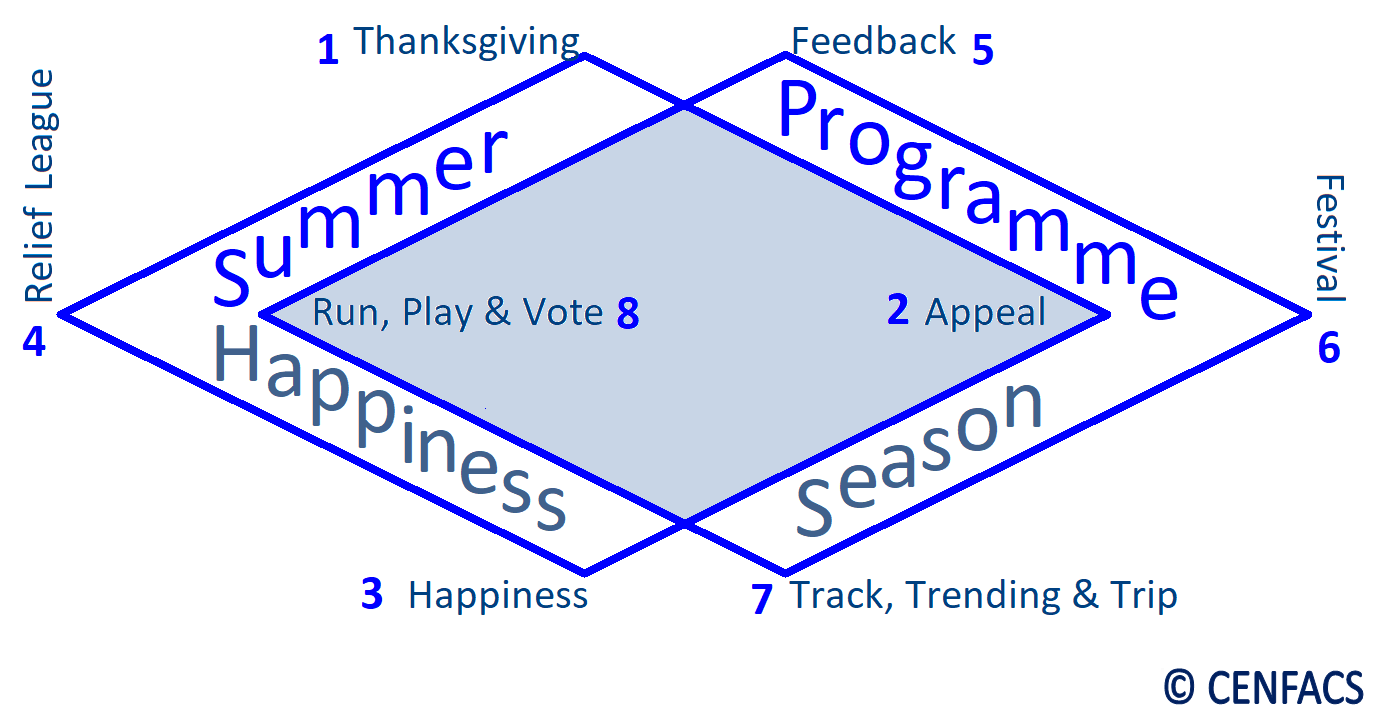
• • Preview of 2026 Summer-of-Happiness and Well-being Programmes
Summer Programme at CENFACS is mainly made of two sets or broad areas of projects for and with Multi-dimensionally Poor Children, Young People and Families; which consists of:
(a) Happiness Projects (Part 1) and
(b) Appeal Projects or Humanitarian Relief to Africa (Part 2).

Besides this main Summer seasonal regular feature, we have also planned other initiatives as side menus. We shall gradually release the contents of these Summer projects as we progress towards Summer Holiday 2026.
Our development calendar/planner already indicates what is planned for July and August 2026. However, should anybody want to find out more, they are welcome to contact CENFACS.
• • • Summer 2026 Programmes, Projects and Activities (Summer calendar/planner)
How to Make This Summer 2026 as of a True Happiness
What are Summer 2026 Programmes, Projects and Activities (S2026PPAs)?
S2026PPAs are seasonal initiatives, events and projects designed to boost mental, physical, and community health. They typically feature a mix of outdoor, creative, community-building and poverty-relieving activities to help people connect, destress, reduce poverty, and improve their overall quality of life. They are given below.
July 2026
∞ Summer Financial Updates: The Impact of Inflation on Service Delivery Costs
The 2026 Edition of Summer Financial Updates (a CENFACS’ Individual Capacity Building and Development resource for Summer) will focus on the factors that contribute to the financial strain on the way we deliver service to the community. It will as well provide advice, tips and hints to protect the community on ways dealing with the consequences of inflation. In particular, it will give some clues on way of reducing poverty linked to inflationary costs.
∞ All-in-one Impact Assessment
July, which is the Analytics month within CENFACS, is the month to be at CENFACS for those who are working on project and programme impacts.
We will be doing two levels of impact assessment as follows:
1) Our usual July Impact Monitoring, Evaluation, Review and Analytics for projects and programmes that we run in the preceding financial year
2) Impact assessment of the different activities linked to the polycrises (e.g. activities to tackle rising prices of food, energy, geo-economic crisis, international aid cuts, conflicts, etc.).
∞ Virtual Summer Festival with Seven Days of Development in July
The focus for our Summer 2026 Festival will be on Disruptions to Poverty Reduction Efforts
This Summer 2026 Festival will reflect on the sudden global and localized shocks (such as geopolitical conflicts, pandemics, supply chain bottlenecks, energy and climate crises) and how they stall or reverse economic progress. These events skyrocket food, energy and transport costs while pushing vulnerable populations back into extreme poverty.
These disruptions manifest in specific ways across global and local economies in the forms of macro-economic and supply chain shocks, the compounding ‘policy crisis’, financial and fiscal policy setbacks, loss of resilience, conflict and displacement, climate change and environmental shocks. They can undermine any progress accomplished in terms of poverty reduction and sustainable development.
July – August 2026
∞ Children, Young People and Families (CYPFs) Summer Programme (Part I): Appeal Projects
Summer Humanitarian Appeal projects are a set of projects to help alleviate multi-dimensional poverty experienced by CYPFs during the Summertime. We normally launch one umbrella appeal that brings under one roof these projects. This year, we are going to launch selected appeals for most of them with special emphasis on the impacts of the polycrises on CYPFs.
One of the selected appeals will be about helping CYPFs to be free from distress caused by the consequences of protracted conflicts, climate shocks, and disease outbreaks. The appeal – End Childhood Distress in Africa – is one of the Summer Appeal projects making the first part of our Summer Programme, which has been published in this post.
Another appeal project that will have a particular attention and that is needed during this period of the polycrises is the Iconic Young Carer Project (iYCP). This project has found its place in our summer plan as the effects of caring and sharing on people’s happiness have been recognised by the last year’s World Happiness Report written by Helliwell et al. (18). The latter argue the reciprocal benefits of the recipients of caring behaviour and the benefits to those who care for others.
∞ Children, Young People and Families (CYPFs) Summer Programme (Part II): Happiness Projects
Happiness projects are another set of Summer projects making the second part of our Summer Programme. We shall release more details about Happiness projects in due course as we come close to Summer holiday.
∞ Summer 2026 Run, Play and Vote to Reduce Poverty
Our Triple Value Initiatives (Run, Play and Vote) for this year have already kicked off. Through e-workshops, we have provided some guidance and help about them. And we are still available to talk to those who need some help. Those who started them should be half-way through with them.
These activities can be run in hybrid manner; that is in-person or virtual depending on the circumstances of participants.
Since we are already in the middle of the year, half-year actions and results about these activities will be sought from those who are practising them.
We shall ask those who undertook exercises relating All Year Round Projects with Triple Value Initiatives integrated into them, such as e-workshops and recreational activities to report on their actions and results as well.
∞ Integration of Le Dernier Carré into the Programme of Embedding Resilience and Innovation to Drive Progress
Our four-step model of poverty relief (that is the Last Square of Poverty Relief or Le Dernier Carré) will be included in some of the elements of the Summer-of-Happiness Programme.
∞ Summer Track, Trip and Trending
Track and Trip activities will be run as normal.
Regarding Trending activity, we are going to follow the direction of poverty reduction via Addressing the Lack of Alternatives to Reduce Poverty. Indeed, CENFACS 2026 Year of Alternatives is also a time to look at when there are no alternatives, particularly but not limited to the Lack of Alternatives to Reduce Poverty, that is situations where no other options or choices are available and often leading to difficult decisions or actions taken out of necessity. In this kind of circumstances of alternative lacking, what can people living in poverty do?
Addressing the Lack of Alternatives to Reduce Poverty requires a multifaceted approach. Because poverty is driven by complex, interrelated factors, effective solutions must tackle the root causes rather than merely treating symptoms. These strategies will focus on expanding choices, building resilience, and creating sustainable pathways upward.
The above is just an indicative plan of work for our Summer of Happiness. This Summer work plan will be reviewed depending on the circumstances and events that may occur as we move throughout the summertime.
We hope you find a happy, helpful and hopeful relief from the above programmes and projects on offer at CENFACS over this Summer!
For details or clarification about the above programmes and projects, including ways of accessing them, please contact CENFACS.
_________
Note: Although the above is scheduled for Summer 2026, we may slightly alter our initial plan and or introduce occasional initiatives to cope with the reality of the unpredictability and complexity of development situations (e.g. humanitarian and emergency situations), in which case we shall let you know as early as we can.
_________
• References
(1) Helliwell, J. F., Layard, R., Sachs, J. D., De Neve, J.-E., Aknin, L. B., & Wang, S. (Eds). (2026). World Happiness Report 2026. University of Oxford: Wellbeing Research Centre
(2) https://impactdots.com/blog/how-and-when-do-you-need-scaling-impact/#:~text=… (accessed in June 2026)
(3) https://www.springimpact.org/toolkit-home/ (accessed in June 2026)
(4) https://www.socialfinance.org.uk/people/what-we-do/the-routes-to-scale-framework (accessed in June 2026)
(5) Escalante, D. & Orrego, C. (2021), Results-Based Financing: Innovative financing solutions for a climate-friendly economic recovery, Climate Policy Initiative at https://www.climatepolicyinitiative.org/wp-content/uploads/2021/05/Results-Based-Financing-Blueprint-May-2021.pdf#:~text=Results… (accessed in June 2026)
(6) https://www.gprba.org/knowledge/resources/guide-effective-results-based-strategies (accessed in June 2026)
(7) https://www.evalcommunity.com/career-center/impact-evaluation/ (accessed in June 2026)
(8) https://www.betterevaluation.org/methods-approaches/themes/impact-evaluation (accessed in June 2026)
(9) https://whatworksgrowth.org/wp-content/uploads/Understanding-impact-evaluation-october-2024.pdf (accessed in June 2026)
(10) https://www.unicef.org.uk/press-releases/2026-brings-no-respite-to-children-living-in-violence-and-conflict-in-the-middle-east-and-north-africa/ (accessed in June 2026)
(11) https://www.globalhealth.ox.ac.uk/news/drought-linked-to-46-increase-in-sexual-violence-among-adolescents-in-southern-africa (accessed in June 2026)
(12) https://www.globalgovernmentforum.com/climate-change-disrupts-education-of-130-million-children-in-africa-report-finds/ (accessed in June 2026)
(13) https://bmjpaedsopen.bmj.com/contents/10/1e004100 (accessed in June 2026)
(14) https://www.pockethrms.com/hr-terms/workforce/ (accessed in June 2026)
(15) https://www.nawdp.org/what-is-workforce-development/ (accessed in June 2026)
(16) https://www.twclondon.org.uk/blogs/what-is-a-vocational-course (accessed in June 2026)
(17) https://www.coursera.org/articles/upskilling?msockid=Oc47b2d36a6164b91139a7796baa655e (accessed in June 2026)
(18) Helliwell, J. F., Layard, R., Sachs, J. D., De Neve, J.-E., Aknin, L. B., & Wang, S. (Eds.).(2025). World Happiness Report 2025. University of Oxford: Wellbeing Research Centre (available at https://happiness-report.s3.us-east-1.amazonaws.com/2025/WHR+25.pdf (accessed in June 2026)
_________
• Help CENFACS Keep the Poverty Relief Work Going This Year
We do our work on a very small budget and on a voluntary basis. Making a donation will show us you value our work and support CENFACS’ work, which is currently offered as a free service.
One could also consider a recurring donation to CENFACS in the future.
Additionally, we would like to inform you that planned gifting is always an option for giving at CENFACS. Likewise, CENFACS accepts matching gifts from companies running a gift-matching programme.
Donate to support CENFACS!
FOR ONLY £1, YOU CAN SUPPORT CENFACS AND CENFACS’ NOBLE AND BEAUTIFUL CAUSES OF POVERTY REDUCTION.
JUST GO TO: Support Causes – (cenfacs.org.uk)
Thank you for visiting CENFACS website and reading this post.
Thank you as well to those who made or make comments about our weekly posts.
We look forward to receiving your regular visits and continuing support until the end of 2026 and beyond.
With many thanks.