Welcome to CENFACS’ Online Diary!
01 July 2026
Post No. 463

The Week’s Contents
• Analytics and Impact Month 2026
• Activity/Task 7 of the Alternatives (A) Year/Project: Find Better Alternatives for Personal Analytics and Impact Analysis to Reduce Poverty
• Double Goal of the Month: Reduction of Algorithmic and Data Poverty
… And much more!


Key Messages
• Analytics and Impact Month 2026
July is CENFACS’ Analytics and Impact Month as it is the time of the year during which we conduct the impact assessment, monitoring, evaluation, review, assurance, reporting and analytics of our programmes and projects. Through these exercises, we analyse what we did over the last 345 days, seize the outputs and, if possible, capture the early impacts made.
It is the time we focus on the effects of our intervention while reviewing what worked well, what badly worked and what did not work at all. We do it by bringing all together the programmes and projects as well as activities that made the preceding financial year. This is what we usually call All-in-one Impact Feedback and Assessment.
It is a feedback because we ask all our stakeholders (our beneficiaries) to give their opinions about our work. This beneficiary or participatory monitoring aims to track the perceptions of project and programme beneficiaries. We expect them to provide us with their unbiased, independent, true and fair views and feelings about our work. From what they feedback and what we have collected as data, we can assess or judge our performance against aims, goals and targets of poverty reduction and sustainable development we set up at the beginning of the financial year.
July is also a time to deep dive into numbers and to listen to what these numbers (numerical data) are telling us; for example if we have been on track or running behind or even tracking ahead. This tracking exercise (or financial monitoring) helps us to discover patterns in numbers achieved and to spot trends.
Broadly speaking, we are going to conduct two main activities this July 2026: analytics and impact.
• • CENFACS Analytics and Activities 2026
• • • CENFACS Analytics 2026
Like any charity analytics, CENFACS Analytics will involve the use of data analysis and statistical methods to improve CENFACS efficiency, effectiveness, and impact. Key areas where this analytics can be applied include fundraising, donor management, programme evaluation, operational efficiency, financial forecasting, and impact measurement. This analytics will have activities.
• • • CENFACS Analytics Activities 2026
Like any charity analytics activities, CENFACS Analytics Activities will be about the use of data to gain insights and improve decision-making across various areas, including fundraising, donor engagement, programme effectiveness, and operational efficiency.
CENFACS Analytics will as well analyse CENFACS’ finances by looking at key financial statements to understand CENFACS’ financial health and performance.
These analytics activities will guide us to know if we hit targets or not, and to focus time and energy on our core mission while adjusting and redeveloping our programmes and projects in improved direction.
From data analysed, we can get information about users’ experience and undertake products/services design and development. In doing so, this gives us the opportunity to predict and plan future activities while reconnecting with stakeholders and stewarding new donors.
• • CENFACS Impact and Activities 2026
• • • CENFACS Impact 2026
Like any charity impact, CENFACS Impact 2026 will be about the positive changes that CENFACS creates or has created in the lives of individuals, communities, Africa-based Sister Organisations, and the environment through the activities it has carried out this ending financial year.
Key aspects of this impact will include tangible change in qualitative and quantitative terms, long-term effects although we are dealing the financial year 2025-2026, demonstrative value, and continuous improvement in terms of the effectiveness of our programmes.
• • • CENFACS Impact Activities 2026
They include the actions taken by CENFACS to achieve its goals and charity objects during this ending financial year. These activities range from direct service delivery and fundraising to advocacy and community engagement to poverty reduction work in Africa.
The impact activities help us to start getting early signs or signals of the systematic change that we would like together with our users to instil into long term change. These activities enable us to begin foreseeing the broader and long-term change or effects of the programmes and projects we implemented in the last 345 days.
For more information about All-in-one Impact Feedback and Assessment or CENFACS’ Analytics and Impact Month, please read under the Main Development section of this post.

• Activity/Task 7 of the Alternatives (A) Year/Project: Find Better Alternatives for Personal Analytics and Impact Analysis to Reduce Poverty
To deal with this Activity/Task, let us explain what it means, provide way of transition to these alternatives and highlight leading frameworks and approaches on this matter.
• • Explain Finding Better Alternatives for Personal Analytics and Impact Analysis in Escaping Poverty
It emerges from analytics and impact literature that ‘Finding Better Alternatives for Personal Analytics and Impact Analysis in Escaping Poverty‘ means moving away from top-down assessments to Participatory Poverty Assessments (PPAs) and Co-created Research. This approach empowers individuals to track their own progress, define their own metrics, and influence policy rather than just being subjects of research.
• • Ways of Transitioning to These Alternatives
To transition to these alternatives, it requires flipping the traditional approach to poverty measurement. It is suggested to shift to participatory approach which considers lived experience and approach that redistribute power.
a) Shifting to participatory alternatives
In this approach, communities and individuals act as co-researchers to identify their own indicators (e.g., housing stability, access to transport, debt reduction) and monitor the effectiveness of interventions.
Shifting to participatory alternatives help as follows:
σ To capture multidimensional poverty: Participatory analytics identify non-economic drivers like social exclusion, vulnerability to shocks and physical wellbeing.
σ To amplify lived experiences: It highlights policy silence – the voices and experience that are often missing from official statistics.
b) Redistributing power
It enables individuals to have direct agency over their own data and influence the anti-poverty programmes that affect their lives.
• • Highlights on Leading Frameworks and Approaches
Among these frameworks and approaches are
σ Participatory Poverty Assessments (PPAs)
PPAs put data collection into the hands of the community rather than solely relying on external census or income thresholds.
σ Participatory Impact Assessments (PIAs)
PIAs involve the community in assessing whether a specific programme or intervention actually helped them get out of poverty. In other words, PIAs focus on working directly with communities to measure substantial, sustainable gains in money, power and capability.
σ The Social Metrics Commission Approach
It combines liquid assets with the weight of inescapable costs (such as rent, childcare, disability) and lived experience indicators to create a more accurate reflection of a family’s finance reality.
σ Co-researching Models
This approach employs individuals who have direct, lived experience of poverty to lead data collection, analysis, and solution design.
σ Qualitative – Quantitative Data Merging
It combines the voice of the poor with large datasets.
σ Multidimensional Measurement Indices
These indices capture the multiple deprivations a person faces simultaneously.
So, Activity/Task 7 of the Alternatives (A) Year/Project is about Finding Better Alternatives for Personal Analytics and Impact Analysis to Reduce Poverty.
Those who would like to undertake this Activity/Task can go ahead. For those who need some help before embarking on it, they can speak to CENFACS.
For any other queries and enquiries about the ‘A’ project and this year’s dedication, please contact CENFACS as well.

• Double Goal of the Month: Reduction of Algorithmic Poverty and Data Poverty
Our goal for July 2026 is double: reduction of algorithmic poverty and of data poverty. But, what is algorithmic poverty and what is data poverty?
• • Understanding Algorithmic Poverty
Algorithmic poverty or digital exclusion, which involves flawed automated systems, happens when poor or biased analytics can result in the hyper-surveillance of low-income citizens, erroneous automated benefit cuts, and skewed predictive scores that trap people in poverty due to flawed automated decision-making.
Poverty is here linked to poor analytics because inadequate data masks the true depth and multidimensional nature of destitution. When metrics solely rely on general income thresholds, they fail to capture localized realities, forcing policymakers to implement broad, inefficient strategies that miss the most vulnerable groups.
The disconnect between poverty and poor analytics involves several key systemic challenges which include the inadequacy of metric design, the lack of granularity, outdated data and reporting lags, and the ignorance of multi-dimensional hardship.
When analytics do not integrate these intersecting elements, they fail to provide a holistic view of the structural barriers that trap individuals in a cycle of disadvantage.
• • Knowing Data Poverty
Data poverty, which is linked to internet access, is poverty stemming from a lack of sufficient access to data and internet services. It is defined as the inability of individuals, households, or communities to afford enough private, secure mobile or broadband data to meet essential daily needs, such as managing finances, applying for jobs or accessing government services.
So, during this July 2026 we are going to work on poverty linked to poor use of analytics (such as algorithms and predictive models). We will as well be focusing on poor internet access for the members of the CENFACS Community. This is our Double Goal for the Month of July 2026.
• • • What We Expect from Our Supporters Regarding the Double Goal of the Month
After selecting the Goal for the Month, we focus our efforts and mind set on the selected goal by making sure that in our real life we apply it. We also expect our supporters to go for the Goal of the Month by working on the same goal and by supporting those who may be suffering from the type of poverty linked to the Goal for the Month we are talking about during the given month (e.g., July 2026).
For further details on the Double Goal of the Month, its selection procedure including its support and how one can go for it, please contact CENFACS.

Extra Messages
• Business Education Programme for Low-income Families to Reduce Poverty – In Focus from 29/06/2026: Community and Social Enterprise Projects
• Shop at CENFACS’ Zero-Waste e-Store during This Summer Season
• World Anti-poverty System (or an International System for Poverty Reduction) and Energy Crisis

• Business Education Programme for Low-income Families to Reduce Poverty – In Focus from 29/06/2026: Community and Social Enterprise Projects
This week, our business education programme covers Community and Social Enterprise Projects. To approach this area of the programme, we are going to explain community projects and social enterprises. We are as well highlighting how we will be working with families planning or wanting to undertake community or social enterprising path.
• • What Are Community Projects?
The website ‘fastercapital.com’ (1) explain that
“Community projects are initiatives that aim to improve the well-being of a specific group of people or a geographic area. They are often driven by the needs and aspirations of the local residents, who collaborate with each other and with external partners to achieve their goals”.
Those low-income families planning or wanting to set up a community project, they need to think of the benefits of their potential community project.
For instance, if a low-income family would like to set up a community garden, it needs to think of benefits such as providing fresh produce, green space, and educational activities for the residents living in a low-income neighbourhood.
• • What Is a Social Enterprise?
The website ‘sprintlaw.co.uk’ (2) states that
“Social enterprise is a commercial way of doing business where your main objective is to address a social or environmental need and most of your profits are reinvested into that mission”.
There are various ways of achieving this. To achieve it, a family can set up one of the following business structures: a limited company by shares, a limited company by guarantee, a community interest company (CIC), a charity or charitable company.
We can help families pick the right business structure depending on their choice, circumstances and ability to pass the test criteria.
• • Ways of Working with Low-income Families on Community and Social Enterprise Projects
• • • Ways of Working with Low-income Families on Community Projects
We can work together with low-income families planning or wanting to start up their community projects that match their passion, dream, skills and budget. We can help them
σ Identify their passion and skills for a community project
σ Research on existing community projects
σ Evaluate community projects
σ Liaise them with local community project organizations or organizers.
Working with them is also about helping these families to handle the four core pillars or metrics for community projects, which are engagement, growth and reach, retention, and impact and outcomes.
In brief, we can work together with them in planning, organising and executing their community project proposals.
• • • Ways of Work with Low-income Families on Social Enterprise Projects
We can support low-income families in building social enterprises by providing business mentoring, access to funding (like enterprise grants), and finding free workspace. We can help them navigate legal structures and e-teach practical skills in marketing, financial management, and product development to ensure their enterprises or business models are sustainable.
Working on social enterprise projects also involves using metrics to measure the Triple Bottom Line (that is, People, Planet, and Prosperity) by evaluating the specific changes their enterprises or business models will generate.
Those who have any queries or enquiries to make about the topic of Community and Social Enterprise Projects, they can talk to CENFACS.
Those who may be interested in or willing to support Business Education Programme for Low-income Families to Reduce Poverty, they should not hesitate to contact CENFACS.
• Shop at CENFACS’ Zero-Waste e-Store during This Summer Season
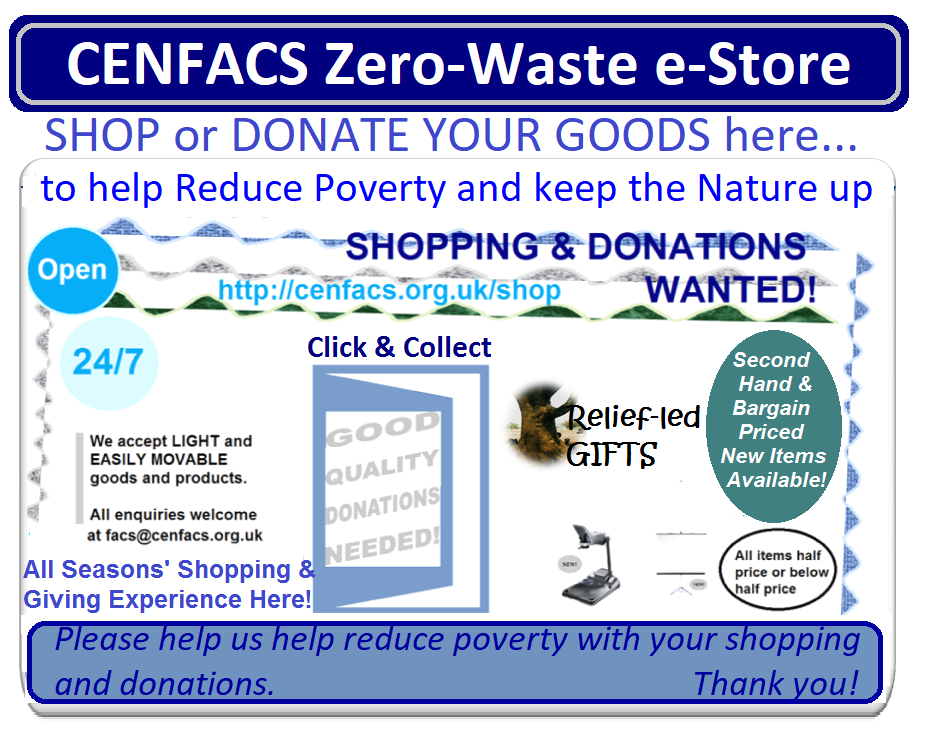
CENFACS e-Store is opened for your Summer goods donations and goods purchases. The store helps you achieve the 5 rules of zero waste living: Refuse, Reduce, Reuse, Recycle and Rot.
At this time, many people have been affected by the lingering impact of the high cost of living mostly driven by the hikes in prices of basic life-sustaining needs (e.g., food, energy, transport, housing, council tax, phone, etc.).
The impacted of the high cost of living needs help and support as prices and bills are significantly above real household disposable incomes for many of those living in poverty.
Every season, every month is an opportunity to do something against poverty and hardships. This Summer too is a good and great season of the year to do it.
You can donate or recycle your unwanted and unneeded goods to CENFACS’ Zero-Waste e-Store, the shop built to help alleviate poverty, lift people out of poverty and prevent poverty and hardships to happen again.
Donating or recycling goods will not only help to reduce poverty. It will also improve your household circularity and circular transition indicators while creating spaces.
You can as well buy second hand goods and bargain priced new items and much more at CENFACS’ Zero-Waste e-Store.
CENFACS’ Zero-Waste e-Store needs your support for SHOPPING and GOODS DONATIONS to reduce poverty with measurable impact on the environment.
You can do something different this Season of Goods Donations by SHOPPING or DONATING GOODS at CENFACS Zero-Waste e-Store.
You can DONATE or SHOP or do both:
√ DONATE unwanted GOODS, GIFTS and PRODUCTS to CENFACS Zero-Waste e-Store this Summer.
√ SHOP at CENFACS Zero-Waste e-Store to support the noble and beautiful cause of poverty reduction with measurable impact this Summer.
Your SHOPPING and or GOODS DONATIONS will help to the Upkeep of the Nature and to reduce poverty and hardships with measurable impact; poverty and hardships exacerbated or brought by the higher cost of living.
This is what the Season of Giving or Summer of Giving is all about.
Please do not hesitate to donate goods or purchase what is available at CENFACS Zero-Waste e-Store.
Many lives have been threatened and destroyed by the higher cost of living.
We need help to help them come out poverty and hardships caused by the higher cost of living.
To donate or purchase goods, please go to: http://cenfacs.org.uk/shop/

• World Anti-poverty System (or an International System for Poverty Reduction) and Energy Crisis
Energy crisis can have its impacts sensibly reduced on the poor if there is an International System for Poverty Reduction. Such a system would prioritize insulating the poorest from volatile fossil-fuel markets through targeted financial subsidies, while accelerating the rollout of decentralized, renewable energy. It would decouple basic, human needs (like food, health, and heating) from global supply chain shocks.
The system could subsidize off-grid renewable infrastructure, expand concessional emergency financing to prevent debt distress, and funding targeted social safety nets to protect the most vulnerable households from surging living costs. A coordinated global system would execute this through targeted strategies such as income and safety net subsidies, decentralized energy access, efficiency and retrofitting, resilient infrastructure.
As far as CENFACS is concerned, the world needs to hear from and give the voice to the poor through an International System for Poverty Reduction. The world can re-create and innovate the international system through the Creation of an International System for Poverty Reduction, which does not exist. This system can help in finding new ways of funding energy poverty reduction, particularly but not limited to Africa. A global energy crisis that makes the world’s poor to bear the brunt of it can only mean that an International System for Poverty Reduction is required; a system that can give them a voice instead of patchy adjustments to the global system.
Too many crises (like global energy crisis) and minor adjustments to the current system are yet further evidence to raise the question of an international or global system to deal with poverty.
If we had an International System for Poverty Reduction (that is a World Anti-poverty System comparable to the institutions of Bretton Woods System), would this system makes the world a better place for the poor?
Every time, there is a global crisis or overlapping crises (like energy crisis), this question comes back, time and time again.
If you think that an International System for Poverty Reduction could have protected the world’s poorest from too many crises including energy crisis, please let us know your arguments. If you do not think so, still let us know what you think.
An International System for Poverty Reduction is a missing piece in the world’s institutional systems. This is CENFACS’ campaign point, which is the creation of an International System for Poverty Reduction.
You can support the campaign or movement for a World Anti-poverty System or International System for Poverty Reduction with your VOICE, by E-SIGNING petition, E-MOBILISING your energy, BRANDING EVENT, etc.
You can join CENFACS’ Campaign for an International System for Poverty Reduction. To join, please contact CENFACS.

Message in French (Message en français)
• Mettre Fin à la Détresse Infantile en Afrique
La détresse infantile en Afrique englobe les graves traumatismes psychologiques, émotionnels et comportementaux subis par les mineur(e)s sur le continent. Elle est principalement causée par des problèmes systémiques tels que l’extrême pauvreté, les conflits armés, les maladies (comme Ebola) et la prévalence généralisée d’expériences infantiles néfastes. Cela conduit une situation inquiétante pour des enfants en Afrique.
• • La situation des enfants en Afrique à l’été 2026
La situation des enfants en Afrique à l’été 2026 demeure extrêmement préoccupante ; des millions d’entre eux ont besoin d’une aide d’urgence face aux conflits prolongés, aux chocs climatiques et aux épidémies. Il est nécessaire de renforcer les interventions intégrées ancrées dans les communautés afin d’apporter à ces enfants une aide vitale. Les statistiques sur la détresse infantile en Afrique mettent en lumière des défis majeurs engendrés par les conflits, les chocs climatiques et l’extrême pauvreté. Des millions d’enfants sont confrontés à de graves épreuves émotionnelles et physiques ; selon certaines estimations (3), la prévalence du trouble de stress post-traumatique (TSPT) avoisine les 50 % chez les adolescent(e)s vivant dans des régions touchées par des conflits, telles que l’Afrique de l’Est.
• • Principaux enseignements statistiques
Ils portent sur les domaines suivants : les conflits et les déplacements de population, les épreuves liées au climat et la détresse psychologique.
S’agissant des conflits et des déplacements, des millions d’enfants vivant dans des zones critiques telles que le Soudan et la République Démocratique du Congo (RDC) ont besoin d’une aide vitale, car ils subissent les traumatismes liés à la violence et au déplacement. À travers l’Afrique, les conflits et la violence ont provoqué des déplacements internes massifs, privant les enfants de la sécurité offerte par leur communauté et de la stabilité de leur quotidien. Selon l’UNICEF (4),
« Des millions d’enfants au Soudan ont besoin d’une aide vitale, de protection et du rétablissement des services essentiels ».
Concernant les difficultés engendrées par le climat, Oxford Global Health (5) souligne que :
« La sécheresse est liée à une augmentation de 46 % des violences sexuelles chez les adolescent(e)s en Afrique Australe… et à une hausse de 51 % des violences émotionnelles dans les zones touchées par la sécheresse ».
Selon le Global Government Forum (6) :
« Le changement climatique perturbe l’éducation de 130 millions d’enfants en Afrique ».
En matière de détresse psychologique, le British Medical Journal (7) a publié les résultats d’une étude sur le trouble de stress post-traumatique (TSPT) chez les enfants et adolescents touchés par des conflits armés en Afrique de l’Est. Ces résultats indiquent que :
« La prévalence combinée du TSPT chez les enfants et adolescents d’Afrique de l’Est s’élevait à 47,8 % ».
Cette étude conclut que la prévalence du TSPT chez les enfants et adolescents d’Afrique de l’Est est élevée. Parmi les facteurs fortement associés à cette détresse figurent le fait d’avoir été témoin de violences et d’avoir subi des traumatismes liés à la guerre.
Pourtant, il est possible de mettre fin à la détresse des enfants en Afrique.
Vous pouvez contribuer à apporter une aide immédiate, un soutien psychologique et des soins médicaux aux enfants vulnérables confrontés aux conflits, aux déplacements de population, à la famine et à la maladie.
Votre don pour lutter contre la détresse des enfants en Afrique peut sauver et reconstruire de jeunes vies en répondant aux conséquences immédiates et à long terme des conflits, des chocs climatiques et des déplacements de population sur le continent.
• • Priorités clés pour soulager la détresse
Votre don contribuera à :
σ Privilégier la prévention des maladies en traitant la malnutrition et en prévenant des maladies telles que le choléra, l’Ebola, la rougeole, le paludisme, etc.
σ Améliorer l’accès à l’eau potable et à l’assainissement pour pallier l’insuffisance des infrastructures WASH (Eau, Assainissement et Hygiène).
σ Soulager la détresse psychologique des enfants et les protéger de l’exploitation, en particulier au Soudan, en République Démocratique du Congo et au Sahel, où des millions d’enfants sont confrontés aux conflits ou au déplacement.
σ Rétablir des environnements d’apprentissage et l’accès à l’éducation dans les zones de conflit où des milliers d’écoles ont été détruites ou occupées.
• • L’impact de votre don
Il n’existe pas de montant unique idéal pour mettre fin à la détresse des enfants en Afrique. Toutefois, votre don permettra de financer des interventions vitales et concrètes, telles que la fourniture d’aliments thérapeutiques ou de vaccins.
Si vous choisissez de faire un don mensuel, votre contribution peut également assurer une stabilité à long terme et garantir l’accès à l’éducation pour ces enfants dans le besoin.
• • Exemples de dons
Un don de 20 £ peut permettre de fournir une aide alimentaire d’urgence essentielle ou des biscuits thérapeutiques riches en protéines pour répondre aux besoins nutritionnels de base d’enfants souffrant de malnutrition.
Un don de 9 £ peut offrir à 100 enfants un repas chaud à base de bouillie, les encourageant ainsi à aller à l’école plutôt que de devenir enfants soldats.
Un don de 15 £ par mois peut parrainer un enfant et lui permettre de recevoir une éducation, un uniforme scolaire, des chaussures et un repas quotidien.
Un don de 17 £ par mois peut aider à fournir à des centaines d’enfants un accès à de l’eau potable saine, prévenant ainsi des maladies potentiellement mortelles.
Soutenir cet appel, c’est aider les enfants d’Afrique à réduire et à atténuer les conséquences de la détresse qu’ils subissent.
Votre soutien permettra de financer des interventions humanitaires vitales pour ces enfants, ainsi que de répondre à des besoins urgents et imprévus.
Votre aide est nécessaire pour répondre aux signes de détresse de ces enfants.
Imaginez un enfant ou un jeune sans rêves ni perspectives d’avenir : quel sera son destin, en particulier dans des zones (comme l’est de la République Démocratique du Congo) où la situation sécuritaire ne cesse de se dégrader en raison des conflits et où les financements ont été réduits ?
Pouvez-vous aider cet enfant ? Oui ou non
Si vous répondez oui, alors vous pouvez aider des enfants…
√ dont les programmes humanitaires ont été affectés par des réductions de l’aide
√ qui ont besoin d’une aide humanitaire vitale
√ qui survivent à la faim, aux conflits et aux catastrophes naturelles
√ privés d’accès à l’eau potable, à la nourriture, aux soins de santé et à l’éducation
√ vulnérables à la malnutrition, aux maladies et à la pauvreté
√ contraints au travail précoce ou au mariage précoce
√ associés à des forces et groupes armés
√ exposés aux abus, à la négligence, à l’exploitation et à la violence
√ en proie à des traumatismes et à une grande détresse
√ confrontés à la guerre, à la famine et à la pauvreté
√ souffrant d’une malnutrition mettant leur vie en péril
etc.
Votre soutien aidera ces enfants à…
√ rêver d’une vie et d’un avenir meilleurs et à les espérer
√ surmonter les réductions de l’aide et les épreuves de la vie susceptibles de devenir des obstacles structurels et des handicaps pour eux
√ échapper aux conséquences néfastes à long terme d’une insécurité persistante
√ éviter de retomber sous le seuil de pauvreté
√ ne pas devenir une « génération perdue » faute de soutien
√ bénéficier de programmes de lutte contre la violence sexuelle et fondée sur le genre (pour ceux qui en ont été victimes)
√ rester en bonne santé et protégés contre les maladies
√ nourrir ou retrouver espoir et attentes
etc.
Votre soutien est indispensable pour soulager la détresse de millions d’enfants confrontés à des situations d’urgence causées par des conflits prolongés, des chocs climatiques et des épidémies en Afrique.
S’il vous plaît, aidez-nous à mettre fin à la détresse des enfants en Afrique.
Pour apporter votre soutien, veuillez contacter CENFACS via ce site web.

Main Development
• Analytics and Impact Month 2026
The name of the July game at CENFACS is Impact Assessment, Monitoring, Evaluation, Review, Assurance, Reporting and Analytics. July is the month during which we conduct our impact assessment, monitoring, evaluation, assurance, review, reporting and analytics of the projects and programmes we delivered during almost last 11 months and 2 weeks.
This July, the way in which we have organised ourselves to conduct the Analytics and Impact Month 2026 is summarised under the following sub-headlines:
∝ Key Words for the Analytics and Impact Month 2026
∝ Analytics and Impact Activities
∝ The Analytical Process within CENFACS
∝ What Is CENFACS Analytics Dashboard?
∝ Analytics of the Year of Alternatives as an Example of Analytical Process within CENFACS
∝ Impact Monitoring of Monthly Goals
∝ All-in-one Impact Feedback and Assessment for July 2026.
Let us look at each of these sub-headlines.
• • Key Words for the Analytics and Impact Month 2026
There are seven key words we are using which are: impact, monitoring, evaluation, assurance, review, reporting and analytics.
Let us briefly explain these key words.
1) Impact
Normally, it takes a considerable amount of time to get the real impact of any intervention, project and programme. However, because we are talking about finding out what projects and programmes have achieved, it makes sense to clarify what we mean by impact.
To do that, we are going to consider different terminologies surrounding impact; terminologies used within the impact literature or field. These terminologies are impact analysis, impact assessment, impact monitoring and impact reporting. Let us briefly explain these terms.
1.1 & 1.2) Impact Analysis and Assessment
To explain these two concepts, we are going to borrow the definition of impact from the Organisation for Economic Cooperation and Development (OECD). The OECD (8) differentiates ex ante impact from ex post impact. This is what it argues.
“Ex ante impact analysis is the needs analysis and planning activity of the policy cycle. It is a prospective analysis of what the impact of an intervention might be, so as to inform policy making”.
“Ex post impact assessment is the evaluation and management of the policy cycle. Evaluation aims to understand to what extent and how a policy intervention corrects the problem it was intended to address. Impact assessment focuses on the effects of the intervention, whereas evaluation is likely to cover a wider range of issues such as the appropriateness of the intervention design, the cost and the efficiency of the intervention, its unintended effects and how to use the experience from this intervention to improve the design of future interventions”.
The above definitions help to understand the scope and scale of the impact of most interventions.
As far as CENFACS is concerned, we will be doing evaluation activities for some programmes and projects; and impact assessments for others. This is because impact assessment is mostly a theory-based activity and has a narrow and tightly-defined focus. Where we need to design evaluation questions and use evaluation techniques, we will do evaluation. Where there is a need for a tightly-defined focus, we will do impact assessment.
We are as well considering that the initiative for change comes from project users or beneficiaries not from CENFACS or CENFACS’ projects or programmes. This is because the impact analysis model of change we are using is a non-linear one. Despite this non-linearity of the theory of change used, our impact analysis will still be based on causality and attribution approach.
1.3) Impact Reporting
After carrying out the analytics and impact of our programmes and projects, we need to report our findings or results. Although we have not yet reached this step, we need to start thinking of the way we shall report. In technical parlance, we need to proceed or think of impact reporting. What is impact reporting?
The website ‘sopact.com’ (9) states that
“Impact reporting is a powerful tool that organisations use to showcase the positive changes they bring to communities and the environment. A well-constructed impact report tells a story of transformation, capturing the outcomes achieved and the significance of the impact”.
During this July 2026, we will be thinking of the various pieces that will make our impact reporting as we are analysing the data from the last twelve months.
2 & 3) Impact Monitoring and Evaluation
We are going to use the definition of monitoring and evaluation as given by Kersty Hobson, Ruth Mayne and Jo Hamilton (10) in their “A Step by Step guide to Monitoring and Evaluation”.
Regarding monitoring, Hobson et al. define it as
“The collection and analysis of information about a project or programme undertaken while the project or programme is on-going”. (p. 5)
Arguing about monitoring, Intrac (11) considers that there are many types of monitoring which include process or performance monitoring, results or impact monitoring, beneficiary monitoring or beneficiary contact monitoring, situation monitoring or scanning, financial monitoring, administrative or logistics monitoring management information.
During our Analytics and Impact Month 2026, we will be working on three monitoring activities which include performance, impact and financial monitoring.
Concerning evaluation, Hobson et al. (op. ct.) explain it as
“The periodic, retrospective assessment of an organisation, project or programme that might be conducted internally or by external independent evaluators”. (p. 5)
In reality, there are many types of evaluation which include formative evaluation, summative evaluation, outcome evaluation, impact evaluation, etc.
The July 2026 evaluation will help CENFACS to evaluate the appropriateness of CENFACS‘ intervention design, the cost and efficiency of its intervention, the unintended effects of this ending financial year’s intervention and the need to improve the design of future interventions.
The Analytics and Impact Month 2026 will be mostly concerned with impact evaluation. An impact evaluation can be defined in many ways.
For example, the website ‘betterevaluation.org’ (12) explains that
“An impact evaluation provides information about the impacts produced by an intervention. The intervention might be a small project, a large programme, a collection of activities or a policy”.
From the above-mentioned definitions of monitoring and evaluation, it is understood that monitoring is an on-going process whereas evaluation is a periodic or discrete one.
4) Assurance
July is also the month to revisit our commitment to the detection and prevention of quality problems that can hinder the quality of our poverty reduction produce or service. Put it simply, assurance is part and parcel of CENFACS‘ July analytics and Impact work. What is assurance?
By assurance, we simply mean what His Majesty Treasury (13) argues, which is
“Assurance is an objective examination of evidence for the purpose of providing an independent assessment on governance, risk management and control processes for the organisation. An assurance framework is a structured means of identifying and mapping the main sources of assurance in organisation, and co-ordinating them to best effect”.
Assurance can be internal and external. In our analytics work, we are conducting internal assurance. What does it mean?
It means what for example ‘anngravells.com’ (14) argues about internal quality assurance, which
“Seeks to ensure that assessment activities have been conducted in a consistent, safe and fair manner”.
This internal quality assurance, which took place since our programmes and projects started, will continue and be deepened this month as it is the Analytics and Impact Month. This will be done via impact feedbacks.
5) Review
We have referred to the online source ‘method123.com’ (15) for the meaning of this key word. This online source defines review as
“An assessment of the status of a project at a particular point in time”.
From this online perspective, we have been performing a project management review at the end of each phase of our projects and programmes. We have been verifying whether or not we have met the objectives. If so, then a decision needed to be approved to proceed to the next project or programme phase.
July is the month we put together all these small project reviews conducted while doing the last reviews for those projects and programmes pending for a final review.
6) Analytics
There are many approaches to analytics. In the context of our July work, we have selected an explanation from ‘dictionary.com’ (16) which is as follows:
“The patterns and other meaningful information gathered from the analysis of data”.
The website ‘oracle.com’ (17) goes further by explaining that
“Analytics is the process of discovering, interpreting and communicating significant patterns in data. Quite simply, analytics helps us see insights and meaningful data that we might not otherwise detect”.
The website ‘bmc.com’ (18) goes broader by stating that
“Data analytics is a broad term that defines the concept and practice (or, perhaps science and art) of all activities related to data…Data analytics is broader in scope and refers to the process of using data and analytical tools to find new insights and make predictions”.
The same web ‘bmc.com’ gives the activities relating to data analytics, which are: data collection, refining, storage, analysis and delivery.
Like any charity analytics, CENFACS Analytics helps to make informed decisions, drive and increase poverty reduction services or sales, reduce costs and improve poverty reduction outcomes/produce. It finally helps us to better deliver a user experience for our projects and programmes by noy only hearing the voice of the project beneficiaries but also taking it into account.
• • Analytics and Impact Activities
In order to carry out the activities relating to Analytics and Impact Month 2026, we have organised them between analytics and impact activities. To explain these types of activities, let us start with activities.
Activities are according to ‘intrac.org’ (19),
“Actions taken or work performed through which inputs, such as funds, technical assistance and other types of resources are mobilised to produce specific outputs”.
From this definition of activities, we can now explain impact and analytics activities.
• • • Impact activities
Impact activities are actions that led to changes. Impact activities enable creation, innovation, reflection, negotiation and support for those in need. Key areas of CENFACS Impact activities include the following:
σ Direct service delivery (like the Advice Service we provide)
σ Fundraising and awareness (like fundraising events through All Year Round Projects, Social Media and Digital Campaigns run by CENFACS, impact reporting of our Individual Capacity Building Programme, Matching Organisation-Investor Programme, etc.)
σ Advocacy and community engagement (e.g., CENFACS‘ Influential Appeal to support the victims of conflict in the Eastern part of the Democratic Republic of Congo, our collaboration with Africa-based Sister Organisations in Africa, and educational and financial programmes to empower households making the CENFACS Community)
σ Volunteer opportunities we provide for people to donate their time and skills to support CENFACS‘ noble and beautiful cause of poverty reduction
σ Impact assessment which we are trying to do this July 2026 by measuring outcomes, building an impact framework and using storytelling of those who benefited from work during this ending financial year.
The above-mentioned activities will help pull out the impact of our work. They will tell if CENFACS has made a tangible difference in the lives of the communities it serves in the UK and in Africa.
An example of Impact activities could be informing and stimulating support or debate – via humanitarian appeals – on the conditions of people stricken by conflicts like in the north-eastern parts of the Democratic Republic of Congo.
• • • Analytics activities
Analytics activities are those that provide an idea about user engagement on our programmes and projects. Through this activity, we can track and analyse user interactions with our programmes.
Key activities for CENFACS Analytics 2026 will include the following:
σ Fundraising analytics (comprising of donor segmentation and profiling, campaign performance analysis, predictive analytics, and identification of fundraising opportunities)
σ Donor engagement analytics (consisting of personalised donor engagement, supporter journey analytics, and engagement tracking)
σ Programme and impact measurement (including beneficiary analysis, outcome measurement, data-driven decision making
σ Operational analysis (involving financial forecasting, cost recovery and efficiency, risk management, and data quality management)
σ Data literacy skills (encompassing developing data skills for those working for CENFACS, and the use of AI-powered tools like personalised donor engagement, predictive analytics and fraud detection).
By carrying out these activities, we shall know if effectiveness and sustainability have been enhanced within CENFACS.
An example of CENFACS Analytics activities could be Activity Analysis, which could include alignment with CENFACS‘ stated charity objects/purposes and strategic objectives, impact measurement of activities on beneficiaries, activity reporting (narratives of key activities) and material activity (disclosure of income and expenditure for each material charitable activity).
To illustrate, we can mention the number of people who used our Advice Service or the different resources to support them to develop their capacity throughout the year.
Another example is the analysis of CENFACS‘ finances covering this ending financial year. Such analytics will include examining CENFACS‘ Receipts and Payments account for this year-end, fund movements, and key performance indicators like surplus/deficit, free reserves, total amount raised over the financial year, average donation, financial position in terms of assets and liabilities, and the overall financial health of CENFACS based on the balance sheet. Most of these indicators and metrics are part of The Charities Statement Of Recommended Practice and reporting requirements.
Both Impact and Analytics activities stem from impact plan and analytics plan we developed to carry out Analytics and Impact Month 2026.

• • • Implementing Analytics and Impact Activities
To implement these activities, we are going to work through the above-mentioned plan.
Let us start with the activities scheduled for Wednesday 01/07/2026.

• • • In focus for Wednesday 01/07/2026: Fundraising for Analytics Activity, Income for Financial Analysis Activity, and Direct Service Delivery for Impact Activity
• • • • Fundraising Analytics
This activity will include the sub-activities below.
σ Donor segmentation and profiling
We shall analyse donor data to understand donors demographics and their giving patterns and preferences. This exercise will consider targeted fundraising campaigns and personalised messaging.
σ Campaign performance analysis
We shall track the key metrics like conversion rates, donation amounts, and donor acquisition costs to assess the effectiveness of fundraising campaigns carried out.
σ Predictive analytics
We shall use historical data to forecast future giving trends, identify potential donors, and optimise fundraising strategies.
σ Identifying fundraising opportunities
We shall analyse data to uncover potential new donors, explore different fundraising channels, and identify areas of growth.
• • • • Income Analysis
We shall analyse the total income and income sources (e.g., donations, grants, trading, and contributions), and variances against budget.
• • • • The Impact of Direct Service Delivery
CENFACS offers direct assistance to individuals and the community through the services it provides such as Advice, Guidance, Information, Signposting, and Outreach.CENFACS also publishes various resources to empower individuals and households under its Individual Capacity Building Programme.
In short, as part of implementing analytics and impact activities, we are going to conduct these the above-mentioned three activities for this week.
• • The Analytical and Impact Processes within CENFACS
We have been continuously and at discrete points in time tracking what has been happening within our programmes and projects while using the data collected to inform programme and project implementation as well as day-to-day management and decisions during the above named period. However, in July this monitoring exercise becomes more intense.
Likewise, we have been periodically assessing the objectives of our planned, on-going, or completed projects, programmes, or policies. During these evaluation processes, we have tried to selectively answer specific questions related to the design, implementation, and results of our programmes and projects.
In July, these evaluation activities become further pronounced as we assess what these programmes and projects have achieved in relation to the overall objectives we set up for them. The results of this evaluation are fed back to improve these programmes and projects, or alternatively to design and develop new ones.
Still in July, we critically examine, reappraise or reconsider our objectives and policies to achievements, and see if there is any progress or set back. This review enables us to improve as well.
What’s more in July, we look at again our loyalty to the detection and prevention of quality issues. This assurance assists in maintaining and improving the quality of our poverty reduction produce.
Throughout the year, we work to finding out, interpret and communicate patterns in data in a meaningful way to the work of CENFACS. We apply those patterns in our decision making process. In July, we put extra emphasis on this analytics which becomes very profound.
Briefly, July is the time we do our Summer tracking by reconsidering the value and relevancy of our work, let alone the overall state of our charitable work. It is in this period of the year that we carry out what we call All-in-One Impact Feedback and Assessment. In other words, we try to listen to our stakeholders while tracking the effects of our intervention and capturing the early impacts of our work by considering all the pieces together as one.
One of the key information management tools we use to do our impact analytics is CENFACSAnalytics Dashboard.
• • What Is CENFACS Analytics Dashboard?
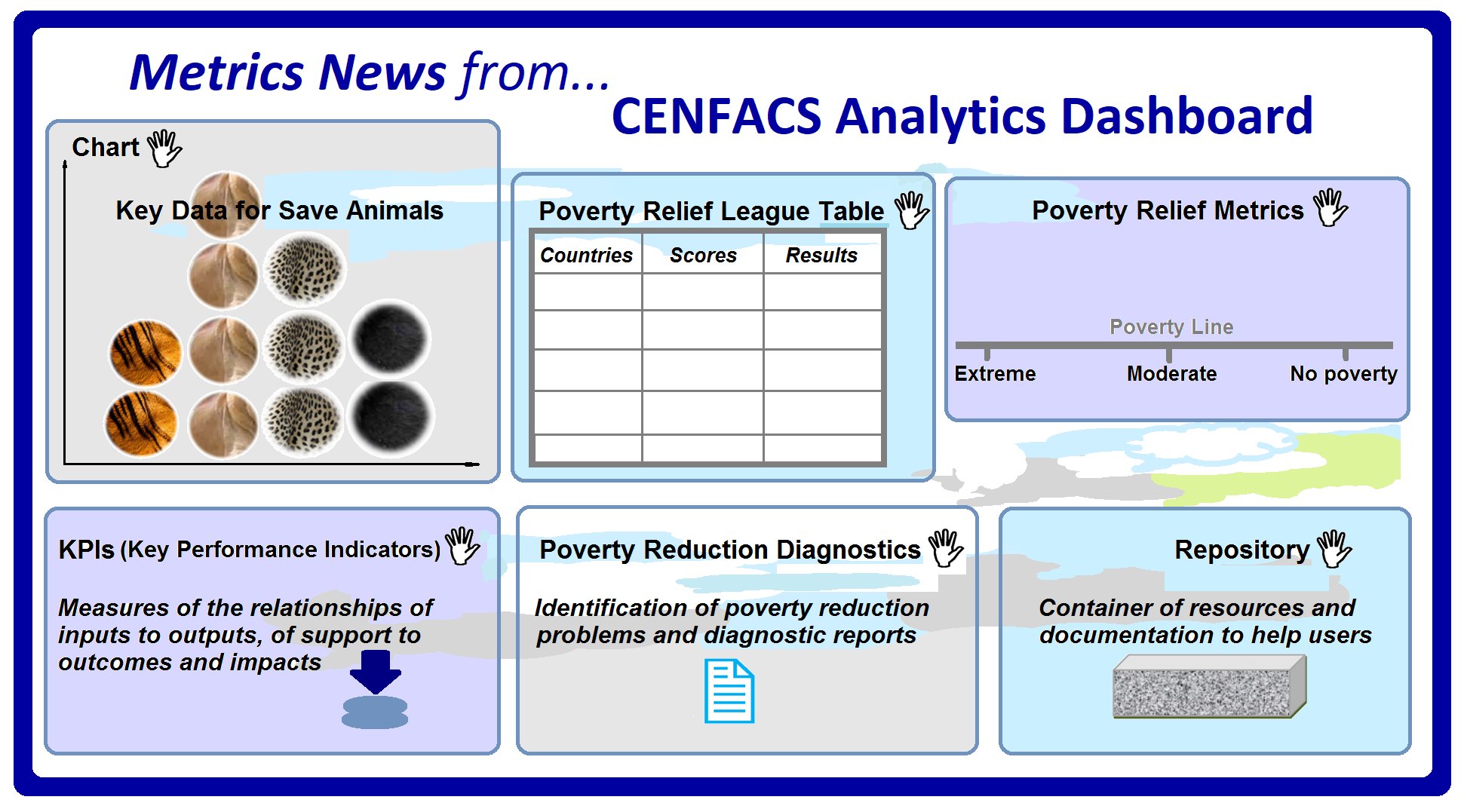
CENFACS Analytics Dashboard is an information management tool that tracks, analyses and displays key performance indicators, poverty reduction diagnostics, poverty relief metrics/dashboards, results from CENFACS’ poverty relief league, etc.
It involves collecting, analysing and presenting key performance indicators and other quantifiable data to track progress, identify trends, and make informed decisions. It is also about using beneficiaries’ data and analytics to understand their experience.
• • • What else does CENFACS Analytics Dashboard offer?
√ It monitors the health of CENFACS in terms of the relationships of support received to outputs and outcomes generated.
√ It provides as well infographics and summaries about some of the campaigns conducted.
√ It enables to discover and identify poverty reduction problems from the examination of symptoms it helps find.
√ It assists in engineering analytical solutions to the problem of reducing poverty.
√ It helps to retrieve information from CENFACS repository about the resources to help users and supporters.
√ It finally reports on metrics or gives metrics news.
For example, during the early stage of the coronavirus pandemic, we used CENFACS Analytics Dashboard to check the health of CENFACS and state of running of CENFACS’ projects and programmes. This checking enabled us to know the extent to which the coronavirus pandemic affected the running of CENFACS and its services. Knowing the distributional effects of the coronavirus pandemic on our projects and programmes, this knowledge helped us to reorganise these projects and programmes differently.
For more on CENFACS Analytics Dashboard, please contact CENFACS.
• • Analytics of the Year of Alternatives as an Example of Analytical Process within CENFACS
Analytics of the Year of Alternatives will be done following the processes of data analytics, which include collecting and ingesting, categorising, managing, storing, performing ETL (extract, transfer and load), analysing and sharing data. Knowing these processes, we can define the Analytics of CENFACS’ Year of Alternatives.
• • • What is the analytics or tracking of Alternatives Year?
The analytics or tracking of Alternatives Year is the 6-month analysis and turning of raw data insights for making better decisions in terms of helping to reduce poverty and enhance sustainable development. To make this possible, we have created a booklet or journal of creative activities or tasks carried out so far to mark 2026 as a Alternatives Year. This booklet/journal is also a record of data.
• • • Booklet/Journal of 2026 Activities as Year of Alternatives
Inside this Booklet/Journal of Year of Alternatives, there is one activity or task per month to be carried out by users. Alongside this activity or task, there is a metrics or analytics indicator to enable the owner of the booklet or journal to measure their performance as shown below.
January 2026
Activity/Task 1: Work with the people in need to find alternatives to unsustainable consumption
Selected analytics quantitative indicator for Activity/Task 1: Waste diversion rate.
February 2026
Activity/Task 2: Locate sustainable alternatives for poor people’s sustainability
Selected analytics quantitative indicator for Activity/Task 2: Multidimensional Poverty Index.
March 2026
Activity/Task 3: Replace high-emission systems with low carbon, sustainable alternatives
Selected analytics quantitative indicator for Activity/Task 3: Greenhouse gas emissions reduction
April 2026
Activity/Task 4: Determine alternatives to protection for the disadvantaged people
Selected analytics quantitative indicator for Activity/Task 4: Quality of life and wellbeing indexes.
May 2026
Activity/Task 5: Tell and share alternative stories
Selected analytics quantitative and qualitative indicator for Activity/Task 5: Deep engagement and sentiment shifts.
June 2026
Activity/Task 6: Create and innovate alternatives for those in need of reducing poverty
Selected analytics quantitative and qualitative indicator for Activity/Task 6: Multidimensional Poverty Index.
So, we can use leading and lagging alternative indicators or metrics to help in understanding the main benefits of the alternatives.
One can journal, quantify and gain insight of the meaning of the data about the last 6 months of Alternatives Year from this booklet/journal of creative activities and make good decision on how to better help to reduce poverty, enhance sustainable development and find better life alternatives.
• • • Impact Monitoring of Monthly Goals
Every month we set up a poverty reduction goal to be achieved for the month. As part of the Analytics and Impact Month, we are starting to assess the changes brought about or by the poverty reduction goals we set up since January 2026. We can use poverty reduction monitoring metrics to conduct this assessment.
The following are the poverty reduction goals we set up from January to June 2026. We have also included besides these goals impact monitoring metrics that can be used.
January 2026
Goal for the Month: Reduction of poverty linked to thoughtless consumption
Impact monitoring metrics for January 2026 goal: Material footprint per capita.
February 2026
Double Goal for the Month: Reduction of poverty as the inability to stop one’s income or assets from becoming a liability due to biodiversity loss
Impact monitoring metrics for February 2026 double goal: Ecosystem dependency.
March 2026
Goal for the Month: Reduction of ecological poverty
Impact monitoring metrics for March 2026 goal: Ecological footprint.
April 2026
Goal for the Month: Reduction of poverty as a lack of protection
Impact monitoring metrics for April 2026 goal: Social protection coverage.
May 2026
Goal for the Month: Reduction of poverty of the imagination
Impact monitoring metrics for May 2026 goal: Futures literacy.
June 2026
Goal for the Month: Discover creations and innovations that really reduce and/or end poverty
Impact monitoring metrics for June 2026 goal: Income and economic resilience metrics.
This tracking is about getting beneficiaries’ results or outcomes.
• • All-in-one Impact Feedback and Assessment for July 2026
This month, we will be conducting three levels of ex post Impact Assessment:
(a) Impact monitoring and evaluation of the programmes and projects we ran in the last financial year
(b) Impact assessment of CENFACS’ embedding long-term resilience through innovation to secure future progress.
(c) Impact feedback about our XX236.3F Programme.
As said above, this Impact Assessment will be ex post. And the evaluation related to this exercise will aim to understand the extent to which and the way in which our projects and programmes corrected the problems of poverty and unsustainable development amongst our intended beneficiaries.
Let us briefly summarise the three levels of impact assessment to be conducted.
(a) Impact monitoring and evaluation of the programmes and projects we ran in the last financial year
As the title of impact indicates, it will be about putting together in the form of one piece of work all the results of monitoring and evaluation activities we have conducted for programmes and projects we ran in the last financial year.
(b) Impact assessment of CENFACS’ Process of embedding long-term resilience through innovation to secure future progress.
We are going to seize the impact of embedding long-term resilience through innovation to secure future progress. We shall look at the impact of the 2025-2026 process of embedding long-term resilience through innovation to secure future progress on our system of poverty reduction, particularly on CENFACS’2020s Poverty Reduction Tools and Programme, and Development Agenda (20).
(c) Impact feedback about our XX236.3F Programme
Like last year, this year’s All-in-One Impact Feedback and Assessment will be extended to include our XX236.3F programme as we are in the month of Monitoring and Evaluation. XX236.3F is our 2020 to 2030 to 2063 Follow up Programme. We are following the implementation of the following:
∝ The International Climate Change Agreement (or the Paris Treaty)
∝ The Istanbul Declaration, in particular the Committee of the Parties to the Council of Europe Convention of Preventing and Combating Violence against Women and Domestic Violence (Istanbul Convention) and its Group of Experts on Action against Violence against Women and Domestic Violence (GREVIO), and its 19th meeting (21)
∝ The Maputo Protocol (the Protocol to the African Charter on Human and Peoples’ Rights on the Rights of Women in Africa), in particular the key achievements of the Maputo Protocol since it was established 21 years ago (22)
∝ The United Nations 2030 Agenda and Sustainable Development Goals
∝ Africa’s Agenda 2063.
The five of them make up our XX236.3F programme.
In brief, we shall conduct a follow-up and examination, look back and analyse data on the overall projects and programmes delivered during the above stated period, while keeping implementing our XX236.3F programme.
We shall soon publish the programmes and projects making this year’s Analytics and Impact. In meantime, for any enquiries about the Analytics Month 2026, please contact CENFACS.
_________
• References
(1) https://fastercapital.com/content/community-projects-From-Ideas-to-Action-Inspiring-Community-Projects-That-Transform-Lives.html (accessed in June 2026)
(2) https://sprintlaw.co.uk/articles/what-is-a-social-enterprise-in-the-uk/ (accessed in June 2026)
(3) https://pmc.ncbi.nlm.gov/articles/PMC12853469/ (accessed in June 2026)
(4) https://www.unicef.org.uk/press-releases/2026-brings-no-respite-to-children-living-in-violence-and-conflict-in-the-middle-east-and-north-africa/ (accessed in June 2026)
(5) https://www.globalhealth.ox.ac.uk/news/drought-linked-to-46-increase-in-sexual-violence-among-adolescents-in-southern-africa (accessed in June 2026)
(6) https://www.globalgovernmentforum.com/climate-change-disrupts-education-of-130-million-children-in-africa-report-finds/ (accessed in June 2026)
(7) https://bmjpaedsopen.bmj.com/contents/10/1e004100 (accessed in June 2026)
(8) https://www.oecd.org/sti/inno/what-is-impact-assessment-OECDImpact.pdf (accessed in July 2022)
(9) https://www.sopact.com/impact-reporting (accessed in July 2023)
(10) https://www.geog.ox.ac.uk/research/technologies/projects/monitoringandevaluation.html (accessed in July 2023)
(11) https://www.intrac.org/wpcms/up-content/uploads/2017/01/Monitoring.pdf (accessed in July 2023)
(12) https://www.betterevaluation.org/methods-approaches/themes/impact-evaluation (accessed in July 2023)
(13) https://assets.publishing.service.gov.uk/government/uploads/system/uploads/attachment_data/file/270485/assurance_frameworks_191212.pdf (accessed in July 2023)
(14) https://www.anngravells.com/information/iqa (accessed in July 2023)
(15) https://www.method123.com/initiation-phase-review.php (accessed in July 2023)
(16) https://www.dictionary.com/browse/analytics (accessed in July 2023)
(17) https://www.oracle.com/business-analytics/what-is-analytics/ (accessed in July 2024)
(18) https://www.bmc.com/blogs/data-analytics-vs-data-analysis/ (accessed in June 2024)
(19) https://www.intrac.org/upcms/wp-content/uploads/2016/06/Monitoring-and-Evaluation-Series-Outcomes-Outputs-and-Impact-7.pdf (accessed in June 2024)
(20) cenfacs.org.uk/2020/03/11/the-2020s-agenda-and-programme/ (accessed in July 2025)
(21) https://www.coe.int/en/web/istanbul-convention/committee-of-the-parties (accessed in June 2026)
(22) https://soawr.org/up-content/uploads/SOAWR-Maputo-Protocol-Report-07-PDF.pdf (accessed in July 2025)
_________
• Help CENFACS Keep the Poverty Relief Work Going This Year
We do our work on a very small budget and on a voluntary basis. Making a donation will show us you value our work and support CENFACS’ work, which is currently offered as a free service.
One could also consider a recurring donation to CENFACS in the future.
Additionally, we would like to inform you that planned gifting is always an option for giving at CENFACS. Likewise, CENFACS accepts matching gifts from companies running a gift-matching programme.
Donate to support CENFACS!
FOR ONLY £1, YOU CAN SUPPORT CENFACS AND CENFACS’ NOBLE AND BEAUTIFUL CAUSES OF POVERTY REDUCTION.
JUST GO TO: Support Causes – (cenfacs.org.uk)
Thank you for visiting CENFACS website and reading this post.
Thank you as well to those who made or make comments about our weekly posts.
We look forward to receiving your regular visits and continuing support until the end of 2026 and beyond.
With many thanks.