Welcome to CENFACS’ Online Diary!
25 November 2026
Post No. 484

The Week’s Contents
• Making Donations with Festive Shopping
• Autumn Matching Organisation-Investor Programme via a Hand Woven Textiles Project – Activity 2 from 23 to 29/11/2026: Matching Organisation’s Artisan Capacity and Supply Chain Setup with Impact Investor’s Product Line and Sustainable Product Model
• The Fourth Highlights of the Analysis and Skills for the Month of Economics of Education and Skill Formation (Skills Development Month) 2026
… And much more!

Key Messages
• Making Donations with Festive Shopping
Please support CENFACS to help others this Giving Season by generating donations when you shop.
As the Festive Season’s preparation has started, anyone can help raise funds for CENFACS through their charitable shopping without giving any penny. It does not cost them any money to give to charities like CENFACS while shopping, whether online or in-person, and being asked either to tick a box or to name or choose a charity to benefit from their festive shopping activities.
You can turn your Festive Shopping into Donations to CENFACS.
By ticking a box to donate to charity or naming or choosing CENFACS, you can enable CENFACS to receive no-direct cash donations from your shopping; donations which we need to help those suffering from poverty and the lingering effects of the cost-of-living crisis.
Please remember that around the festive period millions of shoppers do not claim their points, discounts and rewards. These points, prizes and rewards could have gone to good causes like CENFACS’ noble and beautiful ones.
The amount of unclaimed points, prizes and rewards by festive shoppers can be significant.
Concerning unspent supermarket rewards, Morrisons (1) points that
“Nearly £30 million worth of unclaimed More Card Fivers could help take money off festive essentials, seasonal treats and the big Christmas drop”.
In terms of unused loyalty points, ‘retail-week.com’ (2) states that
“Loyal platform Antavo reports that more than a quarter of UK loyalty points go unspent, and nearly 12% expire before shoppers use them”.
Regarding unspent member rewards, Grocery Trader (3) stated in 2022 that
“The convenience retailer [Coop] said over 4 million of its members in the UK had accumulated £25 million in unspent member rewards, which can be used as an extra cash boost this Christmas. With 73% of Brits having at least one grocery loyalty card, but with only 1 in 5 (20%) checking them weekly and 1 in 10 (10%) never checking how much their cards are worth, there is an estimated £1 billion plus of points and rewards sitting unused across the UK”.
With respect to expired gift cards and vouchers, research by Be Clever With Your Cash (4) estimates that £619 million has been lost to expired gift cards and vouchers over the past fiver years, with 31% of UK adults losing an average of £36.20 each in the UK.
These accumulated loyalty-point liabilities can help good causes, like CENFACS’ noble and beautiful ones. They can be turned into assets for good causes.
So, it does not cost you as a festive shopper anything if you tick a box or name or choose CENFACS as your favourite charity to receive your points, prizes and rewards which could otherwise become unclaimed, unused and wasted.
This festive season, please do not let these free offers resulting from your festive shopping go unclaimed or wasted. CENFACS wants them. CENFACS needs your loyalty shopping points, discounts, vouchers, prizes and rewards that you do not want or need.
We need them to help people living in poverty and hardships. These people require them. We are demanding your no-direct cash gift and support through your festive shopping to help them.
Please support CENFACS raise donations for its cause when you buy gifts, decorations, festive items and everything else.
You could help generate donations for CENFACS when you shop this Festive Season. CENFACS would deeply appreciate if you could inject meaning into festive consumerism by helping its noble and beautiful cause of poverty reduction.
This Festive Season, you could channel festive spending and generosity into practical support for those in need. Combining your shopping with giving helps turn routine seasonal purchases into tangible social impact.
Would you mind ticking a box or naming or choosing CENFACS to benefit from your festive shopping activities?
More on ways of supporting CENFACS’ beneficiaries through your festive shopping as well as CENFACS’ Festive Shopping and Donations Project are given under the Main Development section of this post.

• Autumn Matching Organisation-Investor Programme via a Hand Woven Textiles Project –
Activity 2 from 23 to 29/11/2026: Matching Organisation’s Artisan Capacity and Supply Chain Setup with Impact Investor’s Product Line and Sustainable Product Model
Both parties (i.e., Africa-based Sister Charitable Organisation and Not-for-profit Impact Investor) have agreed to continue in the serialisation of this project. They both score points in the first activity; points which are enough to move to the next round of negotiations or matching talks.
In this second episode of our 4-week Matching Organisation-Investor via a Hand Woven Textiles Project, ACI/ASCO will present its plan for the Artisan Capacity and Supply Chain Setup of the Hand Woven Textiles Project (HWTP), while the NFP Impact Investor will be re-entering the matching negotiations by arguing how he/she may want to approach Product Line and Sustainable Product Model.
To continue these matching talks, we have summarised them around the following points:
σ Activity 2 Matching Concepts
σ Negotiating Points between ASCO and Not-for-profit Impact Investor
σ Reaching a Negotiated Agreement
σ The Match or Fit Test.
Let us provide some highlights about each of these points.
• • Activity 2 Matching Concepts
There are four key concepts that need some clarification, concepts which are artisan capacity, supply chain setup, product line and sustainable product model. Let us briefly explain each of these concepts
• • • Artisan Capacity
It emerges from the sustainability literature (5) that artisan capacity refers to the maximum volume of high-quality goods a craft community or individual artisan can produce within a given period while maintaining quality, safety, and fair labour standards.
ACI/ASCO will be using this definition to negotiate.
• • • Supply Chain Setup
Supply chain setup is explained by ‘cips.org’ (6) as
“The activities required to deliver goods or services to the consumer”.
In this respect, supply chain setup would be the initial design, configuration, and establishment of the suppliers, facilities, workflows, and software systems needed to move goods or services from raw materials to the end customer.
ACI/ASCO needs to demonstrate that its has a supply chain setup to make the goods and services deriving from Hand Woven Textiles Project to reach the end customers or beneficiaries.
• • • Product Line
The meaning of product line used here comes from ‘corporatefinanceinstitute.com’ (7), which argues that
“A product line refers to an array of related products under the same brand. In other words, a product line is a collection of similar products that are sold to customers”.
ACI/ASCO is required to provide the collection of products that will make its product line.
• • • Sustainable Product Model
Within the literature about sustainability, a sustainable product model is explained as a framework or approach for designing, creating, and managing products to minimise environmental harm, support social well-being, and remain economically viable across a product’s entire life cycle. It embeds environmental, social, and economic considerations into decisions from raw materials sourcing and manufacturing to use, repair and end-of-life disposal or recycling.
ACI/ASCO is expected to show that its product model of hand woven textiles is sustainable.
The above-explained concepts will be used in the negotiations and check if they reflect the arguments from each side of this matching programme.
• • Negotiating Points between ASCO and Not-for-profit Impact Investor
In terms of Artisan Capacity and Supply Chain Setup, ACI/ASCO needs to demonstrate that it can build a reliable production pipeline to protect both the artisans and the HWTP ability to fulfil orders. This includes having a fair wage structure, raw material sourcing, and organising skill training and equipment.
σ Fair Wage Structure
ACI/ASCO needs to convince NFP Impact Investor that it will implement a transparent payment model that pays artisans fairly and on time, ensuring the project fulfils its social mission.
σ Raw Material Sourcing
ACI/ASCO will be required to secure reliable local suppliers for cotton, raffia, or silk, and prioritise natural or eco-friendly dyes to appeal to ethical buyers.
σ Skill Training and Equipment
ACI/ASCO can use its initial grant funds to repair or build looms and train weavers in advanced techniques, business literacy, and inventory management.
Concerning Product Line and Sustainable Product Model, NFP Impact Investor‘s arguments will be around handmade and eco-friendly offerings, capacity and yarn preparation, including green logistics. He/she will try to find out the position of ACI/ASCO on them. This is beside the arguments to be put forward.
• • Reaching a Negotiated Agreement
The two sides (ASCO and the NFP Impact Investor) need to reach a negotiated agreement on the contents of Artisan Capacity and Supply Chain Setup (AC&SCS) for the former and Product Line and Sustainable Product Model (PL&SPM) for the latter. It means they need to align their positions on the key areas like the ones given below.
σ Artisan Capacity vs. Product Line Scope
ASCO needs to define what weavers can realistically produce while NFP Impact Investor will look for a defined, tangible product line suited to the commercial income and investment repayment.
σ Supply Chain Setup vs. Sustainable Product Model
ASCO will manage natural fibre sourcing and local logistics, while the NFP Impact Investor will evaluate whether those practices support slow, sustainable fashion environmental goals rather than ad-hoc production.
σ Social Mission vs. Viable Offering
Both can agree that weaving methods and material choices protect fair-wage livelihoods for marginalised or rural artisans while producing items viable for niche, high-value export or target sales channels.
If there is a disagreement between ASCO and NFP Impact Investor, this could open up the possibility for a match/fit test. The match/fit test can be carried out to try to help the two sides of the matching process. The match/fit test can also be undertaken if there is a disagreement on any of aspects of HWTP.
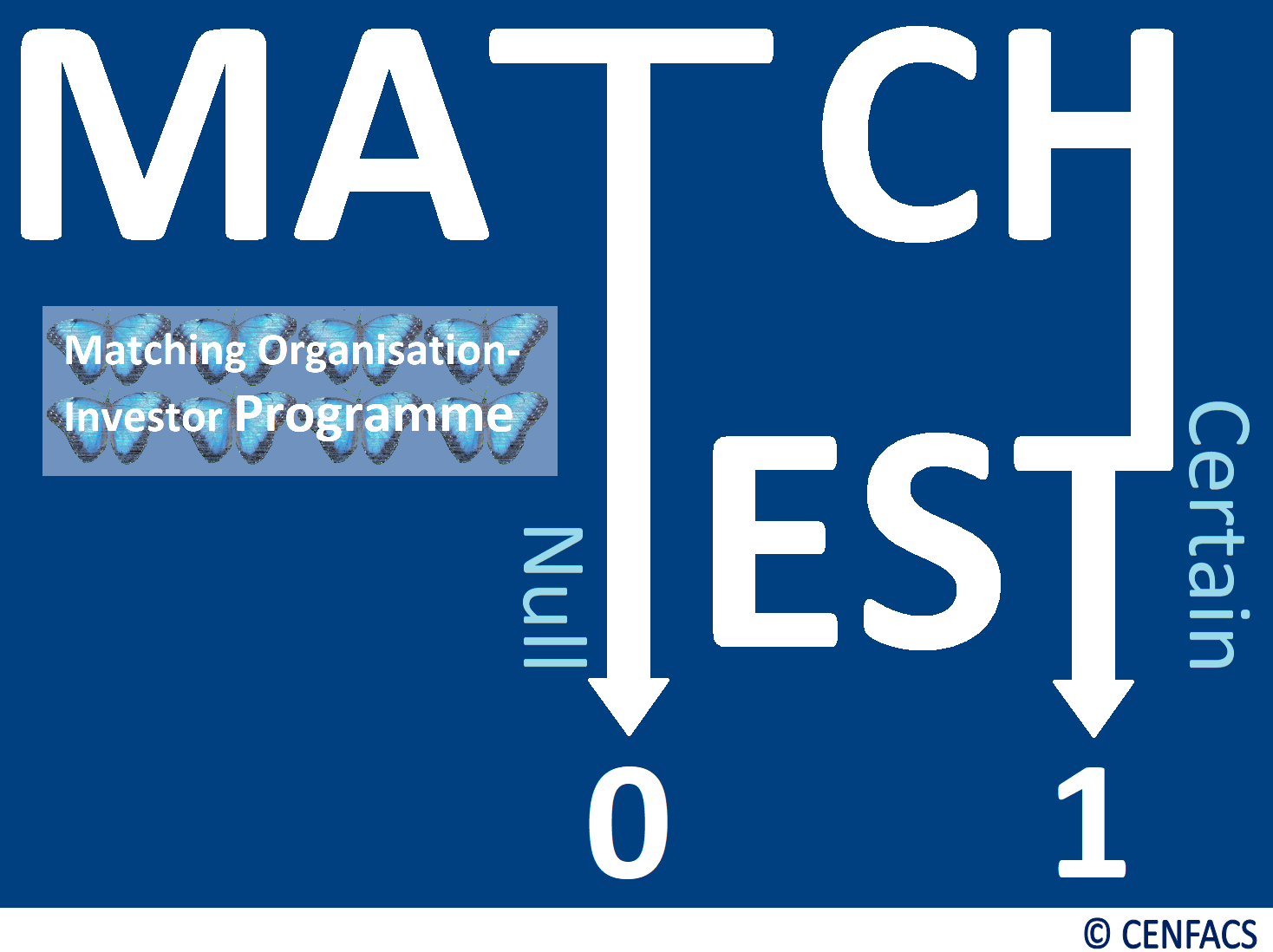
• • The Match or Fit Test Service
As part of the match or fit test, the contents of ACI/ASCO’s AC&SCS Stage must be matched with NFP Impact Investor’s view on PL&SPM. The match test (or matched sampling) will help to increase the accuracy and statistical efficiency of the study of the HWTP by carefully selecting subjects for comparison. The purpose here will be to increase the statistical efficiency of the study on HWTP by controlling for confounding variables when forming a sample.
The fit test will assist in determining how well the observed sample data matches a specified theoretical distribution. The fit test will check if the data collected fits a model or an assumed population distribution. So, the purpose of the fit test is to validate or invalidate the statistical model by checking if the sample data follows an expected distribution.
The match can be perfect or close (that is, when every unit is paired with an equivalent unit) in order to reach an agreement. If there is a huge or glaring difference between the two (i.e., between what the NFP Impact Investor’s approach to AC&SCS Stage and what ACI/ASCOC is saying about its AC&SCS Stage, between what the investor would like the AC&SCS Stage to indicate and what ASCO’s AC&SCS Stage is really saying), the probability or chance of having an agreement at this Second round of negotiations could be null or uncertain.
• • • Impact Advice to ASCO and Guidance to NFP Impact Investor
Where there could be a disagreement, CENFACS can impact advise ACI/ASCO to improve the contents of its AC&SCS Stage. CENFACS can as well guide NFP Impact Investors to work out their expectations in terms of AC&SCS Phase to a format that can be agreeable by potential ASCOs.
CENFACS’ impact advice for ASCOs and guidance on impact investing for NFP Impact Investor, which are impartial, will help each of them (i.e., investee and investor) to make informed decisions and to reduce or avoid the likelihood of any significant losses or misunderstandings or mismatches.
• • • The Rule of the Matching Game
The rule of the game is the more impact investors are attracted by ACI’s or ASCOs’ AC&SCS Stage the better for ACIs or ASCOs. It means that ACI’s or ASCOs’ process must pass the attractiveness test (that is, the evaluation of market’s appeal). Likewise, the more ACIs or ASCOs can successfully respond to impact investors’ level of enquiries and queries about the HWTP the better for investors. In this respect, the matching game needs to be a win-win one to benefit both players (i.e., investee and investor).
The above is the Second Activity of the Matching Organisation-Investor via HWTP.
Those potential organisations seeking investment to set up a HWTP and NFP Impact Investors looking for organisations that are interested in their giving, they can contact CENFACS to be their matchmaker to find their perfect investee or investor.
• • • CENFACS as a Matchmaker
As a Matchmaker, CENFACS can streamline your search process, save time, money and resources to help you find the perfect match in the world of impact investing.
CENFACS platform will help facilitate the matching process between investees and investors. By leveraging the power of AI tools, CENFACS’ Matching Organisation-Investor Programme can streamline the search process for funding opportunities, connecting African charities and impact investors/funders.
Briefly speaking, CENFACS can work with matching applicants and use AI to match organizations with the right impact investors, filtering profiles based on development stages, sectors, and aims.
In this matching process, CENFACS can arrange the match or fit test for them. They can have their fit test carried out by CENFACS’ Hub for Testing Hypotheses.
• • • CENFACS’ Hub for Testing Hypotheses
The Hub can help use analysis tools to test assumptions and determine how likely something is within a given standard of accuracy. The Hub, which can serve as a learning or reference place for those who would like to understand and apply statistical hypothesis testing, can assist to
√ clean, merge and prepare micro-data sources for testing, modelling and analysis
√ conduct data management and administration
√ carry out regression analysis, estimate and test hypotheses
√ interpret and analyse patterns or trends or insights in data or results.
In this respect, CENFACS’ H-tests Hub is knowledge repository designed to demystify the process of using data to make informed decisions and move beyond intuition and guesswork.
For instance, in the context of this Activity 2, it is possible to test the decentralised production hypothesis which consists of arguing that utilising a distributed, home-based, or village-cluster weaving model increases female labour force participation and preserves rural family structures, even if it increases logistics costs and lead times.
Those who would like to apply hypothesis testing in fields of economic development or to deal with poverty reduction, they are welcome to use CENFACS’ H-tests Hub.
For any queries and/or enquiries about this Second stage (or phase) activity of Matching Organisation-Investor via HWTP, please do not hesitate to contact CENFACS.

• The Fourth Highlights of the Analysis and Skills for the Month of Economics of Education and Skill Formation (Skills Development Month) 2026
These fourth highlights are made of the following:
a) The Analysis of Learner’s Decision Taking Process on the Educational Investment and Expenditure to Reduce Poverty – In Focus from Monday 23/11/2026: Risk Aversion and Time Discounting
b) Micro-economic Skills – Under Consideration from Monday 23/11/2026: Liquidity and Income Boosting
c) Practical Household-Level AI and Data Literacy Skills – On the Agenda from Wednesday 25/11/2026, Skill Practice 4: Critical Evaluation, Spotting Hallucinations, Privacy and Boundary Protections.
Let us provide these fourth highlights.

• • The Analysis of Learner’s Decision Taking Process on the Educational Investment and Expenditure to Reduce Poverty –
In Focus from Monday 23/11/2026: Risk Aversion and Time Discounting
To start this fourth analysis, it is better to explain Risk Aversion and Time Discounting.
• • • Explaining Risk Aversion and Time Discounting
Let us start with risk aversion.
According to ‘quickonomics.com’ (8),
“Risk aversion is a concept in economics and finance that refers to the preference of individuals to avoid uncertainty or potential losses when making investment decisions”.
Another definition of risk aversion is provided by ‘economictimes.indiatimes.com’ (9) which states that
“Risk aversion is the human propensity to select low-risk choices instead of potentially higher-profit options”.
As to time discounting, ‘quickeconomics.com’ (10) explains that
“Time discounting is a concept in economics and behavioural psychology that refers to the tendency for people to value immediate rewards more highly than future rewards. It describes how individuals prefer a smaller, sooner reward over a larger, later one, all else being equal”.
These definitions can be applied in the context of the Analysis of Learner’s Decision Taking Process on the Educational Investment and Expenditure to Reduce Poverty.
• • • Application of Risk Aversion and Time Discounting
The analysis suggests that disadvantaged learners or parents may exhibit higher implicit discount rates (valuing immediate survival or income over distant future gains) or perceive higher risk in whether a degree will actually translate into formal employment.
The above is the highlight of the Fourth Analysis of Learner’s Decision Taking Process on the Educational Investment and Expenditure to Reduce Poverty.
For those members of our community who may have any queries or enquiries about this Fourth Analysis which has focused on Risk Aversion and Time Discounting, they can address them to CENFACS.
Those who want further details about The Analysis of Learner’s Decision Taking Process on the Educational Investment and Expenditure to Reduce Poverty, they can contact CENFACS.

• • Micro-economic Skills –
Under Consideration from Monday 23/11/2026: Liquidity and Income Boosting
To deal with this Monday’s skill focus, it would be appropriate to explain Liquidity and Income Boosting
• • • Explaining Liquidity and Income Boosting
Let us begin with liquidity.
There are many ways of explaining liquidity. The website ‘corporatefinanceinstitute.com’ (11) provides two definitions of liquidity, which it expresses as follows:
“In financial markets, liquidity refers to how quickly an investment can be sold without negatively impacting its price”.
“In accounting and financial analysis, a company’s liquidity is a measure of how easily it can meet its short-term financial obligations”.
As to income boosting, the website ‘silencerises.com’ (12) points out that
“An income boost refers to any increase in earnings that enhances financial stability. This boost can arise from various sources, including enhancements in existing jobs or new income-generating activities”.
Like companies and any other human organisations, households need liquidity and may want to boost their income, particularly during the festive period so that they are able to face the festive expenses. They are also required to have basic financial literacy skills to manage their finances or economic matters.
• • • Liquidity and Income Boosting in the Context of Households
Households need to plan or budget for a potential income delay that often stretches into January, particularly if their workplace closes over the festive period and if they face unpaid or unaccrued leave. Since retail, hospitality, and logistics businesses experience massive demand surges during the festive period, they can monetise short-term demand.
The above is our highlight regarding the skills linked to liquidity and income boosting.
Those who would like to dive deep into the skills to handle Liquidity and Income Boosting, they can let CENFACS know.
For those members of our community who may have any queries or enquiries about Liquidity and Income Boosting as well as Micro-economic Skills, they can contact CENFACS.

• • Practical Household-Level AI and Data Literacy Skills –
On the Agenda from Wednesday 25/11/2026, Skill Practice 4: Critical Evaluation, Spotting Hallucinations, Privacy and Boundary Protections
To deal with Critical Evaluation, Spotting Hallucinations, Privacy and Boundary Protections, it makes sense to know what they mean.
• • • Meaning of Critical Evaluation, Spotting Hallucinations, Privacy and Boundary Protections
Let us first approach critical evaluation. According to ‘edu.com’ (13),
“Critical evaluation means thinking carefully about what you hear or read to decide if it makes sense, is true, or is important. When you evaluate something critically you check facts, look for reasons, and think about how the information connects to what you already know . This skill helps you make decisions and understand information better”.
Regarding spotting hallucinations, spotting means – in every English language – noticing, locating or recognising someone or something. One can spot hallucination. According to ‘deakin.edu.au’ (14),
“Spotting hallucinations refers to identifying false sensory perceptions in a person (or make-up facts in an AI system) that do not match reality”.
Concerning privacy protection, the website ‘nhimg.org’ (15) indicates that
“Privacy protection is the set of controls that limit how personal or sensitive data is collected, used, shared, and retained”.
As to boundary protection, ‘cyberghostvpn.com’ (16) states that
“Boundary protection refers to the strategies and technologies used to monitor and control the flow of information across network boundaries ensuring that data is securely managed and unauthorised access is prevented. This involves the use of firewalls, intrusion detection systems (IDS), intrusion prevention systems (IPS), and other network security measures to create a secure barrier between internal networks and external threats”.
These definitions (of Critical Evaluation, Spotting Hallucinations, Privacy and Boundary Protections) help master the skills associated these concepts and apply them to households and families.
• • • The application of these skills (i.e., Critical Evaluation, Spotting Hallucinations, Privacy and Boundary Protections)
Household members need to realise that AI chatbots and search tools make confident sounding mistakes, fabricate facts (hallucinate), or carry hidden biases. Fact-checking import claims against frustrated primary sources.
Likewise, households and families are required to know to never past private financial details, family member medical records, or sensitive personal data into public AI chat windows and adjusting app privacy settings. This will help protect them.
There are practical examples in daily life on how to handle these skills. These examples include managing household budgets, drafting and organising using an AI assistant, evaluating recommendations.
Those households wanting to dive deep into any of the above-mentioned examples or practices, they can let CENFACS know.
For those community members of our community who will be interested in Critical Evaluation, Spotting Hallucinations, Privacy and Boundary Protections, they can contact CENFACS.
Additionally, for those who would like to register their skills on CENFACS Skills Data Bank, they are welcome to do so. This registration will help in matching the support in terms of skills and the needs in the community.
To sum these Fourth Highlights, it is worth saying that they show how strategic investments in education and continuous skill development can directly boost household long-term earning potential, job security, and overall household well-being. They also help understand how household can survive and last with practical household micro-economic tools and skills. They finally provide some clues about data ecosystem making their home through read everyday information.

Extra Messages
•The Skill of Reading Everyday Information for Households and Families
•Tacking Climate Protection and Stake for African Children at the Implementation Level (TCPSACIL) with Full Implementation Sub-phase (Phase 3.4) – From COP31 to COP32: Where Do We Stand Concerning Children’s Climate Protection?
• Activity of the Festive Season: How to Make Your All Year Round Projects Raise Money for Good Causes

• The Skill of Reading Everyday Information for Households and Families
The Skill of Reading Everyday Information for Households and Families (SREI4Hs&Fs) is part of the logic of continuing to empower households and families. It has also to be placed in the context of Practical Household-level AI and Data Literacy, which we have so far developed.
To understand we are talking about, let us explain this skill and give what we have scheduled for it.
• • What Is SREI4Hs&Fs?
SREI4Hs&Fs is the ability of family members to critically interpret, verify, and make sense of the digital data, metrics, and automated content that flows through a modern home. The skill treats the home as a data ecosystem. It means understanding what smart devices, algorithms, and digital interfaces are actually telling you.
• • SREI4Hs&Fs Schedule
To apply this skill, it makes sense to group it by category. Below are these categories and the periods these skills will be developed.
σ Week Beginning Monday 23/11/2026 – Category 1: Smart Home and Utility Literacy
σ Week Beginning Monday 30/11/2026 – Category 2: Consumer and Algorithmic Literacy
σ Week Beginning Monday 07/12/2026 – Category 3: Privacy and Safety Literacy
σ Week Beginning Monday 14/12/2026 – Category 4: Information Verification (Media Literacy).
Those who will be interested in this skill and its categories, they can let CENFACS know so that CENFACS can include them or their needs in the delivery plan. Let us highlight the first category, which is Smart Home and Utility Literacy Skills.

• • Week Beginning Monday 23/11/2026 – Category 1: Smart Home and Utility Literacy
Under this first category, the skills of Interpreting Dashboard Data and Decoding Device Alerts will be looked at.
σ Interpreting Dashboard Data is about understanding smart meter graphs, data-usage from internet device service providers, or screen-time breakdowns on a child’s device.
σ Decoding Device Alerts
This involves knowing the difference between a routine notification (e.g., a robot vacuum needing its bin emptied) and a critical data or privacy alert (e.g., an unrecognised device joining the home WI-FI network).
Those who would be interested in the skills of Smart Home and Utility Literacy, they can let CENFACS know.
For any other enquiries and or queries, please do not hesitate to contact CENFACS.

• Tacking Climate Protection and Stake for African Children at the Implementation Level (TCPSACIL) with Full Implementation Sub-phase (Phase 3.4) –
From COP31 to COP32: Where Do We Stand Concerning Children’s Climate Protection?
COP31 ended in Antalya (Turkiye) with no agreed deal. Despite that our Advocacy on Better Climate Deals for Children continues, as we move on until COP32 happens. This week, we are conducting a stocktaking activity on COP31 and preparing the elements of the next areas of our advocacy work.
• • Stocktaking Activity on COP31
This activity includes what emerged from COP31 like the following matters:
~ No new fossil fuel phase-out roadmap
~ Stalled child-focuses climate finance
~ Omitted cover decision protection
~ Reliance on existing legal frameworks.
The above-selected matters enable to frame our advocacy strategy until the next global climate talks or COP32.
• • Post-COP31 Advocacy Areas
Between now until we start the preparation to follow COP32, we shall
~ Continue to advocate for CO2 emissions cuts as children remain disproportionately vulnerable to extreme heat, floods, and droughts
~ Push for the support of child-targeted programmes, especially for the climate funds so that no child is left behind
~ Amplify our voice to protect the legally binding children’s rights as they are mandated within the United Nations climate decision, in particular the human rights text secured at COP30, the UN Convention on the Rights of the Child (Specifically General Comment No. 26), and the July 2025 International Court of Justice Advisory Opinion affirming states’ legal obligations to protect children’s rights from climate harm.
To get involved and/or enquire about the above-mentioned Post-COP31 Advocacy Activities and to support CENFACS’ TCPSACI and its sub-phase 3.4, please contact CENFACS.

• Activity of the Festive Season: How to Make Your All Year Round Projects Raise Money for Good Causes
You can turn your All Year Round Projects into festive fundraisers. You can help CENFACS raise funds it needs for its noble and beautiful causes while you are undertaking your All Year-Round Project. How can you do it?
You can do it by adding seasonal/festive themes, donation mechanics, and clear impact stories to them.
If you are Running or Organising a Run Activity to Reduce Poverty in 2026, you can dress like a Santa and raise money depending on the challenge (e.g., running laps or distances) and ask people around you to donate accordingly.
Each person can donate to join in and/or others can sponsor each person running. You can organise a virtual or in-person run.
There are steps one needs to follow in order to make their Santa Campaign successful. Amongst the steps, we can mention the following:
plan your Santa Campaign, gather your Santa outfit, choose fundraising activities, promote the campaign, collect donation, engage with the community and invite it to donate through this engagement, and thank donors.
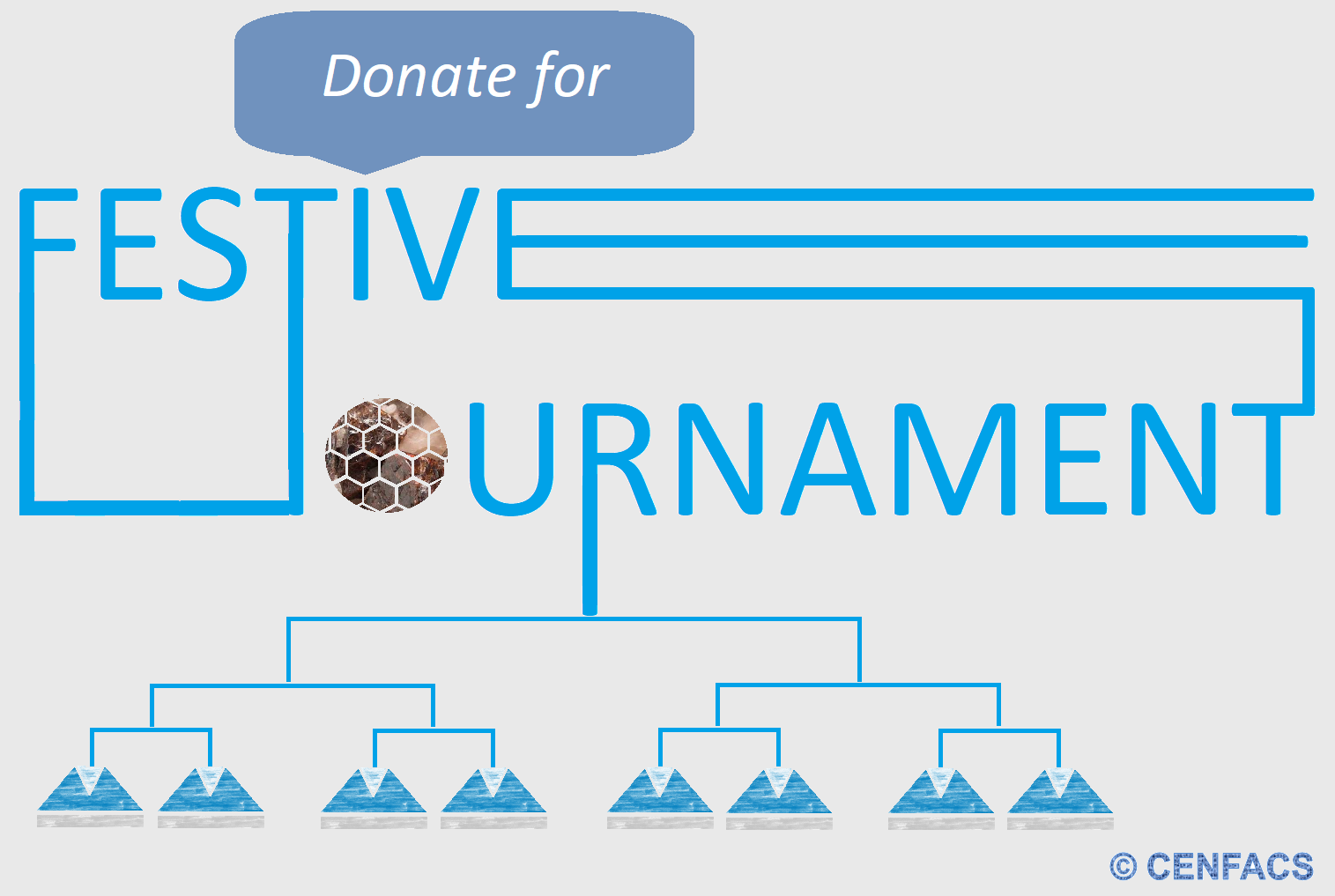
If you are Playing the CENFACS League for Poverty Relief, you can organise a festive tournament and ask participants and your audiences to the tournament to donate.
For instance, you can proceed with the following steps:
plan the in-person or online tournament with the theme of Playing CENFACS League for Poverty Relief, secure a venue (with location, date and time), gather participants by inviting them to register with a fee as fundraising contribution, promote the event, organise the logistics, fundraise, engage the audiences, and thank and follow up participants.
If you are Voting your 2026 African Poverty Relief Manager, you can set up a knowledge challenge in the form of Questions-Answers to find out your 2026 African Poverty Relief and Development Manager. You can ask people who would like to attend or participate or watch the challenge to donate.
As an illustration, you can follow these steps:
define the purpose the knowledge-based challenge, plan the challenge, choose venue and date, recruit participants, promote the event, organise the logistics, fundraise, carry out the challenge, select your deserving 2026 African Poverty Relief Manager by assessing candidates and announcing the winner, thank and follow up participants.
With some inspiration, the above shows that it is possible to raise funds for CENFACS’ noble and beautiful causes while applying any of the three Triple Value Initiatives (or All Year-Round Projects).
However, before embarking on raising funds via All Year Round Projects , you need to discuss the matter with CENFACS so that together with you we can plan How to Make Your All-Year-Round Activity Raise Money for Good Causes.
To discuss the possibility of raising funds for good causes via All Year-Round Projects, please contact CENFACS.

Message in French (Message en français)
• Informations, Conseils, Orientations et Pistes concernant la Réduction de la Pauvreté par le Commerce, en vue de la Préparation des Fêtes de Fin d’Année
Les services d’information, de conseil, d’orientation et d’aiguillage (IAGS, selon l’acronyme anglais) relatifs à la réduction de la pauvreté par le commerce en Afrique constituent des ressources offrant expertise et soutien aux personnes en quête d’informations ou d’accompagnement sur ces questions.
Le dispositif IAGS propose des conseils, des activités de renforcement des capacités et des ressources documentaires destinés à informer les parties prenantes sur la réduction de la pauvreté par le commerce en Afrique.
Par l’intermédiaire de CENFACS, le dispositif IAGS se décline en quatre types de soutien :
a) Le service d’information : Ce service consiste à la mise à disposition d’informations sur les services liés à la réduction de la pauvreté par le commerce en Afrique, à l’attention des personnes en recherche de telles informations.
b) Le service de conseil : C’est un service gratuit, confidentiel et indépendant qui aide les individus et les organisations à comprendre leurs droits, à naviguer dans des systèmes complexes et à résoudre des problèmes concrets liés à la réduction de la pauvreté par le commerce en Afrique.
c) Le service d’orientation : Ça inclut des prestations de conseil, d’accompagnement, d’exploration et de mise en relation avec des services ou des entités spécialisés dans la réduction de la pauvreté par le commerce en Afrique, afin d’aider les individus et les organisations à prendre des décisions éclairées et à s’adapter aux changements.
d) Le service d’aiguillage : Ça consiste à orienter les individus vers d’autres organisations ou réseaux de soutien mieux à même de répondre à leurs besoins en matière de réduction de la pauvreté par le commerce en Afrique. Il permet également de mettre en relation des organisations avec des ressources pertinentes.
Examinons brièvement chacun de ces services.
• • Le service d’information sur la réduction de la pauvreté par le commerce
Les informations publiques concernant les organisations caritatives africaines et leurs initiatives de réduction de la pauvreté par le commerce couvrent plusieurs domaines clés, allant des données économiques locales aux normes de transparence organisationnelle.
Les types d’informations accessibles au public comprennent :
~ Des données sur l’accès aux marchés et les chaînes de valeur
~ Les informations sur le renforcement des capacités et la formation technique
~ Les rapports sur la microfinance, l’apport en capital et la fourniture d’outils
~ Les audits relatifs à la gouvernance financière et à la transparence.
• • Le service de conseil sur la réduction de la pauvreté par le commerce
Le rôle de ce service de conseil est d’offrir une orientation structurelle sur les questions suivantes :
~ Les droits socio-économiques : c’est-à-dire conseiller les communautés sur leurs droits en matière commerciale et sur la manière de naviguer au sein des politiques commerciales locales.
~ Le conseil en matière de capacités et de politiques : il s’agit d’accompagner les organisations de terrain pour tirer parti des accords commerciaux à grande échelle – tels que la ZLECAf (Zone de libre-échange continentale africaine) – afin d’aider les populations locales à sortir de l’extrême pauvreté.
~ L’évaluation d’impact : aider les investisseurs à impact social (à but non lucratif) à identifier des organisations caritatives – comme dans le cadre du programme « Matching Organisation-Investor » de CENFACS – qui privilégient des solutions structurelles favorisant le commerce, plutôt que des aides ponctuelles à court terme.
• • Le service d’orientation sur la réduction de la pauvreté par le commerce
Ce service public, porté par des organisations caritatives africaines, vise à sensibiliser sur la manière dont les initiatives philanthropiques et de développement peuvent évoluer : passer d’une aide traditionnelle sous forme de dons à une autonomisation économique durable fondée sur le commerce.
Les axes principaux de cette orientation incluent :
~ Passer de l’aide directe au soutien des leviers d’autonomisation locale.
~ Financer des services financiers durables et la microfinance.
~ Soutenir l’intégrité des marchés locaux (en évitant le « piège du don »).
~ Mettre l’accent sur l’« aide au commerce » (Aid for Trade) et le développement des entreprises.
• • Le service d’aiguillage sur la réduction de la pauvreté par le commerce
Ce service fonctionne comme une plateforme d’information ou un répertoire. Plutôt que de fournir une aide directe, il oriente le public, les bailleurs de fonds et les entrepreneurs vers des organisations, des outils et des réseaux spécifiques qui utilisent le commerce – et non l’aide traditionnelle – pour bâtir une indépendance économique durable.
Il aide les individus à trouver des entités fiables qui renforcent les marchés locaux africains, garantissent des salaires équitables et développent des chaînes d’approvisionnement résilientes, portées par les communautés elles-mêmes.
Dans le cadre de cette orientation, les ressources peuvent être classées par catégories, selon que l’utilisateur souhaite consommer de manière éthique, soutenir un changement structurel ou bénéficier d’une formation commerciale. Ces points de repère peuvent porter sur :
~ La consommation éthique et les initiatives de commerce équitable ;
~ Le renforcement des capacités et le soutien aux entreprises ;
~ Les cadres de développement et les réseaux d’élaboration de politiques.
Ces points de repère permettent de trouver des ressources, de renforcer le pouvoir d’agir au niveau local, de partager des connaissances et de simplifier les règles.
Pour les ménages ou les membres de la communauté CENFACS qui recherchent des informations et des conseils sur la réduction de la pauvreté par le biais du commerce, mais qui ne savent pas quelle démarche entreprendre, CENFACS peut leur proposer un accompagnement (via une évaluation des besoins réalisée dans le cadre de notre service de conseil) ou les orienter vers des organisations, institutions et services susceptibles de leur venir en aide.
Nous fournissons des informations et des conseils pour aborder les enjeux liés à la réduction de la pauvreté par le commerce, en apportant un soutien à nos membres ainsi qu’à nos organisations partenaires en Afrique (ASO – *Africa-based Sister Organisations*), afin de combler les lacunes en matière d’information et de connaissances. Nos services d’information et de conseil favorisent la créativité, l’engagement communautaire et l’émergence d’opportunités de développement.
Nous pouvons également orienter les personnes qui cherchent à savoir où trouver de l’aide en matière de réduction de la pauvreté par le commerce.
D’autres conseils et pistes sur ce sujet peuvent être obtenus auprès du service et des séances de conseil de CENFACS.
Pour prendre rendez-vous dans le cadre de notre service ou de nos séances de conseil, veuillez contacter le CENFACS en fournissant votre nom et vos coordonnées.
Main Development
• Making Donations with Festive Shopping
How to support CENFACS without directly giving cash while shopping
Two items cover the contents of this Main Development and CENFACS Festive Shopping and Donations Project (that is, a charitable initiative by CENFACS that combines festive themed shopping with fundraising and gift drives to help those in need during the festive season). These items are:
∝ Festive season as an opportunity to do something against poverty
∝ 8-themed ways of donating as a result of your shopping.
Let us summarily look at them.
• • Festive Season as an Opportunity to Do Something against Poverty
Every occasion or season is an opportunity to do something against poverty and hardships. The festive season, which is a great time to share precious moments with your loved ones, is also a period to spread a little extra of that happiness to those who do not have.
We understand that many people including our supporters continue to seriously suffer from the lingering effects of multiple crises of the last five years and are still trying to navigate their way to fully recover from them. However, for people who are already living in poverty, these effects are even intolerable and unbearable for them. Let alone the international aid cuts from developed world to developing one.
There is a reason to support these poor people during this festive season. One of the many ways of supporting them could be with no-direct cash donations through your festive shopping or by making donations not directly with cash while shopping. As some would argue that it offers a way to inject meaning into holiday consumerism by helping those in need.

• • 8-themed Ways of Making Donations Not Directly with Cash while Shopping
CENFACS needs donations from your festive shopping, in particular we need no-direct cash donations, to support those in need. Some festive shoppers who could donate no-direct cash may not understand what it means. This is why it is better we explain the following:
∝ What do we mean by making donations not directly with cash?
∝ Types of donations not directly with cash we are talking about and asking for.
• • • Brief explanation of donations not directly with cash
A donation made not directly with cash (or no-direct cash donation) is an amount given as a gift and which is not a direct transfer of cash, cheque, or a debit or credit card. No-direct cash donations should not be confused with in-kind donations.
In the context of Festive Shopping, the donor gives money indirectly through their shopping activities. No-direct cash donation linked to shopping is therefore about turning festive shopping or any other type of shopping into donations. If there is no shopping, there is no-direct cash donation linked to the shopping.
What are those types of donations that are the result of one’s shopping drive?
• • • Types of donations not directly with cash when shopping
There are two types of no-direct cash donations when shopping, which are:
a) No-direct cash donations when shopping at CENFACS Zero-waste e-shop
b) No-direct cash donations via shopping at other shops or stores.
Let us look at each of them.
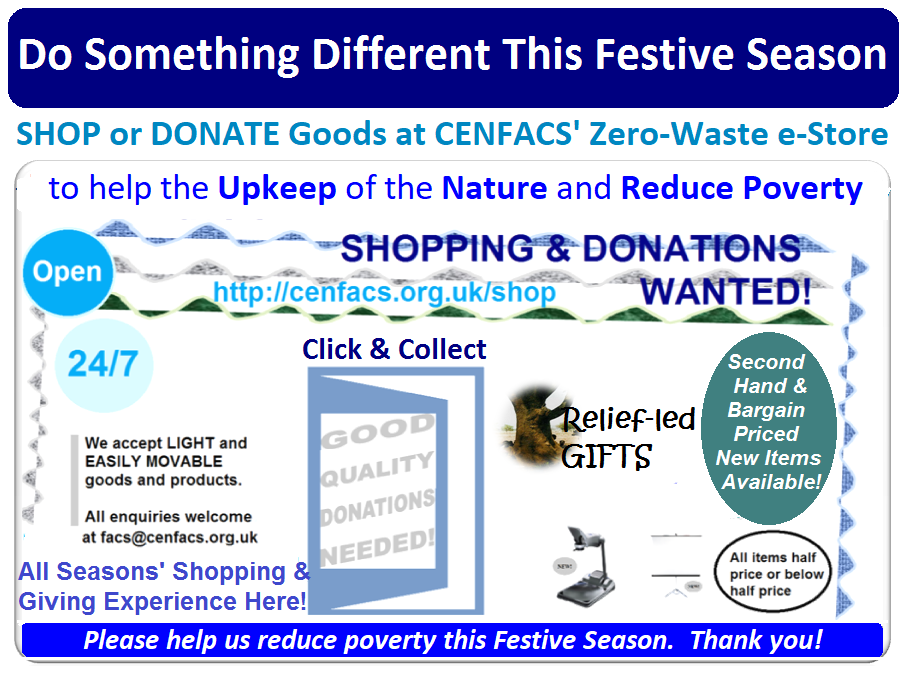
• • • • Indirectly donate when you shop at CENFACS Zero-waste e-shop at http://cenfacs.org.uk/shop/
CENFACS Zero-waste e-Shop is open for both online festive purchase and goods donations. You can shop or donate goods, and make your shopping or donation or both align with the values of festive season and promotes sustainability and charitable action for CENFACS.
• • • • • SHOPPING for GOODS at CENFACS Zero-waste e-Store
You can buy second hand goods and bargain priced new items and much more.
You can do something different this Festive Season by SHOPPING for GOODS at CENFACS’ Zero-waste e-Store.
Your SHOPPING action will help to the Upkeep of the Nature and to reduce poverty.
Festive shoppers can help raise free funds for CENFACS’ noble and beautiful cause every time they shop at CENFACS Zero-waste e-Store.
Please do not hesitate to purchase what is available at CENFACS Zero-waste e-Store.
Many ordinary people and families are struggling to make ends meet at this challenging time as the economy is still not yet fully recovered from the cost-of-living crisis. Many of them do not know how they are going to make ends meet; let alone how they will meet their festive expenses as prices and bills are still higher compared to their real disposable incomes. They need help. We need support as well to help them come out poverty and hardships.
• • • • • Donation of NET-ZERO GOODS this Festive Season
Amongst the goods to donate, we are asking net-zero goods ones.
You can give your unwanted and unneeded goods or pre-loved items to CENFACS’ Zero-waste e-Store, the shop built to help relieve poverty.
You can donate carbon neutral or net zero greenhouse gas emissions goods to help reduce the adverse impacts of climate change and poverty, while creating an opportunity to save non-renewable natural resources. This type of donation can boost the circular economy and improve the upkeep of the nature.
Your GOODS DONATIONS will help to the Upkeep of the Nature and to reduce poverty.
Festive goods donors can help raise free funds for CENFACS’ noble and beautiful cause every time they donate goods at CENFACS Zero-waste e-Store.
Please do not hesitate to donate goods to CENFACS Zero-waste e-Store.
You can even make this e-store better. You can DONATE or SHOP or do both.
• • • • • SHOPPING for and DONATIONS of GOODS at CENFACS Zero-waste e-Store
You can
√ DONATE unwanted pre-loved GOODS and PRODUCTS to CENFACS Zero-waste e-Store during the festive period and beyond
√ SHOP at CENFACS Zero-waste e-Store to support good and deserving causes of poverty relief during the festive period and beyond.
CENFACS’ Zero-waste e-Store needs your support for Festive SHOPPING and DONATIONS.
To donate or purchase goods or do both, please go to: http://cenfacs.org.uk/shop/
• • • • 8-themed ways of indirectly donating when you shop with other stores or shops
You can help CENFACS raise funds through your festive shopping to other shops and stores, whether online or in-person. You can do it via the 8-themed tools mentioned below.
The 8-themed ways of turning your shopping into donations to CENFACS in the lead up to the year-end include those listed below.
1) Raise free funds for CENFACS with your online shopping
This is a type of charity cashback or affiliate-giving model where participating retailers donate a percentage or fixed amount of your purchase to a chosen charity or good cause at no extra cost to you.
For instance, you can sign up at platforms like Give as You Live, select CENFACS as the charity you want to support, shop online and a percentage of your spending will be donated to CENFACS at no extra cost to you.
2) Choose CENFACS as a donation recipient of some of the profits raised from online shopping
It means selecting a specific not-for-profit organisation (e.g., CENFACS) to receive a portion of the money generated when you shop online – either through affiliate commissions paid by retailers or a percentage of a seller’s profits.
To give an idea, you can choose a platform and sign up with the platform designed to facilitate donations via shopping, select CENFACS as your favourite charity, shop online, track donations and spread the word.
3) Donate your unwanted and unused points and cashback to CENFACS as your chosen charity from your loyalty shopping rewards or good causes’ gift cards
It signifies converting leftover loyalty points, air miles, or earned cashback into a financial gift or charitable reward for a not-for-profit organisation (e.g., CENFACS) instead of letting them expire or spending them on yourself.
To illustrate, you can review your accounts with credit cards, loyalty programmes, and cashback sites, research donation options, select convert points into monetary donations, choose donation option (i.e., credit card rewards to donate, loyalty programmes and cashback websites).
4) Pass to CENFACS no-direct cash won from shopping surveys; cash you do not require or want
It is about a reward structure offering alternative payouts or charitable donations after completing customer feedback surveys.
In fact, you can choose reliable survey sites, complete surveys to accumulate earnings, convert rewards or earned-points into cash or gift cards, select CENFACS, donate directly and donate gift cards.
5) Name CENFACS as your favourite deserving cause if it happens that you have the opportunity to click the online option “donate cashback to charities”
This is a prompt asking you to choose or enter the specific registered charity (e.g., CENFACS) you want your cashback earnings sent to.
Selecting CENFACS as your favourite cause can help ensure that your contributions make helpful difference in the lives of those in need.
6) Give away to CENFACS any vouchers received or earned from your shopping; vouchers you do not need or want
It is about turning your retail vouchers, loyalty rewards, or online shopping perks into charitable donations.
In practical terms, it means that you can check voucher validity, contact CENFACS with your vouchers and check with CENFACS if your voucher has been accepted. You can donate your voucher online or in-person. You can as well spread the word and track your donation.
7) Hand out to CENFACS any proceeds from unwanted or unneeded prize draw or award from your shopping
This refers to donating the money or value you get from prizes, giveaways, or rewards earned through shopping that you do not want or need.
To hand them out, you need to verify the award, choose and contact CENFACS, transfer the proceeds, give to CENFACS the proof of the prize to process the donation and get a receipt.
8) Donate any unwanted excess points of your loyalty card from online shopping apps that may support good causes
This involves converting unused reward points from shopping or supermarket accounts into charitable cash donations.
For example, you can check the loyalty programme you have in mind, choose CENFACS if you think that CENFACS’ mission resonates with you, donate online and CENFACS will confirm the donation via email.
However, turning shopping into donations does not mean one cannot donate cash. Of course, they can. If you choose to directly donate cash, CENFACS will happily accept your cash donations.
You can use and or get informed about a variety of ways that many stores and shops offer to support charities through customers’ shopping, particularly during the festive period. You can use them to support CENFACS’ noble and beautiful cause of poverty reduction via your shopping action without directly giving money.
As long as your no-direct cash donations fall within our gift acceptance agreement or criteria, there should not be a problem. CENFACS will acknowledge and thank you for your no-direct cash contributions to its mission and causes.
Please remember CENFACS when you do your Festive Shopping.
To sum up, you can both indirectly donate when you shop at CENFACS Zero-waste e-Store and with other stores/shops.
To indirectly donate to CENFACS through CENFACS’ Zero-waste e-Shop, please go to: http://cenfacs.org.uk/shop/
To indirectly donate to CENFACS via your shopping activity to other shops and stores, please check or ask them if they have any scheme that support charities. Sometimes, they may propose you it themselves at their counters.
Thank you for considering our ask for no-direct cash donations via your festive shopping activities.
For any queries and/or enquiries about CENFACS’ Festive Shopping and Donations Project, please do not hesitate to contact CENFACS.
_________
• References
(1) https://www.morrisons-corporate.com/media-centre/corporate-news/morrisons-reminds-customers-to-claim-nearly-30-million-pounds-of-unspent-more-card-fivers-for-money-off-their-christmas-shopping/index.html (accessed in November 2026)
(2) https://www.retail-week.com/analysis/loyalty-that-pays-turning-rewards-into-christmas-spending-power/7052606.article (accessed in November 2026)
(3) https://grocerytrader.co.uk/british-self-proclaimed-savvy-shoppers-sitting-on-over-abn-of-unused-loyalty-points-despite-rising-cost-of-living/#:~:text=… (accessed in November 2025)
(4) https://www.businesswire-essex.co.uk/brits-lose-619-million-to-expired-gift-cards-and-last-christmas-could-be-next/ (accessed in November 2026)
(5) https://news.sustainability-directory.com/terms/ (accessed in November 2026)
(6) https://www.cips.org/intelligence-hub/supply-chain-management/what-is-a-supply-chain (accessed in November 2026)
(7) https://corporatefinanceinstitute.com/resources/management/product-line/ (accessed in November 2026)
(8) https://quickonomics.com/terms/risk-aversion (accessed in November 2026)
(9) https://economictimes.indiatimes.com/definition/risk-aversion (accessed in November 2026)
(10) https://quickonomics.com/terms/time-discounting (accessed in November 2026)
(11) https://corporatefinanceinstitute.com/resources/accounting/liquidity/(accessed in November 2026)
(12) https://silencerises.com/income-boost (accessed in November 2026)
(13) https://www.edu.com/ela-glossary/critical-evaluation-definition-significance-identification-comparisons-and-examples (accessed in November 2026)
(14) https://blogs.deaken.edu.au/article/spotting-ai-hallucinations-a-guide-for-students-and-researchers/ (accessed in November 2026)
(15) https://nhimg.org/glossary/privacy-protection/ (accessed in November 2026)
(16) https://www.cyberghostvpn.com/glossary/boundary-protection (accessed in November 2026)
_________
• Help CENFACS Keep the Poverty Relief Work Going This Year
We do our work on a very small budget and on a voluntary basis. Making a donation will show us you value our work and support CENFACS’ work, which is currently offered as a free service.
One could also consider a recurring donation to CENFACS in the future.
Additionally, we would like to inform you that planned gifting is always an option for giving at CENFACS. Likewise, CENFACS accepts matching gifts from companies running a gift-matching programme.
Donate to support CENFACS!
FOR ONLY £1, YOU CAN SUPPORT CENFACS AND CENFACS’ NOBLE AND BEAUTIFUL CAUSES OF POVERTY REDUCTION.
JUST GO TO: Support Causes – (cenfacs.org.uk)
Thank you for visiting CENFACS website and reading this post.
Thank you as well to those who made or make comments about our weekly posts.
We look forward to receiving your regular visits and continuing support until the end of 2026 and beyond.
With many thanks.