Welcome to CENFACS’ Online Diary!
11 November 2026
Post No. 482

The Week’s Contents
• Festive Income Booster – In Focus for 2026 Edition: Financial Optimization and Long-term Scaling for Households – How to migrate from festive or alternative side earnings to structured household optimization
• Tacking Climate Protection and Stake for African Children at the Implementation Level with Full Implementation Sub-phase (Phase 3.4): COP31, Green and Climate Skills Development
• Coming This 19 November 2026: The 17th Edition of the Women and Children FIRST Development Day with an Emphasis on Alternative Skills When There is an Economic Tightening Risk
… And much more!

Key Messages
• Festive Income Booster – In Focus for 2026 Edition:
Financial Optimization and Long-term Scaling for Households
How to migrate from festive or alternative side earnings to structured household optimization
The 2025 Edition of CENFACS’ Festive Income Booster (FIB) covers Festive Alternative Income Source (FAIS). It was about a seasonal side hustle that leverages the increased demand for holiday-related goods and services during the Christmas season and other holidays.
In the 2026 Edition of CENFACS’ FIB, it is about how to transition from short-term cash injections to long-term, scalable financial stability. Festive income streams are excellent for quick cash, but they are temporary. To build lasting wealth, one needs to transition down a structured financial path. Financial Optimization and Long-term Scaling (FOLTS) need to follow.
The goal of FOLTS is to transition those short-term gains into permanent financial security or sustainable, year-round business model. There are ways or strategies for making this transition happen. This can be done through the following steps:
σ Financial clean-up
σ Transition to year-round income
σ Automation and systems building.
The 2026 Edition of CENFACS’ FIB highlights these strategies or steps. It also contains the key theories justifying this transition as well as the practicality of these theories for households. It further comes with some measurement like the metrics or Key Performance Indicators about FOLTS.
In short, the 2026 Edition of CENFACS’ FIB as a resource is an educational toolset and not-for-profit service designed to help low-income households and families maximize their current income, eliminate debt, and build sustainable wealth over time. It focuses on moving them from financial survival to long-term stability.
We have given key highlights about this Edition under the Main Development section of this post.

• Tacking Climate Protection and Stake for African Children at the Implementation Level (TCPSACIL) with Full Implementation Sub-phase (Phase 3.4): COP31, Green and Climate Skills Development
Like every follower of climate change talks, we are following COP31 which is being held in Antalya (Türkiye). Our slogan for this follow-up is Antalya Prioritizes Children.
We are following these talks with hopes and expectations as well as with in mind the skills linked to climate change.
• • Hopes and Expectations from COP31
One can hope that this COP31 will help turn climate targets into reality. One can also expect that climate protection of children is among the other priorities of these Antalya talks.
• • Skills to Focus on for This Climate Talks Follow up
As we are in CENFACS’ Month of the Economics of Education and Skill Formation (Skills Development Month), we are as well looking at skills linked COP31. In particular, we are working on Green and Climate Literacy Skills and their development to meet both the needs of our members and beneficiaries as well as of the aim of the Paris Climate Treaty.
Green Skills involve technical know-how for clean electrification, renewable energy grids, energy storage, and sustainable infrastructure.
Climate Literacy Skills cover the translation of high-level environmental science into practical education, ensuring that learners and young workers understand ecological limits, carbon accounting, and climate data.
Those who are following COP31 like us and would like to share their thoughts with us on the above-mentioned skills, they should not hesitate to contact CENFACS.
Those who would like to join our slogan of Antalya Prioritizes Children! or to share their views on COP31, Green and Climate Literacy Skills Development; they can communicate with CENFACS.
To enquire and/or support CENFACS’ TCPSACIL and its sub-phase 3.4, please contact CENFACS.

• Coming This 19 November 2026:
The 17th Edition of the Women and Children FIRST Development Day with an Emphasis on Alternative Skills When There Is an Economic Tightening Risk Alongside Persistent Structural Poverty
This year, our Development Day will still be about skills that can be learnt and developed in order to reduce poverty and enhance sustainable development. It will be about Women, Children and Alternative Skills When There Is an Economic Tightening Risk Alongside Persistent Structural Poverty.
The skills we would like to learn and develop in this 17th Edition are those that focused on alternative or complement to a traditional university degree – Alternative Skills.
Alternative Skills When There Is an Economic Tightening Risk Alongside Persistent Structural Poverty, which will make up our Development Day 0n 19 November 2026, are those that people can learn and develop in order to successfully end Autumn and start Winter 2026. They can be deployed when there is an economic tightening risk alongside persistent structural poverty.
• • An Economic Tightening Risk
Most economists would feel that the UK economy is actively undergoing and presenting a clear risk of further economic tightening this November 2026. On the 5th of November 2026, the Bank of England’s Monetary Policy Committee (1) voted 8-1 to raise the benchmark interest rate by 25 basis points to 4%. There is a sudden shift back to restrictive monetary policy, which is driven by external supply shocks and mounting domestic inflationary pressures.
These shocks and pressures can be handled by Alternative Skills.

• • What Are Alternative Skills?
Alternative Skills are non-traditional or modern abilities – such as social media fluency, digital content creation, or niche technical adaptability – that job seekers highlight on a CV to stand out beyond standard qualification.
The term can also refer to capabilities gained through skills via alternative routes rather than a traditional four year degree or skills learned via alternative credentials like bootcamps.
In the context of women and children empowerment, we are mostly referring to alternative credentials or upskilling, which are in career and post-secondary settings.
The 17th Edition of the Women and Children FIRST Development Day will concentrate on these skills.
• • Women, Children and Alternative Skills When There Is an Economic Tightening Risk Alongside Persistent Structural Poverty
During periods of macro-economic tightening risk and persistent poverty, formal employment opportunities shrink, forcing vulnerable population – particularly women and children – to rely on adaptive survival strategies. Women and children primarily deploy alternative hands-on, community-centered, and self-regulation skills to build resilience, stretch household resources, and generate informal income.
These practical capabilities and coping mechanisms span multiple areas like the ones given below.
a) Informal Income Generation and Hands-on Skills
When traditional job markets close off, women shift to localized micro-entrepreneurship and flexible trades.
These include micro-manufacturing and upskilling, home-based food production, and alternative vocational niches.
b) Strategic Stretching and Financial Adaptation
Resource management becomes a specialized survival skill in itself to offset rapid inflation and income drop.
In these circumstances, the skills involved could be micro-pooling and bartering, aggressive expenditure substitution, and informal community childcare.
c) Children’s Adaptive and Contributory Skills
In persistent poverty, children are often required to build developmental and functional skills much earlier than their peers.
These skills include advanced executive functioning, informal caretaking and household labour, grassroots environmental and digital navigation.
d) Psychological and Emotional Socialization
Poverty exerts chronic cognitive load and biological stress. Maintaining a household under these conditions requires specialized emotional skills.
The skills that can be used at this level are maternal education coaching and future-time orientation.
In short, during periods of macro-economic tightening risk alongside persistent structural poverty, traditional paths to economic advancement can stall. To build resilience, individuals or groups (like women and children) can be forced to pivot towards high-utility, anti-fragile skills that operate outside traditional market dependencies. These skills like the ones we mentioned above will make our Development Day.
• • Reducing Persistent Structural Poverty through Alternative Skills with Characters
To reduce poverty through alternative skills, development frameworks – such as those outlined by the Skills For All framework (2) – group core human capabilities into three main categories. Each character trait or core human competencies links directly to a distinct alternative skill set.
These character traits and their distinctive skills are given below.
1) The Critical Thinker (Cognitive Skills)
In this character trait, these skills involved are critical thinking, literacy and numeracy.
Their impact on poverty reduction is that they teach individual how to analyze data, question assumptions, budget basic finances, and make informed long-term decisions rather than accepting systemic limitations as destiny.
2) The Communicator and Advocate (Socio-emotional/Transversal Skills)
In this second character trait, the skills to apply are clear communication, leadership, and emotional intelligence.
Their impact on poverty reduction can be that they enable people to articulate their needs, negotiate fair wages, navigate institutional systems, build collaborative networks, and advocate for themselves in the workforce.
3) The Adaptable Creator or Entrepreneur (Technical and Vocational Skills)
In this third character trait, the skills that can used include adaptive technical, digital or green-transition skills.
Their impact on poverty reduction would be to equip people with flexible, market relevant trade skills such as digital literacy, repair work, sustainable agriculture, or technical production, allowing them to pivot as economies change and generate sustainable income.
The above-mentioned three character traits and their related skills will be used during our Development Day.
• • The 17th Development Day as a Fresh Opportunity
The 17th Development Day – which will be an interactive dedicated event – will focus on learning non-traditional, practical, or creative abilities that standard education or employment training might overlook. The day will emphasize self-reliance, well-being, community resilience, and practical life skills tailored to the unique needs of our community’s demographic.
It provides an occasion to exchange ideas and to celebrate our capacity to use alternative skills to reduce persistent structural poverty. It centers on asset-based community development, assuming that every community member already brings valuable lived experience on the table and focuses on expanding their toolkit for navigating life on their own terms.
The 17th Edition of our Development Day will provide a window of opportunities to share and celebrate the Wins in terms of Alternatives. It will also offer a chance to Improve or Develop Alternative Skills.
Of course, one day of development may not be enough to respond to all the very difficult problems women and children face; but it could be an extra step or turning point for some of them.
• • Celebrating the Wins while Developing Skills
On the Development Day, we are going to celebrate those wins or successes in terms of achievements and outcomes made the area of alternatives. However, where we failed or fell short to realise our plans, meet our goals and targets, the Development Day can give us the new opportunity or mental/moral resources/strengths to think and acknowledge the losses/failures so that we can improve in the future. In this respect, it is also the day of Alternative Skills Development.
• • Working in Hybrid Fashion on the Development Day
How will the Development Day be organised?
The Development Day will be organised in two parts: Thinking and Celebration.
We will be working in hybrid fashion by splitting the two aspects of this year’s Development Day, which are: Thinking and Celebration.
• • • Thinking part
Since we are going to work in hybrid fashion, the participants to the Thinking part can remotely (from their home or work or anywhere else) think and share their thoughts on the Day using their Alternative Skills.
For example, Development Day Thinkers can share with other participants their thoughts and life/work experiences about Alternatives.
• • • Celebratory part
Potential Development Day Celebrators could group themselves in a small health and safety secure working space (let say a group made up of 2 to 10 people including children) to share and recognize the value of poverty reduction and sustainable development amongst women and children. They can make up a Healthy, Safe and Secure Development Day Small Group (HSSDDSG).
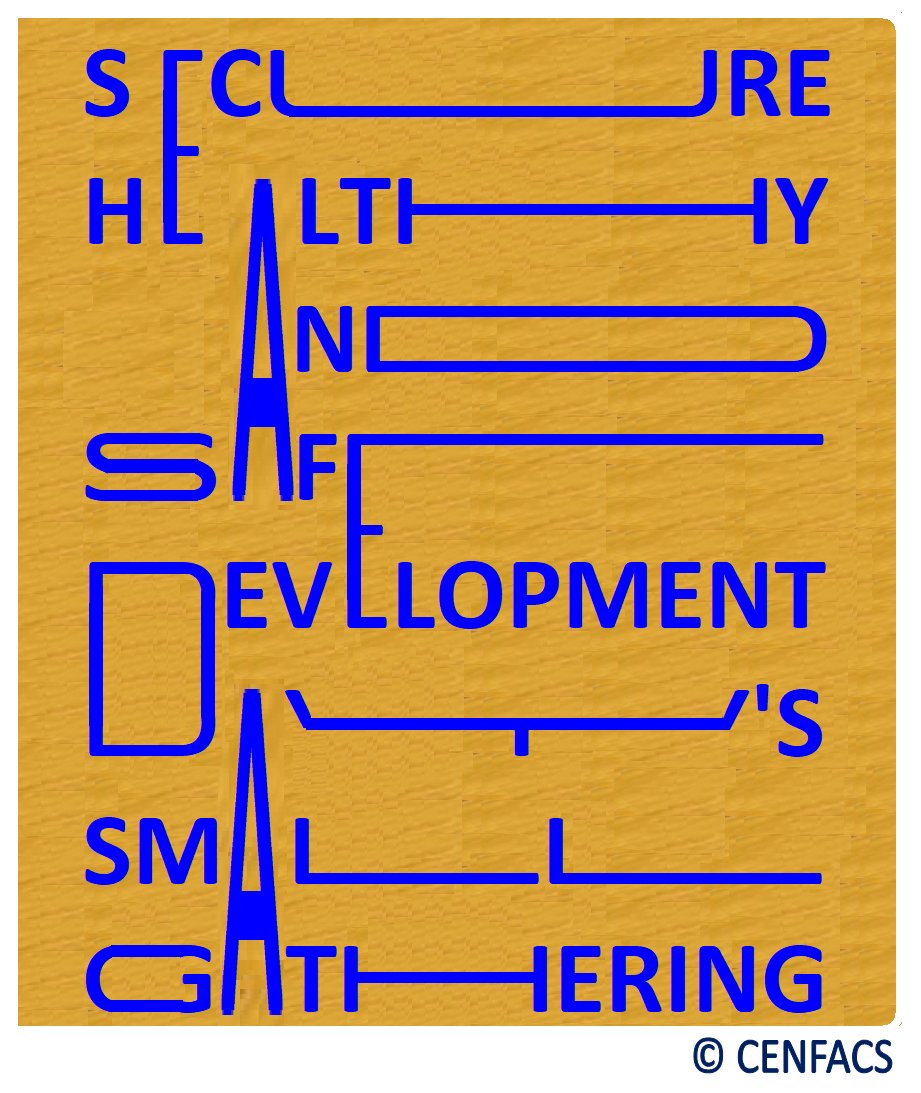
• • • • What is a Healthy, Safe and Secure Development Day Small Group (HSSDDSG)?
A HSSDDSG is a number of two to ten adults including children gathered in a healthy, safe and secure space to share their poverty reduction and sustainable development experiences and wins in an informal and unstructured way.
For example, one can plan a HSSDDSG as follows:
a) Set a clear and simple goal of a HSSDDSG (e.g., meetup to discuss our life experiences on alternatives)
b) Create a session of diverse alternative skills development on the Development Day
c) Include collaborative opportunities between participants
d) Share experiences, resources and support each other
e) Evaluate and gather feedback from each participant
f) Safely conclude their HSSDDSG.
Like in a discussion focus group, the group can systematically collect important information shared for impact monitoring and evaluation, learning and development purposes. The group can as well seize the outputs or outcomes achieved. Finally, the group can report to the community their experience of taking part in a HSSDDSG.
• • Have Queries or Enquiries for the Development Day 2026
The above are the main items that will feature this year’s Development Day. For any queries or enquiries about them, please do not to hesitate to contact CENFACS.
For your reference, please find included below the timeline of CENFACS Development Day milestones.
Wishing you a SUCCESSFUL, HEALTHY, SAFE AND SECURE Development Day 2026!

Extra Messages
• “A la une” (Autumn Leaves of Action for the Upkeep of the Nature in Existence) Campaign and Themed Activities – In Focus from Week Beginning Monday 09/11/2026: Safekeeping Addax Antelope
• Pre-festive Season Strategies for Shifting from Hard Economic Truths to a Sustainable Fresh Start – Pre-festive Season Strategy 4: Managing Your Home as a Sustainable Base of Production rather than a Place of Consumption
• The Second Highlights of the Analysis and Skills for the Month of the Economics of Education and Skill Formation (Skills Development Month) 2026

• “A la une” (Autumn Leaves of Action for the Upkeep of the Nature in Existence) Campaign and Themed Activities – In Focus from Week Beginning Monday 09/11/2026: Safekeeping Addax Antelope
To help keep Addax Antelope safe, we have composed our note around the following headings:
σ What is Addax Antelope?
σ The conservation status of Addax Antelope
σ What can be done to keep safe Addax Antelope.
In addition, we have provided the themed activity we have planned for this week. This themed activity is about Monitoring, Surveillance and Reporting on Mammalian Population.
Let us look at each of the headings of this note.
• • What Is Addax Antelope?
According to ‘theanimalmap.com’ (3),
“The addax is a large desert antelope and the only living species in the genus addax. It belongs to the same group as the oryxes and the sable and roan antelopes, and from a distance it is often mistaken for an oryx”.
Another explanation of addax comes from ‘nrwl.org’ (4), which states that
“The addax is a stocky antelope, with adults weighing roughly 60-125 kg and standing about 95-11 cm at the shoulder [ADW 2024]. Both sides carry long, spiraling horns that average around 72 cm and twist through roughly 1.5 to 3 turns (ADW 2024). The coat changes seasonably: sandy to nearly white in the hot months and darkening to grayish-brown in winter, with white markings on the face, belly, and legs and a dark tuff of hair on the forehead [ADW2024]”.
• • The Conservation Status of Addax Antelope
The website ‘theanimalmap.com’ (op. cit.) notes that
“The addax once lived across almost the entire Sahara, from Mauritania and Western Sahara in the west to Egypt and Sudan in the east, and north to the desert edges of Morocco, Algeria, Tunisia and Libya. The IUCN now lists it as extinct in all of those countries and possibly extinct in Mauritania. Only two countries still have addax living free: Niger, where the last native animals hang on in the Termit and Tin Toumma National Nature Reserve, and Chad, where hards have been reintroduced to the Ouadi Rimé-Ouadi Achim Game Reserve and, since 2023, to the Ennedi Natural and Cultural Reserve”.
The above quote and most research studies on addax antelope indicate it is critically endangered. If this is the case then something needs to be done to keep it safe.
• • What Can Be Done to Keep Addax Antelope Safe
To keep Addax Antelope safe, several measures can be taken, such as the ones given below.
σ Enhance anti-poaching capacity: This includes training and equipping anti-poaching teams to monitor and deter poaches.
σ Establish protected areas: It is about creating and protecting specific areas within Addax Antelope’s habitat to provide a safe environment for the species.
σ Support captive breeding programmes: These programmes aim to stabilize and increase the addax population by breading in captivity.
σ Promote local community involvement: It is about engaging local communities in monitoring and protecting the addax’s environment, which can lead to successful conservation efforts.
σ Collaborate with the oil sector: This involves ensuring that oil extraction activities do not harm the addax by protecting their habitat and preventing disturbances.
These strategies will both help the conservation of Addax Antelope and ensure their survival for future generations.

• • Add-on Activity of the Week’s Campaign: Monitoring, Surveillance and Reporting
To undertake this extra activity, one may need to know the meaning of Monitoring, Surveillance and Reporting.
Monitoring is, according to Oxford Dictionary of Environment and Conservation (5),
“The collection and analysis of information on a regular basis in order to check performance against objectives or compliance with a predetermined standard” (p. 286)
Surveillance is, according to Oxford Dictionary of Environment and Conservation (op. cit.),
“The ongoing systematic collection, collation, and analysis of data and the timely distribution of information to those who need to know so that action can be taken” (p. 439)
Both monitoring and surveillance can be undertaken as activities to keep safe Addax Antelope. Besides these two activities, people can also carry out mammal reporting.
Mammal reporting is referred to in the mammal literature as the practice of documenting and submitting observations, strandings, injuries, or accidental capturing (bycatch) of wild animals to conservation organisations, research groups, or government authorities. It helps scientists track species distribution, monitor population health, and manage marine or terrestrial ecosystems.
So, as part of this week’s “A la Une” Campaign, one can undertake one of these activities ( Monitoring, Surveillance and Reporting) or find out more details about them.
Those who may be interested in this added activity, they can go ahead. Alternatively, they can contact CENFACS for guidance.
To find out more about the entire “A la une” Campaign and Themed Activities, please communicate with CENFACS.

• Pre-festive Season Strategies for Shifting from Hard Economic Truths to a Sustainable Fresh Start –
Pre-festive Season Strategy 4: Managing Your Home as a Sustainable Base of Production rather than a Place of Consumption
To deal with this strategy, let us explain it, then highlight how it can work for your home.
• • What Is Managing Your Home as a Sustainable Base of Production rather than a Place of Consumption?
Managing Your Home as a Sustainable Base of Production rather than a Place of Consumption means shifting the household from an end-user that solely absorbs energy, food, water, and goods into an active centre that generates, regenerates and recycles its own vital resources. In other words, instead of positioning the household as a passive destination of goods, food, and where mass-market decorations are bought and discarded; this approach reframes the family unit as an active, self-contained hub of creation, resourcefulness, and mindful output.
There are implications from this definition in terms of what your home can do to be or stay a sustainable base of production.
• • Implications for Keeping Your Home as a Sustainable Base of Production
To keep your home as a sustainable base of production, this implies some shifts from consumption to production in the following areas:
σ Energy Generation: Instead of solely drawing power from the electrical grid, a productive home generates its own renewable energy through rooftop solar panels, micro-wind turbines, or heat pumps, storming excess capacity in home batteries.
σ Food and Nutrient Cultivation: Rather than exclusively relying on grocery supply chains, the household can produce food via vegetable gardens, greenhouses, fruit trees, and vertical farming; while converting food scraps into rich soil through composting.
σ Water Capture and Re-use: Instead of letting precipitation run off into storm drains, the home can act as a collection-vessel by harvesting rainwater via barrels, green roofs, and filtration systems for irrigation or secondary use.
σ Material Circularity and Repair: In place of a linear ‘buy-use-discard’ cycle, the home can function as a repair and upcycling, workshop where furniture is restored, items are shared or repurposed, and waste is minimized at the source.
The above shows how you can keep your home as a sustainable base of production. Eventually, there are benefits in these home keeping strategies. Among these benefits are
cost reduction (e.g., lower bills), resilience (i.e., protection of your home against disruptions), and lower footprint (through minimized carbon emissions).
The above strategies are not the only ones you can apply. There are other ones. But to make matter short, we can limit ourselves to the above-given ones.
Those who may experience some difficulties in applying them or have any issues to raise about this pre-festive season strategy 4, they are welcome to address them to CENFACS.
We hope Pre-festive Season Strategies for Shifting from Hard Economic Truths to a Sustainable Fresh Start as we presented so far will help everyone of our members to end 2026 on a positive note as well as sustainably and freshly start 2027 as they apply them.
For any other matters linked to the entire Pre-festive Season Strategies for Shifting from Hard Economic Truths to a Sustainable Fresh Start, you can contact CENFACS. CENFACS’ Services and Activities are available to support you in the Application of Your Pre-festive Season Strategies.

• The Second Highlights of the Analysis and Skills for the Month of the Economics of Education and Skill Formation (Skills Development Month) 2026
These second highlights are made of the following:
a) The Analysis of Learner’s Decision Taking Process on the Educational Investment and Expenditure to Reduce Poverty – In Focus from Monday 09/11/2026: Liquidity and Credit Constraints
b) Micro-economic Skills – Under Consideration from Monday 09/11/2026: Price Benchmarking and Arbitrage
c) Practical Household-Level AI and Data Literacy Skills – On the Agenda from Wednesday 11/11/2026, Skill Practice 2: Reading Everyday Information.
Let us provide these second highlights.

• • The Analysis of Learner’s Decision Taking Process on the Educational Investment and Expenditure to Reduce Poverty –
In Focus from Monday 09/11/2026, Second Analysis: Liquidity and Credit Constraints
To start this second analysis, it is better to explain liquidity and credit constraints as well as to look at their relevance to poverty reduction strategy.
• • • What are Liquidity and Credit Constraints?
According to ‘quickeconomics.com’ (6),
“A quick constraint is a limitation on the availability of liquid assets to a consumer or firm, influencing the ability to make purchase or investment at a given time. In essence, it refers to the restriction that prevent individuals or companies from accessing cash or assets that can be quickly converted into cash without significant loss of value. Liquidity constraint can significantly impact economic decisions, influencing consumer spending borrowing and saving behaviour”.
As to credit constraint, the website ‘flyriver.com’ (7) explains that
“A credit constraint arises when an individual is unable to borrow as much as they desire at the prevailing interest rate. This may stem from various factors including information asymmetry, transaction costs, regulatory restrictions, collateral requirements and adverse selection and moral hazard”.
These two definitions can help in the Analysis of Learner’s Decision Taking Process on the Educational Investment and Expenditure to Reduce Poverty.
• • • The use of Liquidity and Credit Constraints to analyze learner’s decision taking process
Liquidity and Credit Constraints represent the immediate financial barriers that prevent individuals or families from investing in human capital, even when the long-term economic returns of education are highly profitable.
Liquidity Constraints (or The Cash-Now Deficit) would be a situation where a household or individual lacks sufficient liquid assets (cash or easily accessible funds) to cover the immediate, out-of-pocket costs of education and daily living expenses.
Credit Constraints (or The Institutional Barrier) occur when an individual cannot borrow money against their future earnings because financial markets are imperfect or unwilling to lend to them.
The two constraints, which slightly capture different dimensions of financial hardship, can be used to explain the educational context, poverty trap mechanisms and opportunity cost. They are relevant to poverty reduction.
• • • Relevance to poverty reduction strategy
When analyzing a learner’s choices, these constraints explain why rational individuals choose short-term survival over optimal long-term investments. Human capital is the primary driver for breaking intergenerational poverty cycles. If policy interventions only focus on the returns to education (e.g., building better schools) without addressing liquidity and credit constraints (e.g., through targeted cash transfers, student loan guarantees, or free tuition), the poorest learners will still be systematically excluded from investing in their own futures.
The above is the highlight of the second analysis of Learner’s Decision Taking Process on the Educational Investment and Expenditure to Reduce Poverty.
For those members of our community who may have any queries or enquiries about this Second Analysis which has focused on Liquidity and Credit Constraints, they can address them to CENFACS.
Those who want further details about The Analysis of Learner’s Decision Taking Process on the Educational Investment and Expenditure to Reduce Poverty, they can contact CENFACS.

• • Micro-economic Skills –
Under Consideration from Monday 09/11/2026, Skill Focus 2: Price Benchmarking and Arbitrage
To focus on price benchmarking and arbitrage, it would be appropriate to explain what they mean and what can be done to empower households with these concepts.
• • • Explaining Price Benchmarking and Arbitrage
The meaning used here for price benchmarking comes from ‘nomitech.com’ (8) which argues that
“Price benchmarking is the practice of comparing prices with relevant competitors, suppliers, industry peers, market average or historical internal data to understand whether the price is high, low, fair or out of step with the market”.
As to price arbitrage, the website ‘fastercapital.com’ (9) explains that
“Price arbitrage refers to the practice of exploiting price discrepancies for the same asset or security in different markets. These discrepancies can arise due to various factors, such as information asymmetry, transaction costs or supply-demand imbalances”.
Both concepts can be used to empower households with micro-economic skills.
• • • Empowering households with these concepts
Low-income households can be empowered by translating abstract micro-economic concepts into actionable survival skills. In a common context, price benchmarking means mapping out what goods should cost, while household arbitrage signifies taking advantage of price differences between locations, times, or formats to maximize a family’s purchasing power.
These concepts can be structured into practical household tools through specific interventions. Let us look at how this can be done.
σ Group Price Benchmarking (Building the Basket)
Low-income families often suffer from the poverty premium – paying more for everyday items because they cannot afford to buy in bulk or travel to cheap stores. Yet, it is possible to coordinate community intelligence to fight this.
This fight can be undertaken through Community Price Auditing and the Fair Price Index.
σ Facilitating Household Arbitrage
In microeconomics, arbitrage involves buying in a low-price market and selling in a high-price market. For a household, selling translates to internal consumption-capturing the price differential as immediate savings. As a charity, CENFACS can act as the logistical bridge.
This can be done through Geographic Arbitrage (Bulk Buying Clubs), Temporary Arbitrages (Storage and Seasonal Shifts), and Format Arbitrage (Digital Switching).
σ Direct Comparison of Structural Interventions
It is possible to weigh the operational trade-offs to see what best fits their community capacity. In other words, the design will take into account the types of household micro-economic skills (e.g., Information gathering and opportunity cost evaluation, economies of scale and capital pooling, and contract optimization and consumer literacy).
σ Overcoming Cognitive and Psychological Scarcity
Micro-economic theory assumes rational actors with perfect information and infinite time. In reality, poverty induces cognitive scarcity, stress makes it difficult to spend hours benchmarking prices.
This can be achieved through Friction Reduction and Micro-grants for Arbitrage Capital.
For those community members of our community who may have any queries or enquiries about Price Benchmarking and Arbitrage and Micro-economic Skills, they can contact CENFACS.

• • Practical Household-Level AI and Data Literacy Skills –
On the Agenda from Wednesday 11/11/2026, Skill Practice 2: Reading Everyday Information
To deal with Read Everyday Information, it makes sense to know what it means, and to look at in practice how households and families can practise it.
• • • What is Reading Everyday Information?
The literature surveyed on this matter indicates that Reading Everyday Information refers to the ability of family members to critically interpret, verify, and make sense of the digital data, metrics, and automated content that flaws through a modern home.
Instead of viewing reading as just translating text on a page, this skill treats the home as a data ecosystem. It means understanding what smart devices, algorithms, and digital interfaces are actually telling you.
Let us look at reading in practice for households and families.
• • • Reading Everyday Information in Practice for Households and Families
Grouped by category, Reading Everyday Information for Households and Families include the following practices or activities:
σ Smart Home and Utility Literacy: This covers Interpreting Dashboard Data and Decoding Device Alerts.
σ Consumer and Algorithmic Literacy: This involves Reading Recommendations and Evaluating Dynamic Pricing.
σ Privacy and Safety Literacy: This encompasses Deconstructing Privacy Policies and Spotting Algorithmic Bias.
σ Information Verification (Mediation Literacy): It is about Identifying AI-generated Content and Cross-checking Sources.
So, Reading Everyday Information can be life-saving skill for households and families as they try to understand the data ecosystem making their home through reading everyday information.
Those households wanting to dive deep into any of the above-mentioned activities or practices, they can let CENFACS know.
For those community members of our community who will be interested in Reading Everyday Information, they can contact CENFACS.
Additionally, for those who would like to register their skills on CENFACS Skills Data Bank, they are welcome to do so. This registration will help in matching the support in terms of skills and the needs in the community.
To sum these Second Highlights, it is worth saying that they show how strategic investments in education and continuous skill development can directly boost household long-term earning potential, job security, and overall household well-being. They also help understand how household can survive and last with practical household microeconomic tools and skills. They finally provide some clues about data ecosystem making their home through read everyday information.
Message in French (Message en français)

• Triple Objectif du Mois : La Réduction de la Pauvreté en Ciblant Trois Types de Besoins Essentiels (L’Énergie, L’Alimentation et Les Ressources Financières)
À l’approche de la saison froide (comme l’hiver), les individus et les ménages sont confrontés à des formes spécifiques de difficultés économiques, liées à la saison ou à des circonstances particulières. Pour préserver une certaine stabilité durant le mois de novembre, il est essentiel d’anticiper et d’éviter trois types de précarité moderne : la précarité énergétique, la précarité alimentaire et la précarité saisonnière induite par la pression commerciale.
• • Trois formes critiques de précarité moderne à combattre : la précarité énergétique, la précarité alimentaire et la précarité saisonnière induite par la pression commerciale
Il s’agit de la précarité énergétique, de la précarité alimentaire et de la précarité saisonnière induite par la pression commerciale. Examinons-les.
σ Précarité énergétique
La définition de la précarité énergétique retenue ici est celle proposée par l’organisation « National Energy Action » (10) :
« Un ménage est en situation de précarité énergétique s’il doit consacrer 10 % ou plus de ses revenus à l’énergie pour maintenir un niveau de chauffage satisfaisant. »
En d’autres termes, la précarité énergétique survient lorsqu’un ménage doit dépenser plus de 10 % de ses revenus rien que pour couvrir ses factures d’énergie.
σ Insécurité/Précarité alimentaire
Le site « sustainweb.org » (11) présente trois définitions de la précarité alimentaire (émanant du ministère de la Santé, du professeur Tim Lang et de la professeure Elizabeth Dowler) :
« a) L’incapacité à se procurer ou à accéder à des aliments permettant de composer une alimentation saine (le ministère de la Santé) ;
b) La précarité alimentaire se traduit par une alimentation de moindre qualité, un accès plus difficile, une santé plus précaire, une part plus importante du revenu consacrée à l’alimentation et un choix restreint parmi une gamme limitée de produits (le professeur Tim Lang) ;
c) L’incapacité à consommer des aliments en quantité suffisante ou de qualité adéquate, de manière socialement acceptable, ou l’incertitude quant à la possibilité d’y parvenir (la professeure Elizabeth Dowler). »
Pour simplifier, la précarité alimentaire implique de devoir réduire la qualité ou la quantité de son alimentation par manque de moyens financiers.
σ Pauvreté saisonnière commercialisée
Commençons par la pauvreté saisonnière.
Selon R. Durai et al. (12),
« La pauvreté saisonnière décrit une situation de vulnérabilité cyclique et prévisible où le bien-être des ménages, la sécurité alimentaire et la sécurité économique se détériorent à intervalles réguliers au cours de l’année. »
Cette situation peut s’aggraver. Selon « humanact.org » (13), la commercialisation intensifie ces difficultés lorsque des événements liés à la consommation (par exemple, les fêtes) imposent des pressions financières et sociales supplémentaires aux familles à faibles revenus.
Comme le souligne également « humanact.org »,
« La pauvreté saisonnière survient lorsque les difficultés économiques existantes deviennent inévitables… Pour les familles déjà en situation de précarité, Noël et le Nouvel An ne sont pas des événements neutres sur le plan émotionnel, mais des moments de tension… La pauvreté saisonnière ne se résume pas à un simple manque de ressources financières. Elle englobe également les conséquences sociales et psychologiques qui apparaissent lors des périodes de forte consommation. Elle est le reflet d’une inégalité permanente qui existe tout au long de l’année. »
Ainsi, la pauvreté saisonnière de fin d’automne est liée aux besoins sociaux, psychologiques et financiers engendrés par les fêtes de fin d’année.
Il est impératif de réduire ces trois formes de pauvreté. Notre objectif pour novembre 2026 est d’atteindre cet objectif.
• • Réduction de la précarité énergétique, alimentaire et liée à la consommation saisonnière
La réduction de la précarité énergétique nécessite une combinaison de stratégies, telles que l’amélioration de l’efficacité énergétique des logements, la diminution des coûts de l’énergie et l’augmentation des revenus des ménages.
La réduction de la précarité alimentaire exige une approche associant aide d’urgence immédiate et changements économiques et politiques à long terme. Cela implique un soutien en matière de revenus et de protection sociale, des conseils personnalisés et une prise en charge globale, des initiatives communautaires favorisant l’accès à l’alimentation, ainsi que des mesures en faveur de la nutrition des enfants et des élèves — notamment la mise en place de repas scolaires gratuits pour tous et de programmes d’aide alimentaire durant les périodes de vacances.
La réduction de la précarité liée à la consommation saisonnière — particulièrement marquée durant les fêtes de fin d’année — repose sur une combinaison de changements individuels (s’éloigner de l’hyperconsommation), de systèmes de soutien communautaires et de réformes économiques structurelles.
• • Implications sur le choix de l’objectif du mois
Une fois l’objectif du mois défini, nous concentrons nos efforts et notre état d’esprit sur celui-ci, en veillant à le concrétiser dans notre vie quotidienne. Nous invitons également nos soutiens à s’investir dans cet objectif, en travaillant à sa réalisation et en venant en aide aux personnes confrontées à la forme de précarité ciblée pour le mois en question (par exemple, en novembre 2026).
Pour plus de détails sur le triple objectif du mois, la procédure de sa sélection, les modalités de soutien et la manière de s’impliquer, veuillez contacter le CENFACS.

Main Development
• Festive Income Booster – In Focus for 2026 Edition:
Financial Optimization and Long-term Scaling for Households –
How to migrate from festive or alternative side earnings to structured household optimization
The following makes the contents for the 2026 Edition of Festive Income Booster (FIB):
∝ What Is the 2026 FIB Resource?
∝ Who the 2026 FIB Resource Is for
∝ Key Terms
∝ Key Theories
∝ Formula for Scaling
∝ Household Financial Optimization and Long-term Scaling Projects
∝ Goals for Financial Optimization and Long-term Scaling
∝ Main Highlights
∝ Key Performance Metrics for Financial Optimization and Long-term Scaling for Households
∝ Monitoring and Evaluating Your Financial Optimization and Long-term Scaling
∝ A Directory of Resources, Services and Strategic Frameworks for Financial Optimization and Long-term Scaling
∝ What Other Highlights the 2026 FIB Resource Covers
∝ What’s More?
∝ How to Access This Resource.
Let us now highlight these contents.

• • What Is the 2026 FIB Resource?
It is an educational toolset and not-for-profit service designed to help low-income households and families maximize their current income, eliminate debt, and build sustainable wealth over time. It focuses on moving them from financial survival to long-term stability.
The core functions of this resource are
~ Income maximization and benefits access
~ Budget and expense optimization
~ Debt restructuring and relief
~ Long-term scaling (savings and asset building).

• • Who the 2026 FIB Resource Is for
Festive Income Boost is primarily and specifically designed for Multi-dimensionally Income Poor Children, Young People and Families (MIPCYPFs) and it is meant to support them throughout the entire festive season and beyond.
Since the current Edition of FIB is about transitioning from short-term cash injections to long-term, scalable financial stability; this transition framework targets three types of household demographics: the Seasonal Hustler, Budget-strained Households, and The Aspiring Micro-investor.
Let us briefly describe these household demographics.
√ The Seasonal Hustler: Individuals who utilize end-of-year or holiday gig economies to clear debt or accumulate lump sums but lack a structural strategy to invest or scale that capital once the festive season ends.
√ Budget-strained Households: Families that successfully use temporary alternative income streams to offset holiday inflation or cost-of-living spikes and now need to optimize their base cash-flow architecture.
√ The Aspiring Micro-investor: Households looking to convert transactional, active side-income into passive or leveraged assets (like index funds, high-yield savings, or automated investment accounts).
The 2026 Edition of Festive Income Boost is also a guide on financial optimization and scaling for those who need a strategic roadmap for financial long-term growth and well-being. It is free to them.
It is as well designed for any of our members and beneficiaries looking to improve their financial literacy, get out financial squeeze or create a multi-year plan to grow their household net worth without paying for expensive private financial advisors.
All these above-mentioned beneficiaries can find some answers from this year’s edition of FIB to their problem of underlying income poverty in order to financially optimize and scale.
• • Key Terms
There are two key concepts or terms to help the users of the 2026 FIB resource.
These key concepts are: Financial Optimization and Long-term Scaling. Let us briefly explain these terms.
(a) Financial Optimization
Optimization is about establishing a flawless baseline. It focuses on streamlining your current cash flow, minimizing waste, and maximizing efficiency. It ensures your household operates like a well-oiled machine before you try to growth it.
There are goals in optimization, which are:
~ Maximizing cash flow efficiency
~ Minimizing wealth degradation (Taxes and fees)
~ Optimizing cost of capital
~ Establishing structural triage (Emergency liquidity).
(b) Long-term Scaling
Scaling is about expansion. Once your household finances are optimized, scaling shifts your focus from saving money to compounding asset velocity. It focuses on growing your net worth, expanding your income-generating assets, and protecting your lifestyle against inflation and economic volatility.
The goals of long-term scaling are
~ Exponential net worth growth
~ Achieving true financial independence
~ Income stream diversification
~ Generational wealth and legacy planning.
In brief, a household’s financial focus evolves across different asset sizes and horizons (i.e., Optimization, Acceleration and Scaling). The goals for households are about maximizing the efficiency of every piece of money to build sustainable, generational wealth. They are not corporate profits.
The 2026 Edition of FIB is about optimizing households’ financial foundation and scaling its net worth over time.
• • Key Theories
Household financial optimization and long-term scaling are primarily governed by academic frameworks like the Life-Cycle Hypothesis (LCH) and the Permanent Income Hypothesis (PIH), which model how households smooth consumption over time. Pragmatic personal finance systems build on top of these theories by overlaying structural hierarchies and asset allocation frameworks to maximize lifetime net worth while minimizing default risk.
Among these household financial optimization and scaling models or theories are the ones given below.
σ Life-Cycle Consumption Smoothing Hypotheses
Developed by Franco Modigliani and Richard Brumberg, the concept of life-cycle hypothesis posits that rational individuals aim to maintain a stable standard of living through their entire lives.
σ Behavioural Life-Cycle Theory
Pioneered by Richard Thalor and Hersh Shefrin, this theory modifies the classic Life-Cycle Theory by integrating human psychology, variable self-control, and cognitive biases.
σ Capital Allocation Hierarchy and Order of Operations
Modern practical household optimization follows a structured pecking order of capital distribution, balancing immediate downside risk against long-term geometric compounding.
σ Modern Portfolio Theory (MPT) and Human Capital
Harry Markowitz’s MPT optimizes asset allocation by maximizing expected portfolio returns for a given level of risk through diversification. When scaled to households, it must account for human capital – the present value of a household’s future lifetime labour earnings.
The propositions of these theories will be referred to when working with the beneficiaries on financial optimization and long-term scaling.
• • Formula for Scaling
Long-term scaling is driven by the Net Surplus Equation and the Compound Growth Formula as express below.

To safely scale without risking total capital loss, a household must progress through strict phases which are
Phase 1: Survival and Liquidity (The Foundation)
This involves eliminating toxic debt and establishing a liquidity buffer.
Phase 2: Structural Tax and Fee Optimization (Efficiency)
Before choosing specific investments, you must optimize the vehicle you hold them in to eliminate tax drag.
Phase 3: Asset Allocation and Compounding (The Growth Engine)
It is about allocating your surplus capital across a diversified asset framework based on your time horizon.
By adopting these steps, one can optimize their finances and scale in the long run.
• • Household Financial Optimization and Long-term Scaling Projects
Knowing what Financial Optimization and Long-term Scaling are, one may decide to turn their ideas, skills and hobbies into reality by setting up a Household Financial Optimization and Long-term Scaling Project (HFO<SP).
• • • What is HFO<SP?
HFO<SP is a structured effort to reduce recurring expenses, automate cash flow, and build systems that grow your wealth without increasing your daily effort.
Rather than cutting small daily luxuries, the best projects focus on high-impact structural changes that compound over time. There are many examples of HFO<SP.
• • • Examples of HFO<SP
They include
~ The Automated Cash Flow System
~ Fixed-cost -audit and Reduction
~ Home Energy and Utility Efficiency
~ Tax-advantaged Wealth Scaling
~ Build a 3-to-6-month Emergency Fund
~ Eliminate any Debt
~ Automate Your Monthly Investments
Etc.
One can tailor a specific plan for each of them.
Those who will be interested in setting up any of the above-mentioned projects they can speak to CENFACS if they want to find more.
• • Goals for Financial Optimization and Long-term Scaling
For households, financial optimization and long-term scaling are not corporate profits. They are about maximizing the efficiency of every piece of money to build sustainable, generational wealth.
• • Main Highlights
As the focus for this year’s edition is on Financial Optimization and Long-term Scaling for Households, the resource includes the following items:
∝ Tools to optimize finances and scale
∝ How to take control of the way of transitioning from short-term gains into permanent financial security
∝ How to set up HFO<SP
∝ How to apply key performance metrics for HFO<SP
∝ How to monitor and evaluate your HFO<SP
∝ How to scale in the long-term period
∝ How to invest in order to develop HFO<SP
∝ How to use end-of-the-year earning opportunities and openings to realize your goal for HFO<SP
∝ How to earn and save money to finance your HFO<SP
∝ How to find online and offline opportunities to start your HFO<SP
∝ How to successfully remake your income dream during the festive season
∝ Tips and hints to make savings to achieve your goals for HFO<SP.
• • Key Performance Metrics for Financial Optimization and Long-term Scaling for Households
Financial Optimization and Long-term Scaling for Households rely on a combination of cash flow control, balance sheet expansion, debt management, and risk mitigation metrics. These metrics have been categorized below.
σ Cash Flow and Liquidity (The Operational Engine)
The following metrics fall under this category:
~ Savings Rate [(Income – Expense)/Income]
~ Emergency Fund Coverage
~ Monthly Cash Flow.
σ Wealth Accumulation and Net Worth (The Scaling Engine)
Under this category, these metrics can be listed:
~ Net Worth
~ Net Worth Growth Rate
~ Financial Independence Number and Ratio
~ Investment Contribution Rate.
σ Debt and Risk Leverage
This category contains the metrics like
~ Debt-to-Income Ratio
~ Credit Score
~ Risk Protection.
Households can use these key metrics to track their project or plan or activities relating to financial optimization and long-term scaling to ensure this project works accordingly.
• • Monitoring and Evaluating Your Financial Optimization and Long-term Scaling
For a household, Monitoring and Evaluation (M&E) is the systematic progress of tracking your current financial data (monitoring) and assessing your strategic progress (evaluation) to optimize wealth and scale your net worth over time.
Without it, a household may have a budget but lack the insight to know if their financial habits are actually moving them closer to long-term freedom. But, what is exactly monitoring and evaluation?
σ Explaining Monitoring and Evaluation
Monitoring (or the tactical dashboard) is the continuous, routine tracking of financial inputs and outputs (e.g., net income, daily expenses, monthly savings rates, investment contributions).
Evaluation (or the strategic review) is the periodic, big-picture assessment of financial health and trajectory (e.g., quarterly net worth checks, animal asset allocation rebalancing, lifestyle creep audits).
σ Operationalizing M&E for Households
To achieve financial optimization (maximizing the efficiency of your money however small it may be) and long-term scaling (exponentially growing wealth while insulating against inflation and lifestyle creep), a household must establish clear Key Performance Indicators (KPIs) and a strict review cadence.
Examples of these KPIs are:
~ Savings/Investment Rate: The optimization target can be ≥ 20%
~ Liquid Runway (Emergency Fund): The optimization target will be 3 to 6 months
~ Debt-to-Income Ratio: The optimization target may be ≤ 30% (excluding primary mortgage)
~ Net Worth Trajectory: The optimization is expressed as positive month-over-month and year-over-year growth.
Additionally, a household needs to set up the M&E Review cadence (e.g., weekly, monthly, quarterly or annually).
For those members of the CENFACS Community who would like to use metrics for their financial optimization and long-term scaling but who need help, they can contact CENFACS.

• • A Directory of Resources, Services and Strategic Frameworks for Financial Optimization and Long-term Scaling
To optimize household finances and build long-term wealth, you need a multi-layered ecosystem. Managing a household’s capital is structurally identical to running a small business, you must optimize cash flow (incomes and expenses), mitigate risks, and allocate surplus capital into scaling assets. In other words, there is a need of a directory to help households achieve financial optimization and long-term scaling.
• • • The Directory of Resources, Services and Strategic Frameworks for Financial Optimization and Long-term Scaling
This directory includes
σ Cash Flow Optimization and Budgeting Ecosystem
Optimizing your baseline cash flow provides the surplus capital required for long-term scaling. This covers
~ Automated Aggregators (Data Services)
~ Zero-based Budgeting Frameworks
~ Automated Bill Negotiation Services.
σ Debt Structuring and Capital Management
Before scaling outward, households must eliminate toxic liabilities and optimize low-cost leverage. This encompasses
~ Debt Elimination Frameworks
~ Credit Optimization Ecosystems.
σ Wealth Scaling and Portfolio Allocation
Once the household cash flow is optimized, surplus capital must be routed into compounding assets. This includes
~ Robo-Advisors (for Low-cost scaling)
~ Self-directed Brokerages
~ Real Estate Scaling Tools.
σ Professional Fiduciary Services
For advanced household optimization, automated tools should be paired with human fiduciaries. This includes
~ Fee-only Financial Planners
~ Tax Optimization Professionals.
To effectively apply these resources and services, households need to follow a monitored strategic roadmap which consists of the following phases:
Building foundation (phase 1), Optimizing the surplus (phase 2), and Scaling the Ecosystem (phase 3).
The above-named resources and services can help households optimize and scale.
• • What Other Highlights the 2026 FIB Resource Covers
The resource covers some ways of dealing with the following:
√ Casual job interview questions (online, video calls and distance job interviews)
√ Seasonal job search techniques (for both online and offline searches)
√ Job search engines and leads
√ Guidance on AI-powered job applications and CV
√ Reference building techniques
√ How to highlight your skills in your job application and or CV
√ Job adverts and alerts
√ Credit history or score
√ Diary of online job fairs and events
√ Job matching to person specification and profile
√ Online job fraud and employment agency scams
√ Details can potential employers ask and not ask as well as how they can ask them
√ What details to provide and not to provide in your job enquiries and when filling job applications
Etc.
It goes further in exploring e-skills and AI skills, as well as stages and steps that poor families can take to skill up themselves.
In addition, the resource covers security and protection matter when trying to optimize and scale. In this respect, it deals again with the general data protection regulations, child protection and safeguarding issues as well as health and safety restrictions for jobs where these requirements apply.
The resource does not stop there as it includes online employment agency scams and job advert scams which sometimes has dramatically increased in today’s world and employment market as there are always unscrupulous players (scammers, spammers, hackers and fraudsters) on the market who try to take advantage of the poor and vulnerable people like MIPCYPFs.
The resource also contains some highlights about new technologies (such as Chat Generative Pre-trained Transformer or ChatGPT) and how they provide additional streams of income for those using them.
• • What’s More?
The resource is packed with insights such as income statement, balance sheet, cash flow, net worth asset value, etc. It finally reminds us of the areas of law or legal requirements in terms of whatever we do to try to financially optimize and scale in the long term to build wealth to reduce poverty. We should always try to lawfully act and live within our means.
• • How to Access This Resource
The resource will be available as a booklet from CENFACS e-Store. It is normally free of charge, but we will appreciate a donation of £5 to help us help reduce poverty and the cost of renewing and producing this resource on an annual basis. As the side effects of cost-of-living continues and the resilience of voluntary sector is fading, we need financial help like many voluntary and charitable organisations do.
The 2026 FIB resource is a great way to start and set up yourself into 2027.
To order and or find out more about the Autumn ICDP resource, please contact CENFACS with your contact details.
_________
• References
(1) https://www.bankofengland.co.uk/monetary-policy-summary-and-minutes/2026/november-2026 (accessed in November 2026)
(2) https://skillforall.com/home/ (accessed in November 2026)
(3) https://theanimalmap.com/en/animals/addax (accessed in November 2026)
(4) https://nrwl.org/species/addax (accessed in November 2026)
(5) Park, C. (2011), Oxford Dictionary of Environment and Conservation, Oxford University Press, Oxford & New York
(6) https://quickeconomics.com/terms/liquidity-constraint (accessed in November 2026)
(7) https://www.flyriver.com/g/credit-constraint?auth=1793872428472 (accessed in November 2026)
(8) https://www.nomitech.com/benchmarking/what-is-price-benchmarking (accessed in November 2026)
(9) https://fastercapital.com/content/Price-Arbitrage-How-to-Use-Price-Arbitrage-to-Exploit-Price-Difference-and-Make-Profits.html (accessed in November 2026)
(10) https://www.nea.org.uk/what-we-do/policy/what-is-fuel-poverty/ (accessed in November 2026)
(11) https://www.sustainweb.org/foodpoverty/whatisfoodpoverty/ (accessed in November 2026)
(12) R. Durai, S. Gnanasaranya, V. Kaveri, Sruthi Mohan, & S. Amutha, S. Arun, S. Ramaswamy (June-2026), Seasonal Poverty: Determinants, Consequences, and Solutions. INTERNATIONAL JOURNAL OF NOVEL RESEARCH AND DEVELOPMENT, 11(6), a694-a714. https://isnrd.org/papers/IJNRD.2606074.pdf (accessed in November 2026)
(13) https://humanact.org/how-christmas-worsens-seasonal-poverty-and-social-inequality (accessed in November 2026)
_________
• Help CENFACS Keep the Poverty Relief Work Going This Year
We do our work on a very small budget and on a voluntary basis. Making a donation will show us you value our work and support CENFACS’ work, which is currently offered as a free service.
One could also consider a recurring donation to CENFACS in the future.
Additionally, we would like to inform you that planned gifting is always an option for giving at CENFACS. Likewise, CENFACS accepts matching gifts from companies running a gift-matching programme.
Donate to support CENFACS!
FOR ONLY £1, YOU CAN SUPPORT CENFACS AND CENFACS’ NOBLE AND BEAUTIFUL CAUSES OF POVERTY REDUCTION.
JUST GO TO: Support Causes – (cenfacs.org.uk)
Thank you for visiting CENFACS website and reading this post.
Thank you as well to those who made or make comments about our weekly posts.
We look forward to receiving your regular visits and continuing support until the end of 2026 and beyond.
With many thanks.