Welcome to CENFACS’ Online Diary!
14 October 2026
Post No. 478

The Week’s Contents
• 2026 “A la une” (Autumn Leaves of Action for the Upkeep of the Nature in Existence) Campaign and Themed Activities via “NYIAMAMINENE” Project
• Aid to Sustainable Wealth Building, Employability and Support Ecosystems – In Focus from Week Beginning Monday 12/10/2026: Inclusive Ownership and Economic Diversification
• Making Donations Not Directly with Cash
… And much more!

Key Messages
• 2026 “A la une” (Autumn Leaves of Action for the Upkeep of the Nature in Existence) Campaign and Themed Activities via “NYIAMAMINENE” Project
Our environmental campaign known as “A la une” has already started and is going to last for six weeks. The main theme of this campaign is still the same, which is Upkeep of the Nature; the sub-theme for this year’s campaign being Saving the Endangered Mammalian Species. This sub-theme will be delivered or conducted via “NYIAMAMINENE” Project.
• • What Is NYIAMAMINENE?
NYIAMAMINENE – which stands for Nurturing Yearning Into Action Maintaining All Mammals In Natural Environment Not Exploited – is an advocacy for the critically endangered large species in Africa. It is a megafauna conservation campaign to help save these mammalian species and similar species threated by extinction.
Far from being a philosophy of compassionate conservation and radical rewilding, NYIAMAMINENE addresses the moral imperative to transform human empathy for wildlife into systemic protection, ensuring all mammalian species can live autonomously in their natural habitats without human exploitation.
NYIAMAMINENE can be broken into three direct conceptual frameworks, which are 1) Nurturing Yearning into Action 2) Maintaining All Mammals in Natural Environment 3) Not Exploited.
• • The Three Direct Conceptual Frameworks Making NYIAMAMINENE
1) Nurturing Yearning into Action
This is the psychological and activist component. It argues that simply having passive yearning – a desire or emotional empathy for animal welfare – is not enough. That internal feeling must be systematically nurtured into tangible legal and physical actions. This includes policy changes, anti-poaching initiatives, habitat restoration, and the dismantling of commercial wildlife trades.
2) Maintaining All Mammals in Natural Environment
This is ecological and conservation component, heavily tied to rewilding. Scientists have found that reintroducing and protecting large mammalian assemblages (such as apex predators and large herbivores) is the most effective way to restore degraded ecosystems. It emphasizes that mammals should not live in artificial, captive, or fragmented spaces, but rather in functioning, natural environments where they can display their innate, evolutionary behaviours.
3) Not Exploited
This represents the Animal Rights and Abolitionist framework. It shifts the goalpost away from traditional ‘animal welfare’ (which merely seeks to make human exploitation, like zoos, circuses, or farming, less cruel) and moves towards true animal autonomy. It asserts that mammals possess agency, dignity, and a right to live entirely for themselves, free from being treated as human commodities.
So, NYIAMAMINENE is a new advocacy project designed by CENFACS to help protect critically endangered large species and keep them up in their natural habitat in Africa. This advocacy is justified by the statistical evidence on threats that large mammals face in Africa.
According to ‘saeon.ac.za’ (1),
“Recent wildlife data reveals a complex and critical landscape for Africa’s critically endangered large mammals. While intensive conservation initiatives have led to stabilization or marginal recovery for certain populations, a landmark 2026 study published in Nature highlights that Sub-Saharan Africa has lost 24% of its total biodiversity since pre-industrial times, with large mammals suffering the greatest losses, dropping more than 75% in historical abundance”.
There are ongoing efforts to prevent further extinctions. As part of these efforts, we set up the ‘NYIAMAMINENE’ project, which will add value to these efforts. ‘NYIAMAMINENE’ project, which has already kicked off, will helps advocate for a safe life for large mammalian species.
• • The Five of Large Mammals Included in “NYIAMAMINENE”
Five of critically endangered mammalian species – i.e., Black Rhinoceros (Diceros bicornis), African Forest Elephant (Loxodonta Cyclotis), Eastern Gorilla (Gorilla beringei), Ethiopian Wolf (Canis simensis), and Addax Antelope – will make up selected composed notes or themed areas of our work; work that we will carry out together to shape the central topic or theme of “A la une” Campaign this Autumn.
We have provided, under the Main Development section of this post, the time frame and titles of these composed notes or themed areas of work as well as their related campaign activities.
The first themed area of work is Saving Black Rhinoceros (Diceros bicornis); themed area which kicked off on the 12th of October 2026.
For further information about this first note, please read under the Main Development section of this post.

• Aid to Sustainable Wealth Building, Employability and Support Ecosystems – In Focus from Week Beginning Monday 12/10/2026: Inclusive Ownership and Economic Diversification
Both inclusive ownership and economic diversification are part of Sustainable Wealth Building. Let first explain them as concepts, then put them in the context of Sustainable Wealth Building.
• • Explaining Inclusive Ownership and Economic Diversification
According to ‘sustainability-directory.com’ (2),
“Inclusive ownership refers to a business model where a broad range of stakeholders such as employees, customers, or community members, have a financial or legal stake in the organization. This approach moves where ownership is concentrated in the hands of a few external investors”.
The website ‘oxford-review.com’ (3) speaks about ownership of inclusion and explains it as
“The principle that everyone has a responsibility to contribute to an inclusive, respectful, and equitable environment”.
These two definitions will be used in our approach to Aid to Sustainable Wealth Building, Employability and Support Ecosystems as part of our Campaign to End Poverty-induced by High Costs of Living.
Regarding economic diversification, it is defined by ‘unfccc.int’ (4) as
“The process of shifting an economy away from a single income source towards multiple sources from a growing range of sectors and markets. Traditionally, it has been applied as a strategy to encourage positive economic growth and development. In the context of climate change adaptation, it takes on a new relevance as a strategy to diversify away from vulnerable products, markets, and jobs towards income sources that are low-emission and more climate resilient”.
Economic diversification will also be utilized to transition from short-term emergency relief to a systemic framework.
• • Inclusive Ownership and Economic Diversification as Part of Sustainable Wealth Building (SWB)
To ensure wealth is retained by the people who generated it, anti-poverty strategies promote shared ownership models that insulate communities from price shocks. This includes
σ Supporting Local Enterprises: Directing guidance , incubation spaces, and financial startup support towards social enterprises, cooperatives, and local small-and -medium businesses.
σ Democratizing Assets: Shifting the financial structures so that community members have a literal stake in local land, property, and business development.
So, supporting local enterprises and democratizing assets will help in this transition from short-term emergency relief to a systemic framework.
CENFACS can support people through this framework by shifting from traditional short-term relief to a wealth building and ecosystem model.
• • Working with the Community on Inclusion Ownership and Economic Diversification
Concerning Inclusive Ownership, CENFACS can structurally design and execute programmes across the three pillars as follows.
a) Aid to Sustainable Wealth Building
Traditional aid focuses on income; inclusive ownership focuses on asset accumulation. CENFACS as a charity can help bridge this gap by working with individuals build equity and long-term financial security.
b) Employability with an Ownership Track
To achieve inclusive ownership, employability programmes must move beyond ‘getting a job‘ and prepare workers become co-owners and decision-makers.
For those struggling to understand how they can become co-owners and decision makers, CENFACS can work with them on these matters.
c) Creating Support Ecosystems
Ownership cannot survive in a vacuum. It requires the building of protective network of infrastructure, policy, and community capital to sustain these assets. And CENFACS can be of help for those needing it.
Regarding economic diversification, CENFACS can support people in need of economic diversification by shifting focus from short-term relief to a long-term community wealth building framework. CENFACS can act as a vital bridge between marginalized individuals and the local economy. It can do it as follows
1) Directing Aid to SWB
CENFACS can help individuals transition from dependency to asset ownership by fostering localized, democratic economic structures.
2) Accelerating Employability through Fair Work
To diversify an individual’s economic prospects, CENFACS can work with people to look beyond immediate job placement and focus on upskilling for resilient industries.
3) Nurturing Local Support Ecosystems
Economic diversification cannot happen in isolation, it requires a resilient framework that connects civil society, local government, and private business. CENFACS can as well work with the community in nurturing local support ecosystems.
Those who would like to enquire about Inclusive Ownership and Economic Diversification as it is presented above, they can contact CENFACS.
Those who want further details about “Aid to Sustainable Wealth Building, Employability and Support Ecosystems” and CENFACS’ Campaign to End Poverty Induced by High Costs of Living as well as to campaign with us, they should not hesitate to communicate with CENFACS.
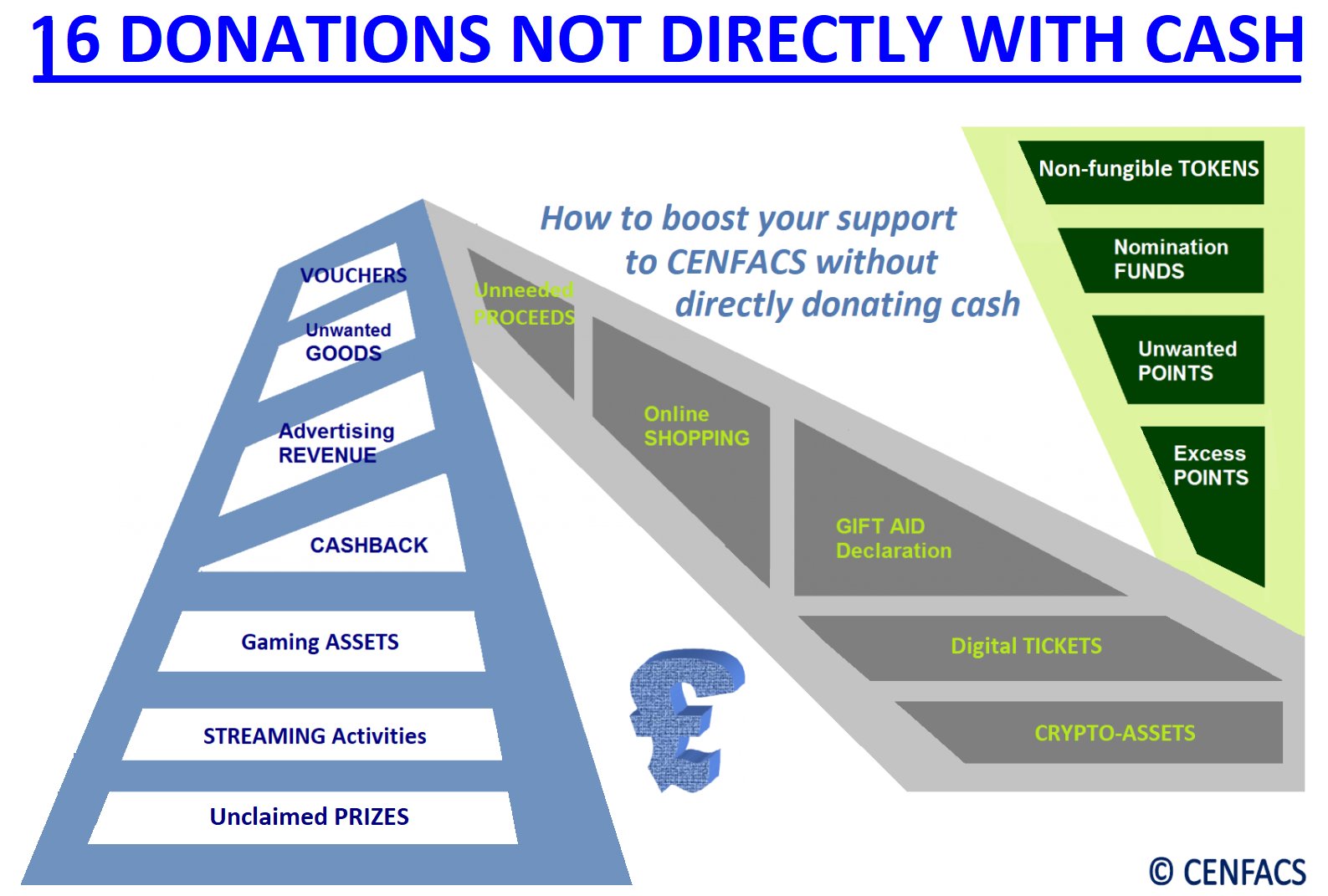
• Making Donations Not Directly with Cash
How to support CENFACS without directly giving cash
Last month, we highlighted ways of supporting CENFACS and of boosting your support. This week, we are adding ways of backing us without you having to directly give cash to CENFACS as well as to its noble and beautiful causes. This is all part of improving the way in which you can make an impact on what CENFACS is doing to help reduce poverty and enhance sustainable development.
Indeed, there are many ways that one can use to help CENFACS without directly given cash. One can unlock barriers to make donations not directly with cash for CENFACS and CENFACS’ noble and beautiful causes. Those who would like to assist CENFACS by using other means than directly giving cash, they can think of the following.
16-themed ways of donating to consider this Autumn and in the lead up to the end of the year:
1) Giving unwanted goods and items to CENFACS e-charity store at http://cenfacs.org.uk/shop/(or by donating a portion of the sale price of your chosen selling platforms if you give items to other stores)
2) Sign up for a Gift Aid Declaration from which CENFACS can earn an extra 25p for every £1 you give as a UK taxpayer (i.e., this option allows CENFACS to reclaim an extra 25 per cent on every eligible donation made by you as a UK taxpayer)
3) Nominate CENFACS for a donation at charity fundraising and donation events (via online nomination forms)
4) Select CENFACS as your preferred charity for donation from advertising revenue (by aligning CENFACS‘ cause with your brand’s values and target audience)
5) Raise free funds for CENFACS with your online shopping or choose CENFACS as a donation recipient of some of the profits raised from online shopping (by employing online shopping fundraising platforms)
6) Donate your unwanted and unused points and cashback to CENFACS as your chosen charity from your loyalty shopping rewards or good causes’ gift cards (with dedicated charity cashback websites)
7) Name CENFACS as your favourite deserving cause if it happens that you have the opportunity to click the online option “donate cashback to charities” (by selecting CENFACS, entering the donation amount, and following the steps to apply the donation, and confirm the pay out)
8) Donate any unwanted excess points of your loyalty card from apps that may give support to good causes (by leveraging the charity donation feature within the retailer’s app)
9) Give away to CENFACS any vouchers received or earned that you do not need or want (by finding out if vouchers are from a voucher provider and by following the instructions on their website or the voucher itself)
10) Hand out to CENFACS any proceeds from unwanted or unneeded prize draw or award you prefer to get rid of (by ensuring the event follows gambling regulations, especially if it is a lottery or raffle)
11) If you are a gaming fundraiser, help CENFACS raise money it needs through your gaming fundraising capability (by creating a fundraising page, planning a sponsored gaming challenge, livestreaming the event on platforms, and using interactive features to encourage donations)
12) Help in online fundraising events like online or digital tickets selling (by selecting a dedicated charity fundraising platform allowing you to create event pages and sell digital tickets or using a general event platform)
13) If you are gaming as a good causes and fundraising livestream donor, you can also support CENFACS (by livestreaming your gameplay and encouraging viewers to donate to a linked fundraising page)
14) If you are running gaming and livestreaming campaigns, you can remember CENFACS in your campaigns (by setting a clear fundraising goal, planning engaging content with interactive platform and fundraising tools)
15) Give cryptocurrency donations (by finding a crypto-friendly charity or a platform, selecting the specific currency you want to donate and initiate the transaction)
16) Donate the proceeds of sales of non-fungible tokens (NFTs) to streamline CENFACS‘ processes of reducing poverty and enhancing sustainable development (by selling the NFT and donating the proceeds via one-time charitable contribution or committing to donate a percentage of royalties, either from your mint or secondary sale of the NFT).
The above sixteen-themed forms of not directly donating cash allow donors to engage with their chosen causes among the variety of projects offered by CENFACS in ways that resonate with their personal values and interests. They are just the few examples of ways of helping that one can think over or come across with to support CENFACS without having to directly give cash. However, this does not mean one cannot donate cash. Of course, they can and if they choose to donate cash, CENFACS will happily accept their cash donations.
To support CENFACS without directly giving cash and or by directly donating cash, just contact CENFACS.

Extra Messages
• ‘Economic Truth to Fresh Start’ Initiative – In Focus from 14/10/2026: Economic Truth Work 4 and Fresh Start Activity 4
• Pre-Festive Season Strategies for Shifting from Hard Economic Truths to a Sustainable Fresh Start
• Practical Activities in the Buildup of the 18th Edition of Making Memorable Positive Difference (MM+D) Project

• ‘Economic Truth to Fresh Start’ Initiative – In Focus from 14/10/2026: Economic Truth Work 4 and Fresh Start Activity 4
From 14/10/2026 to 20/10/2026, we will be dealing with these two areas our “Economic Truth to Fresh Start” Initiative:
a) Economic Truth Work 4 (ETW4) which is on Establishing Feedback Loops and Accountability
b) and Fresh Start Activity 4 (FSA4) which is about Psychological and Social Reconstruction.
Let us look summarize them.
• • Economic Truth Work 4: Establishing Feedback Loops and Accountability
To establish feedback loops and accountability, one needs to understand what they mean. Their meanings can be briefly given as follows.
σ Meaning of Feedback Loop
According to ‘techtarget.com’ (5),
“A feedback loop is the part of a system in which some portion (or all) of the system’s output is used as input for future operations. Each feedback loop has a minimum four stages. During the first stage, input is created. During the second stage, input is captured and stored. During the third stage, input is analyzed and during the fourth stage, the insight gained from analysis is used to make decisions”.
Feedback loops can be positive or negative.
σ Meaning of Accountability
The website ‘dictionary.cambridge.org’ (6) notes that
“Accountability is the fact of being responsible for what you do and able to give a satisfactory reason for it, or the degree to which this happens”.
These definitions will help in understanding how people can move from economic truths to a sustainable fresh start.
σ Establishing Feedback Loops and Accountability as Part of Economic Truths
It is about ensuring that the partnership is equal and that members are compensated to their expertise. This involves
~ Paid consultation: It includes treating members as expert consultants; fairly compensating them for their time, insights, and emotional labour when working on economic research or campaigns.
~ Review Panels: It encompasses establishing a beneficiary-led steering committee to review all economic reports and press releases before they go public to ensure the tone is accurate and dignified.
• • Fresh Start Activity 4: Psychological and Social Reconstruction
To undertake this activity, there is a need to explain reconstruction.
σ Explaining Reconstruction
Its explanation here comes from ‘psychology-lexicon.com’ (7) which takes a psychological stance to state that
“Reconstruction in psychology refers to the process of rebuilding or reintegrating past experiences, memories, or events. This technique is commonly used in therapeutic settings to help individuals gain insight into their past, resolve conflicts, and develop healthier coping mechanisms”.
The understanding of this definition will help when undertaking FSA4
σ Psychological and Social Reconstruction as Part of Fresh Start Activity 4
Economic hardship is heavily isolating. True fresh starts require rebuilt social infrastructure to combat the mental toll of financial stress. This can involve community kitchens and dignity dinners, peer-to-peer mentoring networks.
Those who will be interested in Economic Truth Work 4 (Establishing Feedback Loop and Accountability) and Fresh Start Activity 4 (Psychological and Social Reconstruction), they should not hesitate to contact CENFACS.
Those who have any enquiries and/or queries about “Economic Truth to Fresh Start” Initiative, they can as well communicate with CENFACS.

• Pre-Festive Season Strategies for Shifting from Hard Economic Truths to a Sustainable Fresh Start
Shifting from hard economic truths to a sustainable fresh start before the festive season requires balancing financial reality with emotional well-being. The goal is to close out the year 2026 without accumulating pressure, allowing you to enter the new year (2027) with momentum rather than financial stress.
These strategies can revolve around the conduct of a ‘clean slate’ financial audit, the redefinition of festive value, and the building of a ‘fresh start’ action plan.
In order to work with households and families on these strategies we will be running from next week the following strategies over four weeks:
• • Pre-festive Season Strategy 1: Building Liquidity, Reducing Debt and Gaining Self-sufficiency
Building Liquidity, Reducing Debt and Gaining Self-sufficiency is a proactive financial roadmap designed to protect your wallet before the high-spending winter holidays arrive. Rather than dealing with a financial hangover in January, this strategy focuses on entering the holiday period from a position of absolute strength.
Building Liquidity (Cash Availability) means increasing the amount of easily accessible cash you have on hand before the shopping season begins.
Reducing Debt (Clearing the Slate) involves paying down existing balances like credit cards, store cards, or personal loans – right before seasonal temptations hit.
Gaining Self-sufficiency (Financial Independence) means achieving financial solvency so that your holiday experiences are entirely funded by your own current means.
• • Strategy 2: Leaning into Cooperative Arrangements
Leaning into Cooperative Arrangements means that households and families proactively join forces to share financial costs, logistical burdens, and domestic chores before the chaotic holiday rush hits.
This strategy focuses on collaborative group planning to ease cost-of-living strains and reduce emotional burnout. It involves financial cooperation and cost-splitting, strategic co-parenting and child arrangements, domestic workloads and shared house rotas.
• • Strategy 3: Treating Your Household Budget like a Lean, Resilient Business
Treating Your Household Budget like a Lean, Resilient Business means shifting from emotional holiday spending to a strategic, operations-minded framework. Instead of letting seasonal pressures dictate costs, families adopt corporate principles – such as demand forecasting, strict capital allocation, supply chains management, and risk mitigation – to ensure the household remains liquid and financially sound heading into January.
• • Strategy 4: Managing Your Home as a Sustainable Base of Production rather than a Place of Consumption
Instead of positioning the household as a passive destination of goods, food, and mass-market decorations are bought and discarded, this approach reframes the family unit as an active, self-contained hub of creation, resourcefulness, and mindful output.
These strategies will be run from Mid-October to Mid-November 2026 are scheduled as follows.
σ Week Beginning Monday 19/10/2026 – Strategy 1: Building Liquidity, Reducing Debt and Gaining Self-sufficiency
σ Week Beginning Monday 26/10/2026 – Strategy 2: Leaning into Cooperative Arrangements
σ Week Beginning Monday 02/11/2026 – Strategy 3: Treating Your Household Budget like a Lean, Resilient Business
σ Week Beginning Monday 09/11/2026 – Strategy 4: Managing Your Home as a Sustainable Base of Production rather than a Place of Consumption.
Those who will be interested in these strategies, they can let CENFACS know so that CENFACS can include them or their needs in the delivery plan.
For any other enquiries and or queries, please do not hesitate to contact CENFACS.

• Practical Activities in the Buildup of the 18th Edition of Making Memorable Positive Difference (MM+D) Project
Practical Activities in the lead up to the 18th Edition of MM+D Project – which will be held on 27 and 28 October 2026 and which will focus on the History of Critical Minerals in Africa – are designed to prepare those who are interested in this history.
• • What Are These Practical Activities?
The activities – which bridge historical, resource geology, and socio-economic analysis – explore how Africa’s vast mineral resources – such as cobalt, copper, lithium, and platinum group metals – shaped its history from colonial extraction to the modern green energy transition. They connect our understanding of geology with human industrial development or milestones, military strategy, and global trade/economics.
• • Categories of These Practical Activities
They are various like educational and mapping activities, interactive mining timelines, mapping historical ‘war minerals’, etc.
Under the category of educational and mapping activities, the activity could be about Supply Chain Mapping of Coltan and Cobalt Chronicles. Those undertaking this activity could be asked to trace the geographical and historical shift of a specific mineral from extraction to global use (e.g., coltan to mobile phone use). Additionally, they can compare colonial-era concessions (such as Belgium’s Union Minière du Haut Katanga in the Democratic Republic of Congo) to modern extraction dynamics, charting how infrastructure built around these routes impacted the regional development.
Under the category of Interactive Mining Timelines, the activity can be to Construct a multi-layered visual or digital timeline matching geopolitical shifts to mineral booms. The focus here would be to analyze how changes in international technology (e.g., from early industrial steel manufacturing to modern AI and EV battery technology) altered the global strategic value of African soil.
As argued above, these activities can be of many types. They can be run in the form of workshops, discussion groups, research, games, etc.
Those who would like to prepare themselves for the 18th Edition of MM+D Project, they can try the above-mentioned examples.
Those who have any queries and/or enquiries about these Practical Activities, they can contact CENFACS.
Those who have any issues to raise around the 18th Edition of MM+D itself, they can also communicate with CENFACS.
Message in English-French (Message en Anglais-Français)

• Support Ebola-induced Orphaned Children in Africa
This is a short release cycle in CENFACS’ ongoing Ebola Appeal designed to provide rapid relief since Ebola virus shows no signs of abating although it reaches its peak. The short-cycle appeal is triggered by children who became orphans because of Ebola and the inadequate support they are experiencing, while updating and bringing new feature to the ongoing Ebola Appeal. These new dimensions are provided by the statistics below.
According to ‘unicef.org’ (8),
“More than 1,900 children have been orphaned or separated from their families to the ongoing Ebola outbreak in the eastern DR Congo”.
Similarly, Save the Children (9) notes that
“At least 180 children have lost both parents or primary caregivers (averaging nearly two children orphaned every day)”.
Likewise, the report from ‘reliefweb.int’ (10) points out that
“Thousands more children have been separated from family members while relatives or parents undergo medical screening and treatment”.
Although these numbers of Ebola-induced Orphans are not million, the impact of these orphans could have some ramifications on them and other children in places where there is already a lack of infrastructure and security to protect children.
These children need your support. These Ebola-induced Orphaned Children are those directly infected with the Ebola Virus Disease or children who suffer severe secondary impacts – such as being orphaned, displaced, or stigmatized due to Ebola outbreak in their families and communities.
Your support will help
σ Orphaned children
σ Children experiencing dual parent loss
σ Children separated from family members
σ Children infected by Ebola
σ Children abandoned by their relatives or communities as there is still some cultural belief surrounding the Ebola disease.
To support, please use our usual contact address on this website.
Thank you in anticipation for your willingness to give and help save the lives of the Ebola-induced Orphaned Children in Africa.
• Soutenir les Enfants Rendus Orphelins par l’Ebola en Afrique
Il s’agit d’une phase d’action à court terme s’inscrivant dans le cadre de l’appel de fonds permanent de CENFACS pour la lutte contre l’Ebola ; cette initiative vise à apporter une aide rapide alors que l’épidémie, bien qu’ayant atteint son pic, ne montre aucun signe de recul. Ce volet à court terme répond à la situation des enfants devenus orphelins à cause du virus Ebola et au soutien insuffisant dont ils bénéficient, tout en actualisant et en enrichissant l’appel de fonds en cours. Les statistiques ci-dessous illustrent ces nouveaux aspects.
Selon « unicef.org » (8),
« Plus de 1 900 enfants se sont retrouvés orphelins ou séparés de leur famille en raison de l’épidémie d’Ebola qui sévit actuellement dans l’est de la République Démocratique du Congo ».
De même, l’organisation Save the Children (9) signale que
« Au moins 180 enfants ont perdu leurs deux parents ou leurs principaux tuteurs (soit une moyenne de près de deux enfants devenus orphelins chaque jour) ».
Par ailleurs, le rapport de « reliefweb.int » (10) souligne que
« Des milliers d’autres enfants ont été séparés des membres de leur famille alors que leurs proches ou leurs parents étaient soumis à des dépistages et à des traitements médicaux ».
Bien que le nombre d’enfants rendus orphelins par l’Ebola ne se compte pas en millions, leur situation pourrait avoir des répercussions importantes, tant pour eux que pour les autres enfants vivant dans des zones dépourvues d’infrastructures et de dispositifs de sécurité adéquats pour les protéger.
Ces enfants ont besoin de votre soutien. Il s’agit soit d’enfants directement infectés par le virus Ebola, soit d’enfants subissant de graves conséquences indirectes — telles que l’orphelinat, le déplacement forcé ou la stigmatisation — liées à l’épidémie au sein de leur famille et de leur communauté.
Votre soutien apportera une aide précieuse aux
σ Enfants devenus orphelins
σ Enfants ayant perdu leurs deux parents
σ Enfants séparés de leur famille
σ Enfants infectés par le virus Ebola
σ Enfants abandonnés par leurs proches ou leur communauté en raison de certaines croyances culturelles persistantes concernant la maladie à virus Ebola.
Pour apporter votre soutien, veuillez utiliser les coordonnées habituelles indiquées sur ce site.
Nous vous remercions par avance de votre volonté de faire un don et d’aider à sauver la vie d’enfants africains rendus orphelins par l’épidémie d’Ebola.

Main Development
• 2026 “A la une” (Autumn Leaves of Action for the Upkeep of the Nature in Existence) Campaign and Themed Activities via “NYIAMAMINENE” Project
The following covers the points making this Main Development:
∝What is “A la une” (Autumn Leaves of Action for the Upkeep of the Nature in Existence) Campaign?
∝ “A la une” Campaign Sub-themes
∝ NYIAMAMINENE (which stands for NurturingYearning Into ActionMaintainingAllMammalsInNaturalEnvironment Not Exploited) as a Focus of Our ‘A la Une’ Campaign 2026
∝ Metrics Used by Biologists to Measure the Situation of Large Mammals
∝The Relationship between a Campaign Action for the Upkeep of Large Mammals in Existence and Poverty Reduction
∝ “A la une” Campaign Calendar
∝ Executing our “A la une” Campaign from Week Beginning 12/10/2026 by Focusing on Saving Black Rhinoceros (Diceros bicornis)
∝ Add-on Activity of the Week’s Campaign: Raise Awareness about Large Mammals and the Overall Biodiversity of the Ecosystems.
Before starting the first themed area of this year’s “A la une” Campaign, let us remind those who may not know or remember what is “A la une” Campaign.
• • What is “A la une” (Autumn Leaves of Action for the Upkeep of the Nature in Existence)?
“A la une” is CENFACS’ well-known household campaign for justice towards for nature in the autumnal season.
It is about working together in organised and active way toward the goal of keeping up the nature in (good) existence.
It is about telling those who are in a position to help fix the overexploitation and end extinction of natural species.
It is about gaining support for species for the benefits and gifts they provide to the nature and in the different areas of human life.
It is CENFACS’ branding or theme that holds to account those who are destroying the nature and its resources as well as it looks forward to positively transforming our relationships with nature while changing the way our society works.
Briefly, “A la une” Campaign, which has to be differentiated from one-time protest, has three attributes, which are:
a) It focuses on a concrete goal of keeping up the nature in (good) existence
b) It has specific outcomes for working with CENFACS‘ users to protect nature or the wilderness/wildlands
c) It helps add up value to similar efforts and work on protecting the nature.
“A la une” Campaign needs sub-themes to be completed.

• • “A la une” Campaign Sub-themes
Since we started this campaign, there have been many sub-themes or themed activities or projects. We can mention the six latest ones:
∝ Restoration of Ecological Infrastructures in 2020
∝ Safeguard of Crop Wild Relatives in 2021
∝ Mbulu (Mobilising for Birds’ Useful Life for Us) Project in 2022
∝ Niamankeke (Nurture Insects via Adaptive Management for Action on Nature that Keeps the Endangered as Key to our Environment) Project in 2023
∝ ‘Mbisi’ (Maintaining Bagrus In Situ Inhabitation) Project was a Focus of Our ‘A la Une’ Campaign 2024
∝ “MAMBILANGA” (that is, Mind Amphibians for Maintaining the Balance of Insects in the Lives of Aquatics and Nutrients, and for Guarding Agriculture) was at the center of ‘A la une’ Campaign 2025.
We are still working on these six ‘A la Une’ Campaign sub-themes or projects.
Those who would like more information about ‘A la Une’ Campaign sub-themes or projects, they can contact CENFACS.
Those who would like to support them (that is, these six ‘A la Une’ Campaign sub-themes or projects), they can also contact CENFACS with their support.
This year, the sub-theme we have selected to deliver “A la une” Campaign is “NYIAMAMINENE”.
• • NYIAMAMINENE as a Focus of Our ‘A la Une’ Campaign 2026
NYIAMAMINENE – which stands for Nurturing Yearning Into Action Maintaining All Mammals In Natural Environment Not Exploited – is an advocacy for the critically endangered large species in Africa. It is a megafauna conservation campaign to help save these mammalian species and similar species threated by extinction.
Far from being a philosophy of compassionate conservation and radical rewilding, NYIAMAMINENE addresses the moral imperative to transform human empathy for wildlife into systemic protection, ensuring all mammalian species can live autonomously in their natural habitats without human exploitation.
NYIAMAMINENE can be broken into three direct conceptual frameworks, which are
1) Nurturing Yearning into Action
2) Maintaining All Mammals in Natural Environment
3) Not Exploited.
• • • The Three Direct Conceptual Frameworks Making NYIAMAMINENE
1) Nurturing Yearning into Action
This is the psychological and activist component. It argues that simply having passive yearning – a desire or emotional empathy for animal welfare – is not enough. That internal feeling must be systematically nurtured into tangible legal and physical actions. This includes policy changes, anti-poaching initiatives, habitat restoration, and the dismantling of commercial wildlife trades.
2) Maintaining All Mammals in Natural Environment
This is ecological and conservation component, heavily tied to rewilding. Scientists have found that reintroducing and protecting large mammalian assemblages (such as apex predators and large herbivores) is the most effective way to restore degraded ecosystems. It emphasizes that mammals should not live in artificial, captive, or fragmented spaces, but rather in functioning, natural environments where they can display their innate, evolutionary behaviours.
3) Not Exploited
This represents the Animal Rights and Abolitionist framework. It shifts the goalpost away from traditional ‘animal welfare’ (which merely seeks to make human exploitation, like zoos, circuses, or farming, less cruel) and moves towards true animal autonomy. It asserts that mammals possess agency, dignity, and a right to live entirely for themselves, free from being treated as human commodities.
So, NYIAMAMINENE is a new advocacy project designed by CENFACS to help protect critically endangered large species and keep them up in their natural habitat in Africa. This advocacy is justified by the statistical evidence on threats that large mammals face in Africa.
According to ‘saeon.ac.za’ (op. cit.),
“Recent wildlife data reveals a complex and critical landscape for Africa’s critically endangered large mammals. While intensive conservation initiatives have led to stabilization or marginal recovery for certain populations, a landmark 2026 study published in Nature highlights that Sub-Saharan Africa has lost 24% of its total biodiversity since pre-industrial times, with large mammals suffering the greatest losses, dropping more than 75% in historical abundance”.
There are ongoing efforts to prevent further extinctions. As part of these efforts, we set up the ‘NYIAMAMINENE’ project, which will add value to these efforts. ‘NYIAMAMINENE’ project, which has already kicked off, will helps advocate for a safe life for large mammalian species.
• • • The Five of Large Mammals Included in “NYIAMAMINENE”
Five of critically endangered mammalian species (i.e., Black Rhinoceros (Diceros bicornis), African Forest Elephant (Loxodonta Cyclotis), Eastern Gorilla (Gorilla beringei), Ethiopian Wolf (Canis simensis), and Addax Antelope) will make up selected composed notes or themed areas of our work; work that we will carry out together to shape the central topic or theme of “A la une” Campaign this Autumn.
To execute ‘NYIAMAMINENE’ project and this year’s ‘A la Une’ Campaign, we have drawn up a calendar of work.
• • Metrics Used by Biologists to Measure the Situation of Large Mammals
Among the metrics used by biologists are the ones listed below.
σ Abundance and Population Metrics
They include
σ σ Population Density (the number of individuals per unit area)
σ σ Relative Growth Rate (the speed at which a population is increasing or decreasing)
σ σ Absolute Abundance (the estimated total number of individuals in a specific geographic boundary).
σ Community and Spatial Metrics
They are
σ σ Biomass (the total weight mass of a species or groups of species within an ecosystem)
σ σ Occurrence and Distribution Indices (they track the geographical presence or absence of large mammals across a landscape over time to monitor habitat fragmentation or range shrinkage).
σ Broad Conservation Indexes
They cover
σ σ Living Planet Index (tracks the average relative change in vertebrate population sizes)
σ σ Large Carnivore Observation Index (an effort-corrected metric calculated from observations made by voluntary observers – such as hunters – to track rare or elusive large mammals over vast areas).
The above-mentioned metrics can help in understanding the situation of large mammals.
If we consider for instance Living Planet Index (LPI), the latter measures the average change in the size of wild populations of vertebrate species over time. It assesses trends in the population of these species and provides insights into the state of biodiversity.
In its latest report on LPI 2026, World Wildlife Fund (11) indicates that
“The latest LPI shows a decline of 73% (73.2%). This means that the size of these populations fell by, on average, 73% between 1970 and 2022” (p. 23).
Still in the same report, it is noted that the LPI for Africa is 80%.
• • The Relationship between a Campaign Action for the Upkeep of Large Mammals in Existence and Poverty Reduction
The relationship between “a campaign action for the upkeep of large mammals in existence” (wildlife or megafauna conservation) and poverty reduction is interconnected, presenting both significant socio-economic benefits and localized challenges.
Large mammals (such elephants, rhinos, and big cats) act as “umbrella species”, meaning campaigns to protect them inherently require preserving vast natural ecosystems that support human livelihoods.
The primary pathways linking these two concepts include the following:
~ Revenue and Livelihoods via Nature-based Tourism
~ Safeguarding Ecosystem Services
~ Human-Wildlife Conflict (The Negative Link)
~ The Modern Conservation Consensus.
Let us briefly summarize these pathways.
• • • Revenue and Livelihoods via Nature-based Tourism
Campaigns that successfully protect large mammals safeguard the foundation of global eco-tourism. Nature-based tourism acts as direct economic driver in developing regions, injecting revenue into rural communities through hospitality, guiding, and conservation jobs.
• • • Safeguarding Ecosystem Services
Large mammals function as “ecosystem engineers”. By managing vegetation canopy, fertilizing soil, and dispersing seeds, they help maintain healthy forests and grasslands that combat climate change. Poorer communities directly rely on these healthy ecosystems for clean water, non-timber forest products, and sustainable agricultural land. Destabilizing these systems accelerates rural resource scarcity which exacerbates poverty.
• • • Human-Wildlife Conflict (The Negative Link)
While the long-term relationship is positive, there is an immediate friction point. This is featured by economic strain on the poor.
Indeed, large mammals are expensive and dangerous neighbours. Communities bordering wildlife reserves often face crop raiding, livestock predation, and physical danger. For a subsistence farmer, losing a season’s crops or livestock to an elephant or tiger can immediately induce severe poverty.
• • • The Modern Conservation Consensus
To successfully reduce poverty while protecting wildlife, modern campaigns focus on integrated conservation-development projects.
CENFACS’ Autumn Humanitarian Relief and Nature Conservation Appeals in one of these projects. These combined appeals are about supporting needy people, flora, fauna, funga, communities and organisations in Africa. The humanitarian side is a fundraising drive launched by CENFACS every Autumn. The nature or species conservation aspect of these appeals is about raising money to protect threatened mammalian species (like Black Rhinoceros, African Forest Elephant, Eastern Gorilla, Ethiopian Wolf and Addax Antelope), their habitat, or the broader ecosystem they depend upon.
This shifts large mammals from an economic liability into a community asset, breaking the cycle where poverty drives illegal poaching. This also ensures that protecting nature does not come at the cost of human survival.
• • “A la une” Campaign Calendar
• • • Six Weeks of Campaign for the Upkeep of the Nature
As announced earlier, we have started our 6-week campaign work for the Upkeep of the Nature. The campaign will help in promoting healthy relationships between humans and nature by taking actions to reduce the decline and extinction threat that some types of Mammalian Species are facing. It will also help in the fight against the contributing factors to this decline or extinction threat.
As outlined earlier, the sub-theme of “A la une” for this year is Saving the Endangered Mammalian Species delivered via “NYIAMAMINENE” Project while the “A la une” theme remains the same which is Upkeep of the Nature.
Within these theme and sub-theme, we have composed six notes including monitoring, evaluation and review of the “A la une” Campaign. These notes are in fact campaign actions that can be taken to Save Endangered Mammalian Species.
• • • “A la une” Campaign Composed Notes or Themed Areas for Action
There are five mammalian themed names and five activities to back this campaign. During the following periods within this Autumn and “A la une” season, CENFACS’ advocacy on environment will focus on the following mammalian themed names and activities from the beginning of every Mondays (starting from 12 October 2026 to 15 November 2026).

Note to “A la une” Campaign calendar: (*) WBM means Week Beginning Monday
In total, there are five mammalian themed names which make areas of work and action starting from the 12th of October 2026 and thereafter every Mondays until the 15th of November 2026. The campaign activities related to each of the mammalian-themed names not only provide educational benefits but also foster a deeper understanding of large mammals and their importance to the ecosystems.
From the 16th to the 22nd of November 2026, we shall carry out Impact Monitoring, Evaluation and Review of the “A la une” Campaign and Themed Activities conducted.
The above-mentioned mammalian themed titles and activities will help us to re-communicate our environmental message for the upkeep of the nature in (good) existence as well as triggering better changes the way in which our community/society works.
As you can notice, besides each of these mammalian themed names, there are activities to be carried out. The activities are about how large mammals diversely contribute to human life and society. They are about exploring the intricate web of human-mammalian relationships.
The notes are supposed to guide our action since “A la une” Campaign is about actions, not words. During the run and at the end of these notes and actions, we shall pull impact monitoring and evaluation reports. We shall as well review the campaign results to see how it performed overall and if we achieved our goal, that is Nurturing Yearning Into Action Maintaining All Mammals In Natural Environment Not Exploited (NYIAMAMINENE) – which is an advocacy for the critically endangered large mammalian species in Africa.
To engage with “A la une” Campaign and themed areas as well as to act for a healthy and wealthy nature, please contact CENFACS.

• • Executing our “A la une” Campaign from Week Beginning Monday 12/10/2026 by Focusing on Saving Black Rhinoceros (Diceros bicornis)
To help save Black Rhinoceros (Diceros bicornis), let us provide the definition of this species, its conservation status, and what can be done to save it.
• • • What is Black Rhinoceros (Diceros bicornis)?
It emerges from the literature review of mammals, Black Rhinoceros – also known by the scientific name of Diceros Bicornis – is a large herbivorous mammal native to East and Southern Africa, weighing between 700 to 1,400 kg and standing roughly 1.5 to 1.6 meters tall.
On the website of ‘rhinos.org’ (12), it is stated that
“Diceros bicornis, Dicero from the Greek ‘di’, meaning ‘two’ and ‘cero’, meaning ‘horn’ and ‘bicornis’ from the Latin ‘bi’, meaning ‘two’ and ‘cornis’ meaning ‘horn’.
Additionally, the website ‘rhinoresourcecenter.com’ (13) indicates that
“Black rhino is a medium-sized species, found across Africa, with two horns. It is a browser, living in a habitat with herb and woody browse plants.
• • • Is Black Rhinoceros (Diceros bicornis) Critically Endangered?
Most of the studies surveyed indicate that Black Rhinoceros (Diceros bicornis) is a critically endangered mammalian species.
According to ‘faunahub.com’ (14),
“The black rhinoceros is a browsing African rhino with a hooked upper lip feeding on shrubs. It is assessed as Critically Endangered, though intensive protection has helped some populations recover”.
Major threats surrounding Black Rhinoceros (Diceros bicornis) include
~ Poaching for horn
~ Habitat loss and fragmentation
~ Small, isolated populations.
Because it is critically endangered, Black Rhinoceros (Diceros bicornis) needs to be saved from threats and risks to extinction.
• • • What can be done to save Black Rhinoceros (Diceros bicornis)
To save Black Rhinoceros (Diceros bicornis), which remains listed as Critically Endangered on the IUCN Red List (15), a combination of anti-poaching enforcement, habitat management, community involvement, and anti-scientific breeding is required.
We can categorize these actions as follows.
σ Anti-Poaching and Law Enforcement
They include ranger deployment, advanced surveillance, and targeting illegal trade.
σ Habitat Management and Translocations
They cover range expansion, habitat restoration, and dehorning.
σ Community Engagement and Ecotourism
They involve local incentives, conservancies, and ecotourism.
σ Scientific and Captive Breeding
They encompass endocrinology, tracking, and individual monitoring.
There are several projects helping to save Black Rhinoceros (Diceros bicornis) across Africa. These projects include actions that can be undertaken to save Black Rhinoceros (Diceros bicornis); actions such as
σ Raise public awareness about the conservation status of the Black Rhinoceros (Diceros bicornis) and the importance of protecting its habitat;
σ Develop and implement a conservation management plan to guide long-term protection of the species and its habitat;
σ Collaborate with landowners to secure habitats for the Black Rhinoceros (Diceros bicornis) and to mitigate the impacts of urban development and other threats.
The above-mentioned actions can help save Black Rhinoceros (Diceros bicornis) and its future life.
Besides the above-mentioned actions, there are other initiatives one can take to help save the Black Rhinoceros (Diceros bicornis) population. One of these other actions is to support the good causes working on Black Rhinoceros (Diceros bicornis) matter.
The above actions will help to reduce extinction risks and threats to Black Rhinoceros (Diceros bicornis), which is critically endangered mammalian species in Africa.

• • Add-on Activity of the Week’s Campaign: Raise Awareness about Large Mammals and the Overall Biodiversity of the Ecosystems
Raise Awareness about Large Mammals is the educational and advocacy effort to inform the public about the ecological importance, decline, and conservation needs of large wild animals (such as elephants, rhinos, giraffes, whales, etc.).
There are good reasons to raise this awareness; just as there are activities that one can undertake to apply this awareness.
• • • Reasons for Raising Awareness about Large Mammals
It is known that large mammals, as ecosystem engineers, shape the environment by grazing, trampling, seed dispersal, and browsing. It is also common knowledge that bulky herbivores and marine mammals help store carbon.
However, these large mammals like other species face extinction crisis, which they cannot deal with by themselves. They need humans to undertake activities and campaigns to tackle this extinction crisis.
• • • Undertaking Activities and Campaigns to Save Large Mammals
One can undertake activities and campaigns to save large mammals like Black Rhinoceros by supporting programmes like Mammal Society and international efforts focusing on Rhinos.
• • • Attending and/or Following Key Awareness Events to Save Large Mammals
One can as well as actively participate in the Global Mammal Big Day on 25 October 2026; day during which people worldwide will celebrate the diversity of mammals (large and small) and raise awareness of threats like habitat loss, climate change, and illegal trade. More details on this event can be found at:
https: //globalmammalbigday.com
One can further get involved in future events relating to National Mammal Week (UK). The last one was held between 20 and 26 April 2026.
Additionally, there are ongoing awareness actions such as citizen science, local groups, public engagement, fundraising advocacy, etc.
Engaging with these dedicated awareness days and events can help drive policy changes, fundraising, and community protection.
This add-on activity helps contribute to the conservation of large mammals and the overall biodiversity of the ecosystem.
Those who will be carried out this add-on awareness activity can inform or report to CENFACS about their findings and feelings.
The above is our first note of the “A la une” Campaign for this year.
To find out more about this first note or ‘NYIAMAMINENE’ project or the entire “A la une” Campaign, please contact CENFACS.
_________
• References
(1) https://enews.saeon.ac.za/sub-saharan-africa-has-lost-nearly-a-quarter-of-its-biodiversity/ (accessed in September 2026)
(2) https://lifestyle.sustainability-directory.com/area/inclusive-ownership/ (accessed in October 2026)
(3) https://oxford-review.com/the-oxford-review-dei-diversity-equity-and-inclusion-dictionary/ownership-of-inclusion-definition-and-exclusion/(accessed in October 2026)
(4) https://unfccc.int/topics/resilience/resources/economic-diversification (accessed in October 2026)
(5) https://www.techtarget.com/searchitchannel/definition/feedback-loop (accessed in October 2026)
(6) https://dictionary.cambridge.org/dictionary/english/accountability (accessed in October 2026)
(7) https://www.psychology-lexicon.com/glossary/51-glossary-r/20569-reconstruction.hyml (accessed in October 2026)
(8) https://www.unicef.org/press-releases/ebola-takes-people-children-depend-and-unravels-their-lives-unicef (accessed in October 2026)
(9) https://www.savethechildren.org.uk/news/media-centre/press-releases/2026/nearly-two-children-day-orphaned-dr-congos-latest-ebola (accessed in October 2026)
(10) https://reliefweb.int/report/democratic-republic-congo/number-children-orphaned-or-left-unaccompanied-ebola-democratic (accessed in October 2026)
(11) WWF (2026) Living Planet Report 2026 – The Science of Hope, WWF, Gland, Switzerland
(12) https://rhinos.org/aboutrhinos/rhino-species/black-rhino/ (accessed in October 2026)
(13) https://rhinoresourcecenter.com/library/species/black-rhino/ (accessed in October 2026)
(14) https://faunahub.com/endangered-animals/species/black-rhinoceros (accessed in October 2026)
(15) https://iucnredlist-doi-pdfs.s3 … (accessed in October 2026)
_________
• Help CENFACS Keep the Poverty Relief Work Going This Year
We do our work on a very small budget and on a voluntary basis. Making a donation will show us you value our work and support CENFACS’ work, which is currently offered as a free service.
One could also consider a recurring donation to CENFACS in the future.
Additionally, we would like to inform you that planned gifting is always an option for giving at CENFACS. Likewise, CENFACS accepts matching gifts from companies running a gift-matching programme.
Donate to support CENFACS!
FOR ONLY £1, YOU CAN SUPPORT CENFACS AND CENFACS’ NOBLE AND BEAUTIFUL CAUSES OF POVERTY REDUCTION.
JUST GO TO: Support Causes – (cenfacs.org.uk)
Thank you for visiting CENFACS website and reading this post.
Thank you as well to those who made or make comments about our weekly posts.
We look forward to receiving your regular visits and continuing support until the end of 2026 and beyond.
With many thanks.