Welcome to CENFACS’ Online Diary!
02 September 2026
Post No. 472

Greetings and Welcome back Message
As we embark on the content of this blog and post for the first Wednesday of September 2026, we would like to warmly greet and welcome back all those who are returning this month.
We are delighted to welcome the following again:
∝ Our users, project beneficiaries, supporters, members, representatives of Africa-based Sister Organisations, followers, audiences and other stakeholders who came back from Summer break and school holiday;
∝ Those who have been engaged in work throughout the Summer;
∝ Those who lost touch with us for various reasons and are now eager to reconnect.
This welcome back message is also directed towards those involved in or supporting our UK and Africa Development programmes.
We wish all of you a happy, healthy, and successful return!
The Week’s Contents
• Back-to-poverty-relief Programme 2026: Programme for Pre-autumn Season 2026
• Goal of the Month: Reduction of Back-to-school Poverty in 2026
• Activity/Task 9 of the Alternatives (‘A’) Year and Project: Provide Advisory or Guided Support to People Seeking Alternatives when They Return to Poverty Relief
… And much more!

Key Messages
The key message from our weekly communication and menu, which is often made of three courses, is as follows.
• Back-to-poverty-relief Programme 2026: Programme for Pre-autumn Season 2026
To smooth the understanding of this key message, let us briefly explain back-to-poverty-relief programme, September as advice- and guidance-giving month within CENFACS, the particularity of this year’s programme, the potential beneficiaries of this programme, and the possible needs of these beneficiaries.
• • What Is Back-to-poverty-relief Programme?
Let us start with back to poverty relief.
• • • What is Back to Poverty Relief
Back to poverty Relief means returning focus, donations, or policy efforts towards supporting those struggling with extreme need or poverty as we return from Summer holiday. To do that one needs a programme or method of doing it with projects as well as set up services.
• • • Back-to-poverty-relief Programme
It is a set of related activities and services prepared with an aim of reducing poverty (particularly back-to-school poverty but not exclusively) amongst multi-dimensional poor children, young and families (MDPCYPFs) by working with them to meet their needs after summer break and/or school holiday so that they can start September 2026 without or with less hardship. The programe is made of projects.
• • • Back-to-poverty-relief Project
It is a charitable campaign that supplies underprivileged children with school essentials, a creative classroom craft or icebreaker activity for the new term, or an educational learning module designed to kick off the academic year.
It is also an initiative designed to help MDPCYPFs move out of poverty and achieve long-term financial independence.
The goal of this project is to help underprivileged low-income or displaced children get the items they need for class. The impact expected is to lower school dropout rates and give kids confidence on the first day back.
The main aim is to remove financial and material barriers so that children can return to the classroom with dignity, hope, and the necessary tools to succeed.
In the case of CENFACS, back-to-poverty relief projects provide other benefits than backpacks. These projects are part of services (like information, advice, guidance, advocacy, signposting, etc.
• • • Back-to-poverty-relief Service
It describes wraparound support networks and charities that provide dedicated, end-to-end guidance to pull MDPCYPFs out of immediate financial crises and restore long-term independence. The service focuses on underlying root causes to ensure individuals do not fall right back into poverty.
The core elements of these services include a comprehensive ‘back-to-relief’ framework or service mode usually combines several vital components.
So, Back-to-poverty-relief Programme and Its Corresponding Projects refer to structured, organised efforts designed to help reduce financial hardship, support MDPCYPFs and help them move from temporary assistance to long-term self-reliance.
The programme focuses on addressing the specific challenges faced by MDPCYPFs, in doing so helping them to thrive and improve their living conditions.
Key aspects of the programme include addressing life-sustaining basic needs, the costs of living and learning, access to services, economic opportunities, targeted back-to-poverty-relief assistance, and sustainable solutions.
The programme is made of a number of supportive elements like the following:
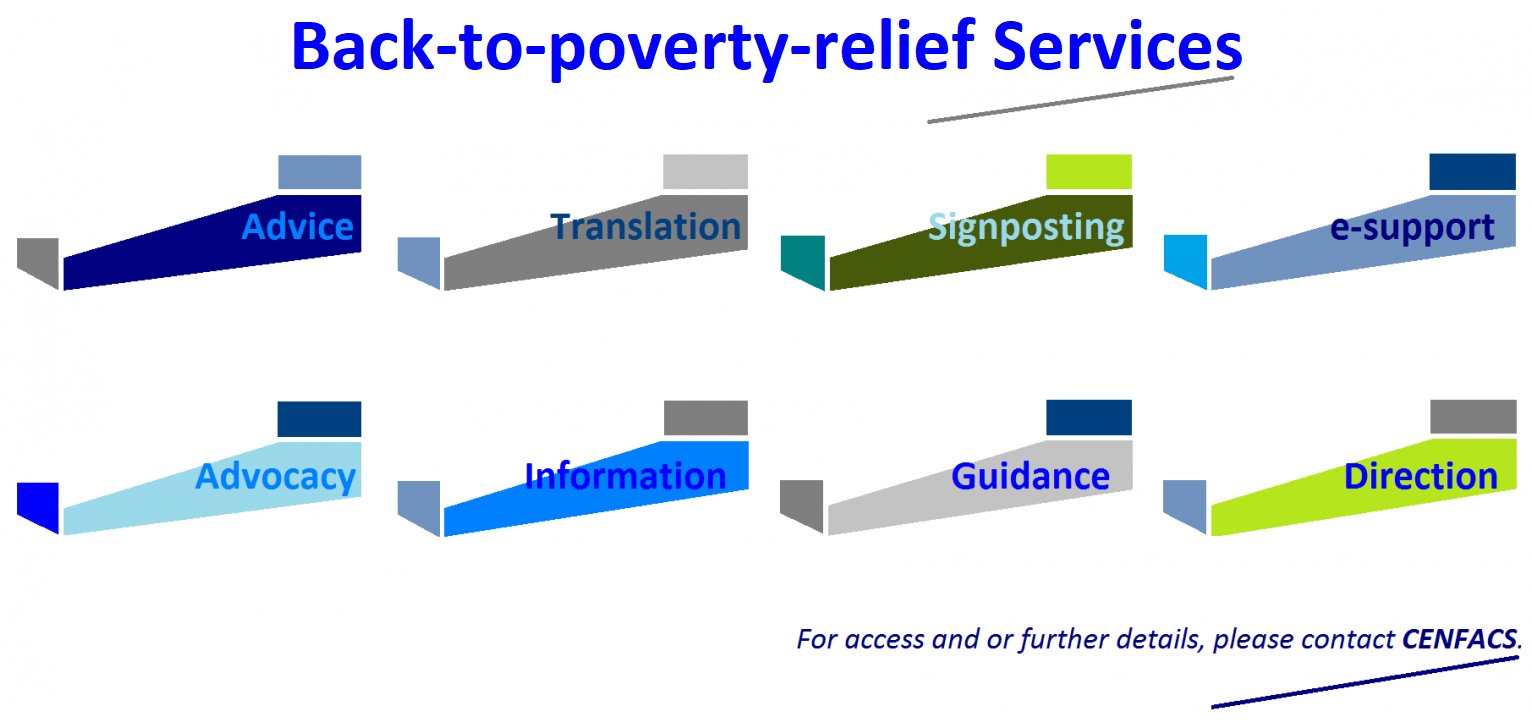
Capacity and skills development, advice, advocacy, translation, information, guidance, support to child educational needs in Africa, signposting, etc.
The programme is generally run around September and can be extended to October depending on the needs and demand in the community and available resources.
• • September: Advice- and Guidance-giving Month
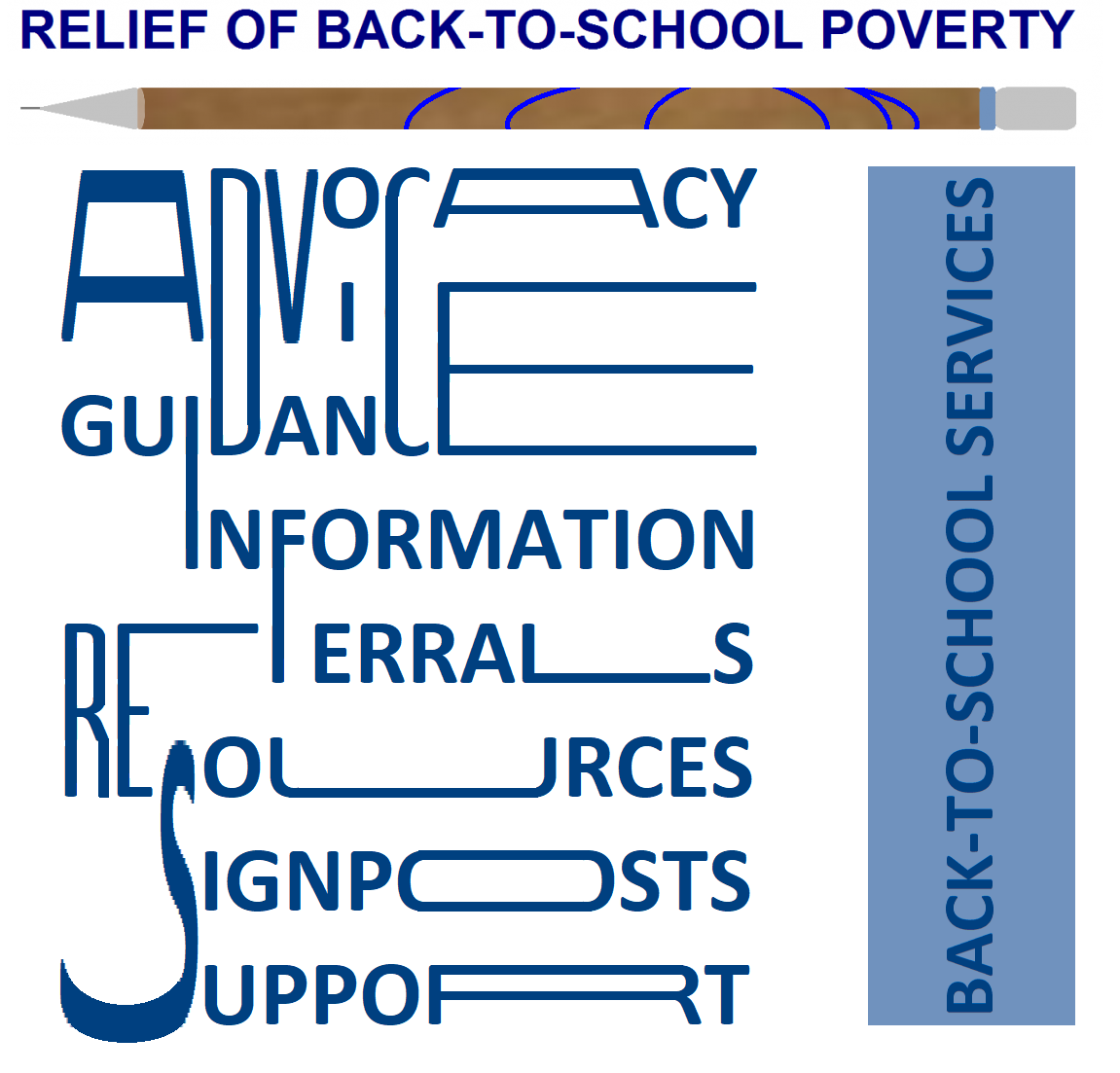
We run Advice service as part of our activities throughout the year. However, Advice is CENFACS’ main theme in September and in the back-to-school season. Because of that, it is more pronounced in September and the back-to-school season compared to other months of the year. In other words, we invest more resources in advice and guidance in September than at any other times of the year.
We provide generalist advice to both individuals and organisations as mentioned above. We also give specialist advice on matters relating to the fields of poverty reduction and Africa’s development.
Where both individuals and organisations need specialist advice in other matters than poverty reduction or Africa’s development, we guide them. We can as well signpost beneficiaries to other organisations/individuals providing specialist advice if beneficiaries’ request for advice is beyond or outside our advice capacity and resources.
Advice and Guidance can be given in the context of Back-to-poverty-relief Programme and outside this context. When Advice and Guidance are given in the context of Back-to-poverty-relief Programme, they become constituent part of this programme like other elements making this programme.
The programme is particular in its kind as it targets certain types of returnees and what these returnees may need.
• • The Particularity of This Year’s Programme
Every September we try to redesign this programme so that it can respond to the needs of the time while taking into account what happened in the past and what may happen in the near future. The Back-to-poverty-relief 2026 programme is designed to include the needs of these returnees. It is also conceptualised to anticipate any changes of economic situation.
Our Back-to-poverty-relief 2026 programme will be delivered in the current context of the UK economy. What is this context?
• • • The Context of UK Economy
It is the one in which:
σ The current bank rate is set at 3.75% as of 30 July 2026, and it is expected to remain unchanged until 7 September 2026, according to the Bank of England (1);
σ The inflation rate in the UK for August was 3.4%, as reported by the Office for National Statistics (2);
σ From the 1st of July to the 30th of September 2026, the price of electricity and gas per kWh for a customer with typical usage on a default tariff, paying by direct debit, is 26.11p per kWh relating to a daily standing charge of 57.19 p for gas, and 7.33p per kWh and 29.04p based on a daily standing charge for electricity, as stated by Smart Meters (3);
σ The average UK private rent in May 2026 was £1,383 per month, rising to £2,294 in London and £1,442 across England, in the opinion of Costliving (4);
σ The cost of back to school in the UK for August 2026, which can vary significantly, is £225, which the average back-to-school bill (that is, families are expected to spend an average of £225 per child on back-to-school essentials, with some spending between £100 and £300), as noted by ‘comparethemarket.com’ (5);
σ The median UK full-time salary is £39,039 roughly £2,636 a month take-home, as given by the Office for National Statistics quoted by CostLiving (op. cit).
However, it is worth noting that in August 2026 UK national strategies rolled out new support ahead of the autumn school term and the upcoming expansion of free school meals.
Key August 2026 Development in these strategies include
σ Early Benefit Payments (by 28/08/2026);
σ Preparation for September 2026 Rollout (with the expansion of free school meals and free breakfast clubs for households on universal credit);
σ The launching of rough sleeping and crisis funds of around £1 billion crisis and resilience funds.
The above-mentioned figures have been considered in the design of our Back-to-poverty-relief 2026 programme. We have also factorised and will consider in this programme other events (like the lingering effects of the polycrises, changing climate, etc.). This year’s programme has been specifically designed to take account of all these indicators, metrics, events and new developments in terms of national strategies.
• • Types of Returnees Who May Need This Year’s Programme
At the end of this Summer 2026 and during this September, we may have five types of returnees, who are:
√ MDPCYPFs who already planned what they want to do and how they will continue to manage the above-mentioned indicators and their other aspects of life
√ MDPCYPFs who already planned their start of September and the end of Summer 2026, but they may need some help to carry on with their plan or family project
√ MDPCYPFs who could not plan because they could be overwhelmed by the impact of these factors/indicators or poverty and may need advice or guidance in terms of coping strategies during this September
√ MDPCYPFs struggling with back-to-school transitions and change from Summer holiday to school return
√ MDPCYPFs who need transitionary skills and transitioning back-to-school programme to adjust to life cycle transition
√ MDPCYPFs who need restoration skills to restore their lives and or things to embrace back-to-school events in a frictionless way.
• • What These Returnees May Need
Because we are dealing with MDPCYPFs, who are supposed to be poor or in need, they could ask for some support in the form of information, advice and guidance to cope or manage their back-to-school problems.
They could even require further advisory support during this September as many of them would face the pressure linked to the end of Summer and the start of Autumn, in particular those families having to deal with the financial pressure of the start of the new academic year for their children.
They need advice and guidance to cope with poverty in which they are already living, to deal with the on-going cost-of-living crisis and the financial pressure to send back to school their children for those having children at schooling age. This is why we have assembled and blended activities and services (that is; the Back-to-poverty-relief Programme) to work with them.
For more details on CENFACS’ Back-to-poverty-relief Programme 2026 and Its Corresponding Projects, please read the details under Main Development section of this post.
• Goal of the Month: Reduction of Back-to-school Poverty in 2026
Our goal for the month of September 2026 is the reduction of back-to-school poverty. To deliver this goal, we need to understand it and work with those who may likely experience back-to-school poverty.
• • What Is Back-to-school Poverty?
Back-to-school poverty refers to the inability to afford the educational requirements of the start of the new school year.
It is the incapability or incapacity for parents and carers to meet the basic life-sustaining needs of the education for their children in terms of purchasing school-related items (such as uniforms, clothes, books, electronics, digital resources, etc.) and providing the basic infrastructures and necessities (whether it is at home or outside) to support the education of their children.
It is the financial strain and exclusion low-income families face when trying to afford required uniforms, supplies, technology, and meals for a new school term.
It creates direct financial and social barriers to education. This situation can exacerbate existing inequalities with children from disadvantaged backgrounds experiencing negative impacts on their attendance, concentration, and overall educational attainment.
This incapacity can include other expenses that compete against or with educational materials; expenses that are school fees, living expenses to start a new school year, transport cost to travel to schools, food, a place to study at home, family relocation expenses, adequate meal to study, a proper bed to sleep well, health costs, basic healthcare and hygiene at home, etc.
As Walden University (6) puts it,
“It [poverty] pervades multiple areas of life – and for parents whose income is below the poverty line, it often means sending their children to school hungry, along with other disadvantages, both academic and otherwise”.
For back-to-school poor children, back-to-school poverty or deprivations could be their inability to cope with changes, new routines and meeting new people. These deprivations have to be added to back-to-school costs.
• • Back-to-school Income and Costs
• • • Back-to-school Income
It refers to the household earnings limit required to qualify for government education grants. These income thresholds and limits cover mainly three areas: universal credit, combined income caps, and means-tested calculations.
In terms of universal credit threshold, many educational grants and free school meals require a net earned income of £7,400 a year or less (after tax and not including benefits) for universal credit claimants.
Regarding combined income caps, certain specific cost-of-living or back-to-school bonus schemes apply a combined parental income limit such as £75,000 or less.
Concerning means-tested calculations, charities and local authorities calculate eligibility using gross or net household income minus specific allowances, assessing capital and savings alongside earnings.
• • • Back-to-school Costs
Without making any international comparisons, it is worth mentioning the back-to-school costs below.
In Africa, the cost of back-to-school items significantly varies by country, ranging from free education in some places to hundreds of dollars or thousands of francs for basic supplies and fees, with costs often representing a substantial portion of family’s income. Although many governments removed primary school fees and introduced free secondary education in recent years, parents still face challenges to cover back-to-school bills and extra expenses.
For instance, in the Democratic Republic of Congo tuition-free primary education was introduced in 2019. However, there are still ongoing costs for families to keep their children in school, such as teacher bonuses, essential school supplies, and uniforms. The total cost significantly varies by region and socioeconomic status.
Another example is Gabon where parents face rising costs for basic items like notebooks and school bags, with some notebooks costing as much as 30,000 CFA francs (around £48 USD), according to local sources.
In the UK, the website ‘confused.com’ (7) indicates that a back-to-school shop costs families on average of around £300 per child, with total yearly expenses climbing much higher.
Similarly, Action for Children (8), notes that basic school supplies and books costs roughly £65 for primary students and nearly £450 for secondary students, on top of expensive uniforms, families also factor in pencil cases, new shoes, school meals, etc.
Last year, the same Action for Children (9) stated that
“According to Child Poverty Action Group and Loughborough University’s Centre for Research in Social Policy, the minimum cost of education in the UK is now over £1,000 a year for a child at primary school. For a secondary school pupil, it costs a family a minimum of £2,300 a year (based on 2024 costings)… With 4.5 million children living in poverty and an ongoing cost-of-living crisis, these costs put huge financial pressure on families who are already struggling to manage high energy bills and inflation … Child Poverty Action Group revealed that learning materials cost a family £64.66 for a child in primary school, and £449.67 for secondary school”.
Those low-income families facing the financial burdens when purchasing essential school-related items (like uniforms, equipment, and digital resources) which can prevent their children from fully engaged with school life, can meet the conditions characterising their children as living below the back-to-school poverty line.
Back-to-school poverty can be tackled. This is why during this September we will be working with those suffering or may suffer from back-to-school poverty so that they can find the tools and means to navigate their way out of this type of poverty.

• • Back-to-school Clinics to Help Tackle Back-to-school Poverty
CENFACS does not provide money to tackle back-to-school poverty; CENFACS can however work with parents of children going back to school in sessions whereby they can have social prescription or the tools to transition or navigate their way out of the back-to-school poverty.
CENFACS can work with the community through its advice service and other services so that the members of its community can find their way out of this type of poverty. Particularly and specifically, CENFACS’ Back-to-school Clinics are designed to work with them to tackle back-to-school poverty or deprivations.
• • • What Are Back-to-school Clinics?
They are temporary or dedicated pre-academic events or at the start of the academic year (generally in September) that provide required support to smooth the beginning of academic year for MDPCYPFs. They help alleviate financial strain and ensure children start the academic year healthy and ready to learn. They combat seasonal poverty through several targeted initiatives.
CENFACS’ Back-to-school Clinics are a sort of community programme that provides services – such as application forms filling, guidance on health services, housing and relocation matters, and linking MDPCYPFs to community and local support services around them. These services cover four areas: finance (application forms), health (guidance on health), housing, and community.
• • • What These Back-to-school Clinics Can Enable
The clinics enable to work with them in the following ways:
√ Reducing the competition between living expenses and educational expenses within the household budget coverage
√ Exploring potential supporters to help them with educational costs for their children education
√ Budgeting with them their living expenses for a better start of the academic year
√ Examining together any issues relating to transport cost to travel to schools or places of education while advising them on net zero CO2 emitting means of transport
√ Discussing ways of saving on energy use, food and meals relating to educational purposes
√ Looking into school catchment area for those looking for a place to study
√ Working on a feasible and realistic plan when studying at home
√ Re-examining back-to-school spending and income budgets for households
√ Supporting family relocation matters (e.g., accommodation in the vicinity of schools and working places for parents)
√ Working with them to tackle hygiene poverty and learning poverty to keep children better engaged with their education and learning
√ Managing transitionary changes from the Summer schedule and routines to the school schedule
Etc.
To benefit from CENFACS’ Back-to-school Clinics, please refer to the above-given timetable relating to Back-to-school Clinics Programme. The first clinic, which will be on Application Forms, will be this coming Friday the 4th of September 2026.

• • • In Focus on Friday 04/09/2026 (11am-2pm): Applications Clinic
This clinic will specifically deal with application forms filling. We shall work alongside potential beneficiaries on back-to-school application forms. This will involve practical guidance and navigation of local authority grants, school hardship funds, etc.
During consultation hours, we shall deal with back-to-school and relief grant applications (like Racing Welfare Return to School Grant which closes normally on 04/09/2026). This back-to-school support includes guidance on searching the council’s portal, applying for school discretionary internal hardship funds, checking personal statement, etc.
Those who would like to apply for grant, they need to prepare all the required evidence such as proof of household income, Child Benefit evidence, and proof of Universal Credit/means-tested benefit.
The above is our poverty reduction goal for this month, which is part of our back-to-school campaign and which we are asking to our audiences and supporters to help or promote.
• • Implications for Selecting the Goal for the Month
After selecting the goal for the month, we focus our efforts and mind set on the selected goal by making sure that in our real life we apply it. We also expect our supporters to go for the goal of the month by working on the same goal and by supporting those who may be suffering from the type of poverty linked to the goal for the month we are talking about during the given month (e.g., September 2026).
One way of the many ones of supporting this goal/back-to-school clinics is to provide us with vouchers which will be passed on to MDPCYPFs approaching us for help and support.
For further details on the goal of the month, its selection procedure including its support and how one can go for it, please contact CENFACS.

• Activity/Task 9 of the Alternatives (‘A’) Year and Project: Provide Advisory or Guided Support to People Seeking Alternatives when Returning to Poverty Relief
This Activity/Task consists of wraparound support, resilience services, or holistic advice infrastructure. It involves a gateway to long-term stability by targeting the root causes of problems (e.g., financial distress). It requires using appropriate approaches or methodologies to realise it. There are approaches that one can try to undertake this Activity/Task; just as there are metrics to measure what has been achieved.
• • Core Approaches to Alternative Support
The following approaches can be used:
σ Resilience Services
These are programmes that provides services like financial literacy, digital inclusion, and help navigating alternative income smoothing tools.
σ The Pathways from Poverty Model
It embeds specialist advice worked into emergency relief settings (like food bank) where people in need can have their queries and enquiries directly dealt with.
σ Integrated Advice Infrastructure
It covers co-located advice networks to provide extensive support (e.g., money coaching or legal advice) to build self-sufficiency rather than repeat reliance on a safety net.
These approaches can be backed by the use of metrics.
• • Metrics Relating to Providing Advisory or Guided Support to People to Find Alternatives when They Are Back to Poverty Relief
When individuals exit or return to poverty relief programmes only to fall back into them (often referred to as poverty recidivism or cycling), advisory and guided support systems step in to build long-term, structured resilience.
To evaluate the success of this advisory and case-management support, organisations use a matrix of Output, Outcome, and Impact/Resilience metrics. These metrics include the ones given below.
a) Process and Output Metrics (The Advisory Footprint)
These measure the volume, reach, and immediate execution of the guided support programme. They include
σ Advisory Engagement Rate
σ Action Plan Completion Rate
σ Referral Concurrency.
b) Intermediate Outcome Metrics (The Distance Travelled)
These evaluate the short-to-medium-term behavioural shifts, resource acquisition, and mindset changes resulting from the guidance. They cover
σ Financial capability metrics (e.g., creation of an emergency micro-savings fund)
σ Employability and skills (e.g., enrollment and graduation from skill-upgrading or vocational training)
σ Distance travelled scales (e.g., goal achievement rate).
c) Impact Resilience Metrics (Long-term Structural Changes)
These metrics measure whether the alternatives provided truly broke the cycle of poverty and established permanent financial independence. They are
σ Recidivism/return rate deflection
σ Velocity of re-exit
σ Lived experience and resilience gap
σ Fiscal demand reduction.
The aforementioned metrics can be used for those who return and/or look for alternatives in poverty relief.
The above is our Activity/Task 9 of the Alternatives (A) Year/Project.
Those who would like to undertake this Activity/Task can go ahead. For those who need some help before embarking on it, they can speak to CENFACS.
For any other queries and enquiries about the ‘A’ project and this year’s dedication, please contact CENFACS as well.

Extra Messages
• Implementing Intergenerational Financial Planning for Families – In Focus from Week Beginning Monday 02/09/2026: Financial Literacy and Mentorship
• All-in-one Double-entry Journal of Happiness, Healthiness and Wellness with the Triple Bottom Line for Summer 2026 – It is time to share the contents of your creative activity
• Unlock Your Summer 2026 Holiday Data and Tell Your Story

• Implementing Intergenerational Financial Planning for Families – In Focus from Week Beginning Monday 02/09/2026: Financial Literacy and Mentorship
Perhaps, the best way of kicking off this first topic of Implementing Intergenerational Financial Planning for Families is to explain financial literacy and mentorship.
• • What Is Financial Literacy?
Financial literacy can be defined in many ways. One of its definitions comes from ‘financialstrategists.com’ (10) which argues that
“Financial literacy is the capability to understand financial concepts and apply this skill in decisions related to savings, investments and debt management”.
This definition can apply to both adults and children.
• • Explaining Financial Mentoriship
Let us explain financial mentor. The Harold Financial Dictionary (11) defines a financial mentor as
“A trusted guide or counsellor that helps a person in the arena of business, personal finance and investments”.
Financial mentoriship will be a collaborative, educational relationship where an experienced guide/person helps someone build money management skills, set goals, and take control over their personal finances.
In the context of the Implementation of Intergenerational Financial Planning for Families, the two concepts can be used and CENFACS can work with families looking at this implementation via these concepts.
• • Working with Families on Financial Literacy and Mentoring
CENFACS can work with families on financial literacy by offering
σ tips and hints about money management (e.g., budgeting, saving, and cutting household costs)
σ personal guidance for families facing urgent money stress
σ support to families to teach children and teens basic money habits through fun, age-appropriate games and lessons
σ digital tools through sharing easy-to-use apps, spending trackers and printable budget planners.
CENFACS can as well work with them on financial mentoring by providing
σ free, one-on-one budgeting support
σ online practical money workshops.
This process of working together involves building trust, assessing their needs, creating action plans and teaching skills (like mindful and thoughtful consumption and budget, avoiding scam loans, etc.).
Those who would like to get further information about Financial Literacy and Mentorship, they can as well let us know.
Similarly, those who may be interested in Implementing Intergenerational Financial Planning or in discussing their Intergenerational Financial Plan, they should not hesitate to contact CENFACS. Equally, those who would like to tackle intergenerational poverty can communicate with CENFACS.

• All-in-one Double-entry Journal of Happiness, Healthiness and Wellness with the Triple Bottom Line for Summer 2026 – It is time to share the contents of your creative activity
After six weeks of journaling, it is time to start sharing the contents of your journal. Indeed, during the last six weeks of Summer, some of you have been journaling on one of the six predictors that explain happiness and healthiness, which are:
income, social support, healthy life expectancy, generosity, freedom, and trust.
They have been also journaling on the components of wellness. They have done it by integrating the Triple Bottom Line into their journals.
As previously said, the contents of these journals could be shared with the community at the end of Summer 2026 as a Summer memory or souvenir. Although Summer is not yet officially over, those who have created their All-in-one Double-entry Journal of Happiness, Healthiness and Wellness with the Triple Bottom Line for Summer 2026 can start sharing with the community. But, what is content sharing?
• • Content Sharing of Your All-in-one Double-entry Journal of Happiness, Healthiness and Wellness with the Triple Bottom Line for Summer 2026
The content Sharing for your Journal of Happiness, Healthiness and Wellness refers to the sharing of user-generated content that showcases your experiences about the applications of Happiness, Healthiness and Wellness projects during Summer 2026.
However, in order to share your contents you may need a strategy, tools and metrics as well as to monitor your social performance.
• • Content Sharing Strategy
You need to plan or strategize yourself the way in which you want to share your content. In other words, you need to have a process of or planning and conducting some content sharing tasks.
• • Content Sharing Tools
You also need implements or instruments to deliver your content to us and others.
For example, if you want to share you content online you can refer to online tools to do it. Let say you use Twitter. You can use Twitter feed to share your content to a range of platforms. You can go online to share your content. You can use online tools to do it. You can share it multiple times. You need to have social sharing plugins on.
Speaking about share phase from memory card to memorable stories, the website ‘max-productive.ai’ (12) suggests to use CapCut AI, which has completely free core features and directly exports to social platforms. It also proposes to utilise Podcastle, which turns your travel stories into podcast.
• • Metrics for Content Sharing
These metrics measure your physical, mental, and emotional progress over time.
σ Happiness Metrics
They include mood ratings, gratitude entries, stress levels, and social connection.
σ Healthiness Metrics
They encompass sleep duration and quality, nutrition tracking, physical activity, and symptom logs.
σ Wellness Metrics
They are mindfulness or thoughtfulness minutes, energy levels, work-life balance, habit consistency.
These metrics can be used when sharing your journal.
• • Monitoring Your Social Performance
You can monitor your performance in content sharing.
For example, you can monitor the traffic you get to your posts relating to your All-in-one Double-entry Journal of Happiness, Healthiness and Wellness with the Triple Bottom Line for Summer 2026; whether it is online or offline.
Please share with the community your experience of happy, healthy and good Summer time through the contents of your journal to help build a better Summer holiday experience and memory.
• Unlock Your Summer 2026 Holiday Data and Tell Your Story
In our July and August 2026 communications, we asked everybody to store and keep their Summer data so that when we all return in September, we can report back or share parts of our Summer experiences that are shareable and spreadable.
Now some of you are back, we can try to feedback our poverty-reduction and development experiences of using Happiness, Healthiness and Wellness projects and of any other similar activities over the Summer period. To feedback, you may need ways of unlocking your summer data.
• • Ways of Unlocking Your Summer Data
To unlock your Summer data, one can proceed with the following:
σ Have your holiday records updated, complete and accurate
σ Know where your data is stored or sitting (e.g., mobile phone camera, laptop, tablet, memory card, etc.)
σ Extract your data including images from sources where they are stored
σ Use technology or manual means to unlock them
etc.
• • Tools to Unlock Your Summer Holiday Data
There are many tools that can be used to unlock your Summer holiday data.
For instance, one can use AI report generator tools for smart reporting (13). Tools (like Pictochart, WPS AI or ChatGPT) can streamline your reporting process and remove friction in your Summer reporting.
• • What You Can Report Back or Story You Can Tell
Apart from the above-mentioned experiences, one can feedback any creations, any other experiences, any community practices and any volunteering stories, if they volunteered, they had over the last two months.
One can report back a personal Summer experience as well.
Likewise, one can combine their Summer journal (about predictors that explain happiness and healthiness) and this reporting back exercise into a single or all-in-one Summer report.
For those who managed to store their Summer data and who would like to share their experiences, this is the time to start unlocking their Summer data and preparing to tell their Summer story.
• • The Good Thing about Sharing Your Experiences
Sharing your experiences with us helps to keep the CENFACS Community active, engaged, connected and grow together. It also contributes in carrying out prescriptive analytics that enables to use smart data discovery capabilities to predict market developments, trends and insights to help relieve or possibly end poverty and hardships within our community and beyond.
Please share your poverty-relieving and development experiences and contents with us; parts of your experiences and contents that you think are shareable and perhaps spreadable.
Should anyone have any concern about data protection issues (in terms of UK General Data Protection Regulation) regarding the sharing of their information, please let CENFACS know. We will be able to assist.
Message in French (Message en français)

• L’Examen de la Performance Financière du CENFACS – Un Extrait de la Revue d’Impact Annuel de CENFACS pour l’Exercice Financier 2025/2026
Ce qui suit est le résumé de nos recettes et paiements pour l’année se terminant le 30 juin 2026.
En ce qui concerne les dépenses : la transition numérique, le télétravail ou le travail hybride, la dématérialisation des processus et la réduction du nombre d’événements en présentiel organisés par le CENFACS ont entraîné une baisse des dépenses liées aux postes « Papeterie et Livres » ainsi qu’« Informatique (Consommables) ». Ces deux postes ont enregistré une chute importante, respectivement de 51 % et de 42 %. Nous avons également moins dépensé pour les Transports et Déplacements (-57 %) ainsi que pour les Rafraîchissements (-25 %). Cette diminution s’explique par le recours au télétravail et aux réunions virtuelles, par la réduction des événements en présentiel et, pour le poste « Transports et Déplacements », par l’utilisation d’alternatives telles que les transports en commun. S’agissant des Rafraîchissements, la baisse est due à une moindre fréquentation des événements en présentiel ainsi qu’à la hausse du coût des fournitures. Enfin, les frais divers de bureau ont également sensiblement diminué, en raison de reclassements de dépenses et d’une réduction des activités de bureau.
Outre ces baisses, nous avons également enregistré certaines hausses : le poste « Bénévoles » a ainsi augmenté de 25 %, reflétant l’expansion de nos programmes et de nouveaux investissements, ainsi que les pressions inflationnistes sur nos finances. Le poste « Impression et Photocopie » a également progressé en raison d’activités de collecte de fonds soutenues et du lancement de nouvelles campagnes. La hausse des coûts du marché et les changements d’organisation ont entraîné une augmentation des frais liés aux locaux et aux charges courantes (eau, électricité, etc.), que le travail s’effectue dans des bureaux ou à domicile ; ces dépenses ont ainsi grimpé de près de 46 %.
D’autres postes ont connu une augmentation modérée, comme ceux relatifs à la Téléphonie (fixe et mobile) et à Internet (+4,9 %). De même, les tarifs élevés de l’énergie et les conditions météorologiques extrêmes (nécessitant le recours à la climatisation ou au chauffage) ont fait grimper les dépenses de charges courantes. Concernant nos abonnements informatiques, le coût des services d’hébergement web et de connexion haut débit a augmenté, entraînant mécaniquement une hausse du montant global de nos abonnements. Ces coûts ont progressé de 12 %, reflétant la tendance actuelle à la hausse des prix pour ce type de services.
En ce qui concerne la collecte de fonds et les recettes, le défi consistant à réunir les sommes nécessaires pour répondre aux besoins de la communauté a persisté. Cette situation s’explique en partie par l’effet cumulé des répercussions persistantes de la hausse du coût de la vie et de l’incertitude économique, facteurs qui ont continué de susciter hésitation ou réticence chez de nombreux donateurs et bailleurs de fonds individuels. Par ailleurs, les réductions de l’aide internationale ont eu une incidence indirecte sur la manière dont le public soutient les causes d’intérêt général en Afrique.
Il convient de noter que certains fonds promis n’étaient pas encore parvenus au moment de la clôture des comptes. De plus, nous avons soumis des demandes de financement auxquelles les donateurs/rices, bailleurs/res de fonds ou organismes subventionnaires potentiels n’ont pas encore répondu. Il est donc permis d’espérer obtenir des réponses favorables ou de réussir à mobiliser des fonds.
Concernant la trésorerie, nos fonds ont maintenu une tendance à la hausse au cours des trois dernières années. Toutefois, pour l’exercice 2025-2026, nous avons observé un retournement de situation. Cela s’explique par le retard des versements de la part de donateurs/rices s’étant engagé(e)s à fournir des fonds ; les sommes ne sont pas parvenues avant la clôture de notre exercice comptable, notre comptabilité étant tenue sur la base des encaissements et des décaissements (et non selon le principe de la comptabilité d’engagement). Il convient également de prendre en compte l’impact de l’inflation sur les mouvements de notre trésorerie.
Nous avons continué à réaliser des économies sur les budgets relatifs aux activités à l’étranger, à la publicité et à la promotion, à la traduction, au mobilier et au matériel de bureau, aux bénéficiaires des projets, à la recherche et au développement, ainsi qu’aux frais de collecte de fonds. Ces économies réalisées sur les dépenses nous ont permis d’éviter un déficit important dans notre compte de recettes et de dépenses pour l’exercice.
Nous espérons qu’une fois les fonds promis reçus et les réponses positives aux demandes obtenues, notre trésorerie se redressera et continuera de croître régulièrement au cours de l’exercice 2026-2027 et au-delà. Nous pouvons également escompter que les fruits de nos efforts de levée de fonds — fondés sur des modèles de financement alternatifs — ainsi que ceux de nos nouveaux modèles économiques se concrétiseront pleinement durant le nouvel exercice (2026-2027) et par la suite.
Des détails supplémentaires sur l’Examen d’Impact Annuel de CENFACS 2025/2026 peuvent être demandés auprès de CENFACS.

Main Development
• Back-to-poverty-relief Programme 2026: Programme for Pre-autumn Season 2026
The following covers our programme for this pre-autumnal season:
∝ Back-to-poverty-relief Projects
∝ Open Days under Back-to-poverty-relief Programme
∝ Back to Humanitarian Relief Work by Supporting Crises-impacted Children in Africa
∝ Back to the Upkeep of the Nature This September 2026
∝ Back to Advisory Support This September 2026
∝ Back to the Upkeep of the Nature with the Theme of “Red Space”
∝ Red Space-focused Note from Wednesday 02/09/2026
Let us briefly explain these contents.
• • Back-to-poverty-relief Projects
These initiatives aim at reducing poverty particularly among multi-dimensional poor children, young people and families (MPCYPFs). They are designed to work with MPCYPFs to find answers to back-to-school pain points they may be experiencing.
They focus on providing support and services to help them meet their needs after school breaks or holidays; in doing so enabling them to start the school year with less hardship or friction. These projects are part of a broader effort to assist them and promote a future free from poverty.
As previously mentioned, most of our projects and programmes are organised to take into account the lives and needs of our beneficiaries, supporters as well. Some of them will be back this week after Summer break. They are back for the New Academic Year and New Relief, year for which we have prepared projects and programmes to work with them so that they can meet their existing, challenging, changing and emerging needs – the back-to-poverty relief projects and programmes.
Amongst the back-to-poverty-relief projects and programmes, there are these two ones: Open Days and Support to Children.
• • Open Days under Back-to-poverty-relief Programme
Since we set up hybrid way of delivering service as a legacy of the coronavirus, we continue to operate virtually/online and in-person. There are reasons we operate both ways.
One of these reasons is that it is not always easy for people, especially those who have some physical handicaps and parents with small kids, to in-person move and meet service providers if this service provision cannot physically come to them even if the need is pressing.
Where we are in a position to in-person organise the service requested, users can in-person access the given service prior to arranging an appointment.
So, our open days will be both virtual and in-person. They are virtual days to enable those in need but cannot move physically to access services. They are in-person for those who prefer in-person open days. For the latter ones, they need to book an appointment for in-person open day to happen.
• • • What are virtual and in-person open days?
Virtual and In-person Open Days (VIODs) are days and hours when CENFACS Community members and the members of sister communities can have real chance or taste of poverty reduction experience with CENFACS. They are part of a back-to-poverty-relief initiative or campaign organised by CENFACS during this September 2026 to enable people in need to access our advice service and other similar services in order to reduce or end poverty linked to their situations or conditions of life.
• • • How VIODs work
Our Virtual Open Day (VOD), which will be every Fridays of September 2026, will be held from 10 am to 2 pm.
You can access VODs by contacting CENFACS.
You do not need to register with us.
Every Fridays, you can either email or phone or even text between 10 am and 2 pm.
Our In-person Open Day (IOD), which will also be every Fridays of September 2026, will be held from 10 am to 2 pm. An appointment needs to be booked to have in-person open day.
For more on CENFACS’ Virtual and In-person Open Hours and Days as well as how they work, please contact us.

• • Back to Humanitarian Relief Work by Supporting Crises-impacted Children in Africa
Another back-to-poverty-relief initiative for this September 2026 is Support for Crisis-impacted Children in Africa, particularly
σ Children in Humanitarian Emergencies
σ Whose International Aid Was Cut
σ In Conflict-stricken and Climate Change-affected Areas of Africa in this September and beyond.
The majority of these children may not start school or return to school this September because of the following events:
σ The outbreak of fighting internally displacing them (like the Eastern part of the Democratic Republic of Congo) and the Ebola virus
σ Violence against them as it is happening in the Central Sahel region of Africa
σ Severe weather conditions (e.g., flooding in Cameroon)
σ The catastrophic ongoing civil and displacement crisis (like in Sudan)
σ The severe climate shocks and flooding that submerged and closed numerous learning spaces (e.g., in Horn of Africa)
σ Severe acute malnutrition (e.g., in East Africa)
σ Aid reductions and regional conflicts placing millions of children at immediate risk of dropping out or missing enrollment (like in West and Central Africa)
Etc.
As a result of these events on children not starting or returning to school this September, we shall revisit the following nine humanitarian appeals, which are:
1) Act in the Interest of Children’s Education (September 2025 Education Appeal)
2) Autumn 2025 Humanitarian Relief and Nature Conservation Appeals
3) Support Children with Diverse Educational Needs and Victims of Crises with No End in Sight in Africa
4) The Internally Displaced Persons of Central Sahel Region Need Your Support
5) Halving Poverty for and with the Unprotected Children in Africa
6) People with Acute Needs in Africa Want to Rebuild and Renew Their Lives: Can You Help?
7) The Severe Humanitarian Crisis-impacted People of Mali Need Your Positive Influence Right Now: Can You Help?
8) End Childhood Distress in Africa
9) Ebola Humanitarian Appeal.
These appeals were launched under the Light projects.
The people on whose behalf these appeals were made included children. Children were amongst displaced persons, the victims of conflict, the impacted of natural events, the Ebola victims, and food insecure as part of appeal beneficiaries.
While one can still ask the progress made to save and rebuild these crises-impacted lives, one can also question about the support that the children affected by these crises are receiving and/or received, especially at this challenging time of the pressures of the costs of living.
This questioning is relevant as we are in September when a new school or academic year starts in many parts of the world and of Africa. This questioning is even founded at this time when many parents will struggle to provide school uniforms and equipment to send their children back to school.
Parents and children have another battle where school infrastructures and buildings were destroyed because of events like wars and natural disasters, or simply occupied as refuges by the war and climate change victims.
These negative effects are even greater for children from poor places in developing countries (like of Africa) where educational opportunities have been denied to many of them regardless of the current global economic situation.
So, during this September we will be working on this back-to-poverty-relief initiative to explore ways of keeping education alive for these unfortunate children living in those parts of Africa in crisis. Through this initiative, we will help get education and learning back on track for these children.
For further details about this initiative, please contact CENFACS.
• • Back to the Upkeep of the Nature This September 2026
September is also the month we resume our advocacy work on the upkeep of the nature.
Back to the Upkeep of the Nature this September 2026 will revolve around three areas of work, which are: a new advocacy project called “NYIAMAMINENE”, access to natural spaces with the theme of “Red Space” and an e-discussion on circular economy (on how to improve circularity inside your household) and actionable transition plan. Let us summary the contents of these three areas.

• • • “NYIAMAMINENE” Project
Normally, our advocacy work on the upkeep of the nature starts from the protection and care of animals in Africa from illegal killings, extinction and poaching. This year, we shall do the same. Our work will be on those large species that have been considered as the most endangered species in Africa in 2026 (14).
Indeed, recent species-specific statistics outline the current state of Africa’s most at-risk large mammals. To name the few, we can mention Black Rhino (Diceros bicornis), African Forest Elephant (Loxodonta cyclotis), African Gorillas, West African Lion (Panthera leo), Mountain Bongo (Trajelaphus eurycerus isaaci), African Wild Dog, Addax Antelope, and Amur Leopard. They are all endangered, with some even critically endangered.
In the last week of September 2026, we shall focus on 5 key critically endangered large mammalian species (i.e., Black Rhinoceros, African Forest Elephant, Eastern Gorilla, Ethiopian Wolf, and Addax Antelope) through our new initiative called ‘NYIAMAMINENE’.
• • • • What Is NYIAMAMINENE?
NYIAMAMINENE – which stands for Nurturing Yearning Into Action Maintaining All Mammals In Natural Environment Not Exploited – is an advocacy for the critically endangered large species in Africa.
Far from being a philosophy of compassionate conservation and radical rewilding, NYIAMAMINENE addresses the moral imperative to transform human empathy for wildlife into systemic protection, ensuring all mammalian species can live autonomously in their natural habitats without human exploitation.
NYIAMAMINENE can be broken into three direct conceptual frameworks, which are 1) Nurturing Yearning into Action 2) Maintaining All Mammals in Natural Environment 3) Not Exploited.
1) Nurturing Yearning into Action
This is the psychological and activist component. It argues that simply having passive yearning – a desire or emotional empathy for animal welfare – is not enough. That internal feeling must be systematically nurtured into tangible legal and physical actions. This includes policy changes, anti-poaching initiatives, habitat restoration, and the dismantling of commercial wildlife trades.
2) Maintaining All Mammals in Natural Environment
This is ecological and conservation component, heavily tied to rewilding. Scientists have found that reintroducing and protecting large mammalian assemblages (such as apex predators and large herbivores) is the most effective way to restore degraded ecosystems. It emphasizes that mammals should not live in artificial, captive, or fragmented spaces, but rather in functioning, natural environments where they can display their innate, evolutionary behaviours.
3) Not Exploited
This represents the Animal Rights and Abolitionist framework. It shifts the goalpost away from traditional ‘animal welfare’ (which merely seeks to make human exploitation, like zoos, circuses, or farming, less cruel) and moves towards true animal autonomy. It asserts that mammals possess agency, dignity, and a right to live entirely for themselves, free from being treated as human commodities.
So, NYIAMAMINENE is a new advocacy project planned by CENFACS to help protect critically endangered large species and keep them up in their natural habitat in Africa.
According to ‘saeon.ac.za’ (15),
“Recent wildlife data reveals a complex and critical landscape for Africa’s critically endangered large mammals. While intensive conservation initiatives have led to stabilization or marginal recovery for certain populations, a landmark 2026 study published in Nature highlights that Sub-Saharan Africa has lost 24% of its total biodiversity since pre-industrial times, with large mammals suffering the greatest losses, dropping more than 75% in historical abundance”.
There are ongoing efforts to prevent further extinctions. As part of these efforts, we are setting up the ‘NYIAMAMINENE’ project, which will add value to these efforts. ‘NYIAMAMINENE’ project, which has already kicked off, will help us to advocate for a safe life for large mammalian species.
• • • Red Space
Another initiative featuring this September 2026 is our advocacy on lands which will be conducted under the theme of ‘Red Space’. Red Space takes stock of the advocacy on spaces and spatial analysis of poverty or spatial poverty theories which we worked on since September 2019.
In September 2019, we worked on the Protection of the Oceans (particularly the waters surrounding Africa and the rivers and lakes in Africa).
In September 2020, we carried on with the advocacy on waters through the theme of “Blue Spaces”.
In September 2021, we had a 3-week work on sea level rise as notes for the “Blue Spaces”.
In September 2022, we had three weeks and five days of advocacy work on safe, inclusive and accessible Green spaces.
In September 2023, we continued our space analysis and advocacy with the theme of “Grey Spaces” and space implications for poverty reduction and sustainable development.
In September 2024, we advocated about Brown Spaces, the redevelopment of these spaces (that is, brown space or brownfield redevelopment).
In September 2025, we worked on Orange Spaces, on areas shown as orange on a poverty map, which represent locations with rising poverty rates or increasing spatial concentrations of deprivation.
This September 2026, we are dealing with Red Space. Red Space generally refers to regions or objects in the universe that appear red due to redshift or the presence of cooler, older stars.
In the context of our advocacy on spaces and spatial analysis of poverty or spatial poverty theories, Red Space will be approached in terms of urban and agricultural planning where other spaces (like blue and green) are considered. In modern urban and regional planning geography, ecological networks are categorized into blue (water), green (vegetation), and red spaces (commercial, tourism, and leisure infrastructure). It is this categorization that will make our Red Space campaign for this September 2026.
The notes for this new advocacy, which start from this 2nd of September 2026, are given below.
• • • E-discussions on Circular Economy and Actionable Transition Plan
To conclude the month, we will be continuing our discussions on ways of improving circularity inside households. The themes for circular economy discussions will be centred on shifting from a ‘take-make-waste’ linear model to a ‘reduce-reuse-recycle’ system by adopting practices and strategies that minimise waste, keep products and materials in high-value circulation and regenerate nature.
We have planned to approach three themes, which are:
a) Thoughtful/Mindful Consumption
b) Product Longevity and Maintenance
c) Resource Efficiency.
These e-discussions will involve new technologies (like Artificial Intelligence) to help bring further circularity inside home and to find out how our community members are doing in terms of economic circularity.
At the end of these discussions, we hope to reach an agreement on the development of an actionable transition plan. The latter is a step-by-step roadmap that will turn our discussed ideas into measurable projects, clear responsibilities and defined timelines to achieve the circular economy goals and aim.
Briefly, Back to the Upkeep of the Nature this September 2026 will include the ‘NYIAMAMINENE’ advocacy project, access to natural spaces with the theme of ‘Red Space’ and e-discussions on circular economy with an actionable transition plan.
• • Back to Advisory Support This September 2026
As above mentioned, Advice is CENFACS’ main theme for September. We provide advice to both individuals and organisations.
• • • Advice Service for Individuals
Some of you are aware that most of CENFACS services in the UK are designed to support multi-dimensional poor children, young people and families (CYPFs). After the summer break, many of them will come back to start their life again. From September onward, they will go back to school for CYPs and to work and training for parents and guardians.
They may need or ask for support to restart or look for occupational opportunity or even just resume their routine activity in September. Their needs could include the following:
∝ Finding a new school or a nursery for children
∝ Registration to health services
∝ Finding accommodation or relocating
∝ Accessing training opportunity or employment
∝ Looking for a new occupation to deal with the economic effects of the costs of living
∝ Finding help to adjust their life after Summer break or any period of inactivity
∝ Looking for direction to overcome the lingering effects of the cost-of-living crisis
∝ Finding ways of resetting or changing their systems of living
∝ Moving forward to protect gains underscored on poverty relief
∝ Building upon progress made on poverty reduction
Etc.
Besides the above main menu, we shall have Transitioning Back-to-school Programme. This is an experiment or experience of working with parents or families who may struggle to manage back-to-school transitions for children suffering from mobility to cope with changes, new routines and meeting new people.
We can provide advisory support to them. Where our capacity is limited, we can refer and/or signpost them to relevant specialist services and organisations to help them meet their needs.
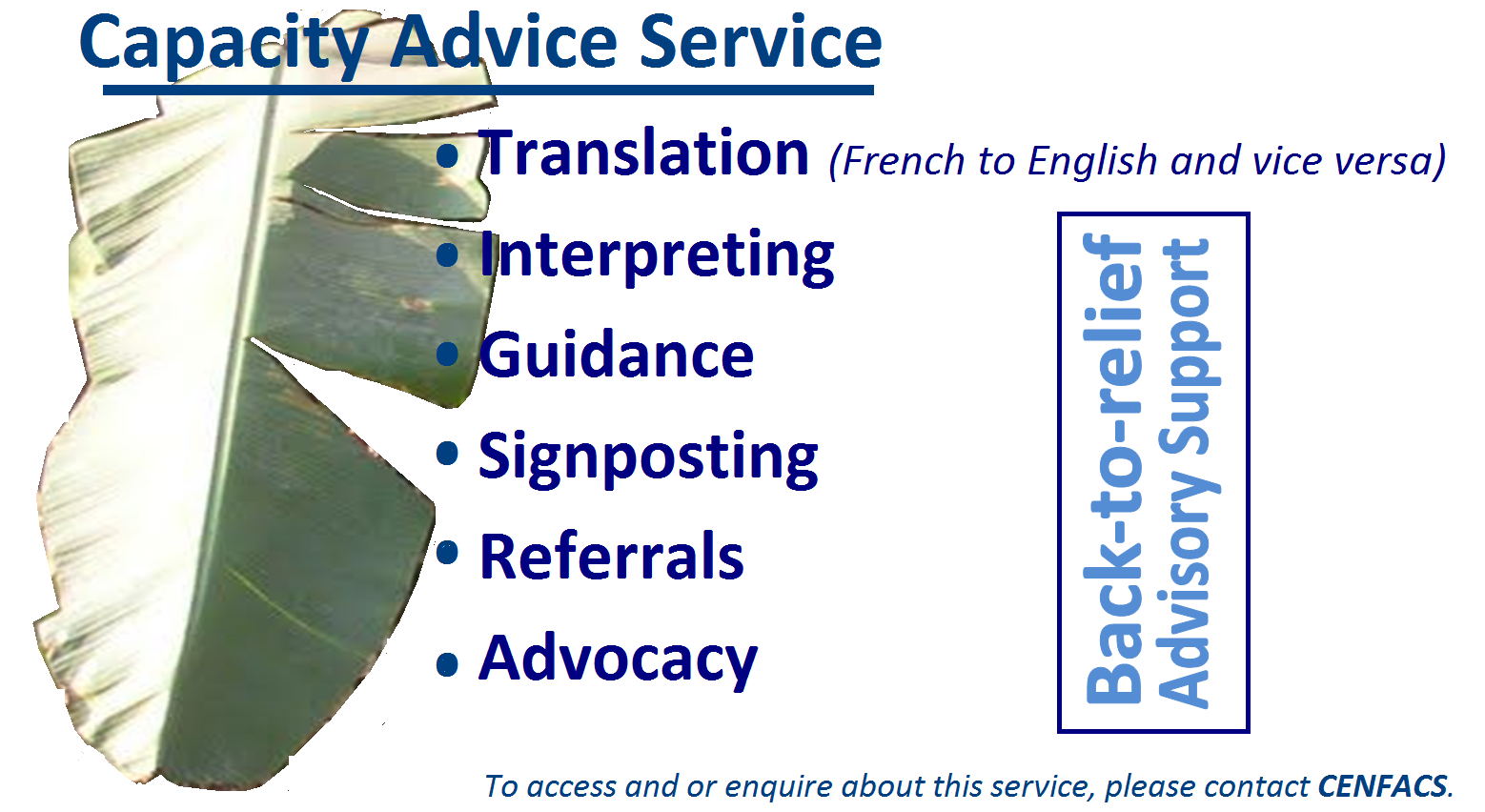
We do it under CENFACS’ Capacity Advice Service which was established since 2004 (through CENFACS’ Capacity Advice and Development project for Croydon’s African and Minority Ethnic People) to help individuals gain various types of help.
The types of help we provide include:
√ Translation (English to French and vice versa)
√ Interpreting
√ Generalist advice
√ Guidance
√ Signposting
√ Referral
√ Advocacy
Etc.
As we are in a digital era, we adapted the provision of the above listed help while still retaining its essence. Four years ago, we introduced leaves in this service to make it Leaves-based Advice Service.
You can contact CENFACS for the range of issues included in this service and to find out if your problem can be dealt with.
Regarding Translation service, we would like to remind everybody that the 30th of September 2026 is the International Translation Day. For those who need a translation service, they can contact us on the day for translation. But, they need to let us know at least three days before so that we can include their request in our plan.
• • • Advice Service for Organisations
The same advice service applies to overseas and Africa-based Sister Organisations.
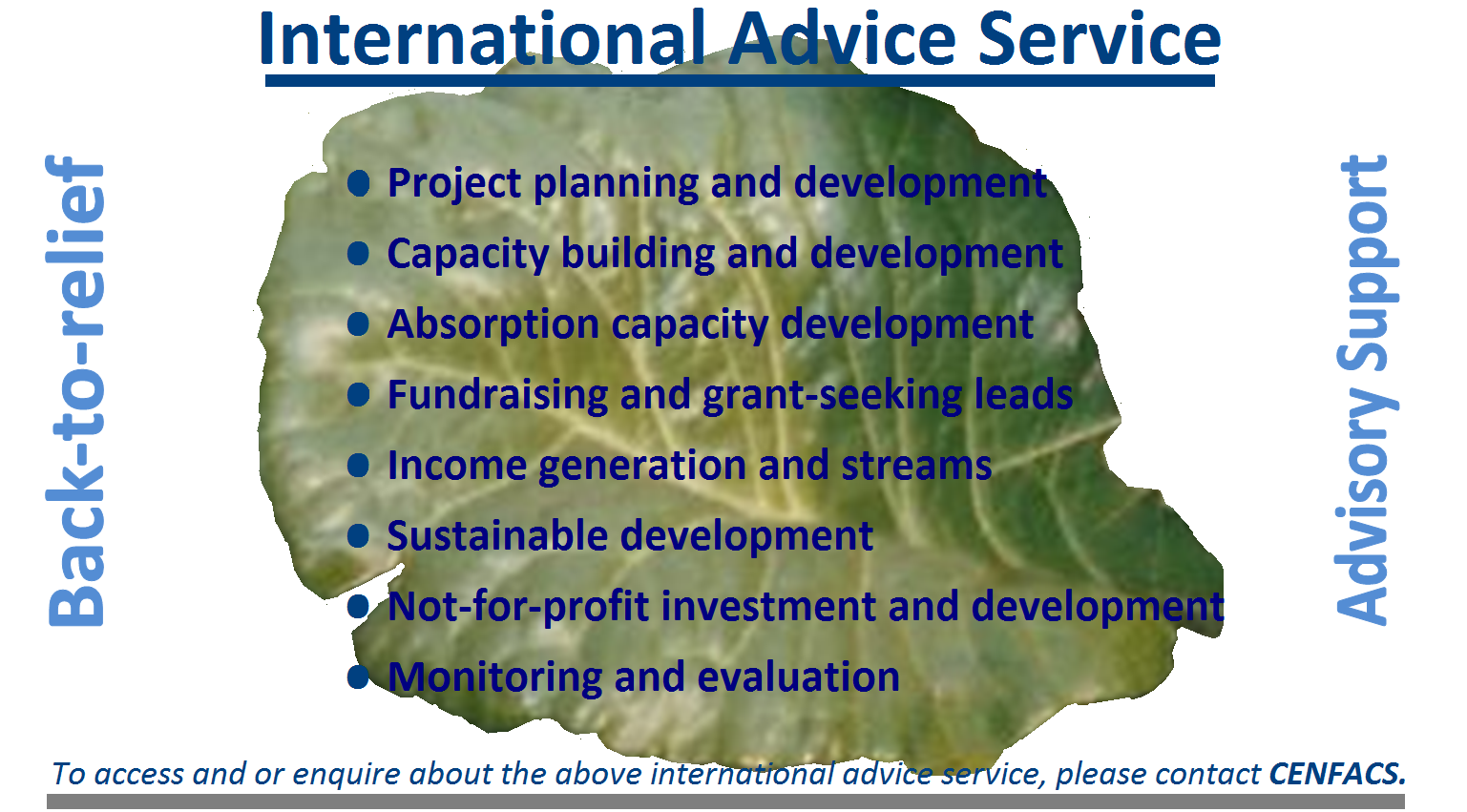
Under our international advice service, we can advise them on the following matters:
√ Capacity building and development
√ Project planning and development
√ Poverty reduction within the context of Africa Continental Free Trade Area
√ Not-for-profit investment and development
√ Absorption capacity development
√ Fundraising and grant-seeking leads
√ Alternative funding strategies
√ Income generation and streams
√ Sustainable development
√ Not-for-profit investment and impact investing
√ Monitoring and evaluation
Etc.
Again, where our capacity to advise is limited, we can refer and or signpost them to relevant international services and organisations. This advisory support for Africa-based Sister Organisations is throughout the year and constituent part of our work with them. However, they can take advantage of our advice-giving month to seek further advice on any of the above matters.
To access advice services, please contact CENFACS. To register for or enquire about advice services, go to www.cenfacs.org.uk/services-activities.

• • Back to the Upkeep of the Nature with the Theme of “Red Space”
The following will help deal with this theme: theme statement and key notes covering this theme.
• • • Theme statement
The theme is
“Integrating (commercial/tourism) red spaces into rural and urban-fringe ecosystems can drive economic diversification, offering immediate benefits such as employment that directly alleviates local poverty”
This Red Space theme, which falls under the back to the upkeep of the nature (which is part of our back-to-relief programme), will be looked at in terms of poverty reduction. This theme has to be considered/interpreted in the context of modern urban and regional planning geography.
Through this Red Space theme, we shall connect the concept of red space with poverty, explain red poverty, highlight red metrics and provide the Four key notes to work with the community on Red Space.
Let us start with the concept of red space.
• • • The Concept of Red Space
According to NASA (16),
“Red space refers to light stretched by cosmic expansion (redshift) or galaxies dominated by cooler, older stars, both of which are crucial for understanding the universe’s structure, history, and ongoing evolution”.
From this perspective, red space generally refers to regions or objects in the universe that appear red due to redshift or the presence of cooler, older stars.
There are other interpretations of red space.
• • • Red poverty
In the opinion of ‘iiasa.ac.at’ (17),
“Nighttime satellite images from IIASA-led study allows to estimate global economic wellbeing… Satellite images of Earth like nighttime radiance or nighttime lights can help map issues like economic growth, poverty, and inequality, especially in places where data are lacking”.
There are other ways of approaching poverty, particularly red poverty. In terms of community development programme and regional data mapping, red poverty is used as a colour-coded label, specifically meaning extreme poverty.
There are different approaches to red poverty like the Poverty Stoplight Approach, Regional and Government Indexing, and Policy Discourse.
a) The Poverty Stoplight Approach
In the poverty stoplight methodologies, data is mapped using traffic light colours as follows:
Red = extreme poverty or severe deprivation in a specified indicator;
Yellow = moderate poverty
Green = no poverty or adequate resources.
b) Regional and Government Indexing
The red category represents regions or districts that significantly fall below both the national and regional poverty thresholds, signaling that they require urgent government aid and intervention.
c) Policy Discourse (RED)
Red can indicate social exclusion, that is the systemic process that prevents individuals from fully participating in society.
• • • Red metrics
The use of red or red space for metrics can be found in multiple contexts.
In the context of poverty reduction, ‘red metrics’ generally refer to performance indicators, data points, or tracking tools that are colour-coded red on dashboards or reports to show that anti-poverty programmes are failing to meet their targets or that specific deprivation levels are critically high.
Depending on the specific framework, the term can highlight operational failures, financial distress, or severe standard-of-living deficit. The use of RAG (Red, Amber, Green) Performance Indicators or traffic light dashboards or even red budgets in household economics are among them.
• • • • RAG (Red, Amber, Green) Performance Indicators
Many government agencies and not-for-profit organizations use RAG ratings to manage poverty reduction strategies, where a red status or red metric means performance is significantly off-target (often 10% or more away from the stated goal).
For instance, an anti-poverty scheme might log a red status for a metric like the percentage of low-income families accessing local family hub support.
• • • • Traffic Light Dashboards in Multidimensional Poverty
These are programmes that measure multidimensional poverty (tracking health, education, and living standards simultaneously) often display progress using colour-coded dots.
A red dot or a red indicator on a regional poverty dashboard shows minimal progress (e.g., a 0% to 10% advance towards a quarterly target for reducing malnutrition or boosting school attendance). It signals to policymakers that a specific regional intervention requires immediate intervention or re-allocation of funds.
• • • • The Use of Red Budget in Household Economics
In household economics, being in red represents the literal threshold where low-income families cannot afford life’s essentials – such as energy, food, and housing – even after professional debt or income maximization advice.
Similarly, there are organizations (like Citizens Advice in the UK) track severe household financial strain using the concepts such as the National Red Index, which identifies households trapped in a negative or red budget (where essential outgoings exceed income).
• • • Four key notes to work on Red Space
To materialise what we have said above, we have planned four key notes or topics (as shown on the above figure relating to red space theme) which include:
1) Historical Connections between Red Space and Poverty (The relationship between Red Space and Spatial Poverty)
2) Turning Red Metrics into Green Metrics
3) Elimination of poverty linked to Red Space
4) Interaction between Red Space and other spaces (Orange, Brown, Blue, Green and Grey Spaces) in the process of poverty reduction and sustainable development.
The notes or topics will be the vehicle by which we shall illustrate the central theme or message of the Red Space. Through these notes, we hope users in their journey with us will undergo change in the long term in the way they approach Red Space.
Let’s now summarise the first note or topic of our September 2026 work on Red Space; note which starts from 02 September 2026.

• • • In focus from 02/09/2026: Historical Connections between Red Space and Poverty
The phrase ‘red space in connection with poverty‘ typically refers to historically relined areas (neighborhoods marked in red on discriminatory security maps or the broader spatial concentration of economic deprivation in urban planning.
Historically, discriminatory housing practices like redlining drew red borders around low-income and minority neighborhoods, cutting them off from investment and locking in generations of poverty.
These historical connections can be looked at in terms of economic deprivations and their legacies.
• • • • Historical Redlining and Economic Deprivation
They include investment withdrawal, wealth stunting, and persistent segragation.
σ Investment withdrawal
Banks and government agencies labeled minority and low-income neighbourhoods as hazardous or red in security maps, denying them mortgages and business loans.
σ Wealth stunting
This practice prevented families in these red zones from buying homes and building generational wealth, cementing long-term poverty.
σ Persistent segragation
Even though redlining was banned decades ago, its economic and racial footprints persist in modern cities.
• • • • Physical and Environmental Consequences
Redlining left some legacies in terms of green space and infrastructure.
σ Lack of green space
Relining and impoverished urban areas routinely suffer from the ‘gray–green divide’, containing far fewer trees, parks, and national amenities than wealthier neighbourhoods.
σ Infrastructure disparities
Communities trapped in these spatial zones often deal with higher pollution, heat islands, and poor housing quality, which reinforce health and economic disparities.
• • • Working with CENFACS Community Members on Historical Connections between Red Space and Poverty
What we are interested in here is to improve our community members’ understanding of Red Space. We are as well interested in them understanding the above-mentioned historical connections so that the mistakes of the past do not repeat themselves.
By working together with them, they can improve the way they can approach Red Space. By joining forces, we can identify areas of unmet needs within our community because of redlining and generate projects or activities to help satisfy those unmet needs by overturning redlining barriers.
So, this note will help us to work together with the community members so that they can be empowered on matter relating to Red Space and the negative effects of redlining.
For those of our members who would like to work with us on the above-stated matter, they are welcome to work with us.
For those members who would like to share their experience in terms of redlining; they are also invited to share it with us.
For those who would like to further discuss with us any other matters or insights relating to the Red Space, they should not hesitate to contact CENFACS.
Finally, those who have any queries and enquiries about this year’s Back-to-poverty-relief Programme and Its Corresponding Projects, they can let CENFACS know them.
_________
• References
(1) https://www.bankofengland.co.uk/monetary-policy/the-interest-rate-bank-rate (accessed in September 2026)
(2) https://www.baba-int.com/2026/08/uk-inflation-rate-august-2026-what-ons.hmlt (accessed in September 2026)
(3) https://www.smartenergygb.org/smart-living/smart-energy-tips/what-is-the-price-cap-and-will-it-affect-your-energy-bills?… (accessed in September 2026)
(4) https://costofliving.net/insights/cost-of-living-in-the-uk/ (accessed in September 2026)
(5) https://www.comparethemarket.com/credit-cards/back-to-school-costs/ (accessed in September 2026)
(6) www.waldenu.edu/progressas/education/resource/what-is-poverty-and-what-role-does-it-play-in-our-school (accessed in September 2023)
(7) https://www.confused.com/money-saving/family-finances/cost-of-back-to-school-shopping (accessed in September 2026)
(8) https://www.actionforchildren.org.uk/blog/cost-of-back-to-school-shopping/ (accessed in September 2026)
(9) https://www.actionforchildren.org.uk/blog/cost-of-back-to-school-shopping/ (accessed in September 2025)
(10) https://www.financialstrategists.com/financial-advisor/financial-literacy/ (accessed in September 2025)
(11) https://www.financial-dictionary.info/terms/financial-mentor/ (accessed in September 2026)
(12) https://max-productive.ai/blog/best-ai-tools-summer-holidays-2025/ (accessed in September 2025)
(13) https://www.allaboutai.com/best-ai-tools/productivity/report/#:~:text=… (accessed in September 2025)
(14) https://www.iucnredlist.org; https://www.africanwildtrekkers.com/africa-most-endangered-animals-2026/; and https://www.ifaw.org/international/journal/20-most-endangered-animals-wildlife-africa (accessed in September 20
(15) https://enews.saeon.ac.za/sub-saharan-africa-has-lost-nearly-a-quarter-of-its-biodiversity/ (accessed in September 2026)
(16) https://science.nasa.gov/mission/hubble/science/science-behind-the-discoveries/hubble-cosmological-redshift/ (accessed in September 2026)
(17) https://iiasa.ac.uk.at/news/may-2022/identifying-global-poverty-from-space (accessed in September 2026)
_________
• Help CENFACS Keep the Poverty Relief Work Going This Year
We do our work on a very small budget and on a voluntary basis. Making a donation will show us you value our work and support CENFACS’ work, which is currently offered as a free service.
One could also consider a recurring donation to CENFACS in the future.
Additionally, we would like to inform you that planned gifting is always an option for giving at CENFACS. Likewise, CENFACS accepts matching gifts from companies running a gift-matching programme.
Donate to support CENFACS!
FOR ONLY £1, YOU CAN SUPPORT CENFACS AND CENFACS’ NOBLE AND BEAUTIFUL CAUSES OF POVERTY REDUCTION.
JUST GO TO: Support Causes – (cenfacs.org.uk)
Thank you for visiting CENFACS website and reading this post.
Thank you as well to those who made or make comments about our weekly posts.
We look forward to receiving your regular visits and continuing support until the end of 2026 and beyond.
With many thanks.