Welcome to CENFACS’ Online Diary!
13 May 2026
Post No. 456

The Week’s Contents
• Rebuilding Africa in 2026 with a Focus on Scaling Evidence-based Interventions, Institutionalizing Learning and Strengthening Local Ownership
• All in Development Stories Telling Serial 2: Stories of Shifting from Compliance to Culture; Stories of Moving from Protecting Progress to Systems Acceleration (From Wednesday 13/05/2026)
• Climate-resilient Asset Building Programme for Households – In Consideration from 13/05/2026: Financial Inclusion and Tools
… And much more!

Key Messages
• Rebuilding Africa in 2026 with a Focus on Scaling Evidence-based Interventions, Institutionalizing Learning and Strengthening Local Ownership
CENFACS does not only work in bringing and lighting a Blaze of Hope for the victims of destructive wars, natural disasters and other major crises (like the coronavirus shock or the cost-of-living crisis or aid emergency or energy crisis). CENFACS takes the process of working with these victims further in helping them to overcome underlying poverty and hardships induced by these events as well as supporting them to build their future.
CENFACS works with them and or their representative organisations to alleviate poverty and hardships as the lack of hopes and expectations. In the process of relieving poverty as the lack of hopes and expectations, the next step or phase of our advocacy is Rebuilding or Renewing Lives. We call it Rebuilding Africa. The latter depends on the events of the preceding and current years; events which determine the theme or focus of this rebuilding process.
• • The Focus for This Year’s Rebuilding Africa
This year, our Rebuilding Africa advocacy will focus on Scaling Evidence-based Interventions, Institutionalizing Learning and Strengthening Local Ownership for Further Poverty Reduction with Communities and Africa-based Organisations (ASOs)
In our work on Rebuilding Africa, we shall work with communities in Africa and Africa-based Organisations to
σ Scale up proven interventions (expand successful, evaluated pilot projects)
σ Translate MEL (Monitoring, Evaluation and Learning) findings into policy changes
σ Deepen local ownership (Shift from external evaluation to strengthening local capacity for MEL)
σ More focus on pro-poor structural growth
σ Manage risk proactively
Etc.
It is all about Rebuilding by boosting sustainable, locally-led systems where evidence informs planning, accountability, and the efficient allocation of resources.
• • Where Rebuilding Africa Can Take Place
Rebuilding Africa can take place in any place in Africa that needs to be rebuilt or built forward. CENFACS’ ASOs will be part of this rebuilding process.
There are ways in which ASOs can play their role in the rebuilding process where African countries need Scaling Evidence-based Interventions, Institutionalizing Learning and Strengthening Local Ownership for Further Poverty Reduction.
The following three examples can illustrate these ways.
a) To scale evidence-based interventions during this ongoing energy crisis, ASOs are focusing on integrating fragmented power systems, deploying decentralised renewable energy, accelerating charity-private partnerships, and developing local technical skills.
b) To institutionalize learning, ASOs are adopting a multilayered approach that prioritizes local capacity building, digital transformation, creating training adapted to local energy needs, and establishing knowledge-sharing hubs.
c) To strengthen local ownership and reduce poverty during the ongoing energy crisis, ASOs are required to focus on building indigenous, technical capacity, financing local energy projects, and implementing responsible local content policies. They are focusing on community-based, local capital-led energy solutions.
So, during this period of energy crisis, there are many places where rebuilding work is needed in Africa and where our ASOs can be part of this rebuilding process and play their rebuilding role.
Further details about this advocacy work on Rebuilding Africa can be found under the Main Development section of this post.

• All in Development Stories Telling Serial 2: Stories of Shifting from Compliance to Culture; Stories of Moving from Protecting Progress to Systems Acceleration (From Wednesday 13/05/2026)
Our All in Development Story Telling Programme and Series continue with Serial 2, which is about Stories of Shifting from Compliance to Culture and Stories of Moving from Protecting Progress to Systems Acceleration. Let us reveal the contents of this two-story series.
• • Stories of Shifting from Compliance to Culture
• • • What are Stories of Shifting from Compliance to Culture?
Stories of Transitioning from Compliance-driven Actions to Cultural Transformation (in short, Stories of Shifting from Compliance to Culture) are the narratives of moving from policing to partnering or turning “must-do” rules into “want-to-do” behaviours or replacing rigid fear-based compliance with trust-based ownership.
They involve moving away from a “check-the-box” mentality – where rules are followed merely to avoid penalties – towards a mindset where ethical behaviour, safety, and inclusion are embedded in everyday actions.
• • • Examples of Stories of Shifting from Compliance to Culture to donate
These stories can take the forms of “springboard stories” – small, true narratives that inspire others to realize that cultural change is not just possible but already happening. They are centered on individual accountability, peer-to-peer influence, and a “human-first” approach rather than a “rule-first” approach.
Examples of these stories include stories of
σ Turning compliance into a personal mission
σ Shifting from a culture of hiding mistakes to a culture of learning (The Ownership of Mistakes)
σ Showing that you do not need a huge budget or executive mandate to change the culture, highlighting that ordinary actions have big impacts (The “Small Wins” Stories)
σ Turning a rule-based activity into engaging, real-world experience
Etc.
If you are a member of our community and have this type of stories, please do not hesitate to tell and share your story with CENFACS. If you are not our member, you can still submit your story.
To donate, tell and share your storying gift of Stories of Shifting from Compliance to Culture, please contact CENFACS.

• • Stories of Moving from Protecting Progress to Systems Acceleration
Stories of Strategically Transitioning from Simply Protecting Previous Progress to Accelerating It through Systemic Integration (in short, Stories of Moving from Protecting Progress to Systems Acceleration) are the chronicles of leveraging existing gains to rapidly scale up systemic change. They represent a strategic shift from defensive maintenance (simply protecting progress) to transformative acceleration (integrating improvements deeply into institutional structures).
Key aspects of these chronicles include systemic integration, strategic transition, and accelerating progress.
• • • Examples of Stories of Moving from Protecting Progress to Systems Acceleration to donate
These stories highlight how individuals and communities can use technology, behavioural shifts, and new narratives to speed up progress, often moving from “a victim of the system” perspective to “system designer”.
As identified in the literature on these stories, examples in this shift are the stories of
σ Moving from fixing individual cases to changing the rules of the system
σ Shifting from fragmented action to systemic collaboration, often turning a niche situation into a new mainstream
σ Embracing technology as a tool for acceleration rather than viewing it solely as a threat
σ Highlighting, scaling and normalizing rather than just protecting, the new way of living or operating
σ Redefining progress to include community health, equity, and environmental sustainability
Etc.
If you are a member of our community and have this type of stories, please do not hesitate to tell and share your story with CENFACS. If you are not our member, you can still submit your story.
To donate, tell and share your storying gift of Stories of Moving from Protecting Progress to Systems Acceleration, please contact CENFACS.

• Climate-resilient Asset Building Programme for Households – In Consideration from 13/05/2026: Financial Inclusion and Tools
Perhaps, the starting point is to explain Financial Inclusion and Tools, then highlight how we intend to work with households on them.
• • What Is Financial Inclusion? What Are Financial Inclusion Tools?
According to ‘oxford-review.com’ (1),
“Financial inclusion refers to the process of ensuring that individuals and businesses, regardless of their income leads or social status, have access to useful and affordable financial products and services”.
In the context of this programme, financial inclusion is about empowering poor or low-income households to access financial resources by giving them control over their economic decisions while enhancing their social and economic mobility.
It is not a surprise if the World Bank (2) argues that
“Access to affordable financial services – such as payments, credit savings products, and insurance – is critical for poverty reduction and economic growth”.
As far as Financial Inclusion Tools are concerned, they are technologies, programmes, and strategies to provide underserved populations with access to affordable financial services, credit, and education. These tools include digital and mobile banking platforms, credit-building programmes, AI and data-driven solutions, digital financial literacy and education tools, policy and strategy frameworks.
Although CENFACS does only provide a few of these tools, it can however work with households on Financial Inclusion and Tools.
• • Working with Households on Financial Inclusion and Tools
It involves increasing access to banking, credit, savings, and financial literacy to foster household stability. Key Financial Inclusion and Tools to work with households making our community include digital benefit, calculators, affordable community finance options, and tailored financial education programmes.
Ways of working households include the following:
σ Digital assessment and advice tools to help these households find financial support for those facing financial hardship
σ Offering tips and hints on budgeting and money management skills
σ Financial education and literacy programmes (e.g., activity to help households find financial resilience)
σ Access to digital tools relating to finances
σ Informing and guiding households about communtiy-based savings and credit tools
σ Using digital tools to deliver better support to our household members
Etc.
Those households interested in building climate-resilient assets through Financial Inclusion and Tools, they can work with CENFACS.
For any queries and/or enquiries about Financial Inclusion and Tools as well as Climate-resilient Asset Building Programmes for Households (including how to access this programme), please do not hesitate to contact CENFACS.
Extra Messages
• ReLive Issue No. 18, Spring 2026: People with Acute Needs in Africa Want to Rebuild and Renew Their Lives, Can You Help?
• Story Submission and Permission
• Basic Home-based Bookkeeping and Accounting for Poverty Reduction – Featured from 13/05/2026 – Bookkeeping 2: Transaction Categorization; Accounting 2: Income and Expense Categorization

• ReLive Issue No. 18, Spring 2026: People with Acute Needs in Africa Want to Rebuild and Renew Their Lives, Can You Help?
The 18th issue of CENFACS’ Once-a-year Spring Appeal for Renewing Lives (ReLive), which focuses on advocating for the support of People in Acute Needs or Those in the Most Serious Humanitarian Crises in Africa who require help to rebuild and renew their lives this Spring 2026, is still running.
The Campaign is about working with those in the most serious humanitarian crises in Africa to create enhanced relief so that they can rebuild and renew their lives. They need rebuilding, renewal and support due to the convergence of armed conflict, climate-induced disasters, and economic distress.
The Campaign will help meet rebuilding and renewal needs like
σ Healthcare facilities, water systems, and local food production in Sudan
σ Reconstruct razed villages, damaged schools, and transport infrastructure in the Sahel
σ Re-establish health and create special protections from gender-based violence in the Eastern DRC
σ Rebuild economic base for pastoralists and farmers
σ Provide clean water, education, and healthcare to the Internally Displaced Persons
σ Rebuilding destroyed homes for communities in South Kivu (DRC)
σ Restoration of basic services and civilian infrastructure for communities in the Central Sahel
σ In brief, rebuild and renew lives in a gradual, safe and sustainable way.
The Campaign is done through Gifts of Renewing Lives and Life-renewing Projects (LRPs).
As part of this Campaign, we are running 14 Gifts in a world of 20 Reliefs or Helpful Differences. What does this mean?
It means donors or funders have 14 Gifts of Renewing Lives or materials to choose from and enable the creation of 20 Reliefs (impacts or values) to select from to make helpful differences to the acute needy.
In total, our Spring Relief 2026 Campaign is providing to potential supporters 14 GIFTS of rebuilding acute needy’s lives in Africa in 20 RELIEFS to make this happen.
For this rebuilding or renewal to happen, support is needed towards LRPs.
To support, please contact CENFACS at http://cenfacs.org.uk/contact-us/
• Story Submission and Permission
• • Story Submission
How to make your stories reach CENFACS and others in the community
Before submitting your story, it is better to check our Short Story Submission Rules.
• • • Short story submission rules
To submit your story, please align your story with our submission rules. Basically, these rules request any storyteller or giver to proceed with the following:
∝ Check CENFACS submission guidelines and deadlines
∝ Be mindful of CENFACS storytelling terms and conditions
∝ Follow entry instructions
∝ Include a short pitch of your story (approximately 32 words)
∝ Be concise and simple
∝ Submit early.
• • • Means or ways through which you can submit or donate your story
There are many means or ways through which you can submit or donate your story or impact story. You can only donate stories or impact stories since we do not buy or sell stories. We are not a literary agent or story publisher. Also, we do not as such accept AI-powered stories.
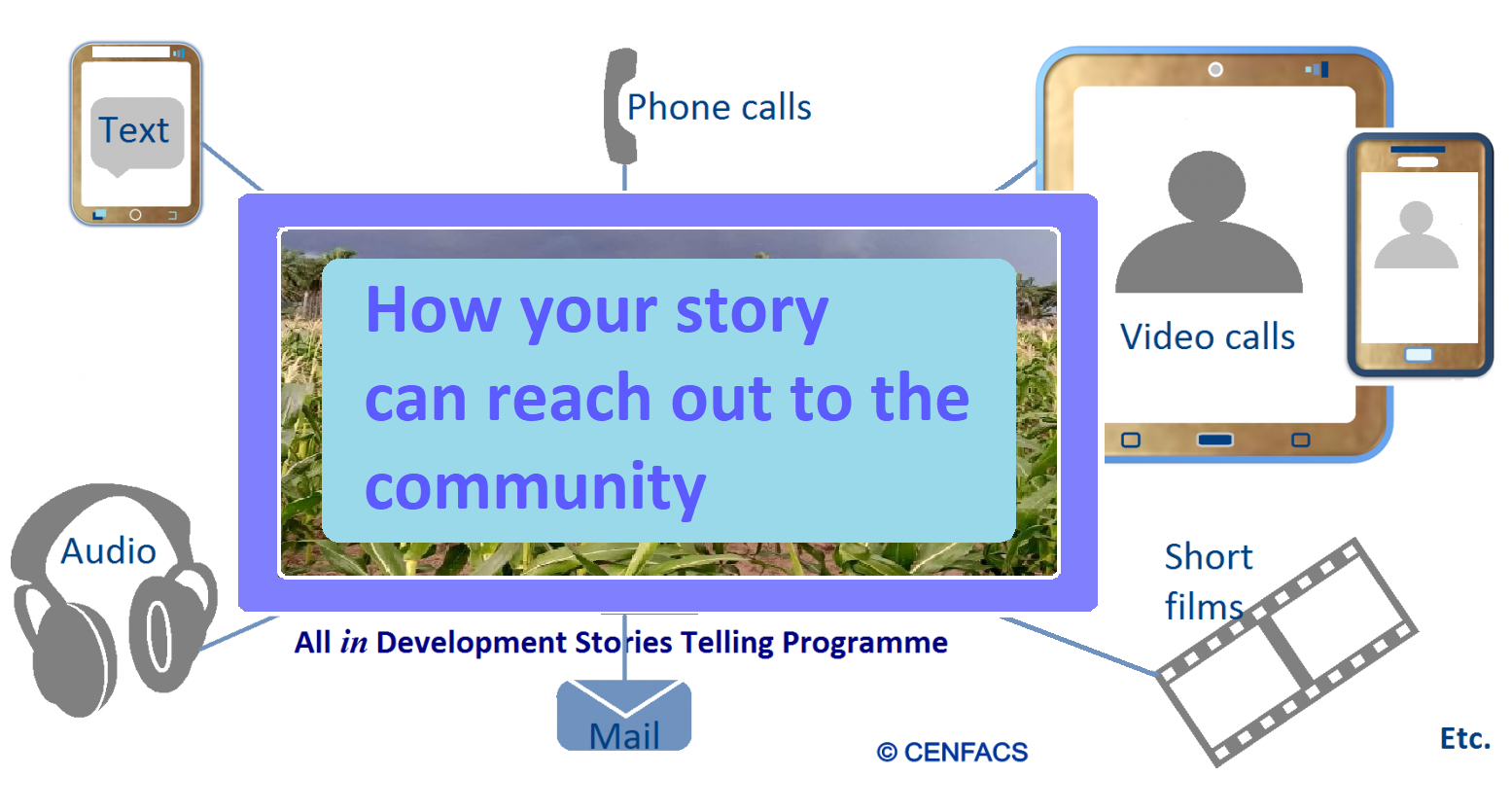
In the context of this Serial 2 of All in Development Story Telling Programme and Series, there are ways that one can use to do it, which include written text options, phone calls, audio storytelling and listening, short film experiences, and video options. Let us highlight each of these means.
• • • • Written text options
You can write your story in a textual format. You can use email, mobile phone, text messing system and CENFACS’ contact form; and send your story in the form of text. To do that, you need basic typing skills, not special skills. You can use the standard Manuscript Format (like a.docx or .doc file) with your last name and your story title.
• • • • Phone calls
You can call CENFACS and give your story via phone.
• • • • Audio storytelling and listening
You can use the capacity of audio to tell your volunteering story. Audio storytelling (with short digital narratives, podcasting, social media and online streaming) can help create and share the impact of the change you made or have made.
• • • • Short film experiences
You can make short films to support your storytelling experiences and create a social impact. You can make film on your smart phone with a video content. Shooting interviews with story participants can also help to create experiences that maximise social media and essential story contents.
• • • • Video options
You can use audio High Definition video calling (for example Skype video calls or Google Meet for video conferencing options) to tell and share you story with CENFACS and others.
If you are going to use video options, it is better to use a free option and non-profit programme, as they are accessible to everybody to join in with at home or wherever they are. By using this free option, you do not add any financial costs to anybody who wants to listen or follow your story.
Some of our users and members may not be able to afford to pay for some types of video options on the market. That is why it is better to use something which is accessible by the majority of people.
For the purpose of data protection, please use the security tips attached to your chosen option.
If you know you are going to tell your story via video calling or conferencing option or storytelling tools that are unfamiliar to the majority of people, and you want CENFACS to participate or join in, you need to let us know at least three days before your story calling or conferencing start so that we can plan ourselves.
You need as well to inform us about the date, time and possibly participants. You can email, phone, text or complete the contact form to let us know as we are busy like you.
If you have a story, you can tell and share with us and others via the above named means. And if you do not mind, we will circulate – with your permission – your stories within the CENFACS Community.
• • • Tracking your submissions
You can keep track of what you have submitted by contacting CENFACS.
• • Permission to Share a Story with CENFACS
Generally, when we ask people’s stories, we also seek permission to share their stories. This is because telling us your story does not necessarily mean that you have given us the permission to share it. Your permission could be verbal or written.
We review the conditions of permission in the light of the law. Our story telling and sharing policy includes as well images or any infographics making these stories or the use of AI-powered stories. Our story telling and sharing policy is available to story tellers on request.
To keep our Story Month within the spirit of this policy, we are dealing with copyright law, permissions and licensing in order to share your story contents. We are particularly working on copyright permissions that story donors need to give to us in order for us to share their stories.
Working on copyright permissions is about staying copyright compliant as far as permissions to share your story is concerned. In simple terms, it means we will ask you whether or not, you agree for us to share your story including imaging or infographic parts of your story.
We are as well responding to any questions linked to copyrights relating to sharing stories.
For those who may have any issues to raise with story telling and sharing in the context of CENFACS’ AiDS Telling and Sharing Programme and Series, they should not hesitate to contact CENFACS.

• Basic Home-based Bookkeeping and Accounting for Poverty Reduction – Featured from 13/05/2026 – Bookkeeping 2: Transaction Categorization; Accounting 2: Income and Expense Categorization
As part of Topic 2 of Basic Home-based Bookkeeping and Accounting for Poverty Reduction (BHbB&A4PR), we are working on Transaction Categorization for Bookkeeping, and Income and Expense Categorization for Accounting for poor or low-income families with income-generating activities (IGAs).
• • Bookkeeping Topic 2: Transaction Categorization
Let us start with the meaning of transaction categorization. According to ‘stripe.com’ (3),
“Transaction categorization, also known as transaction taxonomy, is the process of classifying financial transactions into predefined categories so that businesses and individuals can better understand where funds are coming from and how they are spent… Transaction categorization or transaction taxonomy is the process of categorizing financial transactions by nature, purpose, or type”.
As ‘accountingforeveryone.com’ (4) puts it,
“Bookkeeping, by its nature, involves meticulous record-keeping to track all financial transactions of a business”.
Transaction categorization helps keep bookkeeping effective. Categories are about organizing transactions into understandable categories (e.g., income, expenses, assets, liabilities, and equity). From this perspective and according to ‘accountingforeveryone.com’,
“Categorizing expenses involves assigning every expense to a predefined category that makes sense for the business and complies with accounting principles”.
Transaction categorization can be done manually or by using automated systems. In other words, households have the choice to maintain their records either physically or digitally. They can read transactions descriptions, amounts, and other relevant data. They can classify and label transactions as specific categories.
For instance, Utilities are categorized as Electricity, Water, Gas, Internet Cable, etc.
Once households categorized their financial transactions, it is easier and cheaper for their accountant to critically interpret, classify, and analyse their financial data relating to their income generation activity (IGA). The accountant will ensure that expenses are appropriately and correctly categorized. The accountant will also translate financial data into actionable insights.
• • Accounting Topic 2: Income and Expense Categorization
In accounting, categorizing income and expenses is essential for accurate financial reporting, budgeting, and tax compliance. Categories of expenses include Operating Expenses, Cost of Goods Sold, Capital Expenditures, Non-operating Expenses, and Research and Development Expenses. Categories of income cover Operating Income, Non-operating Income, and Extraordinary Income.
However, there is a difference between categorizing transactions in bookkeeping and income and expense categorization in accounting. Categorizing transactions in bookkeeping involves the process of organizing financial records into categories such as income and expenses. This is essential for maintaining accurate financial records and preparing reports. In contrast, income and expense categorization in accounting goes deeper providing insights into the financial health of the business/IGA and helping in decision-making. While bookkeeping focuses on the accuracy and organization of financial records, accounting involves the interpretation and analysis if these records to make informed business decisions.
• • Bookkeeping and Accounting Activities of the Week: How to Categorize Your Expenses and A Discussion on Asset Depreciation and Amortization
As part of transaction categorization, we shall have two activities as given below.
1) How to categorize your expenses
In this first activity, we shall work with those who would like to learn about or dive deep into transaction categorization.
2) A discussion on asset depreciation and amortization
In this second activity, we shall share your view and understanding about depreciation and amortization. Depreciation is an accounting method used to allocate the cost of a tangible asset (e.g., vehicles, building, and machinery) over its useful life. Amortization spreads the cost of intangible assets (like patents or copyrights) over the expected lifespan. We shall look at their effects on financial statements like balance sheet and income statement.
The above is what we have planned for this week for Bookkeeping Activity/Topic 2 and Accounting Activity/Topic 2.
For those who would like further information about this week’s activities/topics of BHbB&A4PR, they can contact CENFACS. For any other enquiries and/or queries about BHbB&A4PR, please do not hesitate to get in touch.

Message in French (Message en français)
• Objectif du Mois et Activité/Tâche 5 du Projet Annuel « Alternatives (A) »
Notre objectif du mois vise à réduire la pauvreté d’imagination. L’activité/tâche 5 du projet annuel « Alternatives (A) » consiste à raconter et à partager des histoires alternatives avec les personnes qui en ont besoin. Notre objectif du mois et notre activité/tâche 5 sont complémentaires.
Examinons maintenant l’activité/tâche 5 et l’objectif du mois.
• • Activité/Tâche 5 du Projet « Alternatives » (A) : Raconter et Partager des Histoires Alternatives
La cinquième activité/tâche du projet « A » consiste à partager avec les personnes qui en ont besoin des histoires alternatives inspirantes et pertinentes. Mais qu’est-ce qu’une histoire alternative ?
• • • Brève explication des histoires alternatives
Les histoires alternatives sont des récits qui permettent aux individus de s’affranchir des récits rigides et conventionnels et d’explorer une compréhension plus diversifiée et nuancée de leur monde et de leur expérience. Les récits alternatifs servent d’outils pour remettre en question, reformuler ou enrichir les récits dominants, courants ou conventionnels des événements.
Ces histoires peuvent être racontées et partagées dans le cadre du projet « Alternatives » du CENFACS pour l’année 2026. Il y a des avantages en racontant et partageant ces histoires.
• • • Les avantages de raconter ces histoires alternatives
On peut raconter ces histoires pour…
σ Remettre en question les récits dominants afin de proposer différentes interprétations d’événements sociaux, culturels ou historiques, et contester les perspectives dominantes qui peuvent être obsolètes ou oppressives.
σ Réinventer les possibles en proposant des voies alternatives pour favoriser le changement social.
σ Explorer des scénarios hypothétiques, en réexaminant comment l’histoire aurait pu se dérouler autrement.
σ Offrir des perspectives différentes ou racontées différemment de toute histoire en soulignant qu’il y a toujours au moins deux versions.
σ Modifier les perceptions et influencer les décisions (par exemple, dans un contexte juridique).
σ Transformer les faits en un parcours d’empathie et de curiosité.
σ Créer de nouveaux cadres de réflexion afin de réorienter le débat
Etc.
L’activité/tâche 5 du projet « Alternatives (A) » consiste à raconter et partager votre histoire alternative pour la réduction de la pauvreté.
Si vous avez besoin d’aide avant de commencer cette activité/tâche, vous pouvez contacter le CENFACS.
Pour toute autre question concernant le projet « A » et l’engagement de cette année, veuillez également contacter le CENFACS.
• • Objectif du Mois : Réduire la Pauvreté de l’Imagination
Pour atteindre cet objectif, commençons par expliquer ce qu’est la pauvreté de l’imagination.
• • • Que signifie la pauvreté de l’imagination ?
Il s’agit de l’incapacité à voir au-delà du récit dominant, stéréotypé ou actuel. Ce phénomène se produit lorsqu’on n’arrive pas à imaginer la diversité des expériences vécues par les communautés à faibles revenus ou marginalisées, en les réduisant à de simples « pauvres » ou « pitoyables ». C’est aussi une forme de pauvreté due à l’absence de récits alternatifs.
En effet, le type de pauvreté que l’absence de récits alternatifs peut combattre est la pauvreté de l’imagination, ou pauvreté narrative. Cette forme de pauvreté survient lorsque les individus sont limités à un récit unique ou unidimensionnel – généralement négatif, stigmatisé ou stéréotypé – qui masque la complexité de leurs vies. En proposant des récits alternatifs, des contre-récits, on peut atténuer ce type de pauvreté.
• • • Des récits alternatifs pour pallier le manque d’imagination
Les récits alternatifs peuvent pallier le manque d’imagination en :
σ Restaurant la dignité humaine
Il s’agit de partager des histoires multiples, complexes et positives, permettant de passer de la pitié à l’empathie et de réhumaniser les personnes victimes de récits simplistes.
σ Passant d’un récit individuel à un récit systémique
Il s’agit d’utiliser des récits alternatifs pour remettre en question le discours méritocratique (qui impute la pauvreté aux personnes démunies) et souligner comment les barrières systémiques engendrent les inégalités.
σ Changeant la perception de la valeur
Il s’agit de partager des histoires du quotidien, de joie et d’autonomie, plutôt que de simples récits de désespoir. Cela contribue à lutter contre la stigmatisation de la pauvreté.
• • • Ce que nous attendons de nos donateurs/rices concernant l’Objectif du Mois
Après avoir choisi l’Objectif du Mois, nous concentrons nos efforts et notre attention sur cet objectif en veillant à l’appliquer concrètement dans notre vie. Nous attendons également de nos donateurs/rices qu’ils/elles s’engagent pour l’Objectif du Mois en travaillant à sa réalisation et en soutenant les personnes qui souffrent du type de pauvreté lié à cet Objectif du Mois (par exemple, ce mois de mai 2026).
Pour plus d’informations sur l’Objectif du Mois, sa procédure de sélection, les moyens de le soutenir et comment y contribuer, veuillez contacter le CENFACS.


Main Development
• Rebuilding Africa in 2026 with a Focus on Scaling Evidence-based Interventions, Institutionalizing Learning and Strengthening Local Ownership
The following sub-headings explain our advocacy about Rebuilding Africa in 2026:
σ Rebuilding as a Next Step after Bringing and Lighting a Blaze of Hope
σ The Concepts of Scaling Evidence-based Interventions (SEIs), Institutionalizing Learning (IL) and Strengthening Local Ownership (SLO)
σ Programme, Projects and Activities to Scale Evidence-based Interventions, Institutionalize Learning and Strengthen Local Ownership to Further Reduce Poverty
σ Scaling up proven interventions (expand successful, evaluated pilot projects)
σ Translating MEL (Monitoring, Evaluation and Learning) findings into policy changes
σ Deepening Local Ownership (Shift from external evaluation to strengthening local capacity for MEL)
σ Metrics Relating to Scaling Evidence-based Interventions, Institutionalizing Learning and Strengthening Local Ownership
σ Working with Communities and Africa-based Organisations on SEIs, IL and SLO for Further Poverty Reduction.
Let us briefly explain the contents of these sub-headings.
• • Rebuilding as a Next Step after Bringing and Lighting a Blaze of Hope
Rebuilding is the next step in our process of helping in reducing the impacts and effects of war and natural disaster events or any other major crises or shocks. Saying that we are going to rebuild Africa, it does not mean that we are going to remake all the sectors of Africa from scratch.
Rebuilding in the context of our poverty relief work has to be placed in the perspective of working with and helping poor people and their organisations to overcome the ill effects of wars and natural disasters or any other major crises (like misinformation, disinformation, extreme weather events, and social polarization). It is down to Africans to rebuild Africa, not CENFACS. CENFACS as a charity just gives a helpful hand to them to reduce or better end poverty.
• • • What Rebuilding Africa is about
Rebuilding Africa addresses the legacies left by destructive war and natural disaster events or any other major crises or shocks like energy crisis, the cost-of-living crisis and international aid cuts. Every year, many human and wild lives as well as other ways of life have been destroyed as a result of wars, armed conflicts, economic shocks and environmental disasters. These events often lead to humanitarian catastrophes, emergencies, contingencies, crises and responses.
What’s more, where there is destructive war, there is always a destruction of the environmental life. Examples of these destroyed lives are what happened in the Democratic Republic of Congo, Chad, the Central African Republic, Burkina Faso, Mali, etc.
Rebuilding Africa initiative is a response to these events by undertaking projects planning and development activity within CENFACS, with communities and in association with our Africa-based sister organisations.
What will Rebuilding Africa initiative will about for this year?

• • • Rebuilding Africa in 2026
Rebuilding Africa in 2026 will be about Scaling up Evidence-based Interventions, Institutionalizing Learning and Strengthening Local Ownership for Further Poverty Reduction with Communities and Africa-based Organisations. It is the next step after Monitoring, Adapting and Learning Africa’s Systems of Poverty Reduction.
It is all about Rebuilding by boosting sustainable, locally-led systems where evidence informs planning, accountability, and the efficient allocation of resources. To understand this rebuilding process, one needs to explain the concepts that underpin it.
• • The Concepts of Scaling Evidence-based Interventions, Institutionalizing Learning and Strengthening Local Ownership
These concepts are central in the process of this year’s rebuilding and they need explanation. Let us explain them.
• • • Scaling Evidence-based Interventions
It emerges from the literature on systemic scaling that scaling evidence-based interventions is the deliberate process of expanding, adapting, and sustaining proven, small scale programmes or policies to reach larger populations while retaining their effectiveness. It turns successful pilot studies into widely implemented, permanent solutions, often in health, education, or social sectors.
• • • Institutionalizing Learning
Literature on institutions and learning suggests that institutionalizing learning is the process of embedding knowledge, skills and best practices into an organization’s systems, procedures, and culture. It transforms individual insights into collective knowledge, ensuring that improvements are sustained routine, and part of the organization’s core DNA rather than temporary initiatives. Core characteristics of institutionalized learning include embedded systems, culture adoption, sustainability, and alignment.
• • • Strengthening Local Ownership
Let us start us local ownership. According to ‘sustainability-directory.com’ (5),
“Local ownership signifies the active and meaningful participation of local communities in initiatives that directly affect their lives and environment”.
The same ‘sustainability-directory.com’ adds that
“Local populations are not just recipients of aid or directives, but become central actors in the design, implementation, and governance of projects, particularly within the realm of sustainability. At its core, local ownership is about empowering those who reside within a specific area to take charge of their development trajectory”.
From this definition, it can be argued that strengthening local ownership involves empowering communities to take control of their own development and decision-making processes. This is achieved through means such as empowering community members, local governance, shared ownership models, capacity strengthening, and local leadership.
To scale evidence-based interventions, institutionalize learning and strengthen local ownership to further reduce poverty in Africa, one needs programmes, projects and activities as well as to work with both the community and ASOs. Likewise, one is required to plan or have some measures in the form of metrics to check that what they are undertaking as work can bring verifiable results in terms of poverty reduction.

• • Programme, Projects and Activities to Scale Evidence-based Interventions (SEIs), Institutionalize Learning (IL) and Strengthen Local Ownership (SLO) to Further Reduce Poverty
The programme for SEIs, IL and SLO refers to a system-embedded, evidence-driven approach to development. Such a programme will move beyond small-scale pilots to embed proven solutions into ntional systems (government or community-led) ensuring sustainability and long-term poverty reductoon. There are components in such programme. Among these components are projects and activities.
A project designed to scale evidence-based interventions in Africa, while institutionalizing learning and fostering local ownership to reduce poverty is a locally-led, adaptive, and evidence-driven system transformation initiative. It moves beyond temporary, pilot-based solutions towards embedding proven methodologies into national policies, community practices, and sustainable funding solutions. The project will transform from a simple ‘intervention’ into a sustainable, locally-owned engine for ongoing poverty reduction.
As to activities for a project that scales evidence-based interventions while institutionalizing learning and strengthening local ownership in Africa, these activities require a holistic approach, moving beyond simple replication to embedding solutions within local systems. This type of projects will focus on vertical scaling (policy change), functional scaling (adding components), and organisational scaling (strengthening local partners).
These activities will be categorized according to the project phases as follows:
Phase 1: Preparatory and Co-design Activities (Setting the Foundation)
Activities include in this Phase 1 are conducting scalability assessments, stakeholder mapping and engagement, contextual adaptation, and establishing local governance structures.
Phase 2: Scaling Evidence-based Interventions (Vertical and Horizontal Expansion)
Activities making this Phase 2 include capacity building and training, developing scalable units, policy advocacy and dialogue, and leveraging existing systems.
Phase 3: Institutionalizing Learning and Data-driven Adaptation
Activities covering Phase 3 encompass establishing learning systems, developing data systems, acknowledging exchange networks, and action-oriented research.
Phase 4: Strengthening Local Ownership
Activities relating to Phase 4 will be transitioning to local ownership, strengthening capacity for local charities (e.g., ASOs), securing long-term financing, and cultivating local leadership.
The above-mentioned programme, project and activities will enable to Scale Evidence-based Interventions (SEIs), Institutionalize Learning (IL) and Strengthen Local Ownership (SLO) to Further Reduce Poverty.
• • Scaling up Proven Interventions (Expand Successful, Evaluated Pilot Projects)
Scaling up evidence-based interventions to reduce poverty in Africa requires shifting from direct, small-scale service delivery to sustainable models that emphasize local leadership, digital integration, and systemic change.
Key strategies in terms of scaling interventions include adopting community-led development, leveraging technology for financial inclusion, and strengthening local partnerships.
To scale the impact on Africa from CENFACS and ASOs, the following needs to happen:
σ Shifting to Localized and Community-led models
It involves moving away from top-down approaches by decentralizing operations, re-empowering local partners, and conducting community-led fundraising.
σ Leverage Technology and Data
Integrating technology can exponentially increase reach, particularly in rural or inaccessible areas. This strategy includes digital financial tools, digital platforms, and data-driven decisions.
σ Build Sustainable Partnerships
Collaborating with other sectors and organizations can help scale solutions that a single charity cannot achieve alone.
σ Focus on Long-term Impact and Resilience
Scale is also about longevity of impact not just numbers.
The above-named strategies will scale the impact and contribute to the mission of Rebuilding Africa.
• • Translating MEL (Monitoring, Evaluation and Learning) Findings into Policy Changes
Translating MEL findings into policy change in Africa can be done by aligning rigorous evidence with compelling narratives, fostering collaborative partnerships with policymakers and integrating community voices through participatory methods.
Key strategies include building trust through localized evidence, using proactive dissemination and implementing adaptive management. In these strategies, there is a need to bridge the gap between MEL and policy.
Essential approaches to help in this bridge will be the following ones:
σ Develop Collaborative and Localized MEL Systems
It involves co-designing with stakeholders, decolonization of MEL, and integration of local knowledge.
σ Strengthening Evidence for Policy Influence
It includes the use of mixed methods to create persuasive evidence-based narratives for policymakers, the application of adaptive management, and leveraging of proxy indicators.
σ Build Capacity
It entails investing in technical capacity, creating peer learning environment, and establish strategic partnerships.
σ Proactive Dissemination and Advocacy
It encompasses tailoring findings for decision-makers, using policy hubs, and focusing on accountability.
These strategies and approaches can transform MEL from a reporting requirement into a powerful tool for driving systemic, policy-level change.
• • Deepening Local Ownership (Shift from External Evaluation to Strengthening Local Capacity for MEL)
Deepening local ownership in MEL in Africa requires a strategic shift from treating local partners as data collectors to viewing them as co-owners of the knowledge creatin process. This involves transforming from external accountability-driven assessments to internal learning-oriented systems that strengthen local agency.
Key strategies to achieve this include the following ones:
σ Shift from Participation to Co-ownership
It is about moving beyond simply including local staff in meeting to empower them to make decisions about MEL process. This includes co-designing evaluation frameworks, adopting participatory methodologies, and prioritizing learning over reporting.
σ Strengthen Local Capacity and Infrastructure
It suggests moving away from the use of international consultants and instead investing in local talent. It covers localizing staffing and leadership, investing in technical training, utilizing local evaluators, and developing collaborative platforms.
σ Decolonize MEL Processes and Mindsets
It implies changing the power dynamics between international charities and their local partners. It includes ensuring equitable partnerships, utilizing local knowledge, shifting from external to local accountability.
σ Adjust Funding and Administrative Procedures
It is about having adaptive practices to enable local ownership. It includes providing unearmarked/core funding, simplifying reporting requirements, budgeting for capacity building.
So, deepening local ownership can help reduce poverty in Africa.

• • Metrics Relating to Scaling Evidence-based Interventions, Institutionalizing Learning and Strengthening Local Ownership
Whether it is about scaling interventions or institutionalizing learning or strengthening local ownership, there will be metrics (that is, quantitative, measurable indicators to track, monitor, and assess the success, performance, or health of these activities). What are these metrics?
• • • Metrics Relating to Scaling Evidence-based Interventions
These metrics will be around four domains: reach/adoption, programme fidelity, effectiveness/outcomes, and scalability/cost-effectiveness.
a) Reach and Adoption Metrics
They measure the speed and volume of expansion. They include total beneficiaries reached, adoption rate, service coverage, demographic reach, etc.
b) Fidelity and Quality Metrics
They ensure that the intervention remains effective as it expands. They include adherence rate, participant attendance/retention, competence of staff, etc.
c) Effectiveness and Outcome Metrics
They verify that the intervention still works at scale. Among these metrics, it is worth mentioning standardized outcome metrics (e.g., increased literacy rates, improved health scores), value of the outcomes (total benefit to beneficiaries or society), etc.
d) Scalability and Cost-effectiveness Metrics
They evaluate the sustainability of the growth. Examples of these metrics are cost of intervention per beneficiary, cost per unit of outcome, waitlist/demand statistics, staff-to-participant ratio, etc.
• • • Metrics Relating to Institutionalizing Learning
They help to track the shift from delivery direct services to strengthening local systems, focusing on sustainability, policy adoption, and capacity building within government or community syructures.
Key metrics and areas of measurement include the following:
σ Institutional Capacity and System Strengthening
They measure the improvement of organisational processes, staff skills, and the adoption of tools within local institutions. These metrics are Government/Local ownership, skill acquisition, adoption of digital tools, monitoring and evaluation capacity, resource availability, etc.
σ Pedagogical and Learning Quality Improvements
They focus on pedagogical shifts in classrooms and teacher performance rather than just student test scores. They involve teacher performance, teacher training effectiveness, learning assessment adotion, etc.
σ Sustainability and Scale-up
They track the long-term viability of the learning models after initial funding. They include cost per student, system integration, policy influence, etc.
σ Date-driven Decision-making
They show that institutional learning is guiding future planning. Examples of these metrics are routine data use and adoption of technology.
• • • Metrics Relating to Strengthening Local Ownership
They are shifting from tracking beneficiary numbers to measuring the transfer of power, resources, and decision-making to local actors. Key metrics focus on three core dimensions (that is, resources, agency, and ways of being) often evaluated through local partnerships and community-led monitoring.
The examples of key metrics and indicators used to measure deepened local ownership in Africa include the following:
σ Funding and Resource Allocation (Shifting the Power)
They include direct funding proportion, overhead/unrestricted funding, funding diversity, and sustainability ratio.
σ Decision-making and Agency (Who Holds the Power)
They encompass local leadership ratios, design participation, equitable partnership score, consortium leadership, etc.
σ Community Engagement and Accountability (Ways of Being)
They involve community-led monitoring data, grievance redressal usage, capacity building uptake, etc.
σ Implementation and Operational Metrics
Among these metrics are the use of local systems and contextual relevance.
The above-mentioned metrics will enable to convert raw data (relating to interventions, learning and local ownership) into actionable insights, helping to identify trends, evaluate the effectiveness of our rebuilding work, while guiding strategic decisions in terms of Rebuilding Africa.

• • Working with Communities and Africa-based Organisations on SEIs, IL and SLO for Further Poverty Reduction
• • • Working with Communities on SEIs, IL and SLO for Further Poverty Reduction
It requires a shift from top-down delivery to community-driven development, where local actors lead the design, implementation and evaluation of solutions. To sustainably reduce poverty, interventions must be tailored to local contexts, build on existing social structures, and prioritize local ownership. In this respect, effective approaches to working with communities include what follows at three levels.
At the Level of Scaling Evidence-based Interventions
Working with communities will include adaptation and adoption, implementation via community-based workers, the use of modular scaling, leveraging sectoral approaches, etc.
At the Level of Strengthening Local Ownership and Empowerment
Working with communities will involve the use of community-driven development, establishing community-based organisations, prioritization of local leadership, the building of technical capacity, etc.
At the Level of Institutionalizing Learning and Sustainability
Working with communities will cover creating community learning points, establishing localized monitoring systems, facilitating knowledge exchanges, participatory action research, etc.
• • • Working with Africa-based Organisations on SEIs, IL and SLO for Further Poverty Reduction
It is about shifting from donor-driven agenda to local sustainable partnerships that prioritize local leadership, institutional capacity, and contextual evidence. In this respect, effective strategies will focus on fostering ‘local-plus’ mindsets, where international partners support, rather than dictate development initiatives. Thus, keys ways to work with ASOs will include the following:
σ Scaling Evidence-based Interventions
It is about utilising localized scaling frameworks, investing in data management, focusing on proven models, and identifying scalable units.
σ Institutionalizing Learning
It involves adopting adaptive and long-term funding, creating peer learning networks, documenting local knowledge, etc.
σ Strengthening Local Ownership
It encompasses shifting decision-making power, investing in organisational capacity, promoting local resource mobilisation, fostering joint action-learning, etc.
The above-mentioned areas of work with Communities and ASOs will be undertaken through our capacity building, advocacy and dialogue, advice, networking, and signposting services.
For those Communities and Africa-based Sister Organisations that are looking to working with us, CENFACS is prepared to work with them on Rebuilding Africa.
CENFACS can work with them to scale up interventions, institutionalize learning and strengthen local ownership to further reduce poverty and enhance sustainable development in Africa.
We can work with them under our International Advice-, Guidance- and Information-giving Service.
For further details about Rebuilding Africa in 2026, please also contact CENFACS.
_________
• References
(1) https://oxford-review.com/the-oxford-review-dei-diversity-equity-and-inclusion-dictionary/financial-inclusion-definition-and-explanation/ (accessed in May 2026)
(2) https://www.worldbank.org/en/topic/financial-sector/financial-inclusion (accessed in May 2026)
(3) https://stripe.com/gb/resources/more/what-is-transaction-categorization-a-guide-to-transaction-taxonomy-and-its-benefits (accessed in May 2026)
(4) https://accountingforeveryone.com/how-to-categorize-expenses-in-bookkeeping/ (accessed in May 2026)
(5) https://esg.sustainability-directory.com/term/local-ownership (accessed in May 2026)
_________
• Help CENFACS Keep the Poverty Relief Work Going This Year
We do our work on a very small budget and on a voluntary basis. Making a donation will show us you value our work and support CENFACS’ work, which is currently offered as a free service.
One could also consider a recurring donation to CENFACS in the future.
Additionally, we would like to inform you that planned gifting is always an option for giving at CENFACS. Likewise, CENFACS accepts matching gifts from companies running a gift-matching programme.
Donate to support CENFACS!
FOR ONLY £1, YOU CAN SUPPORT CENFACS AND CENFACS’ NOBLE AND BEAUTIFUL CAUSES OF POVERTY REDUCTION.
JUST GO TO: Support Causes – (cenfacs.org.uk)
Thank you for visiting CENFACS website and reading this post.
Thank you as well to those who made or make comments about our weekly posts.
We look forward to receiving your regular visits and continuing support until the end of 2026 and beyond.
With many thanks.