Welcome to CENFACS’ Online Diary!
06 May 2026
Post No. 455

The Week’s Contents
• May 2026 Stories – All in Development Stories: Stories of Embedding Resilience and Innovation to Drive Progress
• All in Development Story Telling Series and Programme 2026
• Goal of the Month and Activity/Task 5 of the Alternatives (A) Year/Project
… And much more!

Key Messages
• May 2026 Stories – All in Development Stories: Stories of Embedding Resilience and Innovation to Drive Progress
Story telling is our main content for the month of May. It is the month and time of the year we dedicate ourselves to telling and sharing poverty relief and sustainable development stories.
• • Why Do We Tell and Share Stories?
This is because in whatever we do to help reduce poverty and appeal for support to enhance the development process we are engaged in, there is always a story to tell and share from various places we intervene and from different individuals and communities or organisations involving in our work.
• • How Do We Tell and Share These Stories?
We do it through All in Development (AiD) Stories project, which is our storytelling project. The project is made of a one month’s storytelling programme and series as explained below.
• • • AiD Storytelling Programme is a one-month project that focuses on developing and promoting storytelling skills, techniques and approaches in the specific context of CENFACS’ community engagement to poverty reduction and sustainable development.
• • • AiD Storytelling Series is a set of related stories presented by CENFACS or volunteer storytellers with a shared theme and a set number of episodes. The series follow a serial format of a continuous story told over multiple episodes.
There is an explanation about this project that can be found under the Main Development section of this post. Every year, there is a different theme for this storytelling project.
• • This Year’s Theme for AiD Stories Project
This year, the theme for AiD Stories Project is about Stories of Embedding Long-term Resilience through Innovation to Secure Future Progress (In short, Stories of Embedding Resilience and Innovation to Drive Progress). What are these stories?
They are the stories of
σ Embedding, sustaining, and scaling initiatives to create deep-rooted, systemic change, while moving from initial progress
σ Moving from initial progress to long-term impact
σ Transitioning from compliance-driven actions to cultural transformation
σ Focusing on long-term sustainability, systemic resilience, and further innovation for endurance
σ Ensuring future-proofing progress is embedded rather than merely secured temporarily
σ Strategically transitioning from simply protecting previous progress to accelerating it through systemic integration
σ Ensuring the new, more resilient baseline is continuously built upon
σ Transforming our strategy from holding the line to breaking through using systemic integration to accelerate our achievements and continuously elevate our resilience.
These stories can be grouped into Stories of Embedding Resilience/Embedding Resilience Stories and Stories of Innovation to Drive Progress. These stories will be told and shared this May 2026.
• • • When will these stories start?
Entries for May 2026 Stories were opened since last March when we announced the theme statement formula of Spring Relief 2026, which is
“Embedding long-term resilience through innovation to secure future progress”.
So far, some of our members and supporters have shown some interests. For those who have not yet submitted or told us their stories, this is the month to do it.
These stories are based on a principle.
• • Underlying Principle of AiD Stories Project
The principle of AiD Stories Project is that it is about stories told by volunteers or people who are giving their stories not for money or not being paid for their experience they had in relation to the story theme. However, this principle does not stop anybody to provide a story even if what they are saying come from their paid position.
Besides this general principle, we have two criteria we would like to highlight about the theme of AiD Stories Project for this year.
• • Criteria for the Theme of AiD Stories Project 2026
• • • 1st Criterion
For this year’s AiD Stories project, we are mainly interested in Stories of Embedding Long-term Resilience through Innovation to Secure Future Progress, as mentioned above. They are also “Two-horse” stories that highlight the themes of kindness, trust and companionship with those in need. They are the stories of uplift or spiritual comfort and protection from poverty. They are of being kinder than necessary and sharing bonds with others, including the nature.
• • • 2nd Criterion
We are registering people’s personal experiences of resilience and innovation. There are also criteria for these personal experiences of resilience (Resilience Stories) and personal experiences of innovation (Innovation Stories).
• • • • Criterion for Resilience Stories includes the following:
σ Adaptability and pivot (how individuals adjust strategies)
σ Positive meaning-making (subject that reflected on the adversity to find new meaning)
σ Agency and control (actions taken to control what was possible)
σ Support systems (role of the community and other stakeholders).
• • • • Criterion for Innovation Stories encompasses
σ Problem-solving approach (idea that solves a significant problem)
σ Evidence-based impact (support the story with facts, data or verification like local news, metrics, testimonials, etc. to build trust)
σ The happy accident (innovation that changed existing, rigid systems)
σ Future-oriented vision (how innovation shapes the future).
In short, these Resilience and Innovation Stories will be based on the criteria of authenticity, relatability, evidence, action orientation, and inclusivity/inclusion.
For those who have not been reached, their personal stories need to be heard as well.
Additionally, we would like to select amongst submitted stories the best ones.
• • Selecting the Top Real True Story of the Month
Like in the previous years, we would like to select the top three stories of poverty reduction of the month and the real true story of poverty reduction of the month. To do that we will use impact story approach. This approach is often used when monitoring, observability and evaluation are restricted. What do we mean by that?
We mean what ‘civicus.org’ (1) says about impact stories, which is:
“Impact stories are a useful way to systematically documenting anecdotal evidence that expected activities occurred, and the perceived results thereof”.
Our storytelling assessors will try to capture elements of storytelling that respond to our storytelling criteria. Stories that build inclusion and inspire people in terms of Embedding Resilience and Innovation to Drive Progress have more chance to win more votes or points than other ones.
To facilitate and organise ourselves in the way of telling these stories, we are going to do it through a series or programme or a timeline of scripts. There is more information about this series below.
For more information on AiDS project and this year’s storytelling focus and scripts, please read under the Main Development section of this post.
To tell your Embedding Resilience and Innovation to Drive Progress to CENFACS, please contact CENFACS for story telling terms and conditions.

• All in Development Story Telling Series and Programme 2026
The 2026 series of AiDS Telling Programme start from the 6th of May 2026, every Wednesday afterwards and will last until the end of May 2026. These series, which are part of May 2026 Stories, are a timeline of scripts or a set of notes arranged in line to tell and share Stories of Embedding Long-term Resilience through Innovation to Secure Future Progress. But, these stories do not need to be linear (that is, problem > action > solutions). We take non-linear stories as well.
To arrange this programme, we are going to utilise two-sided themes or “Two-horse” stories in a four steps model. To do that we have broken May 2026 Stories into specific actionable narratives as given below.
Side A: Embedding Long-term Resilience
Side A includes 4 types of stories below.
a.1) Embedding progress, sustaining, and scaling sustainable initiatives to create deep-rooted, systemic change
These are the tales of scaling deep for systemic transformation or of embedding change to make it stick. The core elements of these stories are embedding (practice), sustaining (improvement), scaling (deep and wide), and systemic change.
a.2) Transitioning from compliance-driven actions to cultural transformation
They are the narratives of moving from policing to partnering or turning “must-do” rules into “want-to-do” behaviours or replacing rigid fear-based compliance with trust-based ownership.
a.3) Focusing onlong-term sustainability, systemic resilience, and further innovation for endurance
These are the accounts of building a regenerative future, transformative resilience, or sustainable, future-proof innovation. They are of the ability to bounce forward (rather than just back) by transforming systems to be more adaptable to unexpected shocks. The key themes with this concept are systemic resilience, long-term sustainability and future innovation.
a.4) Ensuring future-proofing progress is embedded rather than merely secured temporarily
They are the fables of building lasting, systemic and structural resilience rather than chasing temporary or reactive gains. They are about creating regenerative, deeply rooted changes that endure over time, ensuring future progress is structured and continuous rather than just a fleeting improvement. Key aspects of these plots are systemic embedding, long-term stewardship.
Side B: Innovation to Secure Future Progress
Side B also contains 4 types of stories as given below.
b.1) Moving from initial progress to long-term impact
These are the talks of small steps, big impact or from the seeds to trees.
b.2) Strategically transitioning from simply protecting previous progress to accelerating it through systemic integration
They are the chronicles of leveraging existing gains to rapidly scale up systemic change. They represent a strategic shift from defensive maintenance (simply protecting progress) to transformative acceleration (integrating improvements deeply into institutional structures). Key aspects of these chronicles include systemic integration, strategic transition, and accelerating progress.
b.3) Ensuring the new, more resilient baseline is continuously built upon
They are the anecdotes describing continuous, iterative strengthening – building on recent improvements (the new baseline) to ensure ongoing adaptability.
b.4) Using systemic integration to accelerate our achievements and continuously elevate our resilience
These are the recitals involving connecting disparate parts – people, processes, technology, and communities – to create a unified, adaptable whole that thrives under pressure rather than just enduring (for instance, integrating humanitarian aid with community action).
The breakdown of May 2026 Stories theme enables to create a 4-part series.
From the above-mentioned four steps from each side, we can organise our stories line. There is no single logic or model of organising a story. We thought that to make it easier, our storytelling series will follow these four plus four (4+4) model or two-story sequences:
The four plus four (4+4) or two-story sequences can be linked each other in a sequential way.
For further details about these two-story sequences or timeline of AiD scripts, please continue to read under the Main Development section of this post.

• Goal of the Month and Activity/Task 5 of the Alternatives (A) Year/Project
Our Goal of the Month focuses on reducing the poverty of imagination. Activity/Task 5 of the Alternatives (A) Year/Project is about telling and sharing alternative stories with those in need. Both our Goal of the Month and Activity/Task 5 are complimentary.
Let us look at these Activity/Task 5 and Goal of the Month.

• • Activity/Task 5 of the Alternatives (A) Year/Project: Tell and Share Alternative Stories
The fifth activity/task of the “A” Project is about sharing with those in need some inspiring and insightful alternative stories. But what are alternative stories?
• • • Brief Explanation of Alternative Stories
Alternative stories are narratives that empower individuals to break free from rigid, conventional narratives and explore more diverse, nuanced understanding of their world and experience. Alternative narratives act as tools to challenge, reframe, or expand upon dominant, mainstream, or conventional accounts of events.
These stories can be told and shared to feature CENFACS Year 2026 of Alternatives.
• • • The Good Things about Telling These Alternative Stories
One can tell these stories…
σ To challenge dominant narratives as way of offering different interpretations of social, cultural or historical events, challenging dominant perspectives that may be outdated or oppressive
σ To reimagine possibilities by offering alternative paths to foster social change
σ To explore “what if” scenarios, re-examining how history might have unfolded differently
σ To offer different or differently told perspectives of any story by highlighting that there are at least two sides to every tale
σ To alter perceptions and influence decisions (e.g., in legal contexts)
σ To transform facts into a journey of empathy and curiosity
σ To create new frameworks as a way of changing the direction of conversation
etc.
So, Activity/Task 5 of the Alternatives (A) Year/Project is about Telling and Sharing Your Alternative Story for Poverty Reduction.
For those who need any help before embarking on this activity/task, they can speak to CENFACS.
For any other queries and enquiries about the ‘A’ project and this year’s dedication, please contact CENFACS as well.

• • Goal of the Month: Reduction of the Poverty of Imagination
To approach this goal, let us first explain the poverty of imagination.
• • • What Does Mean the Poverty of Imagination?
It means the inability to see beyond the current, dominant, or stereotypical narrative. It happens when one fails to imagine the diversity of experience in low-income or marginalized communities assuming them to be only ‘poor’ or ‘pathetic’. It is also poverty due to the lack of alternative stories.
Indeed, the kind of poverty that a lack of alternative stories can address is the poverty of the imagination or poverty of narrative. This form of poverty occurs when people are restricted to a ‘single story’ or ‘one-dimensional’ narrative – usually a negative, stigmatized, or stereotypical one – that masks the complexities of lives. By introducing alternative, counter-narratives, this type of poverty can be mitigated.
• • • Introducing Alternative Stories to Address the Poverty of Imagination
Alternative stories can address the Poverty of Imagination by
σ Restoring human dignity
It involves sharing multiple, complex and positive stories which can shift the focus from pity to human empathy as well as re-humanizing the victims of ‘single-story’.
σ Shifting from individual to systemic narrative
It is about using alternative stories to challenge the meritocracy narrative (which blames the poor for their poverty) and highlight how systemic barriers create inequality.
σ Changing the perception of value
It includes sharing stories of everyday life, joy and agency – rather than just stories of despair. This helps challenge poverty stigma.
σ Empowering agency
It encompasses using alternative stories to show that peoples in poverty are active, not just passive victims, helping them regain control of their own stories.
The above is our Goal for the Month of May 2026.
• • • What We Expect from Our Supporters Regarding the Goal of the Month
After selecting the Goal for the Month, we focus our efforts and mind set on the selected goal by making sure that in our real life we apply it. We also expect our supporters to go for the Goal of the Month by working on the same goal and by supporting those who may be suffering from the type of poverty linked to the Goal for the Month we are talking about during the given month (e.g., May 2026).
For further details on the Goal of the Month, its selection procedure including its support and how one can go for it, please contact CENFACS.

Extra Messages
• Basic Home-based Bookkeeping and Accounting for Poverty Reduction – Featured from 06/05/2026 – Bookkeeping 1: Organizing Your Receipts; Accounting 1: Separation of Household and Income Generating Activity Finances
• Climate-resilient Asset Building Programme for Households – In Focus from Wednesday 06/05/2026: Asset Protection
• All-Year-Round Projects Lifecycle – Step/e-Workshop 12: Impact Evaluating Your Play, Run and Vote Projects; Integrating Triple Value Initiatives into Your All-Year-Round Projects Impact Evaluation

• Basic Home-based Bookkeeping and Accounting for Poverty Reduction – Featured from 06/05/2026 – Bookkeeping 1: Organizing Your Receipts; Accounting 1: Separation of Household and Income Generating Activity Finances
As part of activity/topic 1 of Basic Home-based Bookkeeping and Accounting for Poverty Reduction (BHbB&A4PR), we are working on Organizing Your Receipts for Bookkeeping Activity/Topic 1, and Separating Household Finances from Income Generating Activity Finances for Accounting Activity/Topic 1 for poor or low-income families with income-generating activities (IGAs).

• • Bookkeeping Activity/Topic 1: Organizing Your Receipts
Organizing Your Receipts is about tracking spending, preparing accurate tax returns and feeling in control of your accounting process. It helps to know where money goes each month and do budgeting.
To organize your receipts, you can use manual data entry (on paper) or receipt management software. You can either utilise a traditional filing cabinet or digital folder to organize your receipts.
You need to have a reliable way of organizing your IGA receipts. You have options such as
σ having a filing system
σ using folders sorted by expenses categories
σ storing backups of digital images in two places, like a cloud account and a local drive
σ isolating personal spending from IGA expenses
σ scanning and electronically storing your receipts
σ having cloud-based systems that allow you to organise each receipt or invoices by date, supplier, or relevant category tags
etc.
Depending on your skills and needs, you can put in place the receipts organisation system that is the most appropriate for you and your IGA.
• • Accounting Activity/Topic 1: Separation of Household and IGA Finances
Generally, accounting for poor or low-income households and families with IGAs focuses on simplicity, tracking actual cash flow, and separating household needs from business operations.
The reason why these households and families are trying to run IGA is to lift themselves out of poverty. Because of that, the primary goal for them is to ensure the IGA is profitable, sustainable, and supports improved living standards.
Separating their household finances from IGA finances will help them check if their IGA or business model is profitable or not. This separation also helps them distinguish between family expenses (like food, rent, school fees, etc.) and business expenses (such as raw materials, transport and other ones) to prevent depleting business capital.
This separation will further assist in defining what funds are for reinvestment in the business versus what is available for personal consumption.
The above is what we have planned for this week for Bookkeeping Activity/Topic 1 and Accounting Activity/Topic 1.
For those who would like further information about this week’s activities/topics of BHbB&A4PR, they can contact CENFACS. For any other enquiries and/or queries about BHbB&A4PR, please do not hesitate to get in touch.

• Climate-resilient Asset Building Programme for Households – In Focus from Wednesday 06/05/2026: Asset Protection
To deal with Asset Protection, let us define assets and asset protection, then explain how CENFACS intends to work with households on asset protection.
• • What Is an Asset?
According to Oxford Dictionary of Business and Management (2),
“Asset is any object, tangible or intangible, that is of value to its possessor” (p. 38)
In similar terms, the website ‘assetprotectionplanners.com’ (3) explains that
“Assets refers to any property owned by a person or entity. There are three main asset categories: current assets, fixed assets and financial assets”.
The same ‘assetprotectionplanners.com’ states that current assets are resources that can be converted into cash within one year. Fixed assets are long-term resources such a buildings or equipment. Financial assets are investments in the assets of other institutions.
Knowing what asset is, it is possible to explain asset protection.
• • What Is Asset Protection?
Asset protection can be explained in many ways. One of its definitions comes from ‘financestrategists.com’ (4) which explains that
“Asset protection refers to the various legal and financial strategies employed to safeguard an individual’s or entity’s assets from potential claims by creditors, litigants, and other potential claimants”.
The website ‘financial strategists.com’ goes further in stressing this:
“In today’s litigious society, it is crucial for individuals and businesses to have a well-thought-out asset protection plan to minimize the risk of financial loss”.
Individuals, households and businesses can buy an insurance policy as an asset protection strategy. Households making the CENFACS Community can do the same. As part of encouraging them to do so, it is better to work with them on asset protection matter.
• • Working with Households on Asset Protection
It involves providing education, legal support, and structural tools that help them safeguard their financial future while ensuring compliance with legal standards. Effective strategies with them will include fostering financial independence, managing legacies, and helping households protect assets from personal creditors or care costs. In practical terms, we shall work with them on the following:
σ Offering training, credit counselling and workshops to empower households to manage their own money, reducing vulnerabilities to debt
σ Providing guidance and facilitating the use of legal structures to protect assets, especially when a household beneficiary is receiving a legacy
σ Assisting in protective management in terms of appropriation of assets and asset management advice
σ Signposting households to low-cost (even free) access professional advisors experienced in trust law or asset trust
σ Connecting households with specialized debt-solving charities
etc.
Those households interested in building climate-resilient assets through Asset Protection, they can work with CENFACS.
For any queries and/or enquiries about Asset Protection as well as Climate-resilient Asset Building Programmes for Households (including how to access this programme), please do not hesitate to contact CENFACS.

• All-Year-Round Projects Lifecycle – Step/e-Workshop 12: Impact Evaluating Your Play, Run and Vote Projects; Integrating Triple Value Initiatives into Your All-Year-Round Projects Impact Evaluation
In Step/Workshop 11 of your Play, Run and Vote Projects, you conducted an outcome evaluation by measuring your behaviour, participation to and achievement following the delivery of these projects. You also integrated Triple Value Initiatives (TVIs) into your All-Year-Round Projects (AYRPs) outcome evaluation.
Now, you can proceed with an impact evaluation and integration of TVIs into this impact evaluation. An impact evaluation will help to evaluate the effect of your Play, Run and Vote Projects on you and the environment surrounding you. The integration of TVIs will ensure that sustainability will be part of your daily project activities.
But, what is an impact evaluation? We are going to define it on its own and in the context of AYRP framework, then integrate TVIs into this evaluation.
• • Impact Evaluating Your Play, Run and Vote Projects (12.1)
• • • Basic Understanding of an Impact Evaluation
The definition we have chosen to understand an impact evaluation comes from ‘betterevaluation.org’ (5). According to ‘betterevaluation.org’,
“An impact evaluation provides information about the impacts produced by an intervention. The intervention might be a small project, a large programme, a collection of activities, or a policy”.
The same ‘betterevaluation.org’ states that
“An impact evaluation can be undertaken to improve or reorient an intervention (i.e., for formative purposes) or to inform decisions about whether to continue, discontinue, replicate or scale up an intervention (i.e., for summative purposes)”.
In other words, an impact evaluation tries to measure the difference between outcomes with an intervention and without it in a way that can attribute the difference to the intervention, and only the intervention.
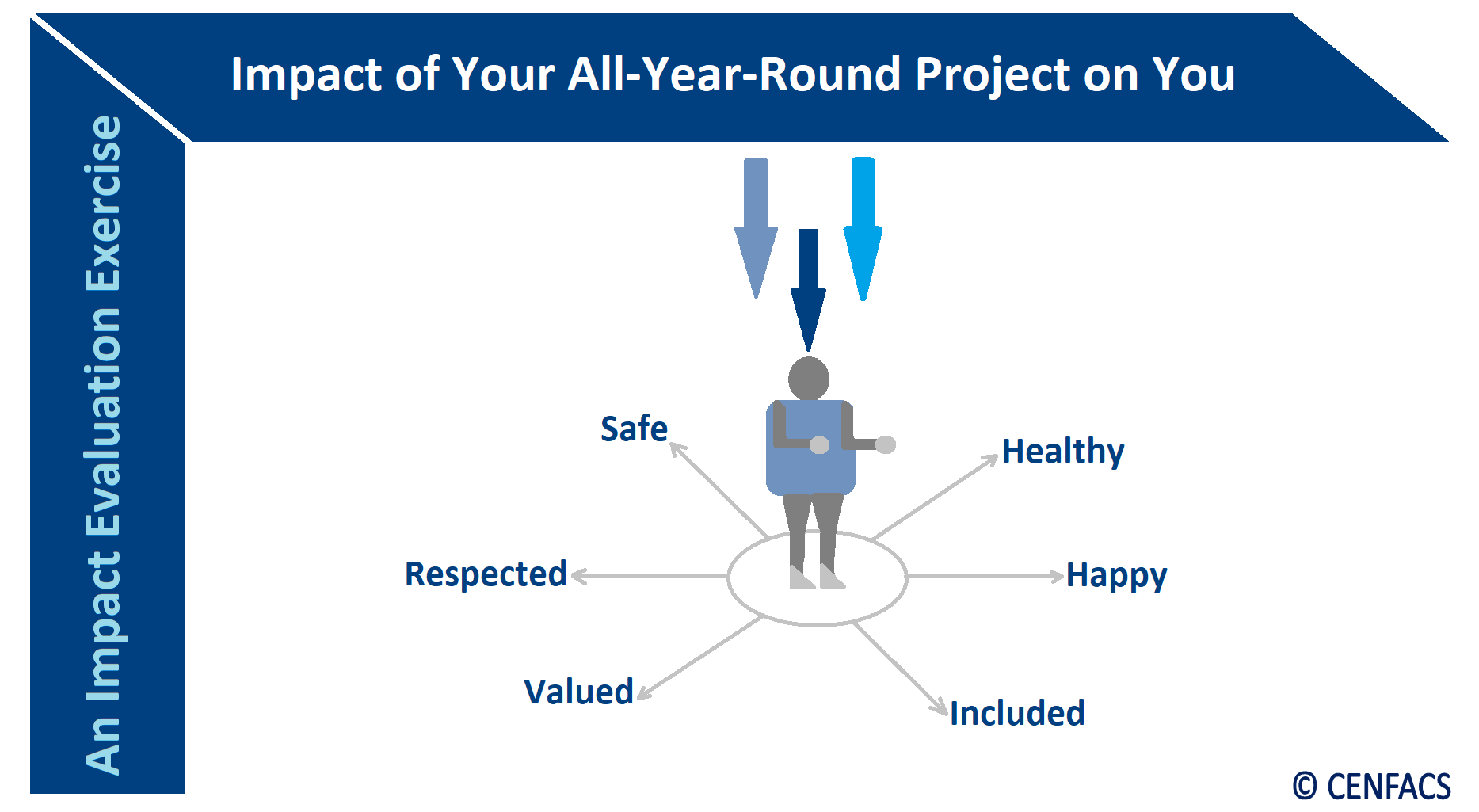
For instance, an impact evaluation of your Run Project will assess changes in your wellbeing that can be attributable to your Run Project. The figure below is an impact evaluation exercise showing how your all-year-round project can impact on you.
To carry out an impact evaluation, one needs to answer/know the why, when, what and who to engage in the evaluation process. Also, one can base its impact evaluation on a particular way of thinking or a theory.
• • • Theories to Be Used in Your Impact Evaluation
To simplify the matter, an all-year-round project beneficiary will use a theory of change that will guide them to causal attribution or to answer cause-and-effect questions; meaning that changes in outcome are directly attributable to an intervention (here your Play, Run and Vote Projects). Therefore, you need to better plan and manage your impact evaluation.
The above basic understanding of an impact evaluation can lead to the interpretation of impact evaluation of AYRPs.
• • • What is an AYRP Impact Evaluation?
AYRP impact evaluation is a continuous process of assessing the long-term, direct or indirect, intended or unintended effects of an intervention throughout its entire lifecycle – rather than as a single, final activity. This approach embeds monitoring and evaluation into the project’s daily operations, enabling adaptive management by providing ongoing feedback to improve implementation, ensure sustainability, and demonstrate accountability continuously.
Key aspects of AYRP impact evaluati0n include the following:
σ Continuous monitoring and evaluation: Continuous evaluation to assess performance and outcomes at various stages (baseline, midline and endline)
σ Focus on causal attribution: It involves investigating what changed and why it changed, linking effects directly to project activities
σ Mixed methods and participatory approaches: They are about involving beneficiaries and stakeholders in the evaluation process
σ Sustainability and long-term effects: It looks beyond immediate outputs to assess if benefits will continue after funding ceases, while examining long-term, transformative change.
There are benefits in conducting AYRP impact evaluation; benefits which include better risk management, strengthened credibility, and improved accountability.
Impact evaluation perceived in this manner will help a user of AYRPs to foster a culture of learning and continuous improvements in their AYRPs and life.
• • • Example of Planning and Managing the Impact Evaluation of Your All-Year-Round Projects
To better plan and manage the impact evaluation of Your All-Year-Round Projects, you can proceed with the following:
σ Describe what needs to be evaluated
σ Identify and mobilise resources for your evaluation
σ Decide who will conduct the evaluation and engage it
σ Set up an evaluation methodology/approach/technique
σ Manage your evaluation work
σ Implement your evaluation work
σ Evaluate the result/impact of Your All-Year-Round Projects on you and/or others
σ Share your evaluation results/report.
The above is one of the possible ways of impact evaluating your All-Year-Round Projects. For those who would like to dive deeper into Impact Evaluation of their Play or Run or Vote project, they should not hesitate to contact CENFACS.
Because sustainability must be part of daily project activities, this impact evaluation will not be enough unless you incorporate Triple Value Initiatives (TVIs) in them.
• • Integrating Triple Value Initiatives into Your All-Year-Round Project Impact Evaluation (12.2)
Integrating Triple Value (often referred to as Triple Bottom Line or 3Ps: People, Planet, Prosperity) initiatives into AYRP impact evaluation requires embedding social, environmental, and financial metrics directly into the project lifecycle, rather than assessing them as an afterthought.
There are guidelines to integrate these initiatives into AYRPs. One way of doing it is to follow these steps:
σ Define 3P metrics by developing specific, measurable indicators for each dimension (People/Social, Planet/Environmental, Prosperity/Economic)
σ Establish baseline (that is, measure the state of all three Ps before the project begins to allow for comparative evaluation)
σ Implement integrated data collection that tracks 3P indicators continuously
σ Use digital dashboards to visualize real-time or regular updates on sustainability and social metrics
σ Regularly engage key stakeholders to understand the soft social impacts
σ Embed a process evaluation that tracks how the project is delivered
σ Include impact assessment techniques (using Social Return on Investment, Life Cycle Assessment, and Triangulation techniques)
σ Integrate the 3P results into all project reporting, giving equal weight to environmental, social and economic impacts
σ Apply the results of previous annual evaluations to inform future project planning
σ Align indicators with established frameworks.
By following the above-mentioned steps, a user of AYRPs would show that they treated sustainability as a core component of AYRP performance and value creation.
• • Working with AYRP Users on Triple Value Initiatives Integration
CENFACS can work with AYRP users to integrate these initiatives into their project tools and lifecycle thinking processes. This will stop these TVIs being ‘add-on’ and enable them become part of the impact evaluation of their AYRP success.
For those who are not familiar with project impact evaluation as well as the integration of Triple Value Model into their AYR project, they should not hesitate to contact CENFACS if they need support.
They can contact CENFACS by
phoning, texting, e-mailing and completing the contact form on this website.
We can together discuss in detail your/their proposals about either your/their Run or Play or Vote projects, as well as the integration of TVIs into these projects.
For any queries and/or enquiries about All-Year-Round Projects Lifecycle and Impact Evaluation as well as about the Integration of Triple Value Initiatives into Projects, please contact CENFACS.
• • Concluding Note about This 12-week e-Workshop Programme
To conclude this 12-week e-workshop programme, we would like to thank those who have been engaged with it.
We would like to ask to those who can to measure the impact and effectiveness in working with them/you on how to plan, execute and evaluate your All-Year-Round Projects, as well as on how to integrate Triple Value Initiatives into them.
For example, they/you can state that on overall they/you have positive or negative impacts from this programme. They/you can send your statement to CENFACS’ usual contact details as given on this website.
Those who need help for any aspect of the plan of their All-Year-Round Projects, they should not hesitate to contact CENFACS. Likewise, those who would like to discuss any matter linked to TVIs Integration.
Good luck with their/your All-Year-Round Projects and the Integration of TVIs into them!

Message in English-French (Message en Anglais-Français)
• CENFACS’ be.Africa Forum E-discusses the Impact of Armies Protecting Natural Resources on Poverty Reduction in Africa
Army Protecting Natural Resources (also known as Military Assistance to Protect the Environment: MAPE, or green warriors) involves leveraging military personnel, technology, and logistics to combat environmental crime, sustainably manage land and mitigate climate change.
There are many examples of anti-poaching operations, combating illegal mining, protecting ecosystems, and rehabilitating lands to improve biodiversity where sometimes armies have been called to intervene in Africa. However, there is a controversial debate in terms of the impacts of armies getting involved in such operations or activities. In particular, this controversy is on whether their involvement will enable to reduce poverty.
There are those who believe that Armies Protecting Natural Resources in Africa (APNRiA) can reduce poverty by securing sustainable livelihoods for local communities, preventing resource-driven conflicts, and preserving economic assets. Effective military involvement through civil-military cooperation can stop illegal poaching and illegal logging that strip populations of income and food security. Military forces can protect forests, water and wildlife. Armies can prevent the degradation of ecosystems that often leads to increased poverty. Military skills training and support can enhance environmental law enforcement and reduce the organized crime that steals resource wealth from local communities. State forces can secure natural resources and foster economic stability, essential for poverty reduction.
There are those who do not believe in the capacity of APNRiA in alleviating poverty and building resilience against environmental degradation in Africa. They think that armies or APNRiA can take advantage of the situation to help themselves instead of helping in the reduction of poverty. Among the arguments they advance are the following ones:
σ Poverty among military personnel in Africa is high with many soldiers struggling with low wages, poor living conditions, and inadequate welfare, despite increasing national military expenditure in many African countries
σ Soldiers’ salaries are often failing to meet basic needs and not reflecting the high risk of fighting insurgency
σ Many low-ranking soldiers and personnel face poverty-level wages
σ Real income of military or armed forces personnel families is very low compared to the impact of inflation
σ Investment in military personnel welfare is low with poorly funded militaries
σ Continued and increasing military expenditure in many African countries’ budgets does not translate into improved, higher wages for the average soldier
σ A good number of military personnel in Africa lived in poverty just as the majority of populations being in poverty
In brief, the general trend for militaries in Africa is a struggle to meet basic needs. Yet, it is possible to reduce or end military poverty in Africa.
The above provides materials and space for reflection, expression, discussion, agreement, disagreement and action.
Those who may be interested in reflection, expression, discussion and action on the Impact of Armies Protecting Natural Resources on Poverty Reduction in Africa can join our poverty reduction pundits and/or contribute by contacting CENFACS’ be.Africa Forum, which is a forum or space for discussion on poverty reduction and sustainable development issues in Africa and which acts on behalf of its members by making proposals or ideas for actions for a better Africa.
To contact CENFACS about this discussion, please use our usual contact address on this website.
• Le Forum ‘Une Afrique Meilleure’ de CENFACS discute en ligne de l’Impact de la Protection des Ressources Naturelles par les Armées sur la Réduction de la Pauvreté en Afrique
La protection des ressources naturelles par les armées (également connue sous le nom d’Assistance Militaire à la Protection de l’Environnement ou « guerriers verts ») consiste à mobiliser le personnel, les technologies et la logistique militaires pour lutter contre la criminalité environnementale, gérer durablement les terres et atténuer le changement climatique.
On compte de nombreux exemples d’opérations anti-braconnage, de lutte contre l’exploitation minière illégale, de protection des écosystèmes et de restauration des terres pour améliorer la biodiversité en Afrique, où l’intervention des armées a parfois été requise. Cependant, l’impact de l’implication des armées dans de telles opérations ou activités fait l’objet d’un débat controversé. Ce débat porte notamment sur la capacité des armées à contribuer à la réduction de la pauvreté.
Certains estiment que les Armées de Protection des Ressources Naturelles en Afrique (APRNA) peuvent réduire la pauvreté en garantissant des moyens de subsistance durables aux communautés locales, en prévenant les conflits liés aux ressources et en préservant les actifs économiques. Une implication militaire efficace, grâce à la coopération civilo-militaire, peut mettre fin au braconnage et à l’exploitation forestière illégale qui privent les populations de revenus et de sécurité alimentaire. Les forces armées peuvent protéger les forêts, l’eau et la faune sauvage. Elles peuvent prévenir la dégradation des écosystèmes, souvent à l’origine d’une pauvreté accrue. La formation et le soutien des forces armées peuvent renforcer l’application du droit environnemental et réduire le crime organisé qui spolie les communautés locales de leurs richesses naturelles. Les forces de l’État peuvent sécuriser les ressources naturelles et favoriser la stabilité économique, éléments essentiels à la réduction de la pauvreté.
Certains doutent de la capacité de l’APRNA à réduire la pauvreté et à renforcer la résilience face à la dégradation environnementale en Afrique. Ils estiment que l’APRNA pourrait profiter de la situation à son propre avantage au lieu de contribuer à la réduction de la pauvreté.Parmi les arguments avancés figurent les suivants :
σ La pauvreté est élevée parmi le personnel militaire en Afrique. De nombreux soldats sont confrontés à de bas salaires, à de mauvaises conditions de vie et à une protection sociale insuffisante, malgré l’augmentation des dépenses militaires nationales dans de nombreux pays africains.
σ Les soldes des soldats ne permettent souvent pas de couvrir leurs besoins fondamentaux et ne tiennent pas compte des risques élevés liés à la lutte contre l’insurrection.
σ De nombreux soldats et personnels subalternes perçoivent des salaires de misère.
σ Le revenu réel des familles du personnel militaire est très faible par rapport à l’inflation.
σ L’investissement dans le bien-être du personnel militaire est faible, les armées étant sous-financées.
σ L’augmentation continue des dépenses militaires dans les budgets de nombreux pays africains ne se traduit pas par une amélioration des salaires du soldat moyen.
σ Un grand nombre de militaires en Afrique vivent dans la pauvreté, à l’instar de la majorité de la population.
En résumé, la tendance générale des armées africaines est la difficulté à satisfaire leurs besoins fondamentaux. Pourtant, il est possible de réduire, voire d’éliminer, la pauvreté militaire en Afrique.
Ce qui précède offre matière à réflexion, expression, discussion, d’accord, désaccord, d’opinions et action.
Les personnes intéressées par la réflexion, l’expression, la discussion et l’action concernant le rôle des armées dans la protection des ressources naturelles et la réduction de la pauvreté en Afrique peuvent rejoindre notre groupe d’experts sur la réduction de la pauvreté et/ou contribuer en contactant le ‘me.Afrique’ du CENFACS (ou le Forum ‘Une Afrique Meilleure’ de CENFACS), qui est un forum ou espace de discussion sur les questions de réduction de la pauvreté et de développement durable en Afrique et qui agit au nom de ses membres en faisant des propositions ou des idées d’actions pour une Afrique meilleure.
Pour contacter le CENFACS au sujet de cette discussion, veuillez utiliser nos coordonnées habituelles sur ce site Web.
Main Development
• May 2026 Stories – All in Development Stories: Stories of Embedding Resilience and Innovation to Drive Progress
The items making the contents of May 2026 Stories include the following:
∝ What is All inDevelopment Stories Project?
∝ May 2026 Stories: Stories of Embedding Resilience and Innovation to Drive Progress
∝ Story Telling Sequences or Series
∝ AiDS Serial 1: Stories of Embedding and Scaling Initiatives for Systemic Change; Stories of Progress to Long-term Impact (Starting from Wednesday 06/05/2026)
∝ Further Information about May 2026 Stories.
Let us highlight each of these elements.
• • What Is All in Development Stories Project?
All in Development Stories (AiDS) is a life story building, developing, telling, sharing and learning project set up by CENFACS in 2009 in order to give opportunities to volunteers, interns and other development supporters and enthusiasts to inspire others and spread the good news and will of better change to the community. It is also a narrative approach to documenting and managing features, tasks and project progress that has features or properties, storytelling programme and series.
• • • AiDS Properties
The project, which is run during the month of May, has seven properties as follows:
1) AiDS is a telling and sharing story
It is about telling and sharing with us your experience and achievements made in the fields of local (UK) and International (Africa) developments.
2) AiDS is an expression of the problem
It expresses the problem (of poverty) to be solved, the user’s or project beneficiary’s perspective, and the desired outcome.
3) AiDS is a learning and development process
It is also about learning from volunteers and interns how they improved their own life, changed deprived lives and reached out to the needy communities. After learning, one can try to develop strengths and better practices to solve problems.
4) AiDS is an inspirational and motivational support network
The project seeks to inspire and motivate others on the road of change for better change; especially for those (who are part of our network and those who would like to be part of it) who might prepare and use their summer break or any other occasions to take up volunteering and or internship roles and positions.
5) AiDS is a “two-horse” story
It highlights the themes of kindness, trust and companionship with those in need. It is the story of uplift or spiritual comfort and protection from poverty. It is of being kinder than necessary and sharing bonds with others (those who need help), including the nature.
6) AiDS is a building storytelling skills initiative
It helps story tellers to develop skills to tell and supply stories (stories generation) to meet the demand of stories listeners (stories heard) in order to connect those in need to poverty reduction. These stories that connect to poverty reduction can be linear and non-linear as well as deliberately action-oriented.
7) AiDS finally is a state-of-the-art project
After all, it is the art of poverty relief telling story that enables us to get up-to-date information, knowledge and thinking in the fields of poverty reduction and sustainable development from those who went on the grounds to learn and experience real-life development works. They return with volunteering stories to tell and share. As the National Storytelling Network (6) puts it in these terms:
“Storytelling is the interactive art of using words and actions to reveal the elements and images of a story while encouraging the listener’s imagination”.
• • • AiDS Telling Programme
The programme, which is a short-term project (of one month in May), focusses on the process of storytelling by developing and promoting storytelling skills, techniques and approaches with the purpose of enhancing communication, creativity, empathy, and engagement to poverty reduction and sustainable development.
The programme uses narratives, stories and personal anecdotes to enhance engagement, comprehension, and retention of information relating to poverty reduction and sustainable development.
• • • AiDS Telling Series
It is a set number of episodes or chapters with a defined beginning and end that focuses on presenting a collection of related stories with the purpose of engaging audiences, exploring themes, and developing narratives. Through this series, stories will be shared with an audience in a serial format or a continuous story told over multiple episodes.
This year’s storytelling and sharing will be about Stories of Embedding Resilience and Innovation to Drive Progress.
• • May 2026 Stories: Stories of Embedding Resilience and Innovation to Drive Progress
Let us explain these stories.
• • • What are Stories of Embedding Resilience or Embedding Resilience Stories?
Stories of Embedding Resilience refers to case studies, reports or narratives that describe how a person or organization successfully integrated resilience into their practices, systems, or culture. They are those of how we built systems, changed rules, or cultivated new habits. They are about documenting the transition from vulnerability to strength.
They are power narratives that illustrate how individuals have transitioned their challenges into opportunities for growth and success. These tales are often revolved around the themes of perseverance, growth and transformation, showcasing how people have risen above difficulties to achieve triumphs.
These stories remind us that resilience is not just about enduring hardships but about growing from them, transforming challenges into steppingstones for success. They inspire us to never give up, to keep pushing forward, and to believe in our potential.
These stories should not be confused with Embedding Resilience Stories.
Embedding Resilience Stories refers to the act of using storytelling as a technique to build resilience in individuals or teams. essentially embedding narratives to foster adaptation growth and learning. They are the stories of overcoming adversity, hero journeys, or lessons learned.
The difference between Stories of Embedding Resilience and Embedding Resilience Stories lies in whether the narrative itself is the tool being inserted (embedding stories) or the focus is on narrating the process of making resilience a permanent part of a culture (stories of embedding). In other words, ‘Stories of Embedding Resilience’ tells the story of the system change, while ‘Embedding Resilience Stories’ uses stories to change the mindset of the people within the system.
• • • What are Stories of Innovation to Drive Progress?
Stories of Innovation to Secure or Drive Progress often emerge from solving complex, urgent problems by rethinking traditional methods, leveraging technology, and focusing on sustainability.
For instance, it is worth mentioning AI-powered logistics to fight hunger, blockchain humanitarian solutions, and transformative shifts in manufacturing. These stories highlight how innovation is not just about high-tech gadgets but rather applying the best tools – digital or mechanical – to create a more sustainable and equitable future.
Innovation-to-drive-progress Stories are narratives that showcase how creative ideas, technological advancements, or novel business models are implemented to solve complex problem, enhance efficiency, and foster long-term growth. These stories move beyond theoretical concepts to highlight tangible results – such as new-products, services, or optimized processes – that bring real-world benefits and societal improvements. These stories often focus on how organisations and individuals transition from idea to reality, focusing on the “why” (inspiration), “what” (culture), and “how” (trust and creativity) behind the innovation. These stories are crucial to shifting perspective from seeing innovation as a luxury to recognizing it as a necessity for survival and growth in a rapidly evolving world.
Stories of Embedding Resilience/Embedding Resilience Stories and Stories of Innovation to Drive Progress will be told and shared this May 2026. The following Ven Diagramme presents these stories.

• • • Breaking May 2026 Stories into Specific Actionable Narratives
May 2026 Stories can be broken into specific actionable narratives as shown below.
Side A: Embedding Long-term Resilience
Side A includes 4 types of stories below.
a.1) Embedding progress, sustaining, and scaling sustainable initiatives to create deep-rooted, systemic change
These are the tales of scaling deep for systemic transformation or of embedding change to make it stick. The core elements of these stories are embedding (practice), sustaining (improvement), scaling (deep and wide), and systemic change.
a.2) Transitioning from compliance-driven actions to cultural transformation
They are the narratives of moving from policing to partnering or turning “must-do” rules into “want-to-do” behaviours or replacing rigid fear-based compliance with trust-based ownership.
a.3) Focusing on long-term sustainability, systemic resilience, and further innovation for endurance
These are the accounts of building a regenerative future, transformative resilience, or sustainable, future-proof innovation. They are of the ability to bounce forward (rather than just back) by transforming systems to be more adaptable to unexpected shocks. The key themes with this concept are systemic resilience, long-term sustainability and future innovation.
a.4) Ensuring future-proofing progress is embedded rather than merely secured temporarily
They are the fables of building lasting, systemic and structural resilience rather than chasing temporary or reactive gains. It is about creating regenerative, deeply rooted changes that endure over time, ensuring future progress is structured and continuous rather than just a fleeting improvement. Key aspects of these plots are systemic embedding, long-term stewardship.
Side B: Innovation to Secure Future Progress
Side B also contains 4 types of stories as given below.
b.1) Moving from initial progress to long-term impact
These are the talks of small steps, big impact or from the seeds to trees.
b.2) Strategically transitioning from simply protecting previous progress to accelerating it through systemic integration
They are the chronicles of leveraging existing gains to rapidly scale up systemic change. They represent a strategic shift from defensive maintenance (simply protecting progress) to transformative acceleration (integrating improvements deeply into institutional structures). Key aspects of these chronicles include systemic integration, strategic transition, and accelerating progress.
b.3) Ensuring the new, more resilient baseline is continuously built upon
They are the anecdotes describing continuous, iterative strengthening – building on recent improvements (the new baseline) to ensure ongoing adaptability.
b.4) Using systemic integration to accelerate our achievements and continuously elevate our resilience
These are the recitals involving connecting disparate parts – people, processes, technology, and communities – to create a unified, adaptable whole that thrives under pressure rather than just enduring (for instance, integrating humanitarian aid with community action).
Both Stories of Embedding Resilience/Embedding Resilience Stories and Stories of Innovation to Drive Progress will be presented via AiD Story Telling programme. They can be compared and contrasted in terms of their similarities and differences. One can even use Ven Diagramme to compare and contrast these/their stories.
During this month of May, we are running 4+4 or two-story series of AiD Story Telling programme.
For those who want to tell their Stories of Embedding Resilience/Embedding Resilience Stories and Stories of Innovation to Drive Progress; they can choose among the following sequences to tell their stories.
• • Story Telling Sequences or Series
AiD Story Telling Series: Starting on 06/05/2026 and after every Wednesday until the end of May 2026
The following two-story series or sequences have been planned for this month of storytelling (May Stories).
σ Serial 1: From Wednesday 06/05/2026:
σσ Stories of Embedding and Scaling Initiatives for Systemic Change
σσ Stories of Progress to Long-term Impact
σ Serial 2: From Wednesday 13/05/2026:
σσ Stories of Shifting from Compliance to Culture
σσ Stories of Moving from Protecting Progress to Systemic Acceleration
σ Serial 3: From Wednesday 20/05/2026:
σσ Stories of Focusing on Sustainability, Resilience and Innovation
σσ Stories of Building Resilient Baseline
σ Serial 4: From Wednesday 27/05/2026:
σσ Stories of Embedding Long-term Resilience rather than Temporary Security
σσ Stories of Systemic Integration for Accelerated, Resilient Achievements.
Both Stories of Embedding Resilience/Embedding Resilience Stories and Stories of Innovation to Drive Progress will help beneficiaries this May 2026.

• • AiDS Serial 1 Starts from Wednesday 06/05/2026:
Stories of Embedding and Scaling Initiatives for Systemic Change and Stories of Progress to Long-term Impact
We have two stories from our two-story model: Stories of Embedding and Scaling Initiatives for Systemic Change and Stories of Progress to Long-term Impact. Let us look at each of them.
• • • Stories of Embedding and Scaling Initiatives for Systemic Change
• • • • What are Stories of Embedding and Scaling Initiatives for Systemic Change?
They are those of embedding progress, sustaining, and scaling sustainable initiatives to create deep-rooted, systemic change. In other words, they are the tales of scaling deep for systemic transformation or of embedding change to make it stick. The core elements of these stories are embedding (practice), sustaining (improvement), scaling (deep and wide), and systemic change.
These stories focus on moving beyond temporary pilots to create lasting, widespread shifts in behaviour, policy, and culture. Successful initiatives often involve cross-sector collaboration, the use of narratives to change mindsets, and the integration of new practices into existing infrastructure.
We can work with those who would like to provide these stories.
• • • • Working with AiDS Project Beneficiaries on Stories of Embedding and Scaling
It requires a shift from extractive storytelling (using stories for marketing) to co-creation, where beneficiaries are partners in crafting narratives that illustrate systemic change. This approach ensures stories are authentic, highlight agency rather than victimhood, and provide evidence of how initiatives can be scaled to fix the root causes.
It also means co-creating narratives that center lived experiences, focus on systemic barriers rather than just personal triumph, and empower beneficiaries as agents of change. Instead of merely highlighting individual successes, these stories should illustrate how local, personal experiences link to broader societal or structural issues, advocating for shifts in policy, culture or practice.
To sum up, working with beneficiaries on these stories involve the following:
σ Moving beyond extraction by avoiding treating beneficiaries as sources of data or emotional testimonials
σ Empowering through agency
σ Establishing collaborative protocols
σ Helping beneficiaries to shine a light on where systemic change is working at small scale
σ Conducting interactive sessions where beneficiaries can tell their stories in their own voice
etc.
• • • • Examples of Stories of Embedding and Scaling
Stories of Embedding and Scaling Initiatives for Systemic Change focus on how individuals shifted from fixing immediate problems to altering the underlying rules, power dynamics, or norms of a system. Their examples should reflect this feature.
Examples include the stories of…
σ highlighting how people used their personal or professional experience, one-on-one casework to identify a system issue and change it
σ showcasing how experts by experience changed how services are designed and delivered by challenging existing stereotypes or protocols
σ focusing on moving from a successful pilot project to changing the behaviour of a larger institution or government entity
σ internal transformation where the individual changes their own approach, which then cascades through a system
etc.
To tell these stories, individuals would focus on the ‘messy middle’, the pivot, the relationship, and the ‘what’.
If you are a member of our community and have this type of story, please do not hesitate to tell and share your story with CENFACS. If you are not our member, you can still submit your story.
To donate, tell and share your storying gift of Stories of Embedding and Scaling Initiatives for Systemic Change, please contact CENFACS.
• • • Stories of Progress to Long-term Impact
• • • • What are Stories of Progress to Long-term Impact?
Stories of Moving from Initial Progress to Long-term Impact are the talks of small steps, big impact or from the seeds to trees. They are narratives documenting how incremental, small-scale improvements (often termed as small wins or transformations) accumulate over time to create profound, lasting systemic or individual change.
These stories connect daily actions with ultimate goals. They highlight the journey of change to build hope, justify resources, and provide actionable evidence of success, rather than just raw data.
We can as well work with those who would like to provide these stories.
• • • • Working with AiDS Project Beneficiaries on Stories of Progress to Long-term Impact
It requires moving from a model of collecting testimonies to a model of co-creation and partnership. This approach ensures stories are authentic, ethical, and highlight long-term impact rather than just short-term output.
The framework for working with beneficiaries includes
σ prioritise informed consent and agency
σ co-create
σ pay for time and expertise
σ share final content for approval.
To track long-term progress, there will be use of
σ longitudinal storytelling by capturing beneficiaries’ journey
σ beneficiaries-led content (e.g., user-generated content, such as users taking their own photos, filming video diaries or writing blog posts)
σ help to the beneficiaries to utilize the story bridge framework (i.e., the Person and Setting, the Conflict/Barrier, and the Turning Point)
etc.
• • • • Examples of Stories of Progress to Long-term Impact
These examples are narratives that show an individual overcoming challenges through persistence and consistent effort, transforming a ‘before and after’ scenario that inspires others. These stories usually involve a pivot in strategy, a change in mindset, or enduring a slow, steady, or difficult process that eventually results in a significant lasting achievement.
Their examples include stories of…
σ transitioning to a low-impact life starting with recycling and cumulating in leading community environmental initiatives
σ focusing on small, daily improvements that culminate to a massive change
σ turning grief into long-term action
σ leaving a high-stress role to find a new, sustainable one
σ moving from disliking education to developing a love for learning and helping others to learn
σ slowly transitioning to a low-impact life, starting with recycling and culminating in leading community environmental initiatives.
These stories showcase that to achieve progress it requires endurance and a ‘growth mindset’, treating setbacks as data points rather than defeats.
To effectively tell these stories, individuals need to focus on a transformative choice, a shift in perspective, authentic emotion, and the ‘so what’.
If you are a member of our community and have this type of stories, please do not hesitate to tell and share your story with CENFACS. If you are not our member, you can still submit your story.
To donate, tell and share your storying gift of Stories of Progress to Long-term Impact, please contact CENFACS.
• • Further Information about May 2026 Stories
• • • 2026 Story Areas of Interest
We normally take stories that cover any areas of poverty reduction and local and international sustainable developments.
• • • Contexts of Stories
Stories could come from any level of project/programme cycle (i.e. planning, implementation, monitoring, evaluation and review) as long as it is to do with poverty reduction and sustainable development.
They could also be a result of research and field work activities or studies.
They could finally be an experience of everyday life.
• • • Call for 2026 Entries
As said above, the 2026 Edition of AiDS has already kicked off. For those who want to enter their stories of life renewal, please note you are welcome to do so.
Just read below the annotated timetable for story submission and CENFACS’ storytelling terms and conditions.
We await your responses to our call.
• • • Annotated Timetable for Story Submission in 2026
∝ Start of online (e-mail) and paper-based submission (01/05/2026)
∝ Story submission deadline (31/05/2026)
∝ Notification of receipt/acceptance (by 17/06/2026)
∝ Submission of revised stories (01 to 31/05/2026)
• • • Storytelling Check List
Before submitting, please check that your story meets the following:
√ Relatable
√ Relevant
√ Engaging
√ Inspiring
√ Building inclusion
√ Poverty-relieving
• • • CENFACS Story Telling & Sharing Terms
To tell and/or share your May story, please let us know the following:
√ who you are
√ where and when your experience took place
√ and of course the story itself.
You could also
√ text
√ twit
√ record voice/video
√ send some forms of supporting materials/resources to back up your story.
Should you wish not to be name, please let us know your decision.
Please see below our story telling, sharing and learning terms.
• • • CENFACS storytelling, sharing and learning terms
1) We welcome told, untold, linear and non-linear stories
2) Inside, witness, news, behind the scenes and case stories are eligible
3) We only take real life stories, not fiction stories or fake news or artificial stories
4) Tell true and evidence-based stories only, not lies
5) If possible, back up your stories with facts and data (numerical or textual or voice or video or even infographics)
6) Mention location, dates and names of events in the story
7) We accept photos, images, pictures, videos, info-graphic materials, audios and other forms of resources (e.g. digital or e- technologies) to support, capture and communicate the impact of your story
8) Plagiarism, prohibited, offensive, violation of copyrights and unlawful/illegal materials are not accepted
9) Indicate if AI-technologies or ChatGPT facilities help you in your story to establish ownership
10) Hacking, flaming, spamming, scamming, ransom ware, phishing and trolling practices are not accepted as well
11) We greatly consider stories building on inclusion, inspiring people to change, containing poverty-relieving elements and highlighting nature-based solutions to poverty and hardships.
For further clarification, contact CENFACS.
Tell and share your storyline of change for change by communicating the impact you make!
CENFACS is looking forward to engaging with you through your story. If you have any questions, please do not hesitate to reach out to CENFACS at facs@cenfacs.org.uk.
_________
• References
(1) https://www.civicus.org/monitoring-toolkits/toolkit/impact-story/ (Accessed in May 2023)
(2) Oxford University (2016), Dictionary of Business and Management, 6th Edition, Ed. Jonathan Law (Market House Books Ltd), Oxford University Press, Oxford, UK
(3) https://www.assetprotectionplanners.com/how-to/what-is-asset-protection/ (accessed in May 2026)
(4) https://www.financestrategists.com/wealth-management/asset-protection-strategies/ (accessed in May 2026)
(5) https://www.betterevaluation.org/methods-approaches/themes/impact-evaluation (Accessed in May 2023)
(6) https://storynet.org/what-is-storytelling/ (Accessed in May 2023)
_________
• Help CENFACS Keep the Poverty Relief Work Going This Year
We do our work on a very small budget and on a voluntary basis. Making a donation will show us you value our work and support CENFACS’ work, which is currently offered as a free service.
One could also consider a recurring donation to CENFACS in the future.
Additionally, we would like to inform you that planned gifting is always an option for giving at CENFACS. Likewise, CENFACS accepts matching gifts from companies running a gift-matching programme.
Donate to support CENFACS!
FOR ONLY £1, YOU CAN SUPPORT CENFACS AND CENFACS’ NOBLE AND BEAUTIFUL CAUSES OF POVERTY REDUCTION.
JUST GO TO: Support Causes – (cenfacs.org.uk)
Thank you for visiting CENFACS website and reading this post.
Thank you as well to those who made or make comments about our weekly posts.
We look forward to receiving your regular visits and continuing support until the end of 2026 and beyond.
With many thanks.