Welcome to CENFACS’ Online Diary!
29 April 2026
Post No. 454

The Week’s Contents
• Information, Guidance and Signposts on Alternatives to High-emission Processes and Pollution-induced Poverty Reduction
• Preview of May 2026 Stories
• Basic Home-based Bookkeeping and Accounting for Poverty Reduction
… And much more!
Key Messages
• Information, Guidance and Signposts on Alternatives to High-emission Processes and Pollution-induced Poverty Reduction
Information, Guidance and Signposts (IGS) on alternatives to high-emission processes and pollution-induced poverty reduction continue what we said last week in the 91st Issue of FACS about Alternatives to High-emission Processes and Pollution-induced Poverty Reduction. IGS on these Alternatives and Solutions to Poverty are resources that provide expertise and support for those looking for IGS on these matters.
IGS on Alternatives and Solutions to Poverty are in fact a guide that directs, informs or influences behaviour to help navigate substitutes to high-emission industrialization and ways of reducing pollution-induced poverty. IGS on Alternatives and Solutions to Poverty offer guidance, capacity building and knowledge products that inform stakeholders on alternatives to high-emission processes and pollution-induced poverty reduction.
IGS on Alternatives and Solutions to Poverty provide expertise, instructions or direction to ensure a successful outcome when organisations (like Africa-based Sister Organisations) and members of the CENFACS Community are looking for information, guidance and signposts for alternative ways of life (such transitioning way from greenhouse gas emissions processes or industrialisation and poverty stemming from pollution).
IGS on Alternatives and Solutions to Poverty include three types or areas of support via CENFACS, which are:
a) Information Service: making available information about services relating to alternatives to high-emission processes and pollution-induced poverty reduction for those looking for this information
b) Guidance Service: It includes orientation, counselling, exploration and placement about services and entities focusing on alternatives to high-emission processes and pollution-induced poverty reduction to help people and organisations make informed decisions and adjust to life changes
c) Signposting Service: It guides individuals/organisations to other organisations or support networks that can better meet their needs in alternatives to high-emission industrial processes and pollution-induced poverty reduction. It links organisations to resources for decarbonizing operations (e.g., reduce carbon footprints in humanitarian responses)
More on these services can be found under the Main Development section of this post.

• Preview of May 2026 Stories
This coming May 2026, we shall run two-series or “two-horse” stories, two-sided themes. “Two-horse” stories highlight the themes of kindness, trust and companionship with those in need. They are the stories of uplift or spiritual comfort and protection from poverty. They are of being kinder than necessary and sharing bonds with others, including the nature.
This May’s All in Development Stories will be those of Embedding long-term resilience through innovation to secure future progress. The advance viewing of these stories is given below.
• • Preview of May 2026 All in Development Stories by CENFACS
May 2026 Stories can be broken into specific actionable narratives as follows:
Side A: Embedding Long-term Resilience
a.1) Embedding progress, sustaining, and scaling sustainable initiatives to create deep-rooted, systemic change
These are the tales of scaling deep for systemic transformation or of embedding change to make it stick. The core elements of these stories are embedding (practice), sustaining (improvement), scaling (deep and wide), and systemic change.
a.2) Transitioning from compliance-driven actions to cultural transformation
They are the narratives of moving from policing to partnering or turning “must-do” rules into “want-to-do” behaviours or replacing rigid fear-based compliance with trust-based ownership.
a.3) Focusing on long-term sustainability, systemic resilience, and further innovation for endurance
These are the accounts of building a regenerative future, transformative resilience, or sustainable, future-proof innovation. They are of the ability to bounce forward (rather than just back) by transforming systems to be more adaptable to unexpected shocks. The key themes with this concept are systemic resilience, long-term sustainability and future innovation.
a.4) Ensuring future-proofing progress is embedded rather than merely secured temporarily
They are the fables of building lasting, systemic and structural resilience rather than chasing temporary or reactive gains. It is about creating regenerative, deeply rooted changes that endure over time, ensuring future progress is structured and continuous rather than just a fleeting improvement. Key aspects of these plots are systemic embedding, long-term stewardship.
Side B: Innovation to Secure Future Progress
b.1) Moving from initial progress to long-term impact
These are the talks of small steps, big impact or from the seeds to trees.
b.2) Strategically transitioning from simply protecting previous progress to accelerating it through systemic integration
They are the chronicles of leveraging existing gains to rapidly scale up systemic change. They represent a strategic shift from defensive maintenance (simply protecting progress) to transformative acceleration (integrating improvements deeply into institutional structures). Key aspects of these chronicles include systemic integration, strategic transition, and accelerating progress.
b.3) Ensuring the new, more resilient baseline is continuously built upon
They are the anecdotes describing continuous, iterative strengthening – building on recent improvements (the new baseline) to ensure ongoing adaptability.
b.4) Using systemic integration to accelerate our achievements and continuously elevate our resilience
These are the recitals involving connecting disparate parts – people, processes, technology, and communities – to create a unified, adaptable whole that thrives under pressure rather than just enduring (for instance, integrating humanitarian aid with community action).
The breakdown of May 2026 Stories theme enables to create a 4-part series.
Entries for these Stories on Poverty Relief and Development for May 2026 (May Stories) are now open.
To tell and share your story of Embedding long-term resilience through innovation to secure future progress, please contact CENFACS for story telling terms and conditions.
• • Stories Preview by Prospective Story Creators and Tellers
Those who are preparing and planning their stories to tell, they can also undertake preview of their stories. Their stories preview would be a feature allowing them to view a snapshot, draft, or rendering of their stories (like in Instagram) before it is published. It can also be a way to glimpse their story contents before this story is published.
Previewing their stories helps them as story creators and tellers check the flow, design, and formatting of their stories, including how they appear on different devices before finalizing them, or allows others to see their stories.
This week is all about that, about story planning, drafts, content flow, feed tiles, etc. This involves using tools to arrange and view the sequence of stories before it goes public.
For those who are planning to tell and share their stories with us this coming May 2026, it is better for them not to forget to preview their stories.
For any enquiries and/or queries about May 2026 All in Development Stories, please do not hesitate to contact CENFACS.

• Basic Home-based Bookkeeping and Accounting for Poverty Reduction
This is an e-support that prolongs the help to those who are planning or have decided to set up an alternative income source or generation project this Spring 2026 and after. It is part of 2026 Alternative Income Sources and Projects.
Perhaps, to better understand this support, it makes sense to say to whom it is designed for, to explain bookkeeping and accounting for poverty reduction, and the selected components of this e-support that we have planned to work with families making our community.
• • To Whom This e-support Is for
It is mostly designed for those members of our community and sister communities running income-generating activities and would like to acquire basic knowledge and skills about bookkeeping and accounting. These knowledge and skills can help them understand how they can keep their books and sort out their accounts without necessarily replacing professional bookkeepers and accountants.
Indeed, it makes some difference between a person who organizes its paper receipts in order and record its transactions and then ask a bookkeeper or specialist to complete its bookkeeping and another person who puts all its receipts in bulk in box, drops it to its bookkeeper and asks the bookkeeper to sort them out and proceed with the bookkeeping. Likewise, if books are kept digitally (for instance, those who prefer digital receipts sent to their mobile phones instead paper ones) those who have basic understanding of bookkeeping and accounting software would be half mile away by themselves before seeing a digital bookkeeper or accountant (whether virtual or real).
The e-support includes two areas: bookkeeping and accounting.
• • What Is Bookkeeping? What Is Accounting?
To define bookkeeping, let us refer to what ‘forbes.com’ (1) argues about it which is:
“Bookkeeping is the system businesses use to keep track of their financial activity as it happens”.
There are components in bookkeeping, which are basically
σ Organizing receipts
σ Recording expenses
σ Categorizing transactions
σ Tracking invoices and bills
etc.
As to accounting, Christopher Pass et al. (2) explains that
“Accounting is the process of recording a firm’s financial transactions in appropriate bookkeeping records and of summarizing this information in the form of accounting reports, using acknowledged methods and conventions” (p. 5)
Although Christopher et al. speak about businesses, families and/or households can also record their financial transactions.
Like for bookkeeping, there are components for income generation activity accounting, which are
σ Income generation activity analysis
σ Savings management
σ Market analysis
etc.
Additionally, there is a difference between bookkeeping and accounting. The website ‘forbes.com’ (op. cit.) indicates this difference by arguing that
“Bookkeeping focuses on maintaining clean, accurate records, and tracking transactions, categorizing activity and keeping everything current. Accounting, on the other hand, uses that data to analyze performance, prepare financial statements and guide decisions”.
This difference is not only technical. It also helpful in understanding on how low-income or poor families and households keep their books and deal with their accounts.
• • Bookkeeping and Accounting for Poverty Reduction
Bookkeeping for poverty reduction mostly concerns poor families in the way they try to keep track of their financial activities. Their accounting would be how they analyze their accounts performance, prepare financial statement and make informed decisions.
Because our focus is on poor families and/or those who are trying to generate alternative income to help them reduce poverty they are facing, their bookkeeping and accounting need to be simple and practical. It means, for example in terms of accounting, they need to simply carry out record-keeping by tracking their cash flows to ensure breaking even, building savings, and managing household responses.
• • Components of Bookkeeping and Accounting that Will Be Part of Work Families or Households in Need
From May 2026, we shall work with families or households making our community on the components of both bookkeeping and accounting. The focus will be not only to understand the basic principles of both bookkeeping and accounting for families and households of their circumstances, but also to provide the tools that can transform their small and informal alternative income generative activities into a scalable sustainable source of income that can lift them out of poverty.
Among the components or key aspects in the context of bookkeeping and accounting for poor families and households, it worth mentioning
σ Simple Record-keeping Systems: These include cash flow tracking, simple notebook ledger, asset monitoring, etc.
σ Differentiating Household versus Business: It involves separating personal and business finances or accounts and calculating the margin.
There will be extra support as we will be sharing information and resources about accounting software for families and households to ease the process of learning bookkeeping and accounting. All together will help participants or beneficiaries to transition from just surviving to actively managing their finances which can increase their income and reduce poverty they are facing.
Those may be interested in this e-support, they are free to contact CENFACS for any enquiries and/or queries.

Extra Messages
• All-Year-Round Projects Lifecycle – Step/e-Workshop 11: Outcome Evaluating Your Play, Run and Vote Projects; and Integrating Triple Value Initiatives into Your All-Year-Round Project Outcome Evaluation
• Initiative for Poverty Reduction Without Pollution (I4PRWP)
• Climate-resilient Asset Building Programme for Households (CrABP4Hs) in 2026

• All-Year-Round Projects Lifecycle – Step/e-Workshop 11: Outcome Evaluating Your Play, Run and Vote Projects; and Integrating Triple Value Initiatives into Your All-Year-Round Project Outcome Evaluation
Normally, at the beginning of a project or activity, planners of this project or activity will indicate how they plan to evaluate it. Planners can think of pre-project evaluation, ongoing project evaluation and post-project evaluation. However, what is project evaluation for them?
• • Basic Understanding of Project Evaluation
To simplify the matter, we are referring to what Anna Allen and Catriona May (3) say about it, which is:
“Evaluation is a process of assessing what an activity or project achieves, particularly in relation to the overall objectives” (p. 36)
There are many types of evaluation depending on the areas of emphasis. Evaluation can be before the project starts (pre-project evaluation), when the project is in progress (ongoing evaluation) and when the project is finished (post-project evaluation). Evaluation can also be formative, process/implementation, outcome/effectiveness and impact. It all depends on what you want to achieve in evaluating a project.
In the Step/e-Workshop 11, we are interested in Outcome Evaluation. The latter will be interpreted in the context of AYRP while integrating TVIs into the same evaluation.
• • All-Year-Round Project (AYRP) Outcome Evaluation (11.1)
Let us first explain an outcome evaluation, then AYRP outcome evaluation.
• • • What is an outcome evaluation?
To understand outcome evaluation, one may need to know outcome. Outcome has been described in the United Nations Development Programme’s Guidance on Evaluation (4) as
“The intended changes in development conditions that result from the interventions of governments and other stakeholders, including international development agencies such as UNDP. They are medium-term development results and the contributions of various partners and non-partners. Outcomes provide a clear vision of what has changed or will change globally or in a particular region, country or community within a period of time” (p. 3)
Knowing what outcome is, it is possible to explain outcome evaluation. According to ‘evalcommunity.com’ (5),
“Outcome evaluation is a type of evaluation that focuses on measuring the results or outcomes of a programme or intervention. It is a systematic and objective process that involves collecting and analysing data to determine whether the programme is achieving its intended goals and objectives, and whether the outcomes are meaningful and beneficial to the target population”.
The same ‘evalcommunity.com’ states that there are many types of outcome evaluation which include impact evaluation, outcome-focused evaluation, process evaluation, cost-benefit analysis, and realist evaluation.
In this Step/e-Workshop 11, we are dealing with outcome-focused evaluation. Knowing the meaning of outcome evaluation, we can now explain AYRP outcome evaluation.
• • • What is an AYRP outcome evaluation?
Literature on evaluation suggests that an AYRP outcome evaluation (often known as a continuous, formative, or monitoring-based evaluation) is the process of assessing a project’s results, effects, and impacts continuously throughout its lifecycle, rather than only at the end.
While traditional ‘summative’ evaluations look back after completion, an AYR evaluation tracks changes in outcomes – such as improvements in skills, behaviours, or conditions – on an ongoing basis to ensure the project meets its intended goals.
For instance, an AYRP user can build a logic model (a visual representative of how activities lead to outcomes) at the start; then check against this model throughout the year.
Key components of AYR evaluation are continuous data collection, formative focus, focus on change, and iterative reporting.
There are benefits from this approach (that is, AYRP outcome evaluation) which are early risk mitigation, informed decision-making, accountability, and continuous improvement.
This evaluation differs from final evaluation because AYR evaluation is formative which focuses on the question ‘How can we make this better?’. The final evaluation, which is summative, concentrates on the question ‘Did it work?’.
Let us exemplify this.
• • Example of Outcome Evaluating Your All-Year-Round Projects
Let us assume that one of our users decides to organise a 4-Km-a-day Run Project to raise money for CENFACS’ one of its noble and beautiful causes of poverty reduction, which is to support Africa-based Sister Organisations currently helping displaced persons in the Eastern part of the Democratic Republic of Congo.
In order to outcome evaluate the 4-Km-a-day Run Project, our all-year-round project user will proceed with the following:
∝ Ensure that their project is on course and identify the problems as they come up
(Type of problems could be if everybody taking the run manages to run 4 kilometers or not)
∝ Measure progress towards their objectives
(E.g., if one of the objectives was to raise £500 on a particular day, they will check fundraising progress about this objective)
∝ Seize new window of opportunities
(For instance, if more people turn up than initially expected, our all-year-round project user can think of the possibility of running the activity again another day)
∝ Deal with any challenges during project implementation
(Like to organise a networking/talk session for the extra number of attendees who could not take part in the run because there is a restriction on the number of runners)
∝ Recognise success and failure
(I.e., our all-year-round project user will find out what went wrong or well during the Run Project)
∝ Give some recommendations for the future run of the project
(I.e., ask participants to make suggestions or tell them how you will improve the project if you decide to run it again)
∝ Keep all records
(Of the number of participants/runners, all the people involved, money raised, incidents, accidents, reports, etc.)
∝ Conduct a progress review
(If it is the second time to run your project, you will review the progress made in comparison with the previous run)
∝ Complete evaluation in due course
(I.e., remember to tick all the boxes of you evaluation sheets/forms when you finish your project).
The above is one of the possible ways of outcome evaluating your All-Year-Round Projects. For those who would like to dive deeper into Outcome Evaluation of their Play or Run or Vote project, they should not hesitate to contact CENFACS.
Because sustainability must be part of daily project activities, this outcome evaluation will not be enough unless you incorporate Triple Value Initiatives (TVIs) in them.
• • Integrating Triple Value Initiatives into Your All-Year-Round Project Outcome Evaluation (11.2)
Integrating TVIs – social, environmental, and economic (often referred to as People, Planet, Prosperity or Environmental, Social, and Governance) – into year-round project evaluation requires shifting from once-a-year reporting to continuous monitoring and embedding sustainability metrics into standard project key performance indicators (KPIs).
There is a way of integrating these initiatives based on best practices. It consists of following this guide:
a) Establish a ‘Triple Value’ framework from initiation
This involves defining materiality, creating integrated KPIs, and utilising theory of change or impact map.
b) Implement continuous, year-round monitoring
It is about embedding data collection into ongoing project process. It includes iterative reviews, automate data collection, and regular stakeholder feedback.
c) Adopt quantitative and qualitative techniques
It encompasses using Social Return on Investment (SROI), balanced scored card, and triangulation to validate the triple value impact.
d) Continuous improvement and reporting
It includes actionable reporting, adaptive management, and results verification.
By embedding these measures into daily operations, TVIs become part of the project’s DNA rather than a compliance burden.
• • Working with AYRP Users on Triple Value Initiatives Integration
CENFACS can work with AYRP users to integrate these initiatives into their project tools and lifecycle thinking processes. This will stop these TVIs being ‘add-on’ and enable them become part of the outcome evaluation of their AYRP success.
For those who are not familiar with project outcome evaluation as well as the integration of Triple Value Model into their AYR project, they should not hesitate to contact CENFACS if they need support.
They can contact CENFACS by
phoning, texting, e-mailing and completing the contact form on this website.
We can together discuss in detail your/their proposals about either your/their Run or Play or Vote projects, as well as the integration of TVIs into these projects.
For any queries and/or enquiries about All-Year-Round Projects Lifecycle and Outcome Evaluation as well as about the Integration of Triple Value Initiatives into Projects, please contact CENFACS.

• Initiative for Poverty Reduction Without Pollution (I4PRWP)
I4PRWP is a project to decouple growth from environmental degradation, enabling a green industrialisation that reduces poverty, creates jobs, and lowers carbon emissions simultaneously.
To better understand this initiative, let us highlight its aim, focus, core aspects and strategies, and benefits.
• • I4PRWP Aim
I4PRWP’s aim is to decouple economic development from pollution, thereby alleviating poverty through sustainable livelihoods, improved community health, and clean energy access. In other words, it aims to lift people out of poverty while simultaneously improving the environment, cutting pollution, and reducing carbon emissions.
It will tackle the vicious cycle where poverty drives pollution (e.g., reliance on primitive fuels) and pollution drives poverty (e.g., illnesses that prevent work, destruction of natural resources).
• • I4PRWP Focus
I4PRWP will focus on building a green industrialisation model that leverages local resources and renewable energy rather than relying on fossil-fuel-dependent industrial growth.
I4PRWP will turn pollution into a solution, creating a ‘win-win’ scenario that protects the environment while enhancing the economic wellbeing of marginalized communities in Africa.
• • I4PRWP Key Aspects and Strategies
Among the strategies that will be involved in the implementation of I4PRWP, we can mention the following:
σ Integrating environment into poverty reduction and development by incorporating poverty reduction and environmental sustainability into project planning and budgeting, ensuring that ways of reducing poverty do not destroy the natural resources the poor depend on
σ Ecological micro-industry development through the use of natural resources, such as eco-agriculture, eco-tourism, and sustainable forestry
σ Sustainable agriculture and forestry by helping rural populations gain income through sustainable land-use practices rather than environmentally destructive ones
σ Green technology adoption by working with local people to implement green solutions and clean cooking technologies in low-income homes in Africa to cut energy bills and pollution.
• • I4PRWP Benefits
It is hoped that after the implementation of I4PRWP benefits like the following will be generated:
σ Improved health: Reducing indoor air pollution will reduce illnesses that force families/people into poverty
σ Sustainable livelihoods: I4PRWP will create green jobs that provide long-term income
σ Climate resilience: I4PRWP will protect ecosystems to help vulnerable communities stay resilient to climate-related disasters.
The full project proposals including budget are available on request.
To support or contribute to this project, please communicate with CENFACS.
For further details including full project proposals and budget about I4PRWP ; please do not hesitate to contact CENFACS.
• Climate-resilient Asset Building Programme for Households (CrABP4Hs) in 2026
We are resuming CrABP4Hs starting from this week. CrABP4Hs is part of our aim of continuously empowering households, particularly those making our community. The new version of CrABP4Hs, which is included in our Financial Controls Project, takes into account the elements of asset protection and Financial Resilience Programme for Households, which we ran so far at this time of the year.
To better introduce this new version, let us briefly explain CrABP4Hs and provide the areas we have selected in order to work with households.
• • Basic Understanding of CrABP4Hs
CrABP4Hs is a targeted initiative designed to help families – particularly low-income or vulnerable ones – protect their homes, livelihoods, and savings from the increasing impacts of climate change, such as floods, heatwaves, and storms. It is a set of planned projects that focuses on improving the ability of homes and their occupants to withstand the impact of climate change, like extreme weather events, flooding and rising temperatures.
Through this programme, it is expected that homes will be more durable, energy-efficient, and adaptable to the changing climate, while supporting communities in building their overall resilience.
In the context of Financial Controls Project, CrABP4Hs2026 will focus on ways of supporting households in building their overall resilience. From this perspective, CrABP4Hs2026 will include the following four elements which frame our work with these households:
σ Physical retrofitting and infrastructure
σ Asset protection
σ Financial inclusion and tools
σ Capacity building and education.
These elements will be looked at from the perspective of households since we are trying to work with them so that they could build their assets by adopting climate-resilient approach to these assets. These elements make up the following working plan with them.

Let start the first area of this programme, area which is Physical Retrofitting and Infrastructure.

• • Climate-resilient Asset Building Programme for Households – In Focus from Wednesday 29/04/2026: Physical Retrofitting and Infrastructure
To start the first area of this programme, it is better to explain retrofitting and physical infrastructure for households, and how we can work with them on these matters.
• • • What Is Retrofitting?
According to ‘superhomes.org.uk’ (7),
“Retrofitting is the process of upgrading existing buildings, systems, or infrastructures with new technologies and improvements to enhance their functionality, efficiency, or safety”.
Literature on retrofitting goes further by differentiating it with renovation. It stems from this literature that renovation focuses on aesthetics (for instance redecorating, new kitchens), whereas retrofitting is technical upgrade that improves how the building functions and aims to meet modern standards without requiring full demolition.
Types of physical retrofitting include energy retrofitting, structural retrofitting, functional and sustainability upgrades.
• • • What Is Physical Infrastructure for Households?
It emerges from the literature on infrastructure that physical infrastructure for households refers to the fundamental, tangible, and built systems that link individual homes to the broader community, providing essential services necessary for daily living, comfort, and safety. It serves as the foundation for adequate and dignified quality of life, acting as the bridge between private property and public services.
Core components of household physical infrastructure include ‘networked utilities’ such as water supply, wastewater or sewerage, energy networks, transportation access, information and communication, waste management, etc.
For an effective household management, these components need to have features like reliability, equity, accessibility, sustainability, resilience, maintenance, and upkeep.
From the above explanations, it is possible to clarify what physical retrofitting and infrastructure are. Physical Retrofitting and Infrastructure (PR&I) are about upgrading houses with durable, ecofriendly or disaster-resilient materials, such as elevated foundations to prevent flooding, reinforced roofs to withstand cyclones, or white, reflective paint to combat extreme heat.
This week, we are looking at issues of PR&I that households face and how we can work with them without being specialist on PR&I.
• • • Working with Households on PR&I
There are ways of working with households making the CENFACS Community on PR&I without us necessarily being retrofitters. These ways include
σ Help them to find contractors to manage the retrofit journey if they are homeowners
σ Guide them to identify retrofit grant-makers
σ Inform them on retrofit matters
σ Organize workshop on retrofit issues
etc.
Those households interested in building climate-resilient assets through PR&I, they can work with CENFACS.
For any queries and/or enquiries about PR&I as well as Climate-resilient Asset Building Programmes for Households (including how to access this programme), please do not hesitate to contact CENFACS.


Message in French (Message en français)
Dans le cadre de la poursuite des travaux sur « Les Organisations Caritatives Africaines qui Promeuvent des Alternatives à l’Industrialisation à Fortes Émissions et qui Luttent contre la Pauvreté Induite par la Pollution », qui ont fait l’objet du 91e numéro de FACS, nous avons deux messages : un message pour le questionnaire électronique et un autre pour le mini-atelier thématique.
• Questionnaire électronique sur votre opinion concernant les alternatives à l’industrialisation à fortes émissions et à la pauvreté induite par la pollution
Il s’agit d’un questionnaire électronique destiné à la collecte de données. Il s’inscrit dans le cadre d’un projet de recherche sur les alternatives à l’industrialisation à fortes émissions et la réduction de la pauvreté liée à la pollution en Afrique. Trois de ces questions, liées au travail de nos Organisations Sœurs Africaines (OSA), sont les suivantes :
Q1 : Comment votre organisation suit-elle le lien entre la pollution atmosphérique et la pauvreté liée à la santé ?
Q2 : Quel est le principal obstacle au déploiement à grande échelle des technologies bas carbone en Afrique dans votre zone d’intervention (par exemple, manque de capitaux, lourdeurs réglementaires, manque de compétences techniques ou autre) ?
Q3 : Quel est l’enjeu que vous privilégieriez : le soutien aux femmes et aux jeunes pour accéder à des emplois verts ou la mise en œuvre de solutions industrielles alternatives non polluantes en Afrique ?
N’importe lequel de nos OSA et bénéficiaires peut répondre aux questions ci-dessus. Vous pouvez transmettre votre réponse directement à CENFACS.
Les personnes qui répondent à ces questions et qui souhaitent au préalable en discuter peuvent contacter le CENFACS.
• Mini-atelier thématique sur la transformation industrielle verte et la réduction de la pauvreté liée à la pollution
Cet événement de formation explore la transformation industrielle verte (c’est-à-dire un passage systémique d’une production gourmande en ressources à une production économe en ressources) et la réduction de la pauvreté liée à la pollution. Animée par des experts, cette session de formation collaborative vise à doter les participant(e)s des compétences nécessaires à la mise en œuvre de modèles économiques verts et durables.
L’atelier portera sur la transition des industries polluantes vers des pratiques régénératrices, telles que les énergies renouvelables, les initiatives d’économie circulaire et l’entrepreneuriat vert, afin de créer des emplois tout en réduisant la pauvreté et la pollution.Il abordera l’industrialisation verte (notamment les stratégies pour une production durable comme l’acier vert), l’économie circulaire (notamment les compétences en matière de valorisation des déchets) et la gestion des déchets électroniques pour réduire la pauvreté liée à la pollution.
En termes de résultats, les participants repartiront avec des plans d’action concrets, tels que des modèles d’éco-entrepreneuriat, une meilleure connaissance des techniques durables ou une compréhension plus approfondie de la finance verte.
En bref, l’atelier vise à sensibiliser les participant(e)s aux alternatives aux procédés industriels à fortes émissions et à la réduction de la pauvreté liée à la pollution, ainsi qu’aux moyens de les adopter.
Pour toute question concernant l’atelier, veuillez contacter le CENFACS.

Main Development
• Information, Guidance and Signposts on Alternatives to High-emission Processes and Pollution-induced Poverty Reduction
The following contents are related to Information, Guidance and Signposts (IGS) on Alternatives to High-emission Processes and Pollution-induced Poverty Reduction (A2HEP&PIPR):
σ Explaining Information, Guidance and Signposts (IGS) Services
σ Accessing IGS Services
σ Keyways of Working with Africa-based Sister Organizations (ASOs) and the CENFACS Community on IGS Services
σ Extra Support: AI-enabled Advice Service for ASOs and Individuals.
Let us uncover these contents.
• • Explaining Information, Guidance and Signposts (IGS) Services
In the context of these notes, IGS Services can be broken into the following:
σ Information Service about alternatives to high-emission processes
σ Information Service about pollution-induced poverty reduction
σ Guidance Service about alternatives to high-emission processes for organisations
σ Guidance Service about pollution-induced poverty reduction for households
σ Signposting Service about alternatives to high-emission processes for organisations
σ Signposting Service about pollution-induced poverty reduction for households.
Let us look at each of these services.
• • • Information Service about alternatives to high-emission processes
It is a knowledge hub, advisory platform, or technical repository that helps organisations (like ASOs) transition to low-carbon, sustainable manufacturing practices or use products from these practices. The service focuses on decarbonizing heavy industries – such as cement, steel, and chemicals – by providing data, best practices, and guidance on technologies like electrification, green hydrogen, and carbon capture.
• • • Information Service about pollution-induced poverty reduction
This is a specialized platform, tool, or initiative that provides data, alerts and actionable advice to help low-income people and communities manage, mitigate, and adapt to the health and economic impacts of pollution. The service links environmental quality to economic stability, aiming to break the cycle where pollution causes sickness, lost income, and deeper poverty.
Support under this service includes information about ways of minimizing exposure during high-pollution events, as well as on using cleaner household fuels to reduce health-related costs, protect livelihoods, and enhance resilience.
• • • Guidance Service about alternatives to high-emission processes for organisations
It is a framework, tool, and expert advisory service designed to help organisations (like ASOs) transition to low-carbon, sustainable operations. The guidance service provides actionable advice on switching to cleaner fuels, improving energy efficiency, and adopting new technologies.
Under this service, alternative guidance includes fuel switching, energy efficiency, circular economy, and regulatory compliance.
• • • Guidance Service about pollution-induced poverty reduction for households
It is a structured, advisory, and policy-oriented framework designed to help households and communities mitigate environmental degradation while simultaneously lifting vulnerable households and communities out of poverty.
Key components of this guidance service are mainstreaming environment-poverty, targeted local interventions, capacity building and training, financial and technical advice, and health risk reduction.
• • • Signposting Service about alternatives to high-emission processes for organisations
It acts as a hub or guide that directs organisations (e.g., ASOs) towards low-carbon technologies, sustainable practices, and cleaner energy services. This service is designed to help them transition to net-zero while remaining competitive. It assists them to switch from fossil fuels to cleaner alternatives without stalling their productivity.
• • • Signposting Service about pollution-induced poverty reduction for households
It is a mechanism that connects vulnerable individuals and households experiencing poverty to support services, resources and policies designed to alleviate the health and financial burdens caused by environmental pollution.
Having information about these services can guide organisations and households wanting to know more about the type of support available on alternatives to high-emission processes and ways of tackling pollution-induced poverty.
• • Accessing IGS Services
Those households or members of CENFACS Community who are looking for information and guidance on alternatives to high-emission processes and pollution-induced poverty reduction and do not know what to do, CENFACS can work with them (via needs assessment conducted under CENFACS’ Leaves-based and AI-enabled Advice Service) or provide them with leads about organisations, institutions and services that can help them.
The same support service applies to overseas and Africa-based Sister Organisations. We run an International Advice Service to that effect. This service is designed to support Africa-based Sister Organisations.
Both households or members of CENFACS Community and ASOs can contact CENFACS by
phoning, texting, e-mailing and completing the contact form on this website.
• • Keyways of Working with Africa-based Sister Organizations (ASOs) and the CENFACS Community on IGS Services
CENFACS can work with both ASOs and CENFACS members to bypass high-emission industrialisation by fostering local, sustainable economic models, providing training in green skills, and implementing community-led renewable energy projects. These approaches will simultaneously reduce poverty and environmental pollution.
Likewise, CENFACS can tackle with them pollution-induced poverty by focusing on the intersection of environmental degradation and economic hardship, implementing solutions that provide both immediate relief and long-term, sustainable improvements to health and livelihoods. This could involve a mix of direct community support, education, and advocacy to hold polluters accountable.
As part working together, we can provide information and guidance to address issues surrounding alternatives to high-emission processes and pollution-induced poverty reduction and support to both our members and ASOs to reduce information and knowledge gaps. Our information and guidance services will help them foster creativity, community engagement and opportunities for growth.
For those who are looking for whereabout to find help about alternatives to high-emission industrial processes and pollution-induced poverty reduction, we can direct them.
More tips and hints relating to the matter can be obtained from CENFACS’ Advice-giving Service and Sessions.

• • Extra Support: AI-enabled Advice Service for ASOs and Individuals
We are continuing to improve on our Advice Service, just as we did years ago when we introduced leaves into our advice sessions. As new technologies come onto the poverty reduction market, we need to consider them in the ways we plan, deliver and monitor our services. As a result, this Spring 2026 we are including AI (Artificial Intelligence) technology into our advice sessions to enhance these sessions and help further reduce poverty.
AI-enabled advice service leverages AI to enhance the efficiency and effectiveness of advice delivery. The service will utilize AI technology to provide personalised, data driven advice, improve operational efficiency and deliver this service better. AI applications in our advice service will include predictive AI for risk assessment, robo-advisors, budgeting apps, and AI-based chatbots. These tools will help us analyze data, solve problems, and make decisions, offering advisees tailored recommendations and insights.
• • • Advice Service for Individuals
We can now provide AI-enhanced advisory support to those who need it. Where our capacity is limited, we can refer and/or signpost them to relevant specialist services and organisations to help them meet their needs.
We do it under CENFACS’ Capacity Advice service which was established since 2003 (through CENFACS’ Capacity Advice and Development project for Croydon’s African and Minority Ethnic People) to help individuals gain various types of help.
The types of help we provide include:
√ Translation (English to French and vice versa)
√ Interpreting
√ General advice
√ Guidance
√ Signposting
√ Referral
√ Advocacy
Etc.
As we are in a digital era, we adapted the provision of this help while still retaining its essence. You can contact CENFACS for the range of issues included in this service and to find out if your problem can be dealt with.
• • • Advice Service for Organisations
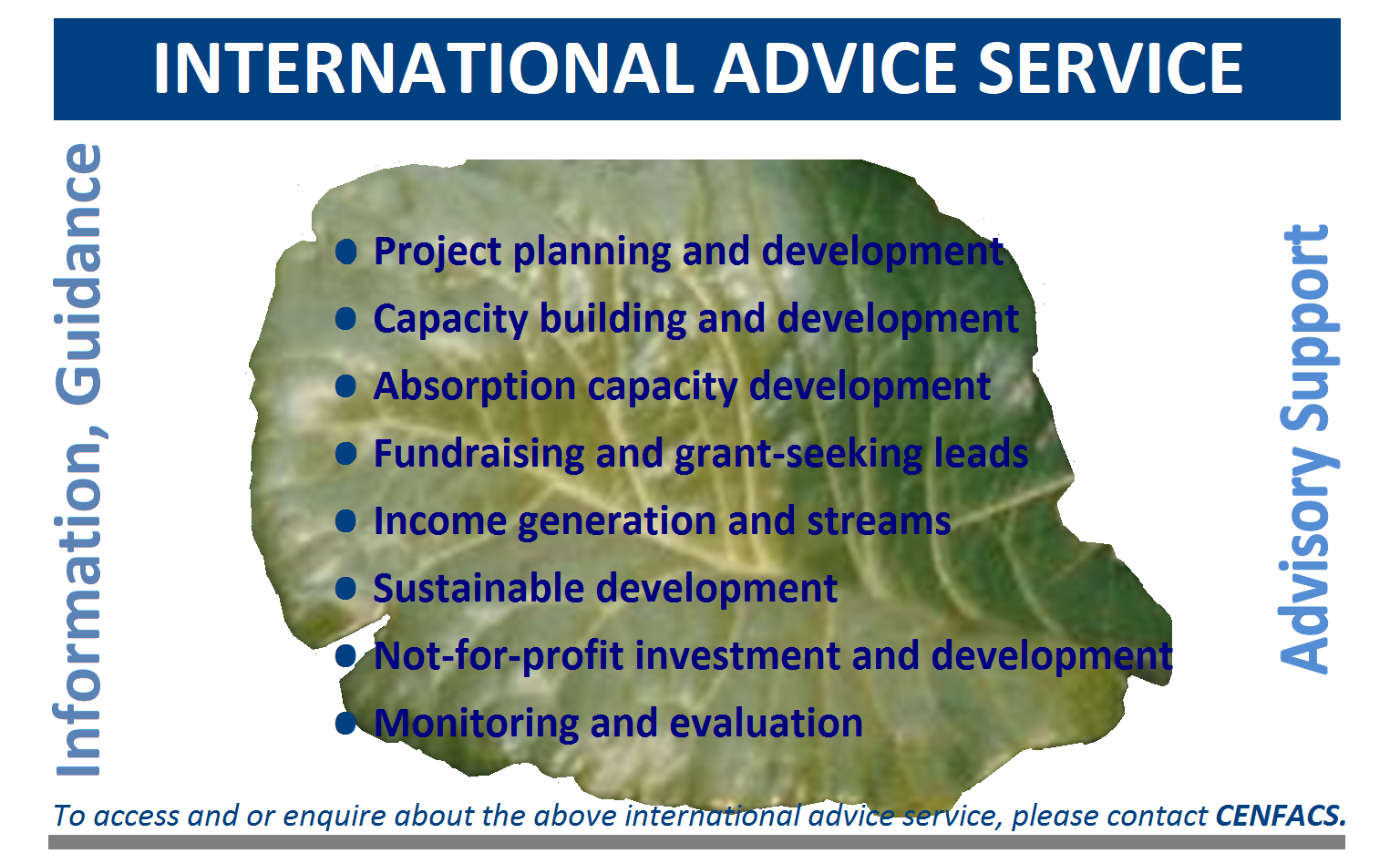
The same enhancement of advice service with AI technology applies to overseas and Africa-based Sister Organisations. We run an International Advice Service to that effect. This service is designed to support Africa-based Sister Organisations. Under our International Advice Service and using AI-enabled technology, we can advise them on the following matters:
√ Capacity building and development
√ Project planning and development
√ Poverty reduction within the context of Africa Continental Free Trade Area
√ Not-for-profit investment and development
√ Absorption capacity development
√ Fundraising and grant-seeking leads
√ Income generation and streams
√ Sustainable development
√ Monitoring and evaluation
√ Guidance for Not-for-profit Investors about Organisations to Not-for-profit Invest for Impact in Africa.
Again, where our capacity to advise is limited, we can refer and or signpost them to relevant international services and organisations. This AI-enabled advisory support for Africa-based Sister Organisations is throughout the year and constituent part of our work with them.
To access this extra support or AI-enhanced advice services, please contact CENFACS. To register for or enquire about AI-enhanced advice services, go to www.cenfacs.org.uk/services-activities.
For any enquiries and/or queries about Information, Guidance and Signposts on Alternatives to High-emission Processes and Pollution-induced Poverty Reduction, please do not hesitate to contact CENFACS.
_________
• References
(1) https://www.forbes.com/advisor/ business/what-is-bookkeeping/ (accessed in April 2026)
(2) Pass, C., Lowes, B. & Davies, L., (1988), Collins Dictionary of Economics, HarperCollins Publishers, London Glasgow
(3) Allen, A. & May, C. (2007), Setting Up For Success – A practical guide for community organisations, Community Development Foundation, London (Great Britain)
(5) web.undp.org/evaluation/documents/guidance/UNDP_Guidance_on_Outcome-Level%20_Evaluation_2011.pdf (accessed in April 2024)
(6) https://www.evalcommunity.com/career-centre/outcome-evaluation/ (accessed in April 2024)
(7) https://superhomes.org.uk/renewable-energy/what-is-retrofitting/ (accessed in April 2026)
_________
• Help CENFACS Keep the Poverty Relief Work Going This Year
We do our work on a very small budget and on a voluntary basis. Making a donation will show us you value our work and support CENFACS’ work, which is currently offered as a free service.
One could also consider a recurring donation to CENFACS in the future.
Additionally, we would like to inform you that planned gifting is always an option for giving at CENFACS. Likewise, CENFACS accepts matching gifts from companies running a gift-matching programme.
Donate to support CENFACS!
FOR ONLY £1, YOU CAN SUPPORT CENFACS AND CENFACS’ NOBLE AND BEAUTIFUL CAUSES OF POVERTY REDUCTION.
JUST GO TO: Support Causes – (cenfacs.org.uk)
Thank you for visiting CENFACS website and reading this post.
Thank you as well to those who made or make comments about our weekly posts.
We look forward to receiving your regular visits and continuing support until the end of 2026 and beyond.
With many thanks.