Welcome to CENFACS’ Online Diary!
25 March 2026
Post No. 449

The Week’s Contents
• Spring Poverty Relief 2026: Focus, Activities, Projects and Programmes
• Climate Action 4 – In Focus from 23 to 29/03/2026: Communicate the Urgency of Climate Change and Share Reputable Information
• Coming This Spring 2026: FACS Issue No. 91 which Will Be Titled as African Charities Fostering Alternatives to High-emission Industrialization and Tackling Pollution-induced Poverty in Africa
… And much more!

Key Messages
• Spring Poverty Relief 2026: Focus, Activities, Projects and Programmes
Last Spring Poverty Relief, we moved forward to protect the gains or legacies of our Building-forward-better-together work while building upon progress to achieve a more equitable and inclusive society. We reinstalled and restored the contents and settings of our system of poverty reduction to get it to a usable state; while stabilising, testing, communicating, continuously monitoring and maintaining the elements of our new system.
After building upon foundational efforts to achieve more equitable and inclusive society, the next steps involve embedding, sustaining, and scaling sustainable initiatives to create deep-rooted, systemic change. Moving from initial progress to long-term impact requires transitioning from compliance-driven actions to cultural transformation.
After protecting the gains or legacies of our Building-forward-better-together work and after building upon progress made to achieve a more equitable and inclusive society, we are now going to focus on long-term sustainability, systemic resilience, and further innovation for endurance to ensure future-proofing progress is embedded rather than merely secured temporarily.
We are as well going to strategically transition from simply protecting previous progress to accelerating it through systemic integration, while ensuring the new, more resilient baseline is continuously built upon. In other words, we are transforming our strategy from holding the line to breaking through using systemic integration to accelerate our achievements and continuously elevate our resilience.
The information about what we are going to do makes the key words of our theme statement for this Spring Poverty Relief 2026. These key words are long-term sustainability, systemic resilience, further innovation, progress acceleration, and continuous resilient baseline. These key words can be turned into the following theme statement formula:
“Embedding long-term resilience through innovation to secure future progress”.
The announcement of Spring Poverty Relief’s theme statement comes with that of activities, projects and programmes making it or the notes composing this theme. These activities, projects and programmes find their expression in this theme and season since Spring Poverty Relief refers to the surge in charitable appeals, fundraising, and community-based aid aiming at addressing poverty, food insecurity, and homelessness, particularly in the Spring months and aligning with Easter and after Easter.
We have provided, under the Main Development section of this post, the activities, projects and programmes we have selected to make this Spring – Spring Poverty Relief 2026 Season.
For further details about Spring Poverty Relief 2026 Season, please go to the Main Development section of this post and read more about it.

• Climate Action 4 – In Focus from 23 to 29/03/2026: Communicate the Urgency of Climate Change and Share Reputable Information
The Fourth Climate Action is Communicate the Urgency of Climate Change and Share Reputable Information. In order to take this action, we are going to cover the following points:
σ What is urgency of climate change?
σ Understanding reputable information
σ Explaining sharing information
σ Communicate the urgency of climate change
σ Key strategies for communicating the urgency of climate change
σ Actionable steps for engagement
σ Compelling communication strategies
σ Effective communication techniques
σ Sharing reputable information
σ Working with the community on ways of communicating the urgency of climate change and sharing reputable information
Let us briefly explain each of these points.
• • What Is Urgency of Climate Change?
It emerges from the climate literature review on climate change that the urgency of climate change refers to the critical need for immediate action to address the accelerating changes in the Earth’s Climate System, primarily driven by human activities. This urgency is underscored by the scientific consensus that greenhouse gas emissions, mainly from burning fossil fuels, are trapping heat in the atmosphere, leading to global warming and related environmental problems. The term emphasizes that we are not just facing a gradual shift, but a rapidly accelerating crisis that demands swift and decisive action to mitigate and adapt to these changes.
• • Understanding Reputable Information
According to ‘libanswer.pstcc.edu’ (1),
“Reputable sources (sometimes called reliable sources) rely on the reputation of their publication (ex. newspaper or journal) or institution … for having high standards of researching, fact-checking, accountability, and ethical reporting”.
Information coming from these sources can be treated as reputable.
The website ‘uagconline.libanswers.com’ (2) speaks instead about credible or reliable source, which it defines as
“One where you can trust the information that the source provides. You can rely on the information provided within the source because the person, publisher, or institution that is providing this information is a credible source for that information”.
• • Explaining Sharing Information
It is stated on the website ‘sciencedirect.com’ (3) that
“Share information refers to the act of distributing knowledge, experiences, or data with others for various reasons such as keeping them informed, reciprocating, helping with research, connecting people, or simply sharing enjoyable moments”.
The information to be shared in the context of these Climate Actions is reputable one.
• • Communicate the Urgency of Climate Change
Perceptions converge that communicating the urgency of climate change requires shifting from abstract data to personal, local stories, emphasizing immediate risks rather than distant threats, and pairing urgent warnings with actionable, hopeful solutions. Consequently, the focus would be on human impacts, such as health and local weather. It implies using plain language and tailoring messages to the audience’s values to foster engagement rather than fear-driven paralysis.
In order to better communicate the urgency of climate change, it may require some communication strategies and techniques.
• • Key Strategies for Communicating the Urgency of Climate Change
Communication experts in this matter recommend the following core strategies:
σ Make your communication personal and local
σ Pair urgency with hope
σ Use plain language
σ Focus on immediate risks, not future scenarios
σ Understand your audience
σ Use trusted messengers
σ Avoid ‘Doom and Gloom’ alone
Etc.
• • Effective Communication Techniques
Theories in climate science communication suggest the following tips:
σ Tell stories, don’t just show statistics
σ Focus on risks, not just uncertainty
σ Engage in dialogue, not debate
Etc.
• • Actionable Steps for Engagement
The involve highlighting co-benefits, using visual aids, and showing that climate action is happening in real life.
• • Sharing Reputable Climate Science Information
Recommendations from experts on the information sharing suggest using authoritative, science-based sources and communicating the information in a relatable, constructive form. To do that, there are key strategies to adopt.
Key strategies will include the following ones:
σ Using data from trusted organizations like the Intergovernmental Panel on Climate Change and NASA Global Climate Change
σ Focusing on local impacts
σ Empowering individuals with actionable solutions rather than just focusing on ‘doom and gloom’
Etc.
• • Working with the Community on Ways of Communicating the Urgency of Climate Change and Sharing Reputable Information
The all-purpose of writing this note is to guide our action. In other words, what is key here is to take action. The note is only a guided principle.
Working with our members to Communicate the Urgency of Climate Change and Share Reputable Information can be done by highlighting the co-benefits in the fight against climate change, using visual aids to illustrate the severity of the climate crisis, and showing that climate action is happening where and when people like them have taken action.
We can work together with them to both communicate the urgency of climate change and share reputable findings on this from trusted, credible sources.
We can engage with them to transform their passive support into active, informed and effective activism that drives both community-level and structural climate action.
Those members of our community in the UK and Africa-based Sister Organisations willing to work with CENFACS on Communicating the Urgency of Climate Change and Sharing Reputable Information as well as on Climate Poverty Reduction; they can take climate actions with us.
For any queries or enquiries about Climate Action 4 and Climate Actions Month, please do not hesitate to contact CENFACS.

• Coming This Spring 2026: FACS Issue No. 91 which Will Be Titled as African Charities Fostering Alternatives to High-emission Industrialization and Tackling Pollution-induced Poverty in Africa
African Charities can foster alternatives to traditional, high-emission industrialization. They can do it by promoting green energy, sustainable, or circular economies instead of traditional, dirty industrial methods. They can as well help communities that have been made poorer by environmental degradation (e.g., loss of fishing or farming due to pollution or high healthcare cost from toxic environments).
Statistics about both high-emission industrialization and pollution-induced poverty tell at lot the stories of these emissions and type of poverty.
Statistics about high-emission industrialization indicate that while African Charities and innovators are fostering low-emission, green industrial alternatives – such as solar-powered agriculture, electric mobility, and clean cooking stoves – their impact is hindered by limited climate change. Essential findings are related to green alternatives, in particular renewable energy and agriculture, clean cooking and e-mobility, green innovation, etc. Key statistical trends cover finance constraints, high-emission dependence, carbon market limitations, etc.
For instance, ‘furtherafrica.com’ (4) notes that
“With 60% of the world’s solar energy potential yet receiving just 2% of global solar investment, the continent [Africa] is well-positioned to play a central role in the global transition to green energy”.
Similarly, ‘africaclimatereports.org’ (5) points out that
“The continent [Africa] hosts 20% of the world’s carbon sinks and contributes less than 4% of global greenhouse gas emissions, yet receives under 10% of adaptation finance and only 3% of total climate funding, this shortfall carries existential consequences”.
Regarding statistics linked to pollution-induced poverty, it is worth mentioning that the latter is a severe, interconnected crisis. Key statistics on pollution-induced poverty are related to the indicators like death toll and economic cost linked to air pollution, poverty exposure as a result of living in areas with unsafe particulate matter or PM2.5 pollution levels, the annual gross domestic product loss linked to pollution-related impacts, and energy poverty driver as a result of the lack of modern energy services.
To illustrate this poverty, the World Bank (6) estimates that
“716 million people living in extreme poverty, calculated as living on less than $1.90 per day, are directly exposed to unsafe PM2.5 concentrations; of these 405 million, or 57 percent are in Sub-Saharan Africa”.
Likewise, ‘greenpeace.org’ (7) mentions the 1.1 million deaths caused yearly by air pollution.
The 91st Issue of FACS, which has to be placed in CENFACS Year of Alternatives and of searching for alternative models and systems for poverty reduction, will be about dealing with alternatives in the fields of industrial development and industrialization. It will involve developing, promoting, and scaling economic models, technologies, and production methods that diverge from conventional, high-carbon, and extractive industrial approaches. It will focus on creating sustainable, inclusive, and localized alternatives – such as circular economies, corporative ownership, or community-based production – to address environmental degradation, social inequality, and the limitations of traditional, resource-intensive growth, without forgetting the reduction and end of pollution-induced poverty.
The 91st Issue of FACS will take into account key theories relating to high-emission industrialization in Africa, in particular the following ones: Pollution Haven Hypothesis/Pollution Halo Effect, Environmental Kuznets Curve, the IPAT (Impact = Population x Affluence x Technology) Model/Identity, Regulatory Chill Theory/”Stuck to the Mud”, and Neoclassical Economic Theory/Pollution Nexus. The 91st Issue of FACS will approach them not only in terms of their explanations on high-emission industrialization in Africa, but also concerning pollution-induced poverty in Africa.
The 91st Issue of FACS will focus on African Charities working on climate justice, that is organisations recognizing that the poorest populations are often the most affected by industrial pollution. The 91st Issue of FACS will also be interested in development charities, which are agencies that promote clean, sustainable, and local livelihoods rather than relying on heavy pollution industries. The 91st Issue of FACS will as well pay some attention to the work of African Charities involved in environmental law or policy, in particular those that campaign to stop pollution at its source to prevent it from causing economic hardships.
The 91st Issue of FACS will also be a story of the relationship between high-emission industrialization and pollution-induced poverty, and how African Charities are trying to play their game well in helping to reduce this form of poverty in Africa.
Far from being simply a negative portrait on high-emission and pollution information, the 91st Issue of FACS will provide some positive usage examples of green alternatives in the areas of renewable energy and promoting regenerative agriculture, empowering small holders, waste-to-value innovations, clean cooking and e-mobility, green innovation, etc. to show that African Charities are engaging with local communities to overturn high-emission and pollution-led processes. African Charities are driving change by helping local people and communities to move away from the high-emission and pollution pathways to long-term sustainability, despite some challenges.
To read more about this new Issue, please keep checking on CENFACS incoming posts this Spring 2026. To reserve a paper copy of this 91st Issue of FACS, please contact CENFACS with your mailing details.

Extra Messages
• Matching Organisation-Investor via a Sustainable Water Project – Activity 5 (from 25/03 to 01/04/2026): Matching Organisation’s Operation and Maintenance with Not-for-profit Impact Investor’s Monitoring, Evaluation and Long-term Sustainability
• All-Year-Round Projects Lifecycle – Step/Workshop 6: Organizing Your Play, Run and Vote Projects; and Integrating Triple Value Initiatives into Your All-Year-Round Projects Organizing
• Household- and Area-focused Programmes for Assets and Economic Building for Families (H&AfP4A&EB4Hs)

• Matching Organisation-Investor via a Sustainable Water Project – Activity 5 (from 25/03 to 01/04/2026): Matching Organisation’s Operation and Maintenance with Not-for-profit Impact Investor’s Monitoring, Evaluation and Long-term Sustainability
The last episode of our 5-week Matching Organisation-Investor via a Sustainable Water Project is about Matching Organisation’s Operation and Maintenance with Not-for-profit Impact Investor’s Monitoring, Evaluation and Long-term Sustainability Criteria.
In order to reach this last episode, African Charity Investee/African-based Sister Charitable Organisation (ACI/ASCO) and Not-for-profit (NFP) Impact Investor settled their difference on project implementation and installation. ACI/ASCO explained how it will integrate the human element with the technology to avoid any failure to adequately invest in the people making the Sustainable Water Project (SWP). ACI/ASCO also clarified how it will link technology development cycle (installation) and human development cycle (implementation). Becasue its explanations were convincing, the two parties agreed to move to this last phase of the matching talks – Activity 5.

To approach this last part of the matching talks, we have organised our notes as follows:
σ Activity 5 Matching Concepts
σ Negotiation Terms between ACI/ASCO and Not-for-profit Impact Investor
σ Reaching a Negotiated Agreement
σ The Match or Fit Test
σ Concluding Note on Matching Organisation-Investor via a Sustainable Water Project.
Let us explain each of these headings.
• • Activity 5 Matching Concepts
There are 5 concepts or key words that need clarification to facilitate the matching talks. These key words are Operation, Maintenance, Monitoring, Evaluation and Sustainability.
Let us clarify them
• • • Operation
To explain operation, let us refer to what ‘deepprojectmanager.com’ (8) articulates about it, which is
“Operations represent the ongoing, repetitive activities that sustain your business and deliver consistent value to customers. These are the day-to-day processes that maintain efficiently, quality, and service levels”.
The same ‘deepprojectmanager.com’ adds that projects are different from operations. According to ‘deepprojectmanager.com’,
“Projects are temporary with defined start and end dates. Projects close once objectives are met… Operations are continuous and ongoing. Operations run indefinitely as long as the business exists”.
From the definition of operation, ACI/ASCO needs to demonstrate to the NFP Impact Investor that SWP will have ongoing and repetitive activities to sustain.
• • • Maintenance
The website ‘safetyculture.com’ (9) explains that
“Maintenance, otherwise known as technical maintenance, refers to a set of processes and practices that aim to ensure the continuous and efficient operation of machinery, equipment, and other types of assets typically used in business”.
There are many types of maintenance like routine, planned, corrective and predictive ones.
This general definition of maintenance can be adapted to SWP.
• • • • Maintenance in a Sustainable Water Project (MSWP)
MSWP refers to the ongoing activities required to ensure the efficient, effective, and long-term operation of water supply and sanitation systems. This includes regular inspections, maintenance activities, and system monitoring to address issues promptly and maintain the infrastructure in good condition. It encompasses both technical and managerial aspects, ensuring that the system continues to function optimally and sustainably. Effective maintenance practices are essential for the longevity and reliability of water infrastructure, contributing to the overall sustainability of water resources and services.
ACI/ASCO can clarify its position in terms of the types of maintenance it will conduct.
• • • Monitoring and Evaluation
Let us first start with monitoring. Monitoring is, according to ‘indepthresearch.org’ (10),
“The systematic and ongoing collection of data and information to track the progress and performance of project, programme, or policy.”
The same ‘indepthresearch.org’ explains that
“Evaluation is a systematic assessment of a project, programme, or policy to determine its relevance, efficiency, effectiveness, impact, and sustainability”.
The website ‘indepthresearch.org’ finally puts together monitoring and evaluation by stating that
“Monitoring and Evaluation is a methodical process that involves acquiring, analyzing, and interpreting data in order to evaluate the development, efficacy, and impact of initiatives, programmes, policies, or interventions”.
The NFP Impact Investor will want see that ACI/ASCO has a monitoring and evaluation plan for the SWP.
• • • Sustainability
Sustainability can be explained in many ways, which all convey more or less the same message. In the opinion of the Community Tool Box (11),
“Sustainability is the active process of establishing your initiative – not merely continuing your programme, but developing relationships, practices, and procedures that become a lasting part of the community”.
The website ‘instituteprojectmanagement.com’ (12) explains it as
“The incorporation of environmental, social, and economic principles into project planning, execution, and evaluation. It entails designing and implementing projects in ways to reduce harm to the environment, support social equity, and contribute to long-term economic resilience. This approach requires considering the broader implications of project decisions, including their impact on future generations”.
The NFP Impact Investor will use these definitions of sustainability in the matching negotiations. ACI/ASCO needs to develop or have a plan for SWP sustainability.
The above-mentioned definitions will formulate the basis to reach a negotiated agreement.
• • Negotiation Terms between ACI/ASCO and Not-for-profit Impact Investor
As part of the negotiating terms, it is understood that ACI/ASCO’s Operation and Maintenance Stage includes project monitoring and evaluation as well. Likewise, it has to be noted that unlike traditional aid, sustainable projects (like SWP) require ongoing, long-term monitoring (often more than 5 years) to ensure the system is still working and that water quality is maintained. This includes evaluating whether the project has created the intended social impact, such as reduced waterborne disease or improved economic productivity.
As indicated by ‘thewaterproject.org’ (13), to make and/or keep SWP sustainable ACI/ASCO needs to be prepared to clarify some issues of concern from the NFP Impact Investor.
Notably and first of all, the NFP Impact Investor may want to know what ACI/ASCO will do to maintain SWP. ACI/ASCO can answer that it will listen to and connect with those who will be closest to the problems that SWP will address.
The NFP Impact Investor could also ask if ACI/ASCO will keep sustainability in mind at each project stage. ACI/ASCO could answer it will do it at all levels (including mapping or sitting, proposal and construction, training and handover, monitoring and maintenance).
The NFP Impact Investor can additionally ask questions about the monitoring and evaluation challenges (like data quality and reliability, lack of resources, complexity of impact assessment, time constraints, limited utilization of evaluation findings, etc.). The NFP Impact Investor can as well ask ACI/ASCO to produce its monitoring and evaluation plan.
ACI/ASCO is required to successfully answer to all these issues if it wants to reach a negotiated agreement.
• • Reaching a Negotiated Agreement
The two sides (ASCO and the NFP Impact Investor) need to reach a negotiated agreement on the contents of Operation and Maintenance (O&M) for the former and Monitoring, Evaluation and Long-term Sustainability (ME<S) for the latter. It means they need to align their positions. This alignment requires active ongoing collaboration that merges ACI’s/ASCO’s mission-driven expertise with the NFP Impact Investor‘s requirements for measurable impact and financial stewardship, This can be achieved through structured planning, clear impact mapping (Theory of Change), agreed Key Performance Indicators and active support.
If there is a disagreement between ACI/ASCO and NFP Impact Investor, this could open up the possibility for a match/fit test. The match/fit test can be carried out to try to help the two sides of the matching process. The match/fit test can also be undertaken if there is a disagreement on any of aspects of SWP.
• • The Match or Fit Test Service
As part of the match or fit test, the contents of ASCO’s O&M Stage must be matched with NFP Impact Investor’s view on ME<S. The match test (or matched sampling) will help to increase the accuracy and statistical efficiency of the study of the SWP by carefully selecting subjects for comparison. The purpose here will be to increase the statistical efficiency of the study on SWP by controlling for confounding variables when forming a sample.
The fit test will assist in determining how well the observed sample data matches a specified theoretical distribution. The fit test will check if the data collected fits a model or an assumed population distribution. So, the purpose of the fit test is to validate or invalidate the statistical model by checking if the sample data follows an expected distribution.
The match can be perfect or close (that is, when every unit is paired with an equivalent unit) in order to reach an agreement. If there is a huge or glaring difference between the two (i.e., between what the NFP Impact Investor’s approach to ME<S Stage and what ACI/ASCOC is saying about its O&M Stage, between what the investor would like the O&M Stage to indicate and what ASCO’s O&M Stage is really saying), the probability or chance of having an agreement at this Fifth and last round of negotiations could be null or uncertain.
• • • Impact Advice to ASCO and Guidance to NFP Impact Investor
Where there could be a disagreement, CENFACS can impact advise ACI/ASCO to improve the contents of its O&M Stage. CENFACS can as well guide NFP Impact Investors to work out their expectations in terms of ME<S Phase to a format that can be agreeable by potential ASCOs.
CENFACS’ impact advice for ASCOs and guidance on impact investing for NFP Impact Investor, which are impartial, will help each of them (i.e., investee and investor) to make informed decisions and to reduce or avoid the likelihood of any significant losses or misunderstandings or mismatches.
• • • The Rule of the Matching Game
The rule of the game is the more impact investors are attracted by ACI’s or ASCOs’ O&M Stage the better for ACIs or ASCOs. It means that ACI’s or ASCOs’ process must pass the attractiveness test (that is, the evaluation of market’s appeal). Likewise, the more ACIs or ASCOs can successfully respond to impact investors’ level of enquiries and queries about the SWP the better for investors. In this respect, the matching game needs to be a win-win one to benefit both players (i.e., investee and investor).
The above is the Fifth Activity of the Matching Organisation-Investor via SWP.
Those potential organisations seeking investment to set up a SWP and NFP Impact Investors looking for organisations that are interested in their giving, they can contact CENFACS to be their matchmaker to find their perfect investee or investor.
• • • CENFACS as a Matchmaker
As a Matchmaker, CENFACS can streamline your search process, save time, money and resources to help you find the perfect match in the world of impact investing.
CENFACS platform will help facilitate the matching process between investees and investors. By leveraging the power of AI tools, CENFACS’ Matching Organisation-Investor Programme can streamline the search process for funding opportunities, connecting African charities and impact investors/funders.
Briefly speaking, CENFACS can work with matching applicants and use AI to match organizations with the right impact investors, filtering profiles based on development stages, sectors, and aims.
In this matching process, CENFACS can arrange the match or fit test for them. They can have their fit test carried out by CENFACS’ Hub for Testing Hypotheses.
• • • CENFACS’ Hub for Testing Hypotheses
The Hub can help use analysis tools to test assumptions and determine how likely something is within a given standard of accuracy. The Hub, which can serve as a learning or reference place for those who would like to understand and apply statistical hypothesis testing, can assist to
√ clean, merge and prepare micro-data sources for testing, modelling and analysis
√ conduct data management and administration
√ carry out regression analysis, estimate and test hypotheses
√ interpret and analyse patterns or trends or insights in data or results.
In this respect, CENFACS’ H-tests Hub is knowledge repository designed to demystify the process of using data to make informed decisions and move beyond intuition and guesswork.
Those who would like to apply hypothesis testing in fields of economic development or to deal with poverty reduction, they are welcome to use CENFACS’ H-tests Hub.
• • • • Hypotheses testing about ACI/ASCO’s Project Operation and Maintenance and NFP Impact Investor’s Monitoring, Evaluation and Long-term Sustainability
Hypotheses regarding ACI/ASCO’s Project Operation and Maintenance and NFP Impact Investor’s Monitoring, Evaluation and Long-term Sustainability can be structured around the causal links between technical performance, data-driven oversight and long-term sustainability. Based on the negotiations between ACI/ASCO and NFP Impact Investor, key hypotheses can be formulated by theme. One can have the following themes:
a) O&M Quality and Long-term Sustainability (with a focus on ACI/ASCO)
b) NFP Impact Investor M&E and Project Sustainability (with a focus on NFP Impact Investor)
c) Interaction between ACI/ASCO and NFP Impact Investor (integrated hypotheses)
Etc.
If one considers the theme a) and focuses on ACI/ASCO, one of the hypotheses could be: Predictive Maintenance Improves sustainability.
Concerning theme b) and NFP Impact Investor focus, one of the hypotheses could be: Joint M&E Increases Technical Commitment.
Regarding theme c) and ACI/ASCO-Impact Investor interaction, one of the hypotheses could be: ESG (Environmental, Social and Governance) Transparency Improves Operational Performance.
For any queries and/or enquiries about this Fifth or last stage (or phase) activity of Matching Organisation-Investor via SWP, please do not hesitate to contact CENFACS.
• • Concluding Note on Matching Organisation-Investor via Sustainable Water Project
To close this project, let us recognize that although this note/presentation has been based on a 5-stage lifecycle thinking tool or model and 5 essential stages of water projects, there could be more than five stages in any sustainable water project lifecycle.
The match probability can be high or average or low depending on how much ASCOs’ needs meet Not-for-profit Impact Investors’ interests.
CENFACS is still available to work with ASCOs that are looking for Impact Advice and Not-for-profit Impact Investors who need Guidance with Impact so that the former can find the investment they are looking for and the latter the organisation to invest in, and both of them can realise their respective Easter dreams.
To work together to make your matching dream come true by finding your ideal investee or investor, please contact CENFACS.

• All-Year-Round Projects Lifecycle –
Step/Workshop 6: Organizing Your Play, Run and Vote Projects; and Integrating Triple Value Initiatives into Your All-Year-Round Projects Organizing
This workshop is divided in two parts: organisation and integration. Let us preent them.
• • Organizing Your Play, Run and Vote Projects (6.1)
After negotiating and agreeing the terms of your all-year-round project, you can now start organising it. What is organizing or organize in the project lifecycle and what is organizing your all-year-round project.
• • Organising in a Project Lifecycle
The literature on the matter suggests that organise or organizing refers to the planning and structuring phase that translates a project’s authorized charter into a concrete, actionable roadmap. It is the crucial bridge between initiation (getting approval) and execution (doing the work), focused on defining who will do the work, what tools they will use, and how the work will be managed.
Organizing, which occurs during the project planning phase, includes creating the project organizing chart, assigning roles, assembling the team, defining scope and work structure, and developing the project plan.
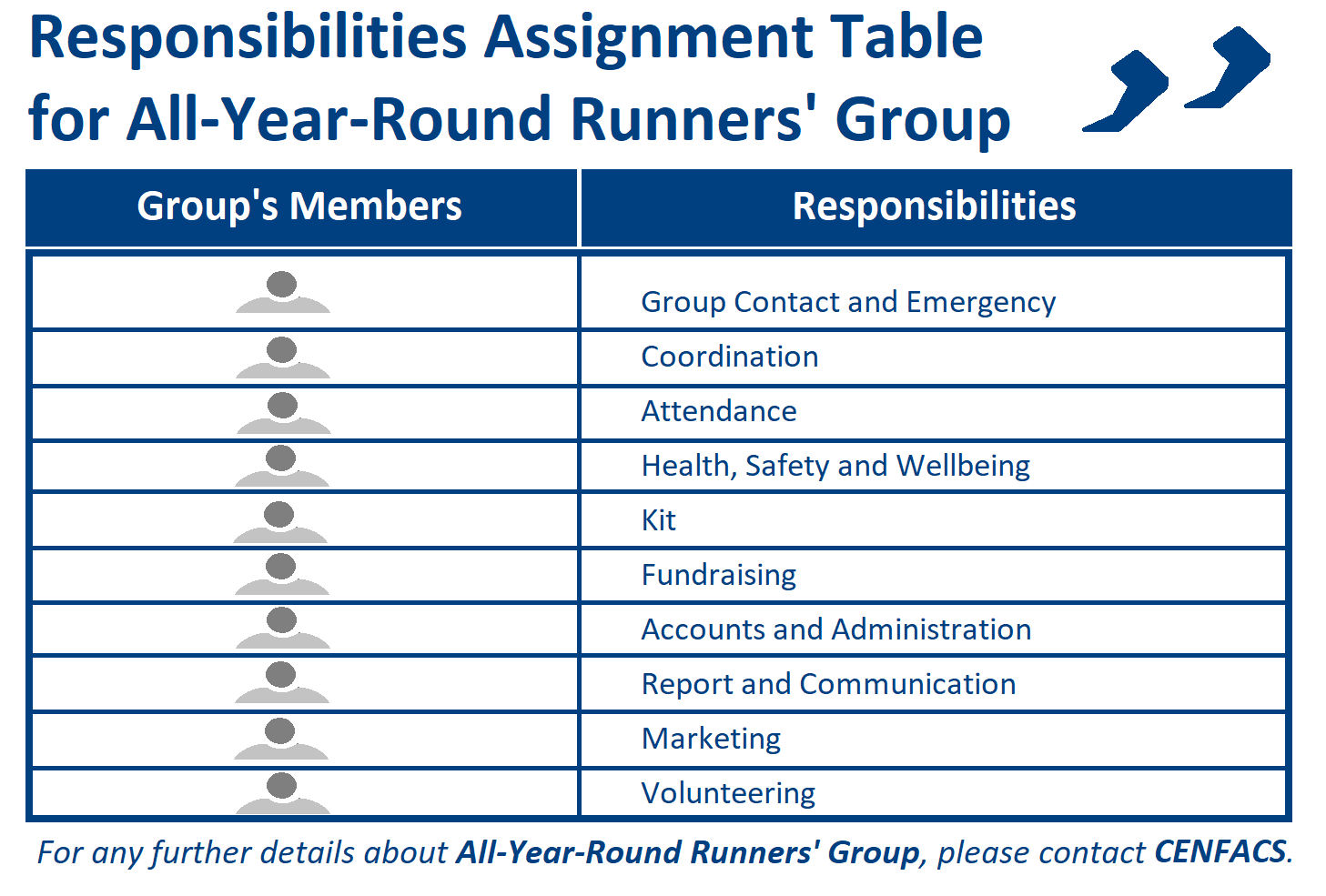
This is the step from which you start to put in place your organisational structure. In project planning parlance, you will identify the roles and responsibilities (as shown in the table below) of each person to be involved in the project in order to facilitate the coordination and implementation of the project activities.
In short, Organizing is a component of the broader planning phase. Planning deals with the technical project aspects (like dates, budget, and risks), while Organizing focuses on the structural aspects (such as teams, responsibilities, and reporting lines).
However, organizing your All-Year-Round Projects require a bit more effort.
• • Organizing Your All-year Round Projects (AYRPs)
• • • What is AYRP organizing?
It emerges from theories and practices on project planning that an AYRP organizing refers to a continuous, strategic approach to managing multiple projects and tasks throughout the entire year, rather than treating them as isolated, temporary events.
It involves a systematic, often digital, process of planning, prioritizing and maintaining projects in a consistent, ongoing flow to avoid burnout and overwhelm. There are components in this organizing.
• • • Key components of AYRP organizing
Key components of this approach include continuous workflow, structured planning, proactive maintenance, and centralized information. These components are normally handled within specific strategies.
• • • Common strategies for AYRP organizing
They are
σ The 4P’s Framework (which focuses on People (roles), Product (deliverables), Process (procedures), and Project (tasks) to structure work
σ Quarterly Goal Mapping
σ Getting Things Done Methods
σ Digital Board Utilization.
This approach helps to maintain a steady space, improves efficiency.
Let us look at in practice how one can organise its AYRP.
• • • An Example of Organising Your All-Year-Round Projects
Let say you would like to Run for Poverty Reduction and you want to undertake it as a group in your local area. You decide to set up a running group and to name it as “All-year-round Runners’ Group”.
To start your organisation, you will proceed with the points below.
• • • • Create a Basic Organisational Structure
You can create a basic organisational structure that identifies your project personnel, creates a management and delivery teams, and assigns roles and responsibilities including coordination. In practical terms, you will have to decide on the following:
Who is (are) going…
∝ to be first at the meeting/gathering point each time the running takes place?
∝ to hold the contact number/details of the group to keep everybody on board?
∝ to keep the attendance register?
∝ to check that everybody is fit and well to run?
∝ to lead or coordinate the run?
∝ to deal with health and safety of the group?
∝ to sort out the equipment if any?
∝ to care for people belongings while they are running?
∝ to make sure that everyone is countable after the Run?
∝ to record your Run event (e.g., filming it, using camera on your phone, a video or voice recorder, etc.)?
∝ to check that everyone leaves the meeting/gathering point safely after the event?
etc.
Depending on your skills, knowledge, experience and resources; you may add more roles and responsibilities.
You can even include a fundraising element into your running activity.
• • • • Including a Fundraising Element into Your Run
If your Run involves any fundraising activity, you need to decide who will volunteer to undertaking fundraising responsibility (or everybody in the group). You can decide how much to raise each time you run without making it as an obligation since the aim of your Run is not to raise money. The aim of your Run is to impact poverty, the health and wellbeing of group members.
• • • • Impact Reporting on Your Run
If you would like to report on your Run, you need to appoint someone to produce a report. You can decide everyone of your members reports on their own Run session/activity. In fact, it is a good idea to report on your Run. This is one of the ways of capturing and sharing the impact you are making on yourself, on the group and others. In monitoring and evaluation jargon, it is called impact reporting.
• • • • Monitoring and Evaluating the Performance of Each Runner and Giving a Prize
If your group is going to select the best runner of the year 2026 and give a prize/reward accordingly; then you need to organise yourself to monitor and evaluate the performance of each runner against your given performance criteria throughout the year, and decide by the 23rd of December 2026 who is the group’s best runner of the year (BRY) 2026.
However, Organizing your AYRP will not be enough unless you incorporate Triple Value Initiatives (TVIs) in it.
• • Integrating Triple Value Initiatives into Your All-Year-Round Projects Organizing (6.2)
Integrating the Triple Value Initiative (TVI) or Triple Bottom Line (TBL) – People, Planet and prosperity – into year-round project organising requires shifting from traditional, short-term project constraints (like time, cost, and scope) to a holistic, value-driven approach. This involves embedding sustainability into project conceptualization, planning execution, and reporting phases throughout the entire project liefcycle.
To integrate the TVI into year-round project organising, you can consider the practices below.
a) Conceptualization and strategic alignment
It includes embedding in project objectives, establishing a purpose-driven culture, and extending planning timeframes.
b) Stakeholder engagement and social value planning
It involves identifying broader needs, developing a social value strategy, and co-creating with beneficiaries.
c) Integrated project execution and governance
It encompasses routinization strategy, adjustment of budgeting processes, and continuous improvement.
d) Monitoring and reporting
It is comprised of the development of comprehensive reporting frameworks, enhanced status reports, Key Performance Indicators-led performance review.
e) Cultivating sustainable project habits
It consists of continuous training, empowerment, and experimentation.
With these practices, your AYRP will transition from simply meeting a goal to delivering lasting integrated value (that is, People, Planet, and Prosperity) throughout the year.
CENFACS can work with AYRP users to integrate these initiatives into their project tools and lifecycle thinking processes. This will stop these TVIs being ‘add-on’ and enable them become part of the organisation of their AYRP success.
For those who are not familiar with project organizing and the integration of Triple Value Model into their AYR project, they should not hesitate to contact CENFACS if they need support.
They can contact CENFACS by
phoning, texting, e-mailing and completing the contact form on this website.
We can together discuss in detail your/their proposals about either your/their Run or Play or Vote projects, as well as the integration of TVIs into these projects.
For any queries and/or enquiries about All-Year-Round Projects Lifecycle and Organizing as well as about the Integration of Triple Value Initiatives into Project, please contact CENFACS.

• Household- and Area-focused Programmes for Assets and Economic Building for Families (H&AfP4A&EB4Hs)
These programmes are among those Seasonal initiatives or initiatives falling within the Season of Light, which ended last week. They are strategic marketing efforts that CENFACS undertakes to align its campaigns with the specific time of the year when supporters’ interest and willingness to give are high. In this respect, they are conceptualised to tap into heightened fundraising activities and emotions associated with the continuation of the giving moments. But what are really H&AfP4A&EB4Hs?
• • Understanding H&AfP4A&EB4Hs
H&AfP4A&EB4Hs are strategic approaches designed to foster wealth retention, economic resilience, and local ownership by focusing on specific geographic areas and individual household capacities.
H&AfP4A&EB4Hs often framed under ‘Community Wealth Building’ (CWB) or ‘Asset-Based Community Development’ (ABCD) – shift away from traditional economic models that solely focus on attracting external investment, instead of leveraging existing local resources.
Within H&AfP4A&EB4Hs a distinction is made between Household-Focused Programmes (HFPs) and Area-Focused Programmes (AFPs).
HFPs are initiatives that focus on increasing the financial security, skills, and tangible assets of individual families, and residents particularly in low-income scenarios. Among HFPs, it can be mentioned the following ones:
σ Asset-building for Low-income Households
σ Asset-based Community Development
σ Financial Inclusion and Educational Programmes
σ Workforce and Employment Initiatives
σ Affordable Housing and Energy Efficiency.
AFPs are initiatives that target specific communities, neighbourhoods, or regions to keep wealth circulating locally and strengthen the economic base. AFPs include the following:
σ Community Wealth Building (CWB) Strategy
σ Community Asset Transfer
σ Local Procurement and Supply Chains
σ Economic Development Area
σ Support for Alternative Ownership.
It is possible to work with the community so that they access and gain the benefits offered by this programme.
• • Working with the Community on H&AfP4A&EB4Hs
As part of supporting our community members in the process of building their assets and economy to reduce poverty we will be working with them on these programmes from next April. The first series of work or activities/projects with them will be on HFPs.
Those who may be interested in working with us on HFPs, they can contact CENFACS. Also, those who have any queries and/or enquiries about H&AfP4A&EB4Hs, they should not hesitate to communicate with CENFACS.

Message in French (Message en français)
• Sources de Revenus et Projets Alternatifs pour Pâques 2026 (SRPAP2026)
Le programme SRPAP2026 est un soutien similaire à l’aide financière que nous proposons chaque année vers le mois de décembre. Il s’agit d’une nouvelle formule, plus courte, destinée à aider les enfants, les jeunes et les familles à faibles revenus (EJF) en leur fournissant des informations, des conseils et un accompagnement pour générer un petit revenu supplémentaire afin de couvrir les dépenses de Pâques, particulièrement en cette période difficile marquée par un coût de la vie élevé.
Puisque CENFACS consacre cette année aux alternatives, le programme SRPAP2026 se concentre sur les Sources de Revenus Alternatives et les Projets Liés à Pâques. Ces sources et projets visent à tirer parti de la forte demande des consommateurs/rices pour les activités thématiques, l’artisanat et les produits alimentaires, allant de petits boulots à des initiatives de collecte de fonds communautaires.
Pour générer ou diversifier leurs revenus, les EJF à revenus alternatifs ont besoin d’un projet ou d’une idée pouvant se transformer en une véritable activité lucrative. Cette activité ou profession constitue leur projet de revenus, tandis que les flux financiers qui en résultent représentent leur source de revenus. Autrement dit, leur projet de revenus alternatifs pour Pâques serait une activité ou un événement organisé et spécifique, utilisant une méthode précise pour générer des revenus pendant la période pascale, avec une date de début et de fin clairement définies. Leur source de revenus alternatifs pour Pâques serait une catégorie générale de revenus, générant des gains ou des recettes, qui peuvent être saisonniers ou passifs.
Les sources de revenus alternatives pour Pâques sont nombreuses : vente d’articles et de décorations sur le thème de Pâques, prestations de services et participation à des événements saisonniers. Avec ses thèmes de printemps, de renaissance et de célébration, Pâques offre diverses opportunités de générer des revenus supplémentaires. Ces activités permettent non seulement de gagner un peu d’argent pendant cette période, mais aussi d’exprimer sa créativité et de contribuer à l’esprit pascal.
Puisque le programme SRPAP2026 vise à générer un revenu supplémentaire pendant la période de Pâques, les personnes qui entreprennent ces activités doivent disposer d’indicateurs pour vérifier si une source de revenus choisie produit les revenus escomptés. Cela signifie qu’elles peuvent évaluer la performance de leur modèle de génération de revenus grâce à des indicateurs clés de performance spécifiques à SRPAP2026, tels que des indicateurs financiers (retour sur investissement), opérationnels (respect du budget) et de marque (notoriété).
Le programme SRPAP2026 propose des méthodologies et des techniques pour créer une source de revenus alternative pendant la période de Pâques, répondant à vos besoins ou à ceux/celles des utilisateurs/rices et bénéficiaires de CENFACS en matière de réduction de la pauvreté, notamment, mais pas exclusivement, de la pauvreté monétaire, durant cette période et au-delà.
Ceux ou celles qui disposent d’une source de revenus alternatifs pour Pâques et souhaitent la transformer en projet de revenu alternatif pour Pâques sont invité(e)s à nous contacter. Nous pouvons également examiner leurs propositions de projet, le cas échéant.
Nous pouvons collaborer avec eux/elles pour concrétiser leurs projets de revenus pour Pâques.
Pour plus d’informations sur le programme SRPAP2026, n’hésitez pas à contacter le CENFACS.

Main Development
• Spring Poverty Relief 2026: Focus, Activities, Projects and Programmes
Spring Poverty Relief 2026 will be about addressing poverty and hardships (in terms of food insecurity, homelessness, and other issues) for those making our community and sister communities in the UK and Africa-based Sister Organisations in the Spring months, while aligning with Easter spirit. It is an effort to provide support to those in need during the Spring season. The focus is therefore shifting from emergency, short-term help to long-term, systemic and dignified support.
Knowing what Spring Poverty Relief 2026 is/well be about, we can now present it by re-explaining its Focus and highlighting its Activities, Projects and Programmes. This is without forgetting the meanings or properties of the kind of building we would like to erect. So, the following items covers Spring Poverty Relief 2026:
σ Spring Poverty Relief 2026 Focus
σ Key Terms Embodying Our Spring Poverty Relief 2026
σ Spring Poverty Relief 2026 Activities, Projects and Programmes
Let us briefly uncover the above-mentioned items.
• • Spring Poverty Relief 2026 Focus
This Spring Poverty Relief 2026, we are going to embed, sustain, and scale initiatives to create deep-rooted, systemic change, while moving from initial progress. Moving from initial progress to long-term impact requires transitioning from compliance-driven actions to cultural transformation.
We also intend to focus on long-term sustainability, systemic resilience, and further innovation for endurance to ensure future-proofing progress is embedded rather than merely secured temporarily.
We are committed to strategically transition from simply protecting previous progress to accelerating it through systemic integration, while ensuring the new, more resilient baseline is continuously built upon. In other words, we will be transforming our strategy from holding the line to breaking through using systemic integration to accelerate our achievements and continuously elevate our resilience.
The information about what we are going to do makes the key words of our theme statement for this Spring Poverty Relief 2026. These key words are long-term sustainability, systemic resilience, further innovation, progress acceleration, and continuous resilient baseline. These key words can be turned into the following theme statement formula:
“Embedding long-term resilience through innovation to secure future progress”.
Before we unveil these activities, projects and programmes; let us highlight the key terms embodying our Spring Poverty Relief 2026.
• • Key Terms Embodying Our Spring Poverty Relief 2026
They are the terms we can use in the implementation of Spring Poverty Relief 2026. These terms or key words are long-term sustainability, systemic resilience, further innovation, progress acceleration, and continuous resilient baseline.
Let us explain them.
• • • Key terms for implementing Spring Poverty Relief 2026
As announced above, these terms or key words are long-term sustainability, systemic resilience, further innovation, progress acceleration, and continuous resilient baseline. Let us highlight these terms.
• • • • Long-term sustainability
According to ‘madrigalcc.com’ (13),
“Long-term sustainability is about creating a business model that thrives despite external pressures and remains competitive in an ever-changing landscape”.
It also means designing for intergenerational equity and enduring ecological or social health.
• • • • Systemic resilience
Systemic resilience can be defined in various ways depending on whether one speaks about system or systemic resilience.
Speaking about systemic resilience, ‘sustainability-directory.com’ (14) states that
“It is the ability of a whole system to absorb disturbances, adapt to change, and contribute to function effectively”.
Arguing instead about system resilience, ‘biologyinsights.com’ (15) points out that
“It describes a system’s capacity to withstand, adapt to, and recover from various disturbances or changes”.
In short, it is about ensuring that interconnected systems (economic, environmental and social) can adapt to disruptions and thrive, rather than just surviving.
• • • • Further innovation
Within the literature about innovation, it is suggested that further innovation refers to the continuous process of improving, upgrading, or building upon existing products, services, or technologies. Unlike the initial creation of a new product, it signifies the ongoing development of innovative activities to enhance performance, increase efficiency, or adapt to changing market conditions.
Summarily, it involves creating adaptive technology, circular economies, and novel strategies that positively shape a better tomorrow.
• • • • Progress acceleration
It emerges from the majority of thinkers about progress and acceleration that progress acceleration is the concept that pace of human, technological or project development is increasing exponentially rather than linearly, often due to compounding innovations. It represents a rapid shift toward improved (efficiency) and faster goal attachment in areas like tech growth, business, and education.
• • • • Continuous resilient baseline
Theories about baseline indicate that continuous resilient baseline is a proactive, evolving framework that establishes a “normal” state of operations and continuously monitors, validates, and adjusts the baseline to withstand and recover from disruptions. It is an approach that allows organisations to treat resilience as a “living” capability that is inseparable from digital trust in modern enterprises.
The above-mentioned key terminology or words or concepts are the ones we shall use in implementing Spring Poverty Relief 2026. There are also relationships between them in order to make this Spring of Poverty Relief. They will be part of the activities, projects and programmes we have planned to deliver this Spring. What are those activities, projects and programmes?
• • Spring Relief 2026 Activities, Projects and Programmes
CENFACS is delighted to present its New Season’s (Spring) Collection of Selected Activities, Projects and Programmes with a choice of relief and climate smart services. For each of these activities, projects and programmes; you will find climate resilient development ambition as well as user-friendly and –centred poverty relief. They are designed with the scents of inclusivity, cleanness, safety, sustainability, resilience and innovation.
These are the activities, projects and programmes to rebuild lives, infrastructures and institutions as we move forward better together greener, cleaner, inclusive and safer towards a net-zero world. They are free, but we do not mind donations. The more you donate, the more we can help relieve lives.
Please find below the selection of Spring Relief 2026 Activities, Projects and Programmes.
• • • April: Protection Month
In Spring 2026, the protection needs for women and children are focused on addressing the intersection of digital risks, escalating gender-based violence, and systemic vulnerabilities, with a strong push towards “Rights, Justice, Action” for all women and girls, as specified by the 70th session of the United Nations Commission on the Status of Women (16). Strengthening legal and social systems is key to this push.
Based on 2026 assessments, the types of protection for women and children we shall work on in April 2026 will be:
Protection of Women and Children (from AI Risk Management and Displacement), and Protection through Alternative Income Source.
a) Women and Children Projects (3W & PPS Reflection Day):
Reflection on Protection of Women and Children from AI Risk Management and Displacement (Protection project)
On our Reflection Day, we will reflect on ways of protecting children from AI-generated content, deepfakes and cyber-bulling. We shall also think on Systemic and Global Protection Priorities, in particular the protection of displaced women and children. These protections are framed within the context of the United Nations ‘Rights, Justice, Action’ campaign for 2026, which aims to dismantle structural barriers to equality.
b) Protection through Alternative Income Sources (Protection and Income project)
This initiative is about the link between protection and alternative income sources. This link is that alternative income is crucial for providing financial protection against risks and threats to one’s primary livelihood. The type of protection can widely vary from financial security for individuals to conservation for entire communities. This type of protection can cover areas such as finance, environment and conservation, investor’s portfolios, social matters, etc.
• • • May: Stories and Voices Month
The plan for May 2026 is made of two main features:
Stories Telling and Sharing project, and the continuation of our Rebuilding Africa project/campaign.
a) All in Development Stories (Volunteer’s Stories Telling & Sharing project)
Tell Your Story This Coming May 2026 – Tell it!
Entries for Stories on Poverty Relief and Development for May 2026 (May Stories) are now open. To tell and share your story of change for change to CENFACS, please contact CENFACS for story telling terms and conditions.
This year’s All in Development Stories will be those of Embedding long-term resilience through innovation to secure future progress. These stories can be broken into specific actionable narratives as follows:
a.1) Embedding progress, sustaining, and scaling sustainable initiatives to create deep-rooted, systemic change
These are the tales of scaling deep for systemic transformation or of embedding change to make it stick. The core elements of these stories are embedding (practice), sustaining (improvement), scaling (deep and wide), and systemic change.
a.2) Transitioning from compliance-driven actions to cultural transformation
They are the narratives of moving from policing to partnering or turning “must-do” rules into “want-to-do” behaviours or replacing rigid fear-based compliance with trust-based ownership.
a.3) Focusing on long-term sustainability, systemic resilience, and further innovation for endurance
These are the accounts of building a regenerative future, transformative resilience, or sustainable, future-proof innovation. They are of the ability to bounce forward (rather than just back) by transforming systems to be more adaptable to unexpected shocks. The key themes with this concept are systemic resilience, long-term sustainability and future innovation.
a.4) Ensuring future-proofing progress is embedded rather than merely secured temporarily
They are the plots of building lasting, systemic and structural resilience rather than chasing temporary or reactive gains. It is about creating regenerative, deeply rooted changes that endure over time, ensuring future progress is structured and continuous rather than just a fleeting improvement. Key aspects of these plots are systemic embedding, long-term stewardship.
a.5) Moving from initial progress to long-term impact
These are the talks of small steps, big impact or from the seeds to trees.
a.6) Strategically transitioning from simply protecting previous progress to accelerating it through systemic integration
They are the tellings of leveraging existing gains to rapidly scale up systemic change. They represent a strategic shift from defensive maintenance (simply protecting progress) to transformative acceleration (integrating improvements deeply into institutional structures). Key aspects of these tellings include systemic integration, strategic transition, and accelerating progress.
a.7) Ensuring the new, more resilient baseline is continuously built upon
They are the anecdotes describing continuous, iterative strengthening – building on recent improvements (the new baseline) to ensure ongoing adaptability.
a.8) Using systemic integration to accelerate our achievements and continuously elevate our resilience
These are the recitals involving connecting disparate parts – people, processes, technology, and communities – to create a unified, adaptable whole that thrives under pressure rather than just enduring (for instance, integrating humanitarian aid with community action).
b) Rebuilding Africa: Scaling up Evidence-based Interventions, Institutionalizing Learning and Strengthening Local Ownership for Further Poverty Reduction with Communities and Africa-based Organisations (Advocacy programme)
In our work on Rebuilding Africa, we shall work with communities in Africa and Africa-based Organisations to
σ scale up proven interventions (expand successful, evaluated pilot projects)
σ Translate MEL (Monitoring, Evaluation and Learning) fundings into policy changes
σ Deepen local ownership (Shift from external evaluation to strengthening local capacity for MEL)
σ More focus on pro-poor structural growth
σ Manage risk proactively
Etc.
It is all about Rebuilding by boosting sustainable, locally-led systems where evidence informs planning, accountability, and the efficient allocation of resources.
• • • June: Creation & Innovation Month
The plan to work on creations and innovations will around ways of dealing with the impact of energy crisis and long-term energy poverty in Africa.
a) Creations and Innovations relating to ways of mitigating the impacts of energy crisis (Creation and Innovation project/Energy Crisis Mitigation project)
Forming from nothing ideas or introducing changes to move forward together will be the main activity during the month of June 2026. These creative ideas and innovative ways of working will enable to find the means to meet the level of ambition we have for the kind of sustainable development and future we want, which we hope will help find ways to deal with the impacts of the energy crisis in Africa.
Using our experience, skills, knowledge and talents to find techniques, technologies and new methods to deal with these impacts will not be enough unless we create and innovate to prevent or at least to mitigate energy crisis. It means there could be another need to bring into existence ideas and introduce changes and new methods to address energy crisis caused by the geopolitical crisis/shock with the oil supply disruption as the result of the closure of the Strait of Hormuz following the military conflict with Iran. This closure affects the supply of oil, gas, aluminum, fertilizers and other supplies upon which many African economies depend.
b) Creations and Innovations to deal with long-term energy poverty (Creation and Innovation project/Energy Poverty Mitigation and Horizon Scanning project)
Creations and innovations to tackle the causes of long-term energy poverty will be conducted to help reduce this type of poverty. Those creations and innovations will help reduce or avoid the persistent inability of chronically low income households to afford or access essential energy services – such as heating, cooling, lighting, and coking – necessary for a decent standard of living and health.
The above summarises the programmes, projects and activities we have planned to deliver this coming Spring. To request further information about Spring Poverty Relief 2026 Activities, Projects and Programmes; please contact CENFACS.
Note:
The above initiatives are only a selection of what we have planned for Spring Poverty Relief Season 2026. We may introduce new initiatives and or upgrade the existing ones depending on the circumstances as we have from time to time to respond to emergencies and urgent humanitarian issues like we did with the sanitary crisis (the coronavirus) and the cost-of-living crisis. We can do it this Spring if the ramifications from the crisis in the Strait of Hormuz become unaffordable for Africa. In which cases, we shall let you know.
Also, in every work we do to try to help reduce poverty, there is always a cost to bear. If you could help alleviate some of our costs, we would more acknowledge your support than just appreciate your gesture.
_________
• References
(1) https://libanswer.pstcc.edu/faq/174567#:~:text= (accessed in March 2026)
(2) https://uagconline.libanswers.com/faq/241353#:~:text (accessed in March 2026)
(3) https: //www.sciencedirect.com/topics/computer-science/share-information (accessed in March 2026)
(4) https: //furtherafrica.com/2025/01/24/africa-poised-to-lead-global-green-industrialisation-with-renewable-energy-potential/(accessed in March 2026)
(5) https://africaclimatereports.org/2025/11/cop30-africa-looks-to-triple-adaptation-finance-by-2030/(accessed in March 2026)
(6) https://logs.worldbank.org/en/developmenttalk/air-pollution-kills-evidence-global-analysis-exposure-and-poverty#:~:text=… (accessed in March 2026)
(7) https://www.greenpeace.org/africa/en/press/55105/the-toxic-air-we-breathe-greenpeace-map-africas-air-pollution-hotspots/ (accessed in March 2026)
(8) https://deepprojectmanager.com/project-vs-operations/ (accessed in March 2026)
(9) https://safetyculture.com/topics/maintenance (accessed in March 2026)
(10) https://indepthresearch.org/blog/what-is-monitoring-and-evaluation-definition-process-objectives-differences/ (accessed in March 2026)
(11) https://ctb.ku.edu/en/table/table-of-contents/sustain/long-term-sustainability/overview/main (accessed in March 2026)
(12) https://instituteprojectmanagement.com/blog/sustainability-in-project-management-a-complete-guide/ (accessed in March 2026)
(13) https://www.madrigalcc.com/post/the-importance-of-focus-on-long-term-sustainability-and-tips-to-work-toward-it (accessed in March 2026)
(14) https://esg.sustainability-directory.com/terms/systemic-resilience/ (accessed in March 2026)
(15) https://biologyinsights.com/what-is-system-resilience-and-why-is-it-important/ (accessed in March 2026)
(16) https://www.unesco.org/en/articles/rights-justice-action-all-women-and-girls (accessed in March 2026)
_________
• Help CENFACS Keep the Poverty Relief Work Going This Year
We do our work on a very small budget and on a voluntary basis. Making a donation will show us you value our work and support CENFACS’ work, which is currently offered as a free service.
One could also consider a recurring donation to CENFACS in the future.
Additionally, we would like to inform you that planned gifting is always an option for giving at CENFACS. Likewise, CENFACS accepts matching gifts from companies running a gift-matching programme.
Donate to support CENFACS!
FOR ONLY £1, YOU CAN SUPPORT CENFACS AND CENFACS’ NOBLE AND BEAUTIFUL CAUSES OF POVERTY REDUCTION.
JUST GO TO: Support Causes – (cenfacs.org.uk)
Thank you for visiting CENFACS website and reading this post.
Thank you as well to those who made or make comments about our weekly posts.
We look forward to receiving your regular visits and continuing support until the end of 2026 and beyond.
With many thanks.