Welcome to CENFACS’ Online Diary!
11 February 2026
Post No. 443

The Week’s Contents
• 2026 Africa Not-for-profit Outlook for Impact Investing – In Focus: Africa-based Sister Charitable Organisations and Causes Working on Sustainable Energy and Energy Poverty Reduction
• Halving
Povertyfor and with the Unprotected Children in Africa• 2026 Economic Inclusion Programme for Households
… And much more!
Key Messages
• 2026 Africa Not-for-profit Outlook for Impact Investing –
In Focus: Africa-based Sister Charitable Organisations and Causes Working on Sustainable Energy and Energy Poverty Reduction
The 2026 Edition of Africa Not-for-profit Outlook for Impact Investing (ANFPOII) deals with Africa-based Sister Charitable Organisations and Causes (ASCOCs) Working in Sustainable Energy. These organizations are not-for-profit, mission-driven ones operating locally or regionally within Africa and aim at facilitating access to affordable, reliable and renewable energy or promote social and economic development.
The 2026 Edition of ANFPOII also covers ASCOCs working on energy poverty reduction. This second type of organisations are not-for-profit, community-focused or philanthropic ones operating within Africa to alleviate the lack of access to affordable, reliable, sustainable, and modern energy services.
Both types of organizations (that is, those working on sustainable energy and those dealing with energy poverty) make up this 2026 Edition of ANFPOII. Most of the organizations cover in this year’s edition would handle both aspects (sustainable energy and energy poverty). Their work intersects or meets together, just as there are key differences between them in terms of main driver, focus, target area and goal.
The 2026 Edition of ANFPOII provides their mission and focus, their operational scope, actions as capacity builders, etc. Their work goes beyond just giving light as they provide holistic energy and poverty solutions.
The 2026 edition of ANFPOII includes trends and analysis about ASCOCs’ work on sustainable energy and energy poverty reduction. It also provides some areas to focus on while highlighting the challenges that ASCOCs face in their work. However, it does not deal with energy funding organisations and facilities, although some of the major energy players can provide funds to support local action.
Like for the previous issues of Africa Not-for-Profit Investment, the 2026 Edition of ANFPOII has to be understood as an extension of CENFACS’ Guidance Programme for those who would like to not-for-profit invest for impact in Africa. The 2026 Edition of ANFPOII does not, however, replace the Guidance for Investing in Africa. It just adds value to it.
Because of its unique contribution to the not-for-profit investment sector, the 2026 Edition of ANFPOII presents the information that not-for-profit investors may want in simple yet concise format. In particular, it highlights the types of services ASCOCs offer in the areas of sustainable energy and energy poverty reduction.
More on 2026 Edition of Africa Not-for-profit Outlook for Impact Investing can be found under the Main Development section of this post.
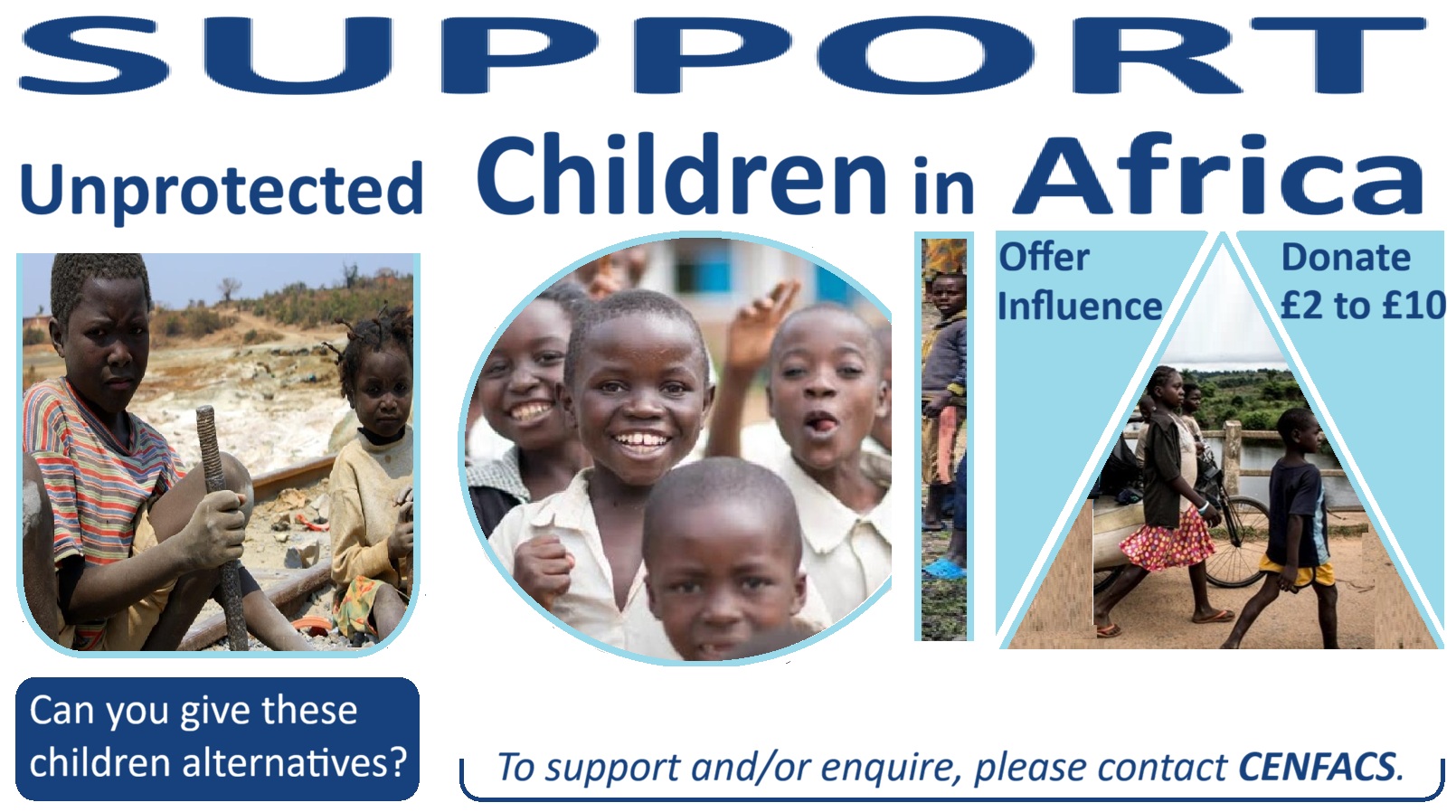
• Halving Poverty for and with the Unprotected Children in Africa
This appeal is about Unprotected Children, that is children or young persons who are not receiving the necessary care, support, or safety measures to protect them from harm, abuse, neglect or exploitation.
These children are those the system has failed them or is absent of safeguarding them, while leaving them vulnerable to significant risks to their physical, emotional, and social wellbeing.
These Unprotected Children can be identified in several scenarios like children at risk of sexual exploitation, children in humanitarian emergencies, children experiencing neglect, children with undiagnosed needs, unaccompanied migrant children, etc.
The critical needs of these children include
σ Safety from violence, exploitation and abuse (like protection from harmful practices, child labour, conflict-related risks, etc.)
σ Legal identity and family care (for example, birth registration, family reunification, and alternative care)
σ Basic survival and health services (such as nutritious food, water, malnutrition treatment, and medical care)
σ Psychological support and education (e.g., mental health support, access to education, and reintegration)
σ Social and economic support (similar to cash benefits, safe spaces, etc.)
σ Specialised care for vulnerable groups of children (for instance, children with disabilities, refugees and migrant children).
These children need your life-saving and humanitarian help to meet their life-surviving need.
Most of these children, who are under the age of 18, need support.
Can you give alternatives to them?
You can help reduce or halve the number of the Unprotected Children in Africa.
Your support will help
√ Address the problem of the Unprotected Children
√ Avoid sexual abuse of these children, forced labour, trafficking, substance and drug abuse, mental health issues
√ Incentivize parents to look for their children, especially those who are separated from them because of various reasons
√ Enhance social protection of these children
√ Halve the number of unprotected children living in poverty
√ Reduce or end deprivations linked to the lack of access to basic services, violence, abuse, neglect, exploitation and other vulnerabilities.
More about this appeal can be found at http://cenfacs.org.uk/supporting-us/
• 2026 Economic Inclusion Programme for Households
Our commitment to continue to empower households making the CENFACS Community carries on with this 2026 Economic Inclusion Programme for Households. Perhaps, the best way of approaching this programme is to explain what we mean by economic inclusion programme and provide information what we have specifically designed or intend to work on with our household members.
• • What Is an Economic Inclusion Programme?
Let us first start with economic inclusion. There are many ways of defining it which result in more or less the same meaning. The definition we shall use here comes from ‘oxford-review.com’ (1) which explains that
“Economic inclusion refers to creating equitable access to financial resources, opportunities, and support systems that enable individuals and communities, especially those historically marginalised, to participate fully in the economy”.
For those marginalised people or households to fully participate, there needs to be some programmes or projects or activities to help them to do so. Focusing on the programmes, the latter are a series of projects and activities designed to help households move out of poverty, increase assets, and build financial resilience.
• • Types of Economic Inclusion Programmes for Households
There are many types of economic inclusion programmes that can be run to support households in need. Amongst these programmes, it is worth mentioning the following ones:
~ Graduation and Livelihood Programmes
~ Financial Inclusion and Literacy Initiatives
~ Community-based Support and Social Enterprise
~ Specialized Employment and Training
~ Essential Needs and Crisis Support
Etc.
In the context of this Winter’s empowerment work programme with households, our focus will on Graduation and Livelihood Programmes, as indicated on the following working plan.

• • Working This Winter with CENFACS Household Members on Graduation and Livelihood Programmes
As said, we intend to work with our household members on Graduation and Livelihood Programmes this Winter 2026. This focus is highlighted in the above-mentioned action plan to deliver 2026 Economic Inclusion Programme for Households. Let us clarify this focus.
• • • What are Graduation and Livelihood Programmes?
There are comprehensive, time-bound, and sequenced interventions, often termed as graduation approaches as they help households ‘graduate’ from extreme poverty. Amongst Graduation and Livelihood Programmes are
~ Productive asset transfers
~ Skill training and technical support
~ Consumption support or cash transfers
~ Coaching and mentoring.
Let us kickoff this Graduation and Livelihood Programmes with Productive Asset Transfers.

• • Graduation and Livelihood Programme 1: Productive Asset Transfers (Wednesday 11/02/2026)
• • • What does this Programme 1 consist of?
This Programme 1 consists of providing assets such as livestock, tools, machinery to generate income.
• • • How will this Programme 1 be delivered?
It will be delivered as an e-discussion or online dialogue. For those of our members who may have any views or thoughts or even experience to share with regard to this matter, they can join our e-discussion to exchange their views or thoughts or experience with others.
To e-discuss with us and others, please contact CENFACS.
• • • How can CENFACS help?
For households making the CENFACS Community and in need of Economic inclusion via Productive Asset Transfers, CENFACS can work with them by conducting needs assessment and developing an action plan on how they can access the productive assets they are looking for to enable them to gradually move out of poverty.
Those who may be interested in this first component of the Graduation and Livelihood Programmes, they can contact CENFACS.
Those who have any queries and or enquiries about 2026 Economic Inclusion Programme for Households, they should not hesitate to raise them by getting in touch with CENFACS.
Extra Messages
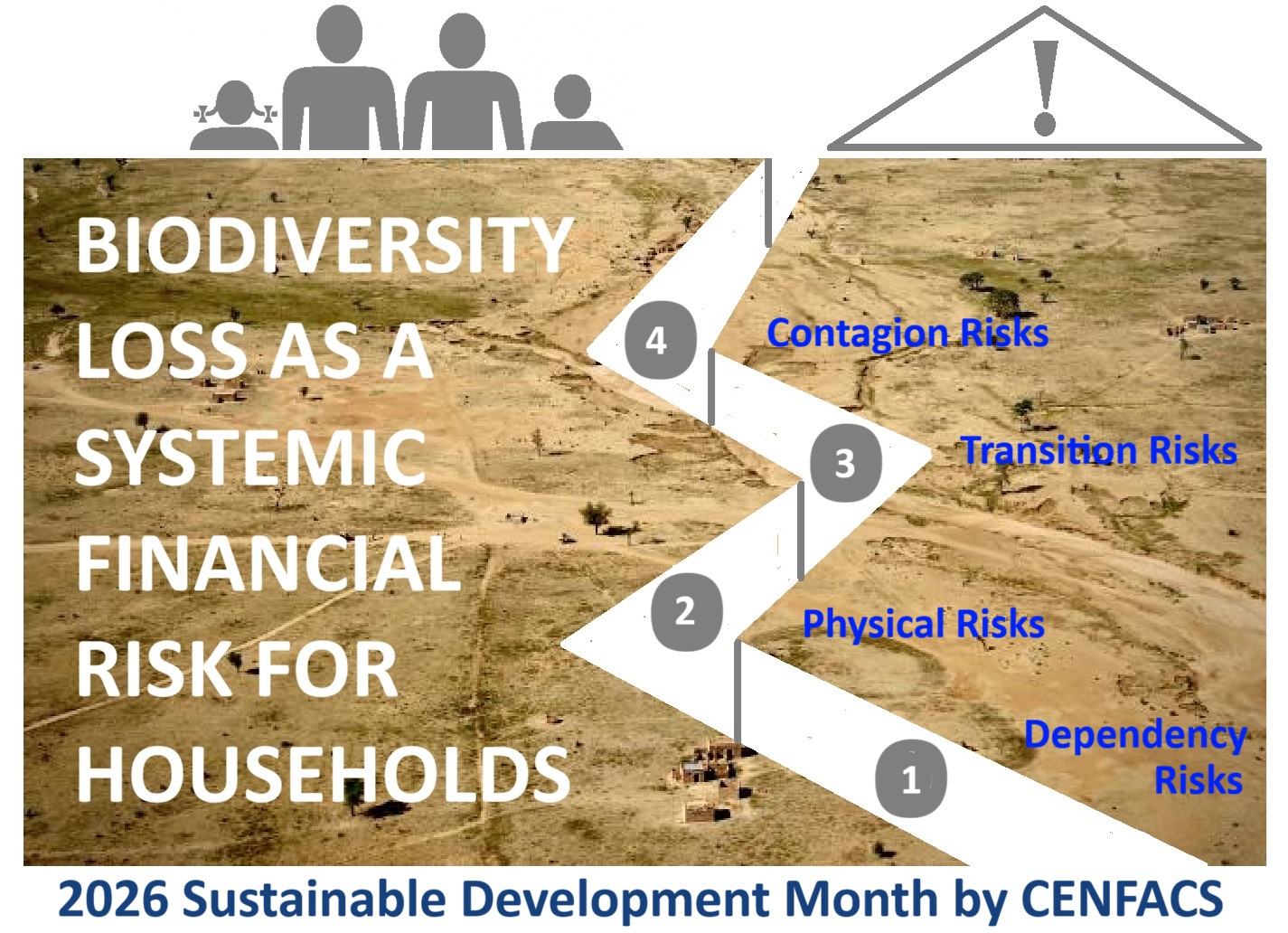
• Week Beginning Monday 09/02/2026 of 2026 Sustainable Development Month – In Focus: Physical Risks to Households Resulting from Biodiversity Loss
• Project Planning/Start Up Service for the Users of Triple Value Initiatives (or All-Year-Round Projects)
• Focus Group Discussion on Climate Technology Double Transfer to Africa

• Week Beginning Monday 09/02/2026 of 2026 Sustainable Development Month – In Focus: Physical Risks to Households Resulting from Biodiversity Loss
Biodiversity loss presents significant, direct physical risks to households by degrading the essential ecosystem services that provide clean water, food, and security. There are physical risks to households. These risks are summarised below.
• • Key Physical Risks to Households
There are
~ Water insecurity and contamination (resulting from the destruction of wetlands and forests)
~ Food insecurity and malnutrition (biodiversity loss reduces pollination and degrades soil health, threatening the production of fruits, vegetables, and nuts
~ Increased risk of infectious disease (the degradation of ecosystems brings humans into closer contact with wildlife, increasing the risk of zoonotic disease transmission such as Ebola)
~ Reduced protection from natural disaster (the loss of coastal ecosystems like mangroves and coral reefs reduces natural buffering against storm surges, and floodings, leaving coastal households more exposed to damage and loss of life)
~ Loss of traditional medicines (the loss of wild plants and animals directly impacts human access to essential affordable medicines)
~ Declining mental and physical wellbeing (the loss of nature degrades environmental quality, leading to increased air and water pollution, which directly impacts physical health).
These physical risks can trigger wider economic consequences for households.
• • Economic and Financial Consequences Linked to Physical Risks
Households rely on ecosystem services for their basic needs and income. When these ecosystems collapse, economic and financial consequences follow, such as
~ Rising food prices and insecurity: Biodiversity loss (e.g., decline in pollinators) reduces agricultural yields, leading to higher food prices
~ Increased household expenses: The loss of natural water filtration (wetlands) or coastal protection (mangroves) forces higher expenditure on utility and disaster repairs
~ Uninsurability of assets: As biodiversity loss increases the frequency of natural disasters (floods, wildfires), insurance premiums may rise, or homes in high-risk areas may become uninsurable.
To mitigate the above-mentioned risks, households in need can try to find support with organisations working on physical risks resulting from biodiversity loss.
• • How CENFACS Can Work with Those in Need of Reducing Poverty Linked to Physical Risks from Biodiversity Loss
To work with them, it requires a holistic, community-based approach that integrates conservation with livelihood security, disaster risk reduction, and social empowerment. The most effective working strategies will focus on boosting resilience of local communities to shocks, such as floods, droughts, and food insecurity, which are amplified by ecosystem degradation.
To sum up, key approaches to working with those in need of reducing poverty linked to physical risks from biodiversity loss will include
σ Promoting climate-resilient and nature-positive livelihoods (via diversification of income sources, supporting sustainable agriculture, developing eco-tourism, implementing payments for ecosystem services)
σ Enhancing disaster risk reduction (by restoring natural buffers, building local infrastructure, and the use of local knowledge)
σ Strengthening community empowerment and governance (by adopting participatory approaches, securing lands and resource rights, fostering local institutions).
σ Improving access to resources and education (through the promotion of renewable energy, the provision of education and training, etc.).
These approaches will enable to foster a ‘win-win-lose’ scenario where ecosystem production is improved, poverty is reduced, and biodiversity loss is reversed.
For those members of our community who may be interested in the above-mentioned approaches and in dealing with Physical Risks associated with biodiversity loss, they are free to contact CENFACS.
For any queries or enquiries about Sustainable Development Month and Biodiversity Loss as a Systemic Financial Risk; please also communicate with CENFACS.

• Project Planning/Start Up Service for the Users of Triple Value Initiatives (or All-Year-Round Projects)
In order to support those who have decided or may decide to engage with All-Year-Round Projects or Triple Value Initiatives, we are running start up sessions for each of them (i.e. Run, Play and Vote projects). What do we mean by running start up sessions for Run, Play and Vote projects?
• • Start up for Run, Play and Vote Projects
Start up for these projects is about working with whoever decides to execute the above mentioned projects to set the tone of their projects and expectations for themselves. It is also about setting realistic goals and working out the right methodology from the beginning to the end in their project journey. It includes better planning and management.
• • Phases of Project Planning and Management
We are going to deal with different phases of project planning or start up from the idea (of running or playing or voting) to the initiative implementation, impact monitoring and evaluation.
Whether you want to run or play or vote; you need to undertake a basic project planning in terms of the way you want to do it. This basic project planning/start-up will include things like the following:
σ Aims (changes you plan to achieve)
σ Impact (a longer-term effects of your project)
σ Inputs (resources you will put into your initiative)
σ Monitoring (regularly and systematically collecting and recording information)
σ Outcomes (changes and effects that may happen from your initiative)
σ Indicators (measures or metrics that show you have achieved your planned outcomes)
σ Budget (income and expenses for your initiative)
σ Reporting (sharing your actions and results)
Etc.

• • All-Year-Round Projects Cycle
Project planning will include the different steps of project cycle (as shown by the All-Year-Round Projects Cycle above), which are:
Identification, preparation, feasibility study, appraisal, negotiations and agreement, start, implementation, monitoring, reviews, termination, evaluation and impact evaluation.
These steps will be approached in a simple and practical way to make everybody (especially those members of our community who are not familiar with them) to understand what they mean and how to use them in the context of Triple Value Initiatives (People, Planet and Prosperity).
As we all know, not everybody can understand these different steps they need to navigate in order to make their initiative or project a success story. That is why we are offering this opportunity to those who would like to engage with the Triple Value Initiatives (People, Planet and Prosperity) or All-Year-Round Projects (Run, Play and Vote projects) to first talk to CENFACS so that we can together soften some of the hurdles they may encounter in their preparation and delivery.
For those who are interested in this service, they can contact CENFACS by phoning, texting, e-mailing and completing the contact form on this website. We can together discuss in detail your/their proposals about either your/their Run or Play or Vote projects as well as how they can insert a Triple Value Initiative (People, Planet and Prosperity) in each of these projects.
For those who would like to discuss with CENFACS their All-Year-Round Project or Triple-value-initiative plans or proposals, they are welcome to contact CENFACS.
• Focus Group Discussion on Climate Technology Double Transfer to Africa
We are continuing to work on issues raised in the 90th Issue of FACS of this Winter 2026. This Issue is titled ‘Local African Charities, the Double Transfer (of Climate Technology and Finance) and Poverty Reduction – Approaching Charitable Transfers from a Win-win Perspective’.
One of the issues raised was the effectiveness and gaps in terms of progress made in coordinating finance and technology transfers. We would like to organise a focus group to deal with this issue.
• • What Will the Focus Group Be about?
The focus group will be a qualitative research method to be used to gather in depth perspectives from experts and stakeholders on how to optimize the combined impact of financial and technological support in climate action in Africa. It will explore the synergies and challenges in ensuring that the provision of funds directly facilitates or is tied to the successful transfer and adoption of necessary technologies.
The focus group will bring together a small group of individuals (between 6 and 10) making the CENFACS Community and others to…
discuss their ideas, experiences, and perspectives on effectiveness and gaps in terms of progress made in coordinating finance and technology transfers and where the current gaps are in achieving a synchronised approach.
The focus group will help understand needs, inform policy, promote ownership, identify barriers, and test new ideas about the double transfer.
To take part in the focus group, group that will use deliberative practice strategies, please contact CENFACS.

Message in French (Message en français)
• Activité/Tâche 2 du Projet «A» : Trouver des Alternatives Durables pour la Durabilité des Personnes Pauvres
Pour comprendre cette activité/tâche, il est préférable de dire en quoi elle consiste et les manières d’y participer.
• • En quoi consiste cette activité 2 ?
L’activité 2 consiste à trouver des alternatives durables ou des approches alternatives (comme les économies circulaires ou les initiatives locales) pour remplacer les modèles dominants et gourmands en ressources par des approches qui privilégient l’autonomisation des communautés, la biodiversité et le bien-être à long terme. Quelles sont les alternatives durables ?
Le site web ‘sustainability-directory.com’ (2) affirme que
« Les alternatives durables sont des choix remplaçant des pratiques nuisibles par des solutions respectueuses de la planète et durables pour un avenir résilient ».
Le site web ‘sustainability-directory.com’ (3) présente l’objectif de ces alternatives en ces termes :
« Les alternatives durables visent à remplacer les pratiques nuisibles par des méthodes qui respectent les limites écologiques et favorisent le bien-être social ».
Cette Activité2 est directement intégrée dans l’Objectif de Développement Durable 1 des Objectifs de Développement Durable des Nations Unies (4), qui est Pas de pauvreté. En particulier, la Cible 1.5 de cet Objectif 1 vise à renforcer la résilience des pauvres et à réduire leur vulnérabilité aux chocs climatiques, économiques et sociaux. Cet objectif se concentre sur le passage de l’assistance purement basée sur l’aide à la création de moyens de subsistance durables et autonomes.
La recherche d’alternatives pour la durabilité indique qu’elles incluent des solutions circulaires parmi d’autres alternatives. Ces solutions visent à promouvoir des initiatives de transformation des déchets en ressources qui créent des opportunités pour les pauvres.
• • S’engager dans l’Activité/Tâche 2
Une chose est de connaître cette Activité/Tâche 2, une autre est de s’y engager. S’engager consiste à travailler avec les membres de notre communauté qui recherchent des alternatives pour trouver la durabilité dans leur vie. Cela pourrait concerner n’importe quel domaine de la vie, comme l’éducation, la santé, le logement, le transport, l’énergie, etc., où ils ont besoin d’alternatives durables (c’est-à-dire un produit, une méthode ou un matériau différent de quelque chose d’autre offrant la possibilité de choix, tout en minimisant les dommages environnementaux, en promouvant l’équité sociale et en garantissant la viabilité économique à long terme).
Ce qui précède concerne l’Activité/Tâche 2.
Ceux ou celles qui souhaitent participer à cette Activité/Tâche peuvent y aller.
Pour ceux ou celles qui ont besoin d’aide avant de se lancer dans cette tâche, ils/elles peuvent nous en parler.
Pour toute autre question ou renseignement concernant le Projet ‘A’ et la dédicace de cette année, veuillez également contacter le CENFACS.

Main Development
• 2026 Africa Not-for-profit Outlook for Impact Investing –
In Focus: Africa-based Sister Charitable Organisations and Causes Working on Sustainable Energy and Energy Poverty Reduction
The following items make up the contents of this outlook:
σ What is 2026 Africa Not-for-profit Outlook for Impact Investing?
σ Main Concepts Used in 2026 Africa Not-for-profit Outlook for Impact Investing
σ Key Points about the Outlook
σ Types of Not-for-profit Organisations Working in the Fields of Sustainable Energy and Energy Poverty Reduction
σ Impact Investing in Africa-based Sister Charitable Organisations and Causes (ASCOCs).
Let us uncover these items.
• • What Is 2026 Africa Not-for-profit Outlook for Impact Investing?
2026 Africa Not-for-profit Outlook for Impact Investing highlights essential information about ASCOCs in terms of their work on sustainable energy and energy poverty reduction. What they provide could be interesting for potential not-for-profit impact investors.
2026 Africa Not-for-profit Outlook for Impact Investing is a mini-guide for those who would like to not-for-profit invest with impact in Africa and in ASCOCs. This mini-guide is therefore for those investors who are new to impact investing and those who want to know where and into what organisation to not-for-profit invest in Africa in the sector of sustainable and renewable energy. Knowing about organisations making this industry/sector is also about understanding the jargon, terminology or concepts used by this industry/sector.
• • Main Concepts Used in 2026 Africa Not-for-profit Outlook for Impact Investing
There are two main concepts used in 2026 Africa Not-for-profit Outlook for Impact Investing, which are sustainable energy and energy poverty.
• • • What is sustainable energy?
Sustainable energy can be defined in various ways which convey the same meaning. According to ‘medianenergy.com’ (5),
“Sustainable energy refers to forms of energy that are renewable and have a minimal negative impact on the environment. It encompasses energy sources that can be continually replenished, thus ensuring their availability for future generations.”.
Types of sustainable energy include solar energy, wind energy, hydropower, geothermal energy, biomass, etc.
The literature survey on sustainable energy also indicates that it is a power derived from sources that can be replenished naturally within a human lifetime, causing no long-term harm to the environment and meeting current needs without compromising future generations’ ability to meet their own needs. It includes renewable, low-emission sources like solar, wind, hydro, and geothermal, aiming to replace fossil fuels to combat climate change.
It is worth noting that while all sustainable energy is generally renewable, not all renewable energy is inherently sustainable (e.g., if a resource is consumed faster than it can regenerate).
• • • What is energy poverty?
Energy poverty can be explained in many ways. One of its explanations comes from the European Union (6) which states that
“Energy poverty occurs when a household must reduce its energy consumption to a degree that negatively impacts the inhabitants’ health and wellbeing. It is mainly driven by 3 underlying root causes: high proportion of household expenditure spent on energy, low income, and low energy performance of buildings and appliances”.
This definition of energy poverty will be used in 2026 Africa Not-for-profit Outlook for Impact Investing. The Outlook will also refer to the Multidimensional Energy Poverty Index developed by Akire and Foster, as explained by Dimaviya Eugène Compaore et al. (7). In this respect, 2026 Africa Not-for-profit Outlook for Impact Investing includes an expenditure approach to energy poverty, which explores the ratio of household income to energy expenditure as a measure of energy poverty. From this approach (and according to Boardman), energy-poor households would be those whose expenditure on fuel or energy services exceed 10% of their income.
Because 2026 Africa Not-for-profit Outlook for Impact Investing deals with energy poverty reduction, it makes sense to explain it. The literature on energy poverty reduction indicates that the latter involves policies, technologies, and financial aid designed to ensure households can afford, access, and use adequate energy for heating, cooling, lighting, and cooking.
Key approaches relating to energy poverty reduction include improving residential energy efficiency (with insulation, retrofits), providing direct financial assistance (subsidies, bill support), and expanding access to sustainable, modern, or renewable energy sources.
• • Key Points about the 2026 Africa Not-for-profit Outlook for Impact Investing
The key points about the 2026 Africa Not-for-profit Outlook for Impact Investing (ANFPOII) include trends we have identified, areas of focus and potential challenges that ASCOCs face in their work on sustainable energy and energy poverty.
Let us highlight these key points.
• • • Trends and analysis
• • • • Key trends and analysis of Africa-based Charities (AbCs) working on sustainable energy
* Key trends
They are as follows.
~ Charities are moving beyond simply providing solar lanterns for light to powering economic activities (e.g., solar water pumps for agriculture). In simple terms, they are moving from light to productive use of energy.
~ There is a shift towards organisations founded and operated by Africans. This means that there is an emerging body of locally-led developers and local owners, as far as sustainable energy is concerned.
~ Charities are heavily investing in solar home systems, community solar mini-grids, and decentralised solar-hybrid systems. This indicates decentralised renewable energy over grid extensions.
~ Programmes are increasingly empowering women as local technicians and distributors, building women-led solar entrepreneurship.
~ Charities are collaborating with private tech companies to use Pay-As-You-Go Hybrid Models, mobile money (like M-kesa) to make solar solutions affordable for low-income households, blending philanthropy with social enterprises.
* Key analysis of the sustainable energy landscape
Findings on this main analysis reveal the points below.
~ There is an uneven dispersion of energy NGOs in Africa where some countries (like Kenya, Nigeria and Tanzania) have technical support and NGO presence, while others (e.g., countries of Sahel region) have none or less.
~ There is an increasing push to unlock local, African-based philanthropy to mitigate funding disparities.
~ There is a proliferation of low-quality or counterfeit solar products, which pushes trusted local NGOs to focus on quality certification and energy consumer education to deal with counterfeit challenge.
~ Local charities are increasingly acting as intermediaries in ensuring rural energy needs as part of energy policy advocacy.
Additionally, there are challenges (like high competition for grants, the lack of maintenance capacity in remote areas, poor infrastructure, the inability of low-income users to pay high upfront costs for solar energy).
Besides these challenges, there are opportunities (such as social entrepreneurship models to offset funding problems, training of local people, leveraging of digital tools for monitoring and mobile money for financial services, PAYG models, etc.)
• • • • Key trends and analysis of Africa-based Charities (AbCs) working on energy poverty
AbCs tackling energy poverty are shifting from traditional aid models towards market-based, sustainable, and technology-driven approaches as the following trends and shifts outline.
* Key trends and shifts
Amongst them are those mentioned below.
~ Charities are increasingly operating as or partnering with social enterprises that use Pay-As-You-Go (PAYGO) technology, making them to shift from donation to social enterprise (PAYGO models).
~ Local NGOs with decentralised renewable energy focus are heavily investing in off-grid solar kits, mini-grids, and increasingly solar-powered productive appliances.
~ Charities specialized in last mile are excelling by reaching remote rural areas where large companies cannot.
~ NGOs are targeting the 900 plus million Africans relying on solid biomass by deploying cleaner cookstoves, making clean cooking to rise.
~ Charities are using community models to train local community representatives to maintain and repair equipment.
* Analysis of challenges and realities
It emerges from this analysis the items mentioned below.
~ Many NGOs struggle with high capital costs.
~ There is a challenge to accompany their help of light to the community with business training for using energy.
~ Local NGOs are engaged in intensive community education to stop theft to and vandalism of energy equipment.
~ There is politization of energy.
From these trends, shifts and analysis, the findings of many studies suggest that the outlook for this year and near future for AbCs working on energy poverty and sustainable energy is to find alternative funding and business models that will help achieve both social impact and social return on investment.
• • • Areas of Focus
The 2026 ANFPOII focuses on areas which AbCs are working to address energy poverty. These areas are off-grid solar kits, mini-grids, productive use of energy, and clean cooking.
Concerning off-grid solar kits, it is about providing solar lanterns and home systems to eliminate kerosene lamps.
Regarding solar mini-grids, they are about building community-level solar mini-grids in rural areas.
As to productive use of energy (PUE), it involves providing solar power for agriculture (irrigation), cooling, and small businesses to raise income levels.
With respect to clean cooking, it is about promoting eco-stoves and bio-energy to reduce deforestation and improve health.
• • Types of Not-for-profit Organisations (NFPOs) Working in the Fields of Sustainable Energy and Energy Poverty Reduction
2026 ANFPOII focuses on two types of organizations: Africa-based Charities working on sustainable energy (or sustainable energy charities), and Africa-based Charities working on energy poverty reduction (or energy poverty reduction charities). Many of these organizations work on both matters (sustainable energy and energy poverty reduction).
• • • Africa-based Charities (AbCs) Working on Sustainable Energy
These AbCs are not-for-profit, mission-driven organisation operating locally or regionally within Africa. They aim at facilitating access to affordable, reliable, and renewable energy to promote social and economic development.
These organisations bridge the gap between energy poverty and sustainable development as they typically focus on clean energy solutions like solar, wind, or mini-grids for underserved communities.
They are featured by key aspects that make them different compared to for-profit entities. Their primary objective is social impact rather than profit maximization. They often rely on grants, donations, or social investment to sustain their operations.
• • • • Key Aspects about AbCs dealing with sustainable energy
Their key aspects revolve around their mission and focus, operational scope, capacity building, advocacy and research, partnership and funding.
~ Mission and focus: Their core mission is to eradicate energy poverty while promoting environmental sustainability, directly supporting the United Nations Sustainable Development Goal 7.
~ Operational scope: They often work in rural and peri-urban areas, providing decentralized energy solutions (like solar home systems) to homes, clinics, schools, or promoting clean cooking methods.
~ Capacity building: They act as enablers, often training local technicians and entrepreneurs to install and maintain energy systems, thereby creating jobs and ensuring project long-term sustainability.
~ Advocacy and research: Many – such as the Africa Coalition on Sustainable Energy Association (ACSEA) or Sustainable Energy Africa (SEA) – combine on-the-ground implementation with policy advocacy, lobbying for a shift from fossil fuels to renewable energy across Africa.
~ Partnership and funding: These charities often act as intermediaries between international donors, governments, and local communities, utilizing grants to de-risk projects and unlock private investments.
• • • • Key organisations working in Africa on sustainable energy
Examples of these organisations include the following:
∝ Africa Coalition on Sustainable Energy (ACSEA)
∝ RES4Africa Foundation (Renewable Energy Solutions for Africa)
∝ Power for All
∝ Energy 4 Impact
∝ African Centre for Environment, Energy & Climate Advocacy (ACEECA)
∝ SolarAid
∝ Altech Group
∝ Nuru (formerly Kivu Green Energy)
∝ AVSI Foundation (via EnDev)
∝ ACERD (Congolese Association for Renewable and Decentralized Energies)
∝ Pot@maï
∝ Misereor
∝ Green Congo
Etc.
The above-mentioned organisations are African-focused charities, not-for-profit organisations and coalitions actively working to transition Africa to sustainable energy. They focus on solar power, mini-grids and clean cooking solutions to improve livelihoods and reduce carbon emissions. Their details can be found online. For those who may experience some difficulties in finding them, they can contact CENFACS for information and guidance.
• • • Africa-based Charities (AbCs) Working on Energy Poverty
AbCs working on energy poverty are not-for-profit, community-focused or philanthropic organisations operating within Africa to alleviate the lack of access to affordable, reliable, sustainable, and modern energy services. These organisations are often characterized by their focus on rural electrification, clean cooking, and capacity building to foster economic development, gender equity, and environmental sustainability.
These organisations have distinctive features relating to their functions and operations.
• • • • Key Aspects about AbCs working on energy poverty
They include functional definition, operational characteristics, and pillars of action.
~ Functional definition
The functional definition of energy poverty AbCs can be understood through their targeted focus, scope of work and social impact.
Concerning their targeted focus, energy poverty AbCs aim to bridge the gap in modern energy access for households, businesses, and public services (like schools, medical centres) that lack reliable power or rely on traditional polluting fuels like firewood and charcoal.
Regarding scope of work, energy poverty AbCs’ work goes beyond ‘giving light’ to providing holistic energy solutions, including off-grid solar systems, mini-grids, clean cooking stoves, and productive use energy tools.
Respecting social impact, energy poverty AbCs are driven by the need to improve living conditions, health (e.g., reducing indoor air pollution), education, and income generation, particularly for women and youth.
~ Operational characteristics in Africa
They include context-sensitive and local, off-grid and mini-grid focus, capacity building, and advocacy and policy.
As far as the context-sensitive and local are concerned, energy poverty AbCs are often based in, or having deep roots within, the local community, utilizing local talent to understand the specific energy needs and cultural contexts.
As to off-grid and mini-grid focus, energy poverty AbCs primarily focus on supplying decentralized, renewable energy (solar, small hydro) to remote areas where national grid extension is infeasible or too slow.
With respect to capacity building, energy poverty AbCs tend to engage in training and technical education to empower local communities to manage, maintain, and own their energy assets.
In terms of advocacy and policy, energy poverty AbCs advocate for a just energy transition by arguing that policies and funding to be prioritized the poor and rural communities.
~ Pillars of action
In order to advance the cause of the energy poor and take action, energy poverty AbCs uses a number of pillars. The key pillars for action are productive use of energy, financial inclusion, gender empowerment, environmental sustainability.
~~ Productive use of energy: It is about promoting energy tools that increase productivity in agriculture, small businesses, and manufacturing.
~~ Financial inclusion: It involves using innovative financial models (e.g., pay-as-you-go, micro-finance) to make clean energy affordable for low-income households.
~~ Gender empowerment: It includes targeting women who are disproportionally affected by energy poverty and are crucial for the adoption of clean cooking solutions.
~~ Environmental sustainability: It encompasses promoting renewable energy to meet climate goals, avoiding the adoption of carbon-intensive, old infrastructure, etc.
Energy poverty AbCs are in fact local and action-oriented actors that perceive and treat energy as a human right and a foundational requirement for sustainable development.
• • • • Key organisations working in Africa on energy poverty
Several African-focused charities, not-for-profit organisations and causes are actively working to combat energy poverty by promoting renewable energy, such as solar power and clean cooking solutions.
Amongst them are the following:
∝ SolarAid
∝ RES4Africa Foundation (Renewable Energy Solutions for Africa)
∝ Africa Coalition on Sustainable Energy (ACSEA)
∝ African Women in Energy and Power (AWEaP)
∝ Energy 4 Impact (part of Merci Corps)
∝ The Africa Trust
∝ Ashen
Etc.
The above-named organisations focus on providing sustainable, off-grid, and community-based solutions to rural and underserved populations. Depending on their mission, objects, speciality and matching services; they work on matters relating to sustainable energy or energy poverty or both.
• • • Intersection and differences between Energy Poverty AbCs and Sustainable Energy AbCs
Energy Poverty AbCs and Sustainable Energy AbCs intersect, while differing between them in terms of goals, methods and immediate focus.
Both AbCs aim to improve energy situation in Africa. There is high overlap between them which is characteristic of modern strategies in the energy and not-for-profit sectors. They work at the intersection aiming to eradicate energy poverty using sustainable, clean energy.
However, there are differences between the two. Sustainable Energy AbCs are primarily concerned with environmental impact and long-term viability (e.g., green, low-carbon, renewable energy), while Energy Poverty AbCs are mostly preoccupied with social equity and basic access (e.g., providing electricity to almost 600 million people lacking it, clean cooking solutions).
2026 Africa Not-for-profit Outlook for Impact Investing considers the two types of organisations.
Unfortunately, 2026 Africa Not-for-profit Outlook for Impact Investing is not a sort of classified entries that list organisations with their names, contact details and description of their work.
For those who are interested in a particular organisation and are struggling to find them, they can contact CENFACS’ Guidance Service for Not-for-profit Impact Investors.
For those not-for-profit impact investors who are looking for a particular organisation working in either of the fields of sustainable energy and energy poverty, they can also get in touch with CENFACS for support if they cannot find them.
For those not-for-profit impact investors who are interested in AbCs, and who would like to dive deeper into their services and activities, they are as well free to reach out to CENFACS.
• • Impact Investing in Africa-based Sister Charitable Organisations and Causes
African Sister Charitable Organisations and Causes (ASCOCs) can be an alternative route for investing in Africa for those investors having other motives than only making profit. Investing in this sort of organisations and causes is a way of thinking differently and approaching poverty from a different and progressive perspective.
The knowledge of these organisations in terms of their mission/objects/speciality and matching services they offer is crucial to decide whether or not to impact invest in them. They are those working on the ground in the fields of sustainable energy and energy poverty.
The above is the highlight of the prospect for not-for-profit investing in Africa’s sustainable energy and energy poverty reduction sectors. It is part of a series of contents for advice and tips planned for 2026 to work with potential not-for-profit impact investors, particularly but not limited to the two following matters:
a) Guidance for Not-for-profit Investors about Organisations and Causes to Not-for-profit Invest for Impact in Africa;
b) Matching Organisation-Investor Programme.
For those not-for-profit impact investors who are interested in sustainable energy sector – in particular in ASCOCs making part of this sector – and who would like to dive deeper into this matter, they are free to contact CENFACS.
For those not-for-profit impact investors who are looking for the above-mentioned guidance and matching programme, they should not hesitate to communicate with CENFACS.
_________
• References
(1) https://oxford-review.com/the-oxford-review-dei-diversity-equity-and-inclusion-dictionary/economic-inclusion-definition-and-explanation (accessed in Febrauary 2026)
(2) https://climate.sustainability-directory.com/term/sustainable-alternatives/ (accessed in February 2026)
(3) https://pollution.sustainability-directory.com/question/what-are-sustainable-alternatives-to-current-practices (accessed in February 2026)
(4) https://sdgs.un.org/2030agenda (accessed in February 2026)
(5) https://www.medianenergy.com/blog/what-is-sustainable-energy (accessed in February 2026)
(6) https://energy.europa.com.eu/topics/markets-and-consumers/energy-consumers-and-prosumers/energy-poverty_en (accessed in February 2026)
_________
• Help CENFACS Keep the Poverty Relief Work Going This Year
We do our work on a very small budget and on a voluntary basis. Making a donation will show us you value our work and support CENFACS’ work, which is currently offered as a free service.
One could also consider a recurring donation to CENFACS in the future.
Additionally, we would like to inform you that planned gifting is always an option for giving at CENFACS. Likewise, CENFACS accepts matching gifts from companies running a gift-matching programme.
Donate to support CENFACS!
FOR ONLY £1, YOU CAN SUPPORT CENFACS AND CENFACS’ NOBLE AND BEAUTIFUL CAUSES OF POVERTY REDUCTION.
JUST GO TO: Support Causes – (cenfacs.org.uk)
Thank you for visiting CENFACS website and reading this post.
Thank you as well to those who made or make comments about our weekly posts.
We look forward to receiving your regular visits and continuing support until the end of 2026 and beyond.
With many thanks.