Welcome to CENFACS’ Online Diary!
17 December 2025
Post No. 435
The Week’s Contents
• Season of Light 2025-2026
• Festive Giving, Gifting and Out-of-poverty Lifting
• Community Value Chains, the CENFACS Community
… And much more!
• Year-end 2025 Thank You Message
As the year 2025 comes to an end, we want to pause and convey our appreciation to all of supporters and to each of you for your loyalty and devotion to the noble and beautiful mission of alleviating poverty.
We would like to extend our heartfelt thanks to everyone who collaborated with us in decreasing poverty and made it achievable for those requiring assistance and for us throughout 2025.
Key Messages
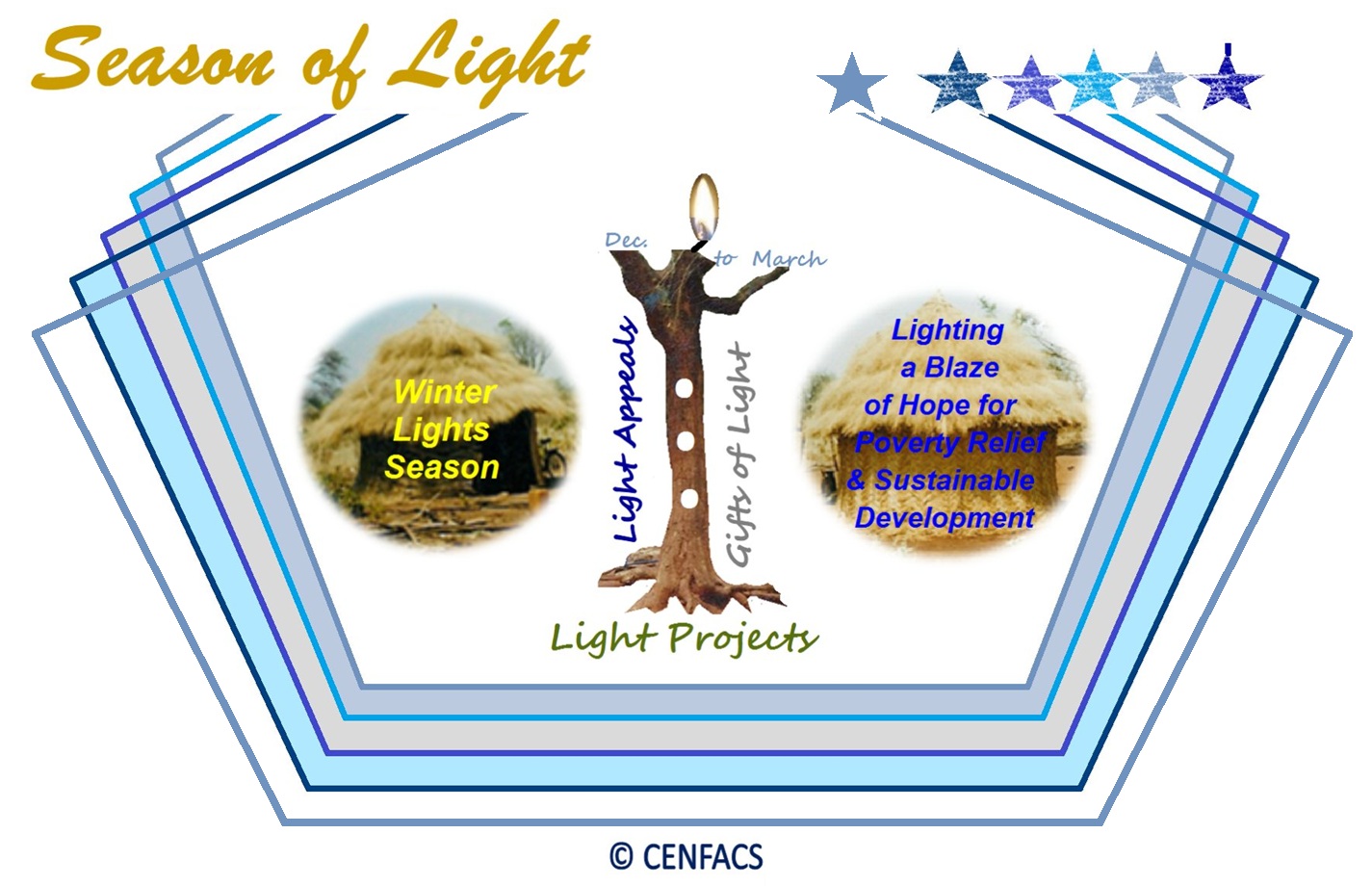
• Season of Light 2025-2026
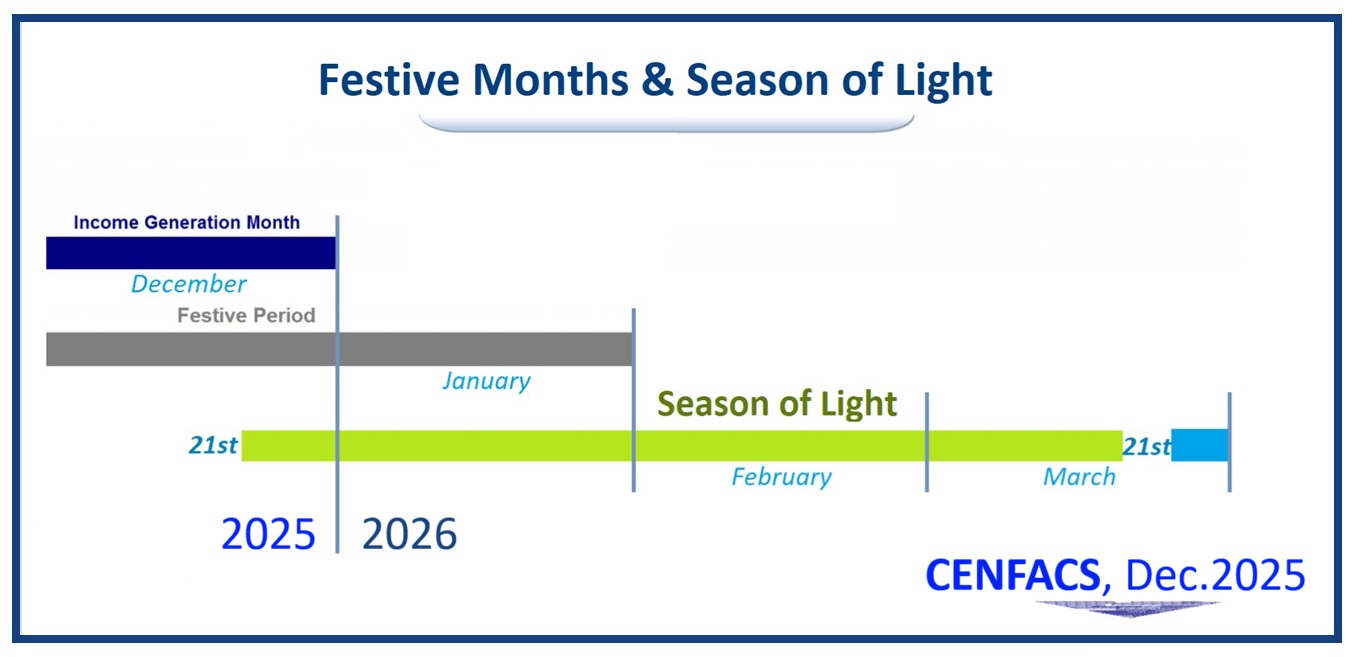
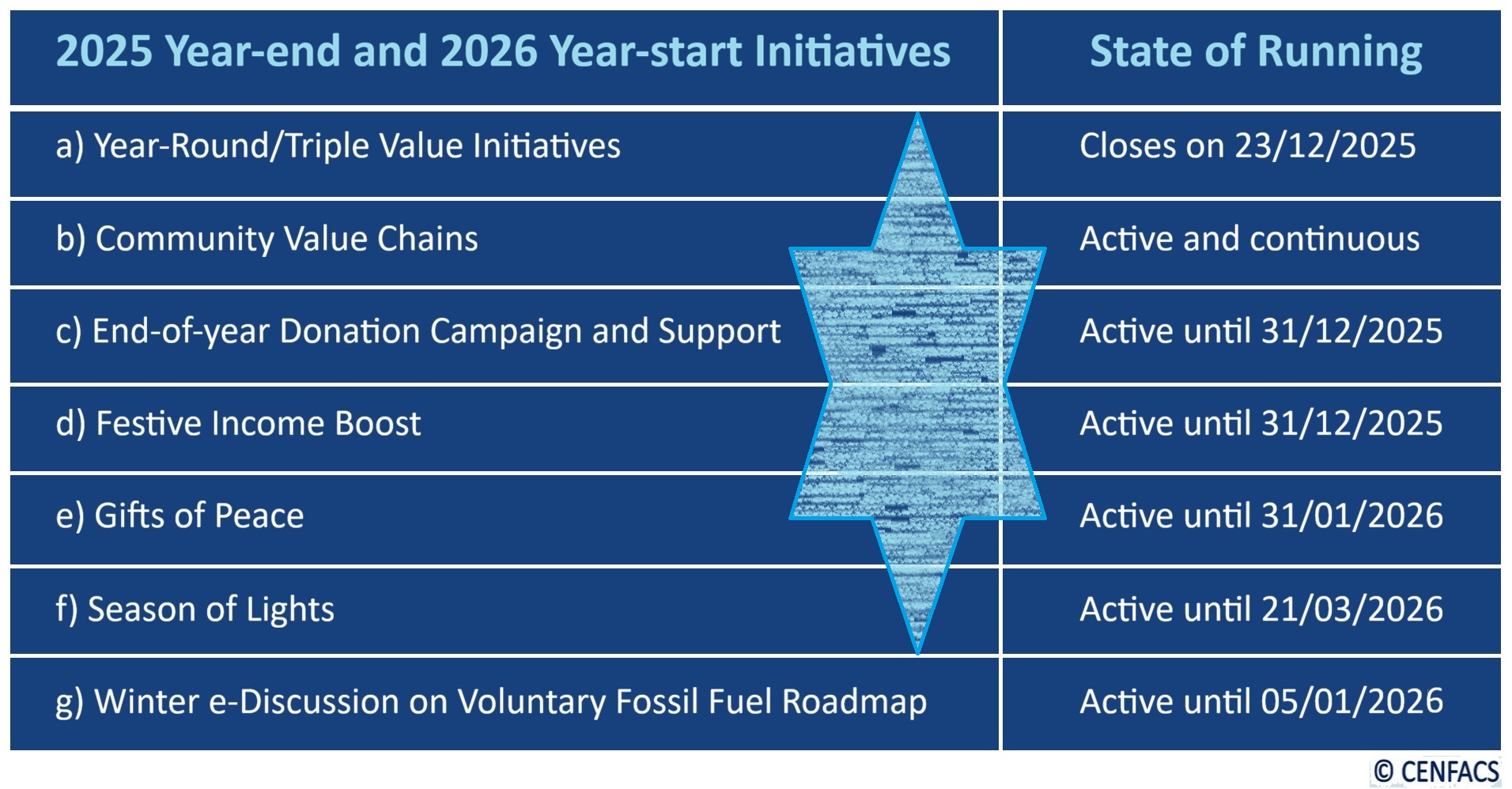
On 21 December 2025, we shall move from Autumn Fresh Start to the Season of Light. As a result, Autumn Fresh Start Projects and Programmes including Campaigns will end to signal the start of the Season of Light within CENFACS.
• • End of the Autumn Fresh Start Season and Campaign
The Autumn Season will officially end on 21 December 2025. The momentum we built from the beginning and throughout Autumn Fresh Start Season continues to galvanise our poverty relief action and is taking our relief journey into the Season of Light, which starts the 21st of December 2025.
• • Start of the Season of Light within CENFACS
The Season of Light, which usually starts the 21st of December of each year and ends around 21 March in the New Year, runs through the Festive Season, which is between 01 December of the ending year (here 2025) and 31 January in the New Year (2026). The Gift of Hope symbolizes the Season of Light, while the Gifts of Peace, which keep on giving, normally feature the Festive Season.
During the Season of Light, we light up a Blaze of Hope for people and communities suffering from the effects and impacts of destructive wars and natural disasters in Africa.
In the coming weeks and months of the Season of Light, our Blaze of Hope will be extended to those who are continuing to suffer from the lingering effects of other crises (such as the cost-of-living, hunger and security crises).
The Season of Light will come with the Lights Appeal or Campaign, which is a set of poverty reduction projects that features the Season of Light.
• • Two Themes, Two Seasons and Two Gifts
The theme for the Season of Light is Hope which we try to bring through a Blaze, while the theme for the Festive Season is Peace.
• • • Hope as theme and gift during the Season of Light
Hope is what we are trying to achieve during the Season of Light to reduce poverty as a lack of hope. Poverty as a lack of hope is about feeling trapped, powerless, and believing a better future is impossible, creating a poverty of hope that fuels cycles of despair, poor decisions, and inaction, making it harder to escape from hardship, even with opportunities present, as stress and limited resources crush aspirations.
The Gift of Hope will help hopeless people to take the steps they need to improve their lives when they are trapped in scarcity. This gift provides strength and direction when facing adversity while inspiring resilience and kindness in those who need them and towards others.
• • • Peace as theme and gift during the Festive Season
The theme of Peace for the Festive Season is a call to action to cultivate a state of mind and a way of living that reflects harmony, hope, and love for others. Peace is both the absence of conflict and the representation of wholeness, harmony, reconciliation, and internal tranquility.
The Gifts of Peace are the transformative experiences that enable the beneficiaries of these gifts to navigate life’s challenges with calmness, unity and a state of goodness in life. They are CENFACS Wintry Gift Appeal initiative to support people living in poverty in Africa.
During the Festive Season, we try to reduce poverty as a lack of peace via the Gifts of Peace; whereas in the context of the Season of Light we work through Lights Appeals/Gifts to relieve poverty as a lack of hope. There is a relationship between light and peace. Light is the source that enables us overcome darkness and access inner peace. Peace is a result or component of accepting the gift of light.
Those who feel themselves hopeless need some hope/lights. They need some belief to attain the wish or desire of poverty reduction, to persist, to build trust in resources and to share hopes.
Under the Main Development section of this post, there is more information about the Season of Light 2025-2026.
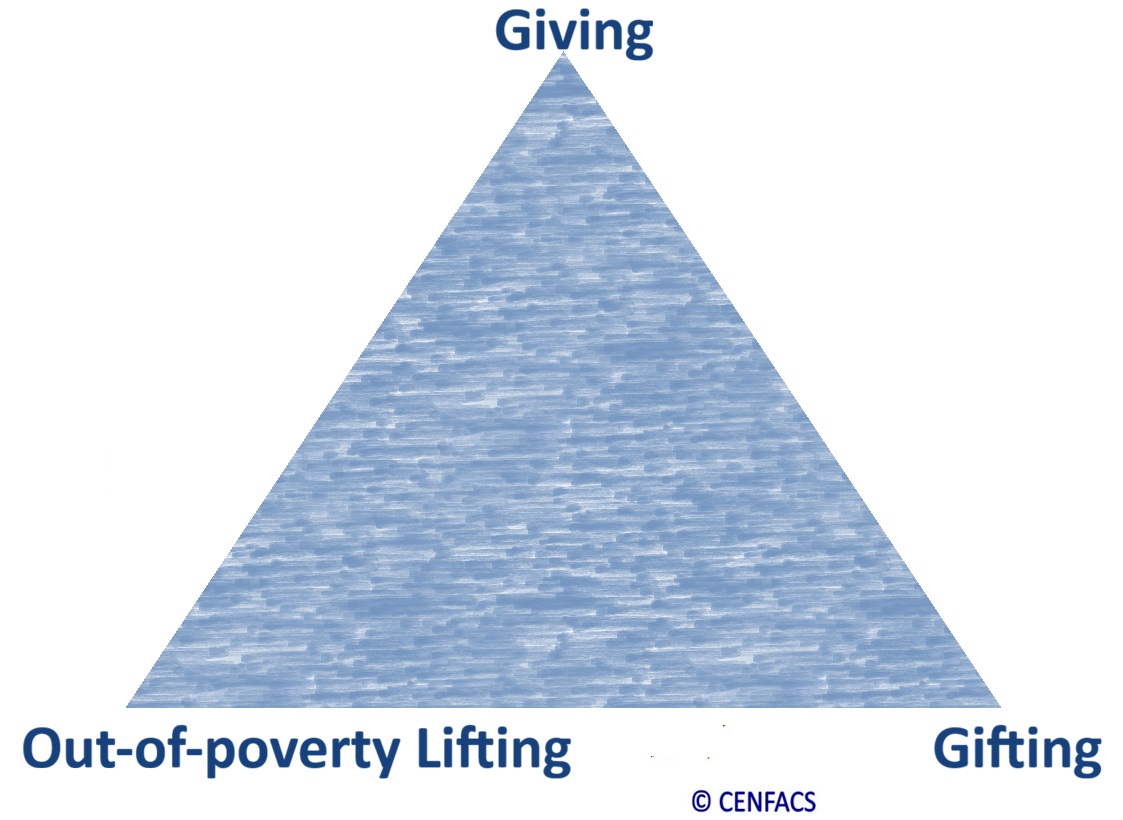
• Festive Giving, Gifting and Out-of-poverty Lifting
Festive Giving, Gifting and Out-of-poverty Lifting are the three ways of engaging with the Festive Season, those in need and CENFACS. As part of this seasonal engagement, of the season of giving and gifting as well as of lifting poor and vulnerable people out of poverty; we are asking supporters to go extra miles in replying to these two fundraising appeals which are: Festive Gift Set and End-of-year Support.
To ease the understanding of these appeals, let us briefly explain Festive Giving, Gifting and Out-of-poverty Lifting.
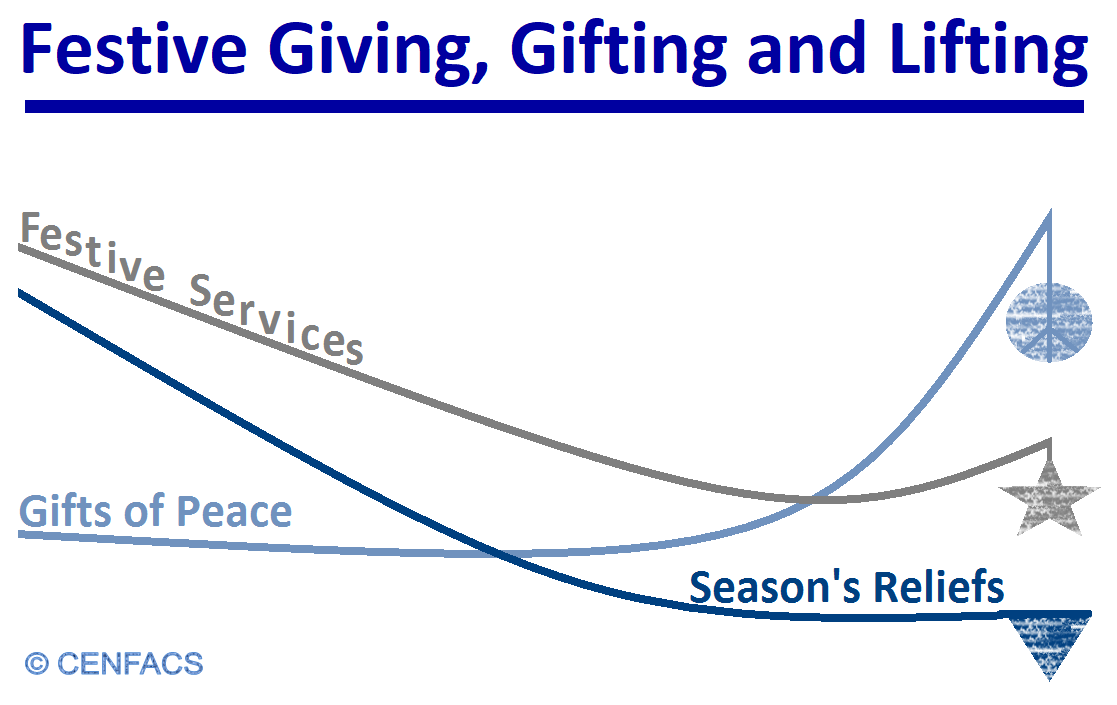
• • What Is Festive Giving? What Is Festive Gifting? What Is Festive Out-of-poverty Lifting?
Festive Giving is the act of sharing joy, love and generosity with those in need during the Festive Season. In other words, it refers to generosity of spirit and broad acts of kindness. It is also the time to give to charities to help the less fortunate enjoy the holiday. The desire of the Festive Giving is to spread festive cheer to the less fortunate.
Festive Gifting is the act of presenting someone with a gift, often involving a tangible object and a relationship-building intent. It is also the practice of giving physical presents or curated gifts set to those in need (who could be family members, friends and peers) during the Festive Season. The desire is to create, maintain or transform social relationships and hierarchies.
Festive Out-of-poverty Lifting is about moving people from living below the poverty line to a state of financial stability, and of creating pathways for people in extreme poverty to achieve lasting financial well-being. The motivation is to end injustices and enable people to escape the cycle of poverty through empowerment rather than just temporary aid.
So, with Festive Giving, Gifting and Out-of-poverty Lifting; we can express love, appreciation, kindness and generosity towards those in need who are looking for brightness. We can do it through Festive Gift Set and End-of-year Support.
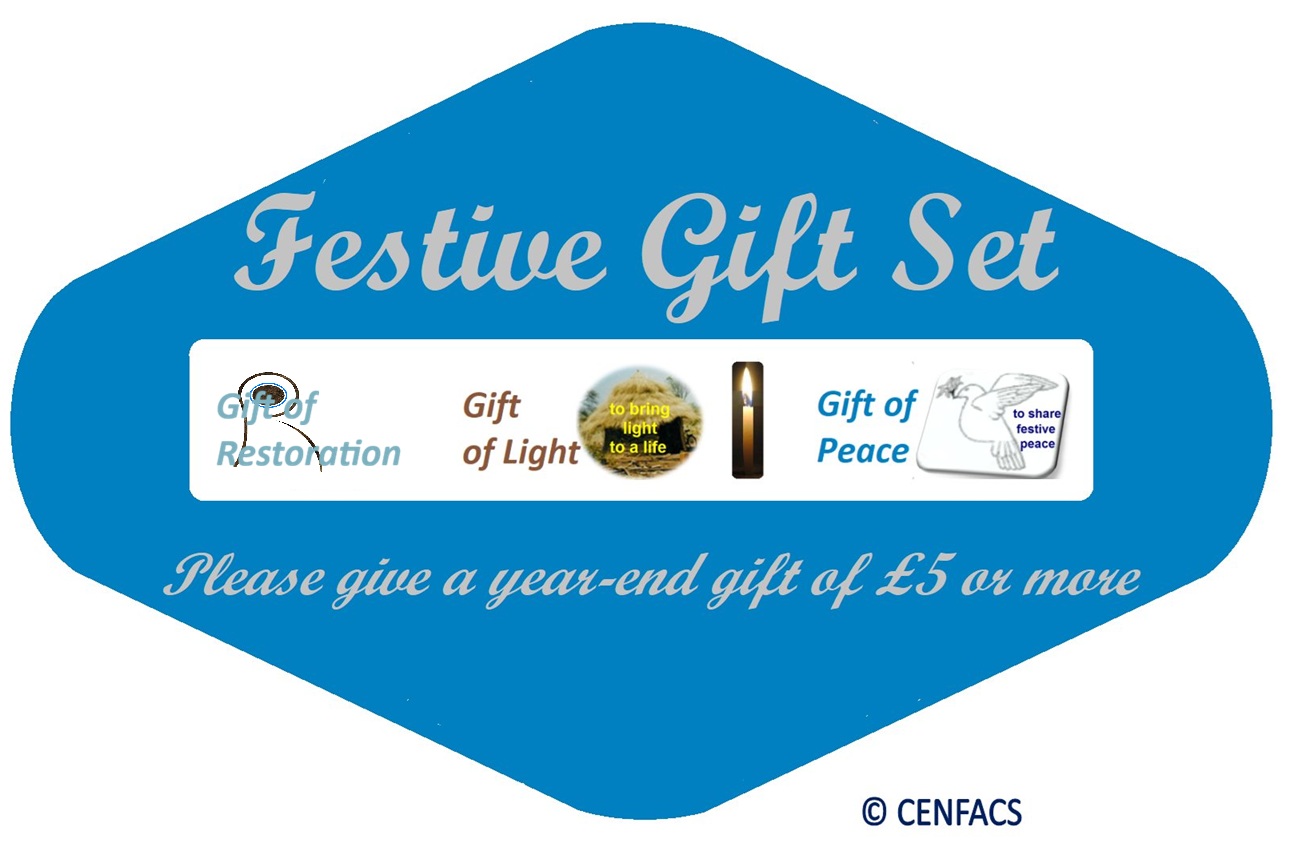
• • Festive Gift Set
Festive Gift Set is a collection of items curated and packaged together to celebrate festive occasion. These sets are thoroughly designed to bring joy and festivity to the recipients. They are made of carefully selected items that complement each other and create a memorable difference and experience for the recipients.
This Festive Gift Set can be given for the remaining fourteen days of this year starting from today as those of the last legacy of the Year 2025 as the ‘Restoration’ Year at CENFACS.
To mark the end of our ‘Restoration’ Year and Campaign, we are appealing to you to support CENFACS’ Year 2025 through a ‘Restoration’ (‘R’) Gift or Year 2025 Gift.
Such a gift will help to undertake five changes as follows:
a) Change in terms of skills as the beneficiaries of this gift will develop new skills (like AI-powered restoration skills) and gain new perspectives, and grow to further reduce poverty (a gift of growth)
b) Change as those in need will become more adaptable, resilient and better equipped to handle future changes and uncertainties (a gift of adaptability)
c) Change as beneficiaries will generate new ideas and approaches to better address poverty and enhance sustainable development (a gift of creativity)
d) Change as members of the CENFACS Community will come together to support each other via change and build stronger bonds (a gift of community building or bond)
e) Change through togetherness as CENFACS users will work together to navigate new challenges, foster a sense of unity (a sense of belonging) and collaboration against poverty and hardships (a gift of togetherness).
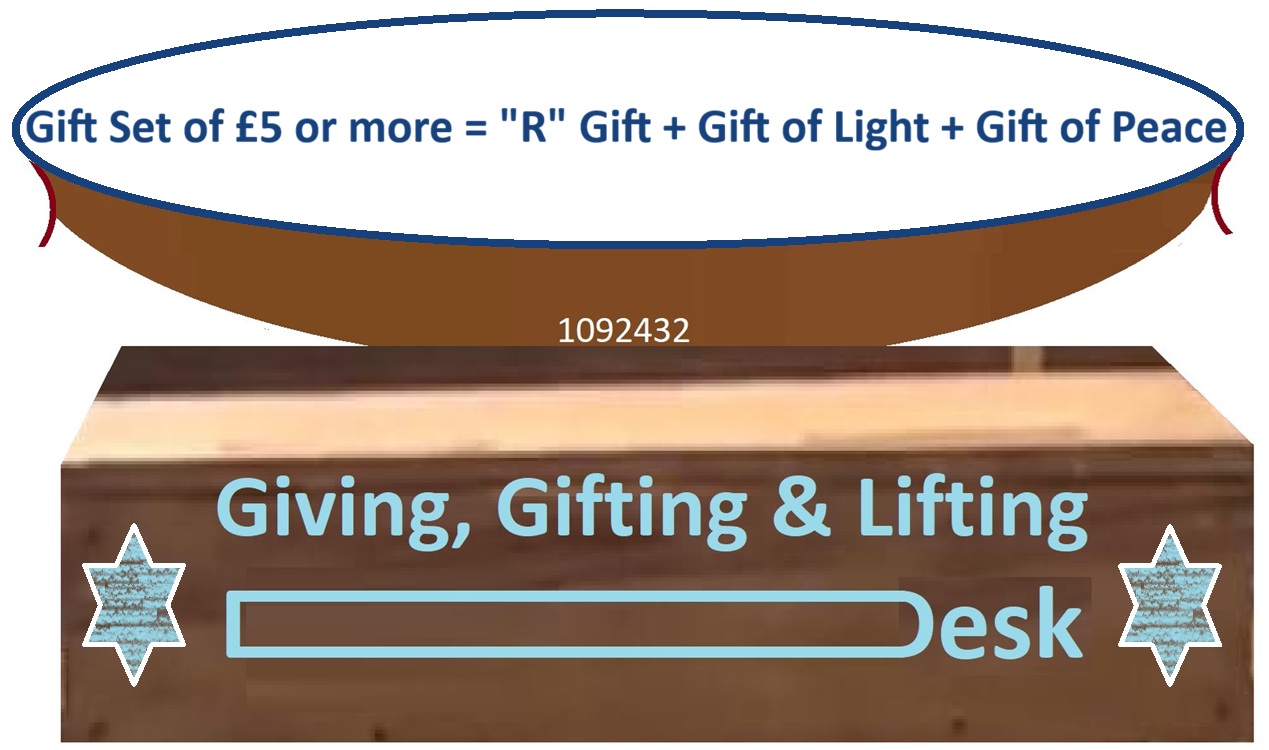
With the ‘R’ Gift plus the Gift of Light plus the Gift of Peace; the three of them give you a Gift Set of £5 or more. What do these gifts express?
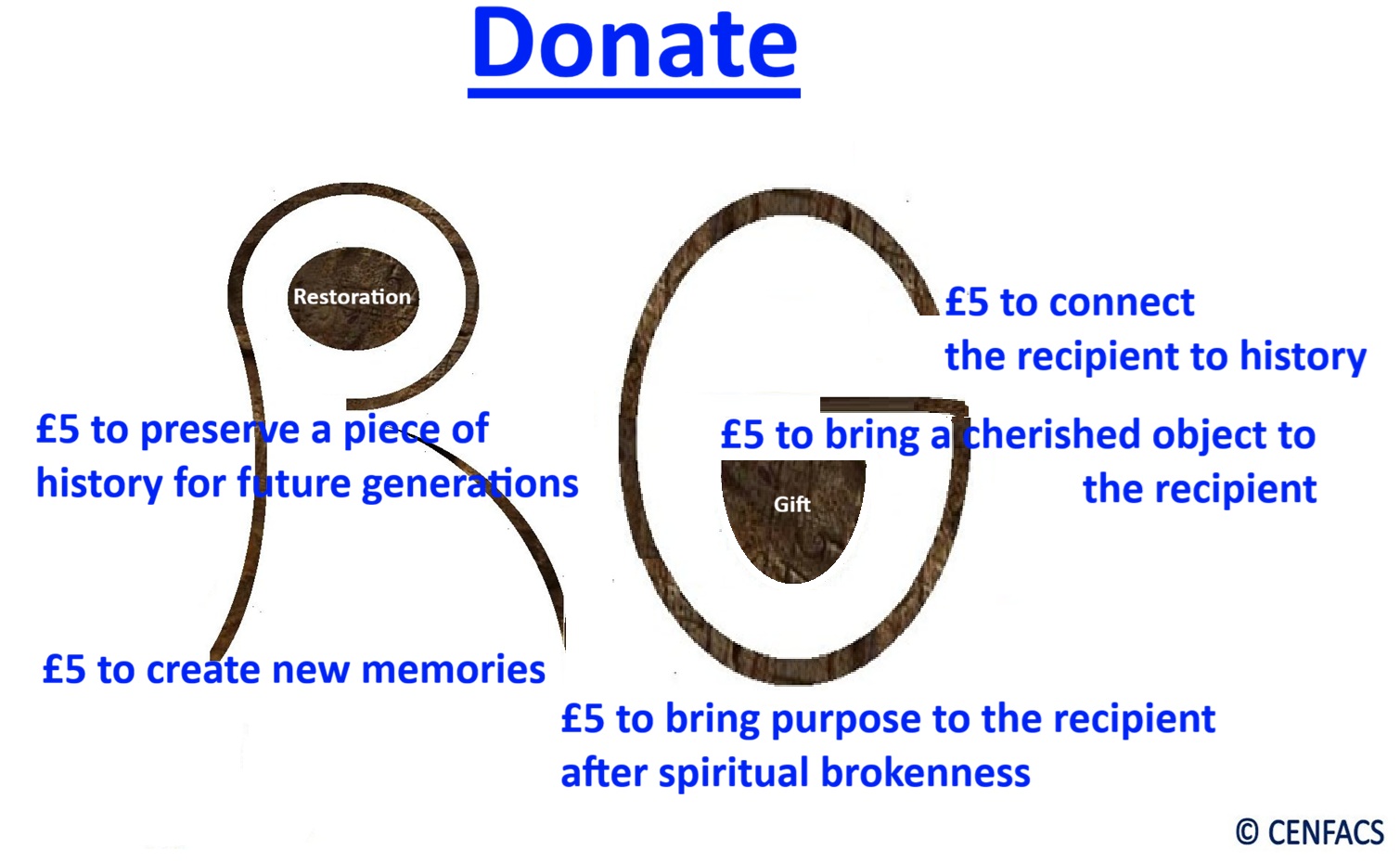
• • • Expressions from the three gifts (of Restoration, Light and Peace)
• • • • The Restoration Gift represents the 12 Restoration Project Episodes of the Year of Restoration within CENFACS
It is a gift of renewal from brokenness which has the following properties:
# Giving something back to its best state
# Bringing a cherished object
# Connecting the recipient to history
# Creating new memories
# Bringing purpose after spiritual brokenness
# Preserving a piece of history for future generations.
The aim of Restoration Gift is providing meaningful support and resources that will enable those in need to restore their economic status and achieve long-term self-sufficiency. This thoughtful and memorable gift you could ever provide to someone will give both immediate relief and restorative opportunities for long-term growth and self-renewal.
You could unwrap your gift of restoration for those in need, this Festive Season!
• • • • The Gift of Light
It is a form of lighting to peoples and communities without access to light. It symbolises hope, warmth and joy for the victims of multiple crises (i.e., the cost-of-living crisis, wars and natural disasters). It is also a donation programme that uses practical and meaningful means to meet the unique needs of transformation from darkness to brightness, to guide or show way of reducing poverty.
• • • • The Gifts of Peace
They are initiatives to promote peace and conflict resolution in war-torn or conflict-affected or disaster-stricken places, while providing aid and resources to those affected by changing climate, wars and conflicts while promoting stability in their communities.
These gifts create long lasting relationships in a world without conflicts between humans as well as between humans and the nature (other living beings and things). At this time of the lingering effects of polycrises, the Gifts of Peace will enable to re-conquer the lost peace and get new form of peace from poverty induced by these effects. This is without forgetting the lack of peace brought by climate change events.
All these initiatives represent some great ways of helping to reduce poverty at this special time of the year. They give more opportunities to supporters to do something different for those in need.
By donating £5 or more for this Gift Set, you will help people in need to leave poverty and hardships behind them and may be forever.
To donate and or enquire about this Gift Set, just contact CENFACS with or without your donation.
• • End-of-year Support and Appeal
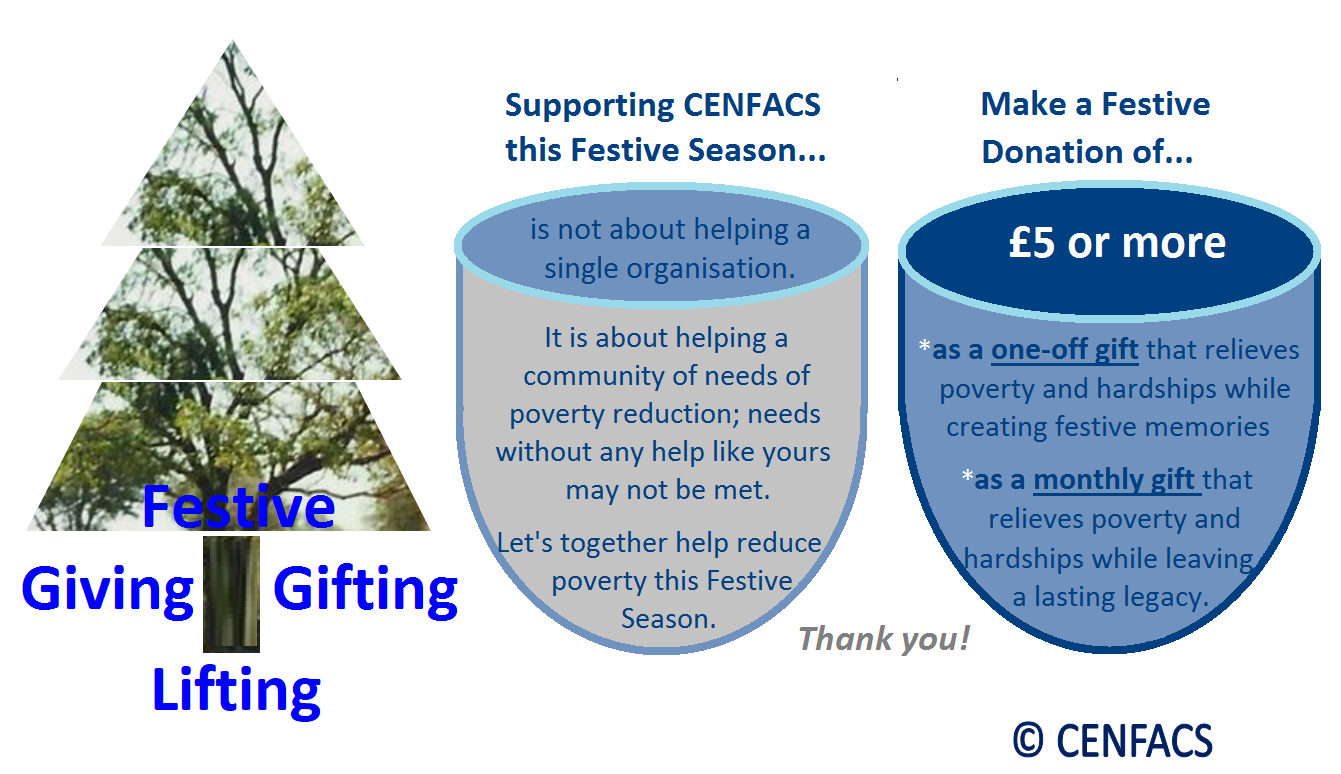
End-of-year Support and Appeal are a great way to show appreciation and spread holiday sheer as 2025 is coming to an end. We would like to ask you to donate as a legacy towards CENFACS’ efforts to help reduce poverty and enhance sustainable development.
You can donate to support CENFACS’ anti-poverty mission and to help reduce poverty and hardships this Festive Season and in the New Year.
Your support can make helpful differences to CENFACS and to those in need, the people and communities that CENFACS serves.
• • • Two ways of responding to this appeal
1) Make a One-off Festive Donation of £5 or more this festive time…
as a way of helping poor people via CENFACS and / or support CENFACS’ work on poverty relief and sustainable development.
You can also support one of the CENFACS projects and programmes if you wish.
2) Make a Monthly Donation of £5 or £10 or £15 or more per month…
as a legacy for CENFACS’ work.
Please make a year-end contribution today to help us continue to deliver the work of CENFACS in the remaining days 2025 and beyond.
This Year-end Support is an inclusive relief sending a never-ending message from the giver that they are part of what we have achieved in 2025 and will do in the coming years.
To make a donation and or enquire about this End-of-year Ask or Support, just contact CENFACS with or without your donation.
• Community Value Chains, the CENFACS Community
CENFACS as a Zero-waste Community of Restorers, which is the Closing Act of the 2025 Year, is being prepared and trended. Before covering this preparation, let us highlight CENFACS’ Community Value Chains.
• • What Is CENFACS’ Community Value Chains (CVC)?
1) It is a community value control, inspirational and motivational project of year-end celebration introduced by CENFACS in 2009. The project is based on a basic idea of development which is as follows:
“What a member of our community best does which well works for them can have an underlying good value. If there is a good value, it is desirable to share such value so that other members of our community could be aware of it and build a sort of chains of beliefs and community spirit/principles within our support network”.
2) It is all about improving lives and outcomes of community members as well as enlivening capacities by sharing good practices, values, achievements and hopes about shared goals for the future; while learning from past mistakes.
In doing so, we can pull together as one community, strengthen our links and bonds, learn our differences and harness transformative changes we all want amongst us and beyond our self-interests.
3) It is finally about sharing and celebrating our wins or impact as a community.
To sum up, CENFACS’ CVC or the CENFACS Community is our voluntary local and non-profit making arm inside which all our projects and activities carried out in the UK are grouped and delivered; the other two domains being CENFACS International and CENFACS Fund for Poverty Reduction and Sustainable Development.
• • What Are Those Shared Values?
Good practices and good values do not need to be big or exceptional or even spectacular. They are the simple good little things we do every day, which may have worked for us and could work for others as well. These good little things could have a bigger impact on us as a community.
They could be life and work learning experiences, lifestyles, helpful differences, social responsibilities and principles that underpin them. At this time of the high costs of living, they could be all the little initiatives one has taken to care for each other in order to have access to economic means of copying and survival.
• • Sharing and Celebrating Our Wins or Impact via CVC 2025
CENFACS as a Zero-waste Community of Restorers will feature our Year-end Giving Campaign.
This celebratory theme for CVC’s 16th Celebration of CENFACS as a Zero-waste Community of Restorers is and will be the Closing Act of the Restoration Year and Project. This celebration or end-of-year sharing will be open to those who would like to share hopes about shared goals for a better future.
We shall again focus on ourselves as a Zero-waste Community of Restorers. As a Zero-waste Community of Restorers we can work together with our community members to minimise waste sent to landfills and incinerators through strategies that followed the ‘5 Rs’ (Refuse, Reduce, Reuse, Recycle, and Rot). This focus will be about our dedication to ecological restoration (like restoring ecosystems and nature) and upcycling objects (through CENFACS’ Zero Waste e-store) to reduce waste and build zero-waste skills.
• • The 16th Celebration of CENFACS Community as Way of Looking both Back and Forward
• • • Looking back on 2025
It will be about
~ how we mobilised support and resources to meet the community’s restoration needs and goals
~ the work we carried out with the members of our community and Africa-based Sister Organisations via restoration skills, styles and models to help reduce poverty and enhance sustainable development
~ how we approached crises and challenging situations to get the best outcomes for poverty reduction via restoration skills, styles and models
~ how we used the fundamental principles of restoration to work with users and project beneficiaries so that they could reduce poverty linked to the lack of restoration
~ reflecting on beneficiaries’ journey out of poverty and how far they come to get valuable insights in terms of poverty reduction and sustainable development via restoration.
• • • Looking forward to 2026
It revolves around
~ making use of the findings from what we did not know, and we now know about the needs and aspirations of the people in need making our community to build a better community
~ planning appropriate responses or new ways of working together with project beneficiaries in 2026 to meet unmet needs and demands
~ setting new realistic goals for 2026 and an action plan to achieve those goals.
For instance, we shall undertake planning for projects relating to the following:
√ combat against climate disinformation
√ finance mobilisation roadmap
√ reduction of long-term energy poverty
√ voluntary energy transitions
√ zero-waste skills.
In this respect, looking forward to 2026 will be about thinking of the direction and shape that the evolution of the community needs and aspirations may take in 2026 and how we can effectively and efficiently work with our members in 2026 in terms of improved course of action in the New Year.
Briefly, the 16th Celebration of CENFACS Community will take the form of a blended sharing of our progress and insights regarding how the year 2025 has impacted everyone’s life, focusing on the beneficial lessons learned to help pave the way for 2026. During this intended sharing, we will appreciate the advantageous experiences derived from the challenges and upheavals faced in 2025.
Our aim is for our community to conclude 2025 on uplifting note or through sharing despite the ups and downs experienced this year, particularly due to the distress caused by rising living expenses that continue to affect many of us. Additionally, we hope for our community to commence 2026 filled with optimism and encouraging mindset.
• • Share, Spread & Tweet the Message
To enable us to build value chains with you and others and to keep our support network alive and networked CENFACS, please spread the message to/pass it on around you.
If you feel that you need first to talk to us before responding to this invitation of end-of-year celebration/sharing, please let us know.
If you prefer to respond via e-mail, you are free to do so at facs@cenfacs.org.uk.
Whichever way or means you choose to enter this year-end sharing project, please reply by the 23rd of December 2025 so as to ease the end-of-year 2025 celebration/sharing and the start-of-year 2026 preparatory activities, projects and programmes.
For further details about this Closing Act of the Restoration Year and Project as a ‘R’ Year, please contact CENFACS.
For the timeline of the themes that made CENFACS’ Community Value Chains so far, please also contact CENFACS.
As part of the closure of 2025 and preparation for 2026, we are as well doing an inventory of skills and are registering the talents and skills of the CENFACS Community.
If you have not yet registered your skills to CENFACS’ Skills Data Bank, this is the opportunity to do it over this festive period. Your skills registration will be essential to ensure that all the skills and skilled people making our community are included in any future plans to improve our community support.
To register or add your skills to the CENFACS Community’s Skills Register or Database, just contact CENFACS.
Extra Messages
• Matching Organisation-Investor via a Small Lottery Scheme – In Focus from Monday 15/12/2025: Activity 3 Involving Alignment of Investee’s Evaluation and Exit Stage with Investor’s Closure and Benefits Realisation Phase
• Income Generation Leads and Advice on Alternative Income Sources: Income Generators, Creators and Curators of the Month
• All Year-Round Projects (or Triple Value Initiatives): 2025 Verdict
• Matching Organisation-Investor via a Small Lottery Scheme – In Focus from Monday 15/12/2025: Activity 3 Involving Alignment of Investee’s Evaluation and Exit Stage with Investor’s Closure and Benefits Realisation Phase
The concluding episode of our three-week Autumn Matching Organisation-Investor via a Small Lottery Scheme (SLS) is on Matching Organisation-Investor through Investee’s Evaluation and Exit Stage with Investor’s Closure and Benefits Realisation Phase.
There has been some synchronization between Investee’s Operation and Monitoring Stage and Investor’s Implementation and Operation Phase. Additionally, the evaluations of Key Performance Metrics (KPMs) concerning monitoring have yielded satisfactory results, with the SLS successfully meeting these evaluations.
The successful outcomes from the synchronization and metric evaluations have paved the way for the third and concluding round of matching discussions. During Activity 3, ASCOC will engage in discussions regarding its Evaluation and Exit Stage, while the not-for-profit (n-f-p) impact investor will present its Closure and Benefits Realisation Plan.
To approach this Third stage/phase of negotiation, we have organized our notes around the following points:
σ Matching Talk Terms
σ ASCOC’s or Investee’s Perspective and Key Actions Regarding Evaluation and Exit Stage
σ Not-for-profit Impact Investor’s Consideration Concerning Closure and Benefits Realisation Phase
σ Reaching an Agreement on the Key Areas of Investee’s Evaluation and Exit Stage with Investor’s Closure and Benefits Realisation Phase
σ The Match or Fit Test Service
σ Impact Advice to ASCOC and Guidance to n-f-p Impact Investor
σ The Rule of the Matching Game
σ CENFACS as a Matchmaker
σ CENFACS’ Hub for Testing Hypotheses
Let us look at each of these points.
• • Matching Talk Terms
There are four key matching terms which are evaluation, exit, closure, and benefits realisation.
Let us briefly explain them.
• • • Evaluation
Evaluation can be defined in various ways. In the context of these matching talks, we are going to refer to what ‘ncvo.org.uk’ (1) argues about it. The website ‘ncvo.org.uk explains that
“Evaluation is about working through a structured process to help you learn and make decision about your work. It involves gathering data to help you understand the way the work was designed, how the work was put into effect (implementation), and the results from a piece of work”.
Evaluation has a cycle, which is planning your evaluation, collecting your data, assessing your data, reviewing your findings and putting them into practice.
ASCOC needs to demonstrate that it has followed this evaluation cycle when evaluating SLS.
• • • Exit
Project exit can be approach from various angles. According to the United Nations Development Programme (2),
“A project exit strategy is a plan describing how the project intends to withdraw its resources while ensuring the achievement of the programme goals are not jeopardized and that progress towards these goals will continue”.
Maher Consulting (3) explains exit strategy further by providing the three approaches to exit strategies, which are:
a) Phasing down: It is the exit case where there will be a gradual reduction of SLS activities and where the n-f-p social impact investor will deploy fewer resources)
b) Phasing out: It is the exit case where the n-f-p social impact investor can withdraw his/her involvement in SLS without turning it over to another institution or third party for continued implementation
c) Phasing over: It is the exit case in which the n-f-p social impact investor can accept the transfer of SLS activities to local people.
The exit strategy helps to clarify and define the role of the n-f-p social impact investor.
• • • Closure
Project closure will be looked at here from the perspective of ‘plane.so’ (4) which states that
“Project closure is the final phase of the project management process, where all activities are completed, deliverables are completed, deliverables are handed over, and the project is formally closed. This phase marks the end of the project lifecycle”.
From this perspective, the n-f-p social impact investor will have its checklist for project closure which will contain the following documents:
Deliverable verification and client acceptance, final SLS performance assessment, financial closure, documentation and archiving, resource release and reassignment, post-project evaluation and lessons learned, administrative closure and legal requirements, stakeholder communication and final SLS report, celebration of SLS completion and recognition of contributions.
• • • Benefits Realisation
Our explanation of benefits realisation comes from ‘pmis.consulting.com’ (5) which argues that
“Benefits realisation is the definition, planning and realisation of the benefits of a business change or business improvement project. It is without doubt the most valuable thing you can do when involved in any kind of change, or significant investment that includes a project or change”.
In relation to this definition of benefits realisation, the n-f-p social impact investor would like to identify clear benefits (e.g., poverty reduction) in the SLS change lifecycle. And ASCOC needs to show that there are benefits in pursuing the SLS.
• • ASCOC’s or Investee’s Perspective and Key Actions Regarding Evaluation and Exit Stage
Activity 3 is about wrapping up the matching talks and ASCOC needs to have its evaluation file ready and containing all the steps in the evaluation cycle. ASCOC is also required to plan to avoid any tensions that may arise between the withdrawal of assistance from the n-f-p social impact investor and the commitment to achieve SLS outcomes.
Its key actions regarding evaluation and exit stage will include the following:
# Final performance review: ASCOC will evaluate whether or not the SLS will meet its planned benefits and achieved the targeted return on investment
# Project closure confirmation: ASCOC will verify that the SLS as a project will be formally closed with the relevant authorities
# Investment payout: ASCOC will receive the final payout of its capital and any remaining surplus, in line with the initial investment agreement
# Lessons learned: ASCOC will conduct a final review of what went well and what will be improved to inform future investment decisions.
• • Not-for-profit Impact Investor’s Consideration Concerning Closure and Benefits Realisation Phase
The n-f-p social impact investor will have its checklist for project closure to check if ASCOC will follow the project closure procedures.
Regarding the benefits realisation, the n-f-p social impact investor would like to know the expected SLS benefits to be delivered for the local people. This is because ASCOC is undertaking the SLS to deliver benefits and ASCOC should not later be criticized to fail to deliver these benefits (e.g., poverty reduction) in the local community. Also, the n-f-p social impact investor wants to know if ASCOC has a strategy to deliver benefits or a Benefits Realisation Framework.
The benefits realisation is the sticking point in these negotiations between ASCOC and the n-f-p social impact investor as there is some belief that gambling is an extractive not a creative industry, redistributing money from lower income households to a few large operators and offshore platforms. There are also arguments that the dependency on gambling can push poor people into a cycle of debt and deeper poverty as they may try to borrow to play lottery. Excessive gambling can drain family saving, lead to asset loss and increase debt.
Because of these reasons and relating sticking point, ASCOC and the n-f-p social impact investor need to work hard to reach an agreement.
In short, the n-f-p impact investor will check the above-mentioned elements forming the closure and benefits realisation phase to ensure that ASCOC’s trustees carefully thought about the SLS in such a way that the interests and mission of their charity are preserved and they will minimize any emerging risks to their charity.
The n-f-p impact investor and ASCOC need to reach an agreement on this third activity of the matching talks.
• • Reaching an Agreement on the Key Areas of Investee’s Evaluation and Exit Stage with Investor’s Closure and Benefits Realisation Phase
Both ASCOC/investee and the n-f-p social impactor need to reach agreement on each of the points: SLS evaluation, exit strategy, closure and benefits realisation. Let us highlight the elements they need to consider in each of these points in order for them to reach an agreement.
• • • Reaching an agreement on evaluation
In negotiations regarding the evaluation of SLS for social impact investment, the negotiation points will be centred on defining, measuring and reporting both the social impact and the financial performance.
Let us briefly present these negotiation points.
# Defining SLS intended impact: Both parties need to agree on targeted outcomes as well as the theory of change (logic model).
# Impact measurement and metrics: Both parties need to agree on the specific framework or methodology to be used (e.g., Social Return on Investment), key performance indicators to track progress and success, data collection and reporting frequency, attribution and deadweight, etc.
# Financial terms and risk: They need to negotiate the expected financial return, the risk sharing, funding utilisation and cashflow, and due diligence (the analysis of SLS financial standing business model and operational strength).
# Governance and oversight: They will also agree on decision-making control, alignment of strategy, and exit strategy.
# Transparency and communication: They are finally required to build trust and be flexible (that is, to be ready to compromise and prioritize the core mission while ensuring financial viability.
• • • Reaching an agreement on exit strategy
Negotiations between ASCOC/investee and n-f-p social impact investor regarding exit strategy will balance both financial return and the preservation of social impact mission.
The key negotiation points will revolve around the definition of success and goals, the timing and conditions of exit, the exit mechanisms and valuation, mission protection and legacy, and stakeholder management. Let us highlight these points.
Concerning the definition of success and goals, they will discuss the expected financial return (which might be below-market rate for impact investing), social impact, and milestones that will trigger or inform the exit process.
Regarding the timing and condition of exit, they will negotiate the investment term (an agreement on lock-in period for the investment), triggering events for an exit to occur, flexibility in terms of timeline for the exit.
As to the exit mechanisms and valuation, they will negotiate the mode of exit or exit routes (e.g., merger with another charity), and the valuation methodology (that is, a method for valuing the SLS at the time of exit).
With respect to the mission protection and legacy, they need determine how any proceeds from the exit will be re-invested to support ASCOC mission, the contractual tools to lock in the mission post-exit, the continuity of governance (in particular, if the n-f-p social impact investor will retain a board set or ongoing advisory role after the financial exit).
As far as the stakeholder management is concerned, they will agree on the communication plan during the exit process as well as the capacity building initiatives within the SLS during the investment term to ensure that SLS can thrive independently after exit.
• • • Reaching an agreement on closure
The key negotiation points between ASCOC and the n-f-p social impact investor will be around financial and legal obligations, impact and operational continuity, and stakeholder management. Let us summarise these points.
Concerning financial and legal obligations, the two parties will agree the terms of settling debts and liabilities, the treatment of remaining funds (surplus assets), restricted and unrestricted funds, the final accounting and financial reporting, and the regulatory compliance.
Regarding the impact and operational continuity, they will discuss the prospects for the continuity of impact or mission alignment, the measuring and reporting of the final impact, and the beneficiary handover.
Briefly, the negotiations (on SLS closure) between ASCOC and the n-f-p social impact investor will be about ensuring the continuity of the SLS charitable purpose and responsible management of SLS remaining assets and obligations.
• • • Reaching an agreement on benefits realisation
The negotiation points on benefits realisation will focus on defining, measuring, valuing, and verifying the social impact and aligning this with financial terms. The negotiation areas will be the definition of the expected benefits and outcomes, measurement and reporting, risk and governance, and financial and legal terms. Let us briefly cover these points.
Regarding the definition of the expected benefits and outcomes, both ASCOC and the n-f-p social impact investor will identify and prioritise these benefits the SLS is intended to achieve, ensure SLS expected benefits align with ASCOC’s overall mission and the investor’s social impact goals, define SLS outcomes (the actual changes or advantages to be gained by beneficiaries) and outputs (direct results of activities), and agree the baseline measures against with SLS performance and the extent of change.
Concerning measurement and reporting, the two parties will negotiate the metrics and key performance indicators to be used, the methodology (e.g., Social Return on Investment) to follow, the data to be collected and the frequency of reports, the level of transparency in reporting and verification to ensure accuracy and honesty.
As to risk and governance, they will decide on risk sharing, governance structure, way of managing disbenefits (negative side effects) of the SLS, contingency and adaptation plans if benefits are not on track.
With respect to financial and legal terms, both ASCOC and the n-f-p social impact investor will discuss the tying of financial returns to outcomes, the cost of impact measurement, the exit arrangements, and the legal and regulatory compliance to ensure that SLS structure and benefits realisation plan comply with the relevant charity law and guidance where the SLS will be implemented in Africa.
The two sides (ASCOC and the n-f-p social impact investor) need to reach an agreement on the contents of ASCOC’s/Investee’s Evaluation and Exit Stage with Investor’s Closure and Benefits Realisation Phase.
If there is a disagreement between ASCOC and n-f-p social impact investor, this could open up the possibility for a match/fit test. The match/fit test can be carried out to try to help the two sides of the matching process. The match/fit test can also be undertaken if there is a disagreement on any of aspects of the SLS.
• • The Match or Fit Test Service
As part of the match or fit test, the contents of ASCOC’s Evaluation and Exit Stage must be matched with n-f-p social impact investor’s view on Closure and Benefits Realisation Phase.
The match test (or matched sampling) will help to increase the accuracy and statistical efficiency of the study of the SLS by carefully selecting subjects for comparison. The purpose here will be to increase the statistical efficiency of the study on SLS by controlling for confounding variables when forming a sample.
The fit test will assist in determining how well the observed sample data matches a specified theoretical distribution. The fit test will check if the data collected fits a model or an assumed population distribution. So, the purpose of the fit test is to validate or invalidate the statistical model by checking if the sample data follows an expected distribution.
The match can be perfect or close (that is, when every unit is paired with an equivalent unit) in order to reach an agreement. If there is a huge or glaring difference between the two (i.e., between what the social impact investor’s approach to Closure and Benefits Realisation Stage and what ASCOC is saying about its Evaluation and Exit Stage, between what the investor would like the Evaluation and Exit Stage to indicate and what ASCOC’s Evaluation and Exit Stage is really saying), the probability or chance of having an agreement at this Third round of negotiations could be null or uncertain.
• • Impact Advice to ASCOC and Guidance to n-f-p Impact Investor
Where there could be a disagreement, CENFACS can impact advise ASCOC to improve the contents of its Evaluation and Exit Stage. CENFACS can as well guide n-f-p impact investors with impact to work out their expectations in terms of Closure and Benefits Realisation Phase to a format that can be agreeable by potential ASCOCs.
CENFACS’ impact advice for ASCOCs and guidance on impact investing for n-f-p impact investor, which are impartial, will help each of them (i.e., investee and investor) to make informed decisions and to reduce or avoid the likelihood of any significant losses or misunderstandings or mismatches.
• • The Rule of the Matching Game
The rule of the game is the more impact investors are attracted by ASCOCs’ Evaluation and Exit Stage the better for ASCOCs. It means that ASCOCs’ process must pass the attractiveness test (that is, the evaluation of market’s appeal). Likewise, the more ASCOCs can successfully respond to impact investors’ level of enquiries and queries about the SLS the better for investors. In this respect, the matching game needs to be a win-win one to benefit both players (i.e., investee and investor).
The above is the Third Activity of the Matching Organisation-Investor via SLS.
Those potential organisations seeking investment to set up a SLS and n-f-p lottery investors looking for organisations that are interested in their giving, they can contact CENFACS to be their matchmaker to find their perfect investee or investor.
• • CENFACS as a Matchmaker
As a Matchmaker, CENFACS can streamline your search process, save time, money and resources to help you find the perfect match in the world of impact investing.
CENFACS platform will help facilitate the matching process between investees and investors. By leveraging the power of AI tools, CENFACS’ Matching Organisation-Investor Programme can streamline the search process for funding opportunities, connecting African charities and impact investors/funders.
Briefly speaking, CENFACS can work with matching applicants and use AI to match organizations with the right impact investors, filtering profiles based on development stages, sectors, and aims.
In this matching process, CENFACS can arrange the match or fit test for them. They can have their fit test carried out by CENFACS’ Hub for Testing Hypotheses.
• • CENFACS’ Hub for Testing Hypotheses
The Hub can help use analysis tools to test assumptions and determine how likely something is within a given standard of accuracy. The Hub, which can serve as a learning or reference place for those who would like to understand and apply statistical hypothesis testing, can assist to
√ clean, merge and prepare micro-data sources for testing, modelling and analysis
√ conduct data management and administration
√ carry out regression analysis, estimate and test hypotheses
√ interpret and analyse patterns or trends or insights in data or results.
In this respect, CENFACS’ H-tests Hub is knowledge repository designed to demystify the process of using data to make informed decisions and move beyond intuition and guesswork.
Those who would like to apply hypothesis testing in fields of economic development or to deal with poverty reduction, they are welcome to use CENFACS’ H-tests Hub.
For any queries and/or enquiries about this third stage/phase/activity of Matching Organisation-Investor via SLS, please do not hesitate to contact CENFACS.
• • Concluding Note on Autumn Matching Organisation-Investor via SLS
African charities and not-for-profit organisations, similar to profit-driven entities, have the opportunity to initiate a lottery program to support their charitable objectives and aspirations, as long as this initiative complies with the legal guidelines of the nations they function in and adheres to their own governing principles. This means they can undertake such actions within the authorities granted to them by lawmakers and according to their foundational regulations (for example, articles of incorporation).
However, it is crucial for them to ensure that the recently established lottery program can utilize trends, insights, and interactions to incorporate their poverty alleviation initiative into the dialogue, fostering engagement and growth among their supporters.
Additionally, they must verify that this lottery program will produce sufficient income, as a larger gap between the sales earnings and the expenses associated with those sales will enable them to identify the financial resources they require to dedicate to their valuable causes.
They must also ensure that the typical cost of lottery tickets will provide both monetary gain and charitable support, with the charitable aspect being more significant than the monetary one.
There exist philanthropic investors who specialize in helping to either launch or expand their concept of implementing a lottery program or offshoot aimed at alleviating poverty. In instances where Africa-based charities, specifically our Africa-based Sister Lottery Charitable Organisations (ASLCOs) or African Poverty Relief Organisations (APRCs) involved in this matching initiative, encounter challenges in locating such investors, we can collaborate with ASLCOs/APRCs to find them.
Similarly, for not-for–profit impact investors seeking opportunities with organizations based in Africa but uncertain about which entity to back, we can assist these investors in directing their funding toward the appropriate organization, at the optimal time, and for the right purpose. In this regard, we can connect the requirements of ASLCOs/APRCs for an investor with the aspirations of not-for-profit impact investors to find a suitable investee.
The likelihood of a successful connection can range from high to average or low, depending on how well ASLCOs/APRCs‘ requirements align with the interests of the investors. We will ensure that this connection is as robust as possible.
We are prepared to collaborate with ASLCOs/APRCs seeking Impact Advice and Not-for-profit Investors in need of Guidance with Impact, enabling the former to discover the investments they desire and the latter to identify the organization suitable for investment, allowing both parties to achieve their goals in the upcoming New Year.
To work together in making your matching aspirations a reality in 2026 by locating your perfect investee or investor, please reach out to us.
• Income Generation Leads and Advice on Alternative Incomes: Income Generators, Creators and Curators of the Month
Our Advisory Service on Leads to Income Generation and Alternative Income Sources is still on. Through this Festive Advice Service, we are looking at and reviewing income generation plans or strategies for those who need a review.
We are as well helping those who would like to turn their skills and hobbies into an active alternative income source.
We are also trying to explore the different income-generation leads or avenues that those in need can use, depending on their personal circumstances; to find the appropriate means to generate little extra income.
In this income generation to reduce poverty, we are as well trying to enlist those who could be named as Income Generation Models or Income Generators, Creators and Curators of the Season.
Income Creators leverage their unique skills and connections to create and monetize their content, making it a significant of the modern economy.
Income Generators are those who pursue any activity or business that creates income or financial surplus. This can include employment, freelancing, investments, business ventures, and rental properties.
Income Curators refer to curators who are responsible for managing and overseeing collections, particularly in the arts or sciences.
We are looking at their models or ways of generating little extra income. We are assessing whether or not their models of generating income are generalizable or duplicatable or just are exceptions to the general rule and to the CENFACS Community.
If anyone has managed to generate little extra income and finds that their way of doing it has an underlying good value that can be shared with the CENFACS CVC members, please do not hesitate to talk to CENFACS.
Likewise, those who would like to set up an alternative income project and who need advisory support to do it, they can contact CENFACS. This is all part of Income Generation Month.
• All Year-Round Projects (or Triple Value Initiatives): 2025 Verdict
The week is finally an occasion to remind the need to report on All Year-Round Projects (or Triple Value Initiatives) which are: Play, Run and Vote projects for poverty relief and sustainable development.
As we are nearing the end of year 2025, it is now the time to report on our three All Year-Round Projects – which are Play, Run and Vote.
We know that this year has been economically challenging for some of you to run some types of activities. However, for those who have managed to undertake and complete the above-named projects, we would like them to share with us and others their experiences, stories and reports regarding these projects.
• • The Action-Results of 2025: Tell it!
You can feedback the outcomes or Action-Results of your…
… Run if you ran for poverty relief over the year 2025 (or organised a Run activity)
… Play if you played the CENFACS League for Poverty Relief
… Vote if you have already voted your 2025 African Poverty Relief and Development Manager.
We would be more than happier to hear your Action and Results to feature the State of Play, Run and Vote 2025, and conclude CENFACS 2025 Year as Year of Restoration. Tell it!
• • What or Who We Want to Hear
We would like to hear from you about the Winner of CENFACS Virtual Trophy of the Year, that is one of the following Three Stars or Bests of the Year:
√ The Best African Country of 2025 which best reduced poverty
√ The Best African Global Games Runner of 2025
√ The Best African Poverty Relief and International Development Manager of 2025.
If you have not yet told us, have your say by 23 December 2025. The Verdict is yours.
Message in French (Message en français)
• Message de Remerciement de Fin d’Année 2025
Alors que l’année 2025 touche à sa fin, nous voulons prendre un moment pour exprimer notre gratitude à tous nos soutiens et à chacun/e d’entre vous pour votre fidélité et votre dévouement à la noble et belle mission de lutte contre la pauvreté.
Nous adressons nos sincères remerciements à tous/toutes ceux/celles qui ont collaboré avec nous pour réduire la pauvreté et ont rendu cela possible pour ceux/celles ayant besoin d’aide ainsi que pour nous tout au long de 2025.

Main Development
• Season of Light 2025-2026
The Lights Season at CENFACS kicks off with the theme of Hope as said above. We are going to deliver this Hope with projects and programmes adapted to the context of crises like the cost-of-living crisis. We are going to add to them the following projects:
σ Project to combat climate disinformation
σ Project for finance mobilisation roadmap
σ Project to reduce long-term energy poverty
σ Project for voluntary energy transitions
σ Zero-waste skills development project.
These projects are all about finding alternative models of using and creating resources as we continue to work on alternative economic models. During the Season of Light, we are going to expand our work on alternatives to alternative energy (consumption and production) models.
The following items make the contents of our Season of Light 2025-2026:
∝ What will shape the Season of Light?
∝ Two themes to bear in mind this Festive and Lights Time: Peace and Hope
∝ The Gift of Light that keeps on giving this Winter
Let us look at these contents.
• • What Will Shape the Season of Light?
The 2025-2026 Season of Light will be about working on the above-mentioned projects. Let us highlight these projects.
• • • Initiatives featuring the season of light like light (or energy) and voluntary energy transition projects
They are particularly those to shift from fossil fuels to renewable energy sources. They also include financial and policy frameworks to enable transitions to happen. Briefly, this type of initiatives will be about moving from fossil-based energy system towards zero carbon alternatives.
• • • Project to Combat Disinformation (PCD)
PCD aims to build resilience amongst our community members against misinformation through transparency, research, and public education. It is about educating our community members on how to critically evaluate information about climate change, spot fake climate news, and understand manipulative techniques and tricks. It is also about building trust in climate poverty reduction.
This will involve collaborating with other organisations working on similar climate disinformation issues, checking facts, researching, detecting and exposing falsehoods, analysing threats from disinformation, while improving media literacy within the community.
• • • Project for Finance Mobilisation Roadmap (PFMR)
PFMR is a strategic plan that will outline the necessary steps, policies, and financial instruments required to raise and deploy capital from various sources (public, private, voluntary, and institutional) to achieve specific goals like the mobilisation of funds for climate change.
The aim of PFMR is to bridge the gap between planning and implementation by identifying bottlenecks, de-risking projects, and creating ‘bankable’ investment opportunities to attract sufficient funding, especially in the era of international aid cuts.
• • • Project for Long-term Energy Poverty Reduction (PLtEPR)
Within the energy literature, a long-term energy poverty refers to a household consistently cannot afford or access essential energy services (like heating, cooling, lighting, and appliances), forcing them to reduce consumption to levels that harm health, well-being, and basic living standards, often due to low income, high-energy prices, and inefficient homes, creating a persistent cycle of deprivation and vulnerability, particularly in vulnerable populations.
PLtEPR aims to provide energy advice to empower households making the CENFACS Community with knowledge on low-cost measures to reduce energy consumption and help to avoid energy poverty becoming intergenerational. PLtEPR will help the following low-income households:
~ In persistent deprivation (that is, those experiencing a chronic inability to meet basic energy needs over extended periods)
~ With inadequate heating and hard health problems because of energy poverty
~ With high energy costs living in poor housing
~ Spending a large chunk of income on energy or fall into arrears bills, impacting their overall financial stability
etc.
In short, PLtEPR is about accessing modern energy, transitioning away from biomass for cooking, stopping indoor air pollution and improving health risks, particularly but not exclusively in Africa.
• • • Zero-waste Skills Development Project (ZwSDP)
ZwSDP is about teaching practical skills (like repair, composting, upcycling, cooking with leftovers) and promoting a waste-reduction mindset (reduce, reuse, recycle) to empower the community to minimise landfill waste, foster sustainable habits, and creating circular economies.
ZwSDP involves training, workshops, community engagement, and creating alternative models for waste management.
ZwSDP is finally about transforming waste management from disposal problem into a resource opportunity.
The 2025-2026 Season of Light will be the case of harnessing transformational and structural changes in the context of increasing uncertainty and climate change so that those who are living in poverty can find the means, paces and spaces they need to navigate out of it.
Besides that, we shall carry on with the financial empowerment programme of our users to reduce financial poverty and mitigate the lingering effects of previous and current crises with some of the initiatives (like AI-powered Financial Capacity and Capability Campaign).
Finally, we shall continue to develop household-focused and area-focused programmes to support poor and vulnerable households so that they can build their assets and economies to overcome intergenerational poverty.
To realise the above-mentioned projects, it requires Hope and Support.

• • Two Themes to Bear in Mind This Festive and Lights Time: Peace and Hope
The theme of Hope is the overall theme of the Season of Lights, while the theme of Peace will be dominant over the festive celebrations period.
• • • The theme of Hope
The theme of Hope is the motif of being proactive and having goal-oriented emotion or mindset, involving the desire for a better future and the belief that achieving that future is possible. This theme is made of notes or pieces of climate information, finance mobilisation, energy transition, zero-waste skills, and energy poverty reduction. This Wintry season, we shall bring a glimmer of hope through these notes or pieces, while making sure that the poor people own the process and have equity in poverty reduction.
Hope – which is an emotion, a catalyst for action and a forward-looking motivation towards a desired future state – will help beneficiaries as follows:
~ to actively cope with everyday challenges and find the appropriate relief and comfort they need
~ to reframe negative situations or events in a positive portrait or mood
~ to cultivate positive engagements, experiences and emotions in life
~ to keep momentum towards a better future
~ to enhance early warning systems
~ to develop resilience initiatives and strategies
~ to engage in a proactive behaviour.
• • • The theme of Peace
The theme of Peace is the unifying idea expressed as a state of completeness, harmony and non-conflict. This theme of Peace comes with gifts – the Gifts of Peace, which are included in the Season of Light.
Peace, which is an actual condition or state of being (either internal or external) that can exist in the present, is the festive theme we choose to spread the joy of Season’s Reliefs to those in need.
During the Festive Season, we try to help their wishes and dreams of poverty relief become true through the Gifts of Peace that put a smile on poor people’s faces and lips with relief notes while hoping they will rediscover freedom from disturbance and disorder caused by crises and other painful events of 2025. The Gifts of Peace are a profound and inner sense of calm, security and well-being that transcends external circumstances or conflicts. They are the results of internal stability and tranquility experienced by those who accept light.

• • The Gift of Light That Keeps on Giving This Winter
What is the Gift of Light?
• • • Understanding the Gift of Light
The Gift of Light is about illumination, knowledge, hope and source of truth that dispels spiritual darkness, ignorance and fear. This gift, which will keep on giving this Winter, has the properties below.
• • • The Gift of Light That Keeps on Giving This Winter
This Winter, the Gift of Light will continue to provide illumination as follows.
• • • • A gift of light for every person in need everywhere!
The Lights Season is the season during which we try to bring light or shine light to impoverished lives in the darkness. We try to bring clarity, brightness to people who need to see clearly and accurately about their life. It is about helping them see the light of relief so that they can see the world in a new relieved light or version.
• • • • A gift of light that ignites and sparks the life of those in need!
This is why we have the Lights project at CENFACS; projects which enable us to bring lights to those in need, and which identify the poverty reduction gaps in human systems and support those areas of these systems which do not receive support. Like the last Winter, this Winter 2025-2026, our Lights projects will focus on two parts or two waves of action:
1) post-epidemics, post-war, post-economic crisis and post-natural disaster developments
2) current and emerging armed conflicts and environmental catastrophes as well as new waves of threats.
However, in these developments and waves, we shall take into account the changing contexts in Africa where there could be scaling down or changing types of crises (for example, the imperialist rivalries between world’s great powers in Africa with their impacts on poverty reduction, threat to international trade due to the current conflict in the Middle East and its implications for poverty reduction in Africa). To mention other crises where the work of poverty reduction could be needed, we can speak about hunger crisis and debt crisis which are still stubborn issues for many low-income countries in Africa.
• • • • A gift of light that helps people to navigate their own way out of poverty with pride!
The Gift of Light is about helping people to help themselves. By using the light, they can find their own way out of poverty and hardships, out of darkness instead of CENFACS telling them what do. They can act with self-esteem and self-respect. In this respect, the Gift of Light is a blessing of empowerment.
• • • • A Blaze of Hope for post-life following crises (e.g., the cost-of-living crisis), armed conflicts and natural disasters
When there are environmental disasters and armed conflicts, there are pledges and commitments to end the effects of wars and disasters. For various reasons, some of these pledges do not always materialise. The post-war and post-disaster developments are sometimes left without support even until the conflicts and disasters return and or strike again.
As we cannot wait the return or repeat of the same wars and disasters; our first Blaze of Hope will go this Winter to the unfinished business of previous destructions and disruptions brought by crises (e.g., the health and the cost-of-living crises in Africa), wars and natural disasters.
• • • • • Examples of areas where a Blaze of Hope may be needed
Our Blaze of Hope will go to the following areas of African countries
~ that experienced overlapping crises that have slowed or stalled poverty reduction
~ not recovered from the poverty increase caused by epidemics (like Mpox, cholera, etc.)
~ experiencing the impacts of international/foreign aid cuts
~ with slow, weak or lack of economic growth to enable poverty reduction to happen
~ with high inequalities that prevent poverty reduction to materialise.
• • • • A Blaze of Hope for the eruption of any crises, armed conflicts and natural disasters
We always advocate for preventive development and we do not seek for destructive events to happen. However, our preparedness and readiness should make us to assemble as quickly as possible advocacy tools should any effects and impacts erupt from new waves of crisis, wars and natural disasters in Africa.
So, our second wave of intervention or Blaze of Hope will go this Wintry season to erupted effects of unexpected crises, armed conflicts and natural disasters in the areas of our interest in Africa.
With these two waves of action over this Wintry Season, we hope to enlighten the lives of those in pressing and emergent need.
• • • • • Examples of areas where a Blaze of Hope may be needed
For this December 2025, we have initially selected or identified six areas of priority that may need lighting a Blaze of Hope, which are as follows:
a) Areas of countries severely affected by food insecurity or the socio-economic impacts of high food prices like in Burkina Faso, Cameroon, Guinee, Congo, Madagascar, Mali and Senegal
b) Areas of vulnerable countries hit by or prone to torrential rains and cyclones that could cause enormous food insecurity such as in Chad, Congo and the Democratic Republic of Congo
c) Areas of countries devastated by other types of weather extremes (such as prolonged and severe drought, extreme temperature, etc.) like Burundi, Madagascar, Congo and countries of the Horn of Africa
d) Areas of countries that are the victims of a high level of persisting civil insecurity such as in in Chad, the Democratic Republic of Congo, Burkina Faso, Cameroon and Mali
e) Areas of countries where innocent people are the victims of unfamiliar forms of civil insecurity (e.g. interpersonal violence, gang violence and insecurity due to the presence of private military company personnel) and forced displacement/refugee influx like in Congo, Mali and Burkina Faso
f) Areas of countries affected by international/foreign aid cuts or gaps in aid pledged like the Democratic Republic of Congo.
The above selection is an initial one, which may change depending how and where humanitarian events will unfold in Africa. The selection will help to start our Light Advocacy and Campaign.
The countries listed in this selection are also mentioned in the Crop Prospects and Food Situation of the Food and Agriculture Organisations of the United Nations (6). None of the above-mentioned countries is experiencing a single issue. Many of them can be subject to multiple issues. For example, the Democratic Republic of Congo is experiencing conflict in its north-eastern provinces, torrential rains in other parts the country and high food prices.
Also, our priority areas can change depending on the events in Africa. For example, if there is eruption of unpredicted or unplanned events (such as natural disasters, natural resource crises, environmental incidents, large scale involuntary migration, health crisis, international trade crisis, etc.), our Blaze of Hope will go to the victims of these erupted events.
For those who can support Light Project, we can count on them to move forward this advocacy or campaign. And we would like to thank them in advance.
For any queries or enquiries regarding the Season of Light, please do not hesitate to contact CENFACS.

_________
• References
(1) https://www.ncvo.org.uk/help-and-guidance/strategy-and-impact-evaluation/about-impact-and-evaluation/why-focus-on-impact-and-evaluation (accessed in December 2025)
(2) https://info.undp.org/docs/pdc/Documents/JAM/Proejct%20Exit%20Strategy%202019DEVMIN.pdf (accessed in December 2025)
(3) https://www.maher.consulting/blog/what-is-a-project-exit-strategy (accessed in December 2025)
(4) https://plane.so/blog/what-is-project-closure (accessed in December 2025)
(5) https://www.pmis.consulting.com/articles/benefit-realisation/ (accessed in December 2025)
(6) https://openknowledge.fao.org/server/api/core/bitstreams/4cb9943d-75bf-4614-8710-14bc9dd11ad3/content
_________
• Help CENFACS Keep the Poverty Relief Work Going This Year
We do our work on a very small budget and on a voluntary basis. Making a donation will show us you value our work and support CENFACS’ work, which is currently offered as a free service.
One could also consider a recurring donation to CENFACS in the future.
Additionally, we would like to inform you that planned gifting is always an option for giving at CENFACS. Likewise, CENFACS accepts matching gifts from companies running a gift-matching programme.
Donate to support CENFACS!
FOR ONLY £1, YOU CAN SUPPORT CENFACS AND CENFACS’ NOBLE AND BEAUTIFUL CAUSES OF POVERTY REDUCTION.
JUST GO TO: Support Causes – (cenfacs.org.uk)
Thank you for visiting CENFACS website and reading this post.
Thank you as well to those who made or make comments about our weekly posts.
We look forward to receiving your regular visits and continuing support until the end of 2025 and beyond.
With many thanks.