Welcome to CENFACS’ Online Diary!
10 December 2025
Post No. 434
The Week’s Contents
• Matching Organisation-Investor via a Small Lottery Scheme – In Focus from Monday 08/12/2025: Activity 2 Consisting of Matching Investee’s Operation and Monitoring Stage with Investor’s Implementation and Operation Phase
• Goal of the Reduction: Reduction of Resource-based Poverty
• Turning Things into Festive Gifts (‘Festive Turns’)
… And much more!
Key Messages
• Matching Organisation-Investor via a Small Lottery Scheme – In Focus from Monday 08/12/2025: Activity 2 Consisting of Matching Investee’s Operation and Monitoring Stage with Investor’s Implementation and Operation Phase
Both Africa-based Sister Lottery Charitable Organisation and/or Cause (ASCOC) and not-for-profit (n-f-p) lottery impact investor have decided to move with the matching talks as they scored points each of them during Activity 1. They agreed to move to Activity 2, while finalising the little bits remaining from Activity 1 of the matching negotiations since these negotiations are a backward and forward process.
Indeed, when the lottery starts to run (although there are still a lot of steps to go), ASCOC or investee will shift its attention from establishing the scheme to monitoring its performance and protecting the investment. It is the stage which makes the investee’s Operation and Monitoring. At this stage, ASCOC will explain how it will track, review, and regulate the process and performance of the Small Lottery Scheme (SLS) to ensure it stays on course and meets its aim as outlined in the SLS plan.
As to the n-f-p impact investor, in the Activity 2 which is about his/her phase of Implementation and Operation, he/she will discuss the execution of SLS business plan and the day-to- day management of the lottery scheme. Like ASCOC/investee, the n-f-p impact investor’s role will shift from assessing feasibility to discussing the monitoring of SLS performance.
To advance in these talks, the contents of ASCOC’s/investee’s Operation and Monitoring Stage have to match with Investor’s Implementation and Operation Phase.
More details about these talks and related negotiating points are given under the Main Development section of this post.
• Goal of the Month: Reduction of Resource-based Poverty
Poor and vulnerable communities, particularly those living in rural areas, often rely on local ecosystems for their livelihoods. When these ecosystems are degraded or not available, this degradation or lack of availability reduces access to essential resources like clean water, timber, and fertile land. This can cause resource-based poverty.
• • What Is Resource-based Poverty?
From the literature review about resources and poverty, it emerges that resource-based poverty refers to the condition where individuals or households lack sufficient resources to meet their needs, either because they have a low amount of available resources or a low ability to convert those resources into useful capital.
In rural areas where people and communities are mostly dependent on natural resources, the degradation of these resources can lead to resource-based poverty which is more than income-based poverty. So, resource-poor are individuals with a low amount of available resources (e.g., law savings).
Like any types of poverty, resource-based poverty can be reduced or ended.
• • Reduction of Resource-based Poverty
It is possible to empower individuals and communities to become self-sufficient again in terms of resources. This involves providing them with training, access to new resources, financial support, and helping them to adapt to new circumstances.
So, the resource-based approach to poverty (that is, poverty as having insufficient material resources to meet material needs) should not be an end of itself. It needs to go far to explore ways of overcoming this type of poverty. In other words, there are implications to it.
• • Implications for Selecting the Goal for the Month
After selecting the goal for the month, we focus our efforts and mind set on the selected goal by making sure that in our real life we apply it. We also expect our supporters to go for the goal of the month by working on the same goal and by supporting those who may be suffering from the type of poverty linked to the goal for the month we are talking about during the given month (e.g., December 2025).
For further details on the goal of the month, its selection procedure including its support and how one can go for it, please contact CENFACS.
• Turning Things into Festive Gifts (‘Festive Turns’)
To turn things into festive gifts, it is better to explain what this means.
• • What Is ‘Turning Things into Festive Gifts’?
Research suggests that ‘Turning Things into Festive Gifts‘ refers to the practice of crafting or repurposing every day or secondhand items into thoughtful and unique festive presents. Instead, buying brand-new items, you can create meaningful, personalized, and often more sustainable gifts by transforming things you already have or can find easily.
This Festive Season, we are going to turn our time, effort, waste, shopping, etc. into donations and gifts. It is a Festive Season of turning things into something purposeful to reduce or end poverty and/or enhance sustainable development. It is about transforming items into festive gifts. You name them ‘Festive Turns‘. ‘Festive Turns‘ involve personalization with personalized messages, seasonal add-ons, thematic and experience-based gifts, and eco-friendly options.
• • Examples of Turning Things into Festive Gifts
They include the following:
# Upcycled and repurposed gift ideas (e.g., decoupage soap or glass jars, upcycled jewelry, repurposed wood, thrifted items, etc.)
# DIY food and drink (e.g., homemade bath salts or body scrubs, spiced nuts or flavoured honey, homemade vanilla extract, hot chocolate mix jars, etc.)
# Personalised gifts (e.g., DIY tote bags, monogrammed items, custom photo books or calendars, hand-painted mugs, etc.)
# Children’s homemade gifts (e.g., salt dough ornaments, decorated pinecones, paper roll creatures, nature-made clay ornaments, etc.)
The above examples are just a few of ways of turning things into festive gifts or donations for those in need. They are about
σ Turning your time and effort into helpful support for those in need this Festive Season
σ Turning waste into valuable resources that support those in need
σ Turning your festive shopping into life-changing gifts for others.
Those who would like to turn things or items into Festive Gifts, but are not sure or struggling to do it, they can work with CENFACS to make turning things possible. Equally, those who would like to donate to make this turning possible, they should not hesitate to donate.
To turn things into festive gifts and/or to donate to make this turning happen, please do not hesitate to contact CENFACS.
Extra Messages
• Autumn 2025 Humanitarian Relief and Nature Conservation Appeals: Only 11 Days Remaining!
• E-discussion on Voluntary Fossil Fuel Roadmap While Supporting All in Development Volunteer Scheme (AiDVS)
• Restoration Year and Project: Impact Monitoring and Evaluation


• Autumn 2025 Humanitarian Relief and Nature Conservation Appeals: Only 11 Days Remaining!
Needy People, Flora, Fauna, Funga, Communities and Organisations in Africa are Asking for Your Support.
These combined appeals, which are made of human relief and nature/species conservation, are about supporting needy people, flora, fauna, funga, communities and organisations in Africa.
The humanitarian relief side is a fundraising drive launched by CENFACS to solicit donations for people experiencing the asymmetrical distribution effects of natural disasters, gap/shortage in digital creation skills, young people suffering from social inequalities (like in Morocco and Madagascar), and out-of-school children in Africa.
The nature or species conservation aspect of these appeals is about raising money to protect threatened species (like African Forest Elephant for fauna, Marasmodes Genus for flora and Afrothismia Fungiformis for funga), their habitat, or the broader ecosystem they depend on.
The two aspects of these appeals will work together as there are links between humanitarian needs and long-term conservation goals in Africa.
The appeals include the following five selected projects:
1) Digital Creation Skills
2) Symmetry Poverty Reduction Projects
3) Youth Social Inequalities Reduction
4) Rescuing Children’s Education
5) African Forest Elephant, Marasmodes Genus and Afrothismia Fungiformis.
Supporting these combined appeals will provide three types of relief:
a) Human relief for project beneficiaries
b) Nature/species relief through the protection of these species and biodiversity
c) Shared relief for both humans and nature/species (expressed as human-nature connection) in terms of the contribution of the well-being of both humans and the environment.
Donors and funders can seize the opportunity provided by these projects and the giving festive season to directly and respectively donate or fund these projects.
A message about this appeal can also be passed on to a person who is in a position and willing to support. Many thanks to those who will be passing this message!
We understand that the world is still trying to find ways of coming out of multiple crises (food, energy, climate change, geo-economic crises, etc.). This struggle affects the ability of people to support good and deserving causes.
However, the effects of these crises are even stronger in places where there is a high level of poverty and where humans are busy with their own problems than to worry about nature/species conservation, like in Africa. This is why we have launched these seasonal appeals to help not only to reduce poverty but also to save both human and species lives from these crises.
Therefore, we are inviting those who can, to donate £7 to create 3 reliefs (1 relief for humans, 1 relief for other natural livings and 1 shared relief between humans and nature) or any amount starting from £7 or more as they wish or can.
You can gift aid your donation as well as support these projects in a way that is the most suitable and related to your situation, status, circumstances, budget, capacity, feeling, and willingness.
To donate, gift aid and support otherwise; please contact CENFACS.
• E-discussion on Voluntary Fossil Fuel Roadmap While Supporting All in Development Volunteer Scheme (AiDVS)
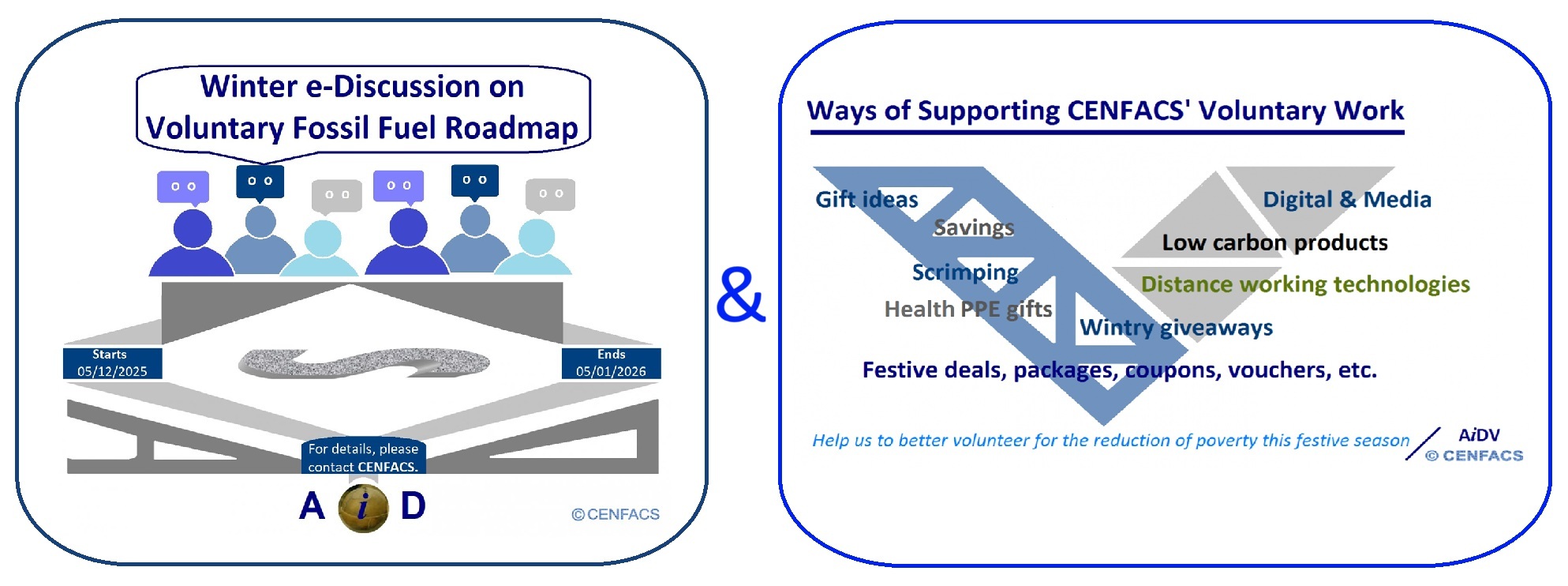
Our e-discussion continues with the following matters:
√ How the creation of roadmap would support planning and investment for our Africa-based Sister Organisations working on energy transition;
√ The building and developing a momentum towards clear energy
√ The kind of energy transition needed in Africa to improve health outcomes and economic resilience
√ Practical steps to disinvest from fossil fuels
√ Strategies for reinvesting into cleaner energy sources
√ How our Africa-based Sister Organisations can set up their own energy transition roadmap
√ How these organisations can finance their voluntary energy transition programmes and projects
Etc.
While our Winter e-discussion is going on, we are asking for support for CENFACS’ All in Development Volunteer Scheme (AiDVS). This is because there is a link between a discussion on voluntary energy transition (here voluntary transition from fossil fuels) and support to volunteers.

• • The Link between Winter e-discussion on Voluntary Fossil Fuel Roadmap and Support to Volunteers
Volunteers (here All in Development Volunteers) are key drivers and a fundamental asset of community-led energy initiatives. They are key players in any efforts of a voluntary transition to sustainable energy, including in inputting elements to the roadmap for that transition to happen.
Their role in terms of this link can be found at different levels of work for voluntary energy transition and the design of the roadmap for this transition. In particular. it can be found at the levels below.
~ Initiation and delivery: Many of community energy projects run by CENFACS’ Africa-based Sister Organizations (ASOs) are initiated, developed, and delivered by committed volunteers.
~ Community engagement and trust: Volunteers act as ‘trusted intermediaries’ engaging people who might otherwise be excluded or passive in the transition process. Their local roots and personal contacts foster the trust necessary for wider community buy-in and participation.
~ Social benefits: Besides energy outcomes, our Winter e-discussion would touch on social benefits through volunteering; benefits like addressing energy or fuel poverty, creating local jobs and skills training, and building stronger community resilience.
~ Sustainability of efforts: Relevant support to volunteers – including funding resources and guidance – is key for a voluntary fossil fuel roadmap. Without this support, the valuable asset of volunteers can be jeopardized.
So, supporting volunteers, here CENFACS’ All in Development Volunteers, and their scheme is a necessary investment to enable and sustain the people-driven process of a voluntary energy transition (here transition from fossil fuel energies), including the roadmap or plan for this transition to materialize.
• • Supporting All in Development Volunteer Scheme (AiDVS)
It is possible to support CENFACS and its AiDVS from wherever you are (at home, work, away, online, abroad, on the go and move, etc.). Supporting us does not need to be magical and majestic. It can be in any thing or means that can advance the work of AiDVS.
Your support will help us to support others who need support during this festive time.
One can still enjoy a great festive season while supporting us to support others.
There are many simple helpful and useful ways of adding great value to our voluntary work.
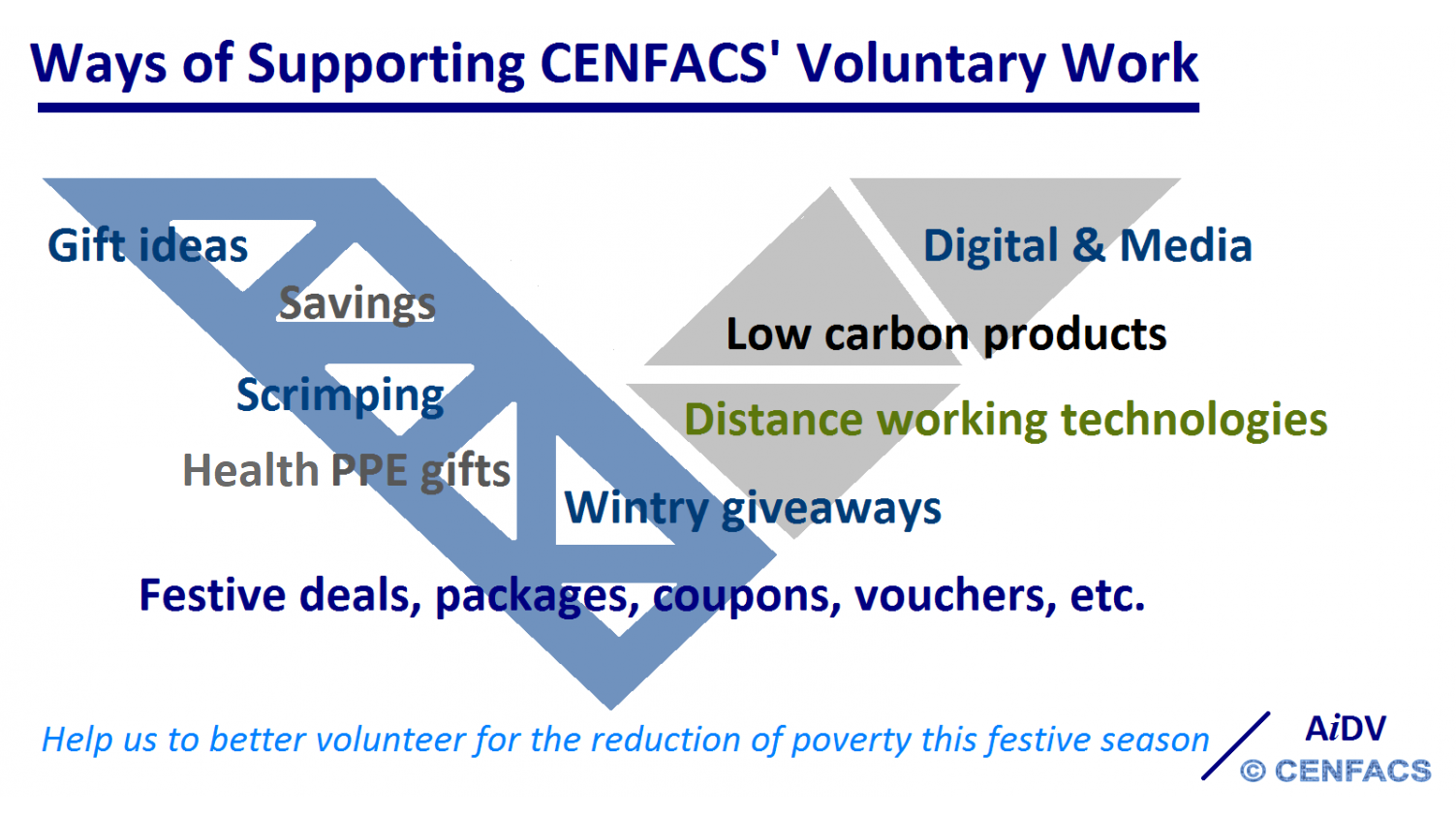
Here are 12-themed enhancers or ways of adding great value to CENFACS’ AiDVS:
1) Gift ideas for the best ways of monitoring, evaluating and reviewing projects and programmes in the New Year
They could include project management software, books and guides, evaluation tools, digital gadgets, free subscriptions to journals and publications, etc.
2) Money-saving and scrimping tips from scrimpers for AiDVS
Tips from seasonal scrimpers could be on budgeting wisely (to track expenses and set limits), grocery savings (e.g., donate coupons), reduction of utility bills, financial tools (like cashback apps), smart shopping, etc.
3) Festive deals and packages for AiDVS
For instance, one can offer New Year’s Eve Packages, discount codes and offers (seasonal discounts, package deals, early booking deals, etc.)
4) Festive free coupons, promo codes and vouchers for AiDVS
They include free vouchers from popular retailers or brands, percentage price off orders and saving on selected items, which can help AiDVS save on their holiday shopping.
5) Net-zero or low carbon economic products to protect the environment and nature
To name the few, we can mention energy-efficient appliances, renewable energy products, eco-friendly products, water-saving devices, sustainable food choices, waste reduction solutions, etc.
6) Digital and media support to better volunteer for a climate neutral and sustainable world
Options include online platforms and courses, digital tools for activism, volunteer matching platforms, youth engagement, etc.
7) Health and safety gifts for healthy and safe volunteering in the New Year
These gifts can include aid kits, personal protective equipment, hydration and nutrition, comfort and ergonomics, health and wellness, safety training and resources, emergency preparedness, etc. These gifts will help volunteers stay healthy and safe for their well-being and the success of their efforts.
8) Wintry and festive giveaways to volunteer for a net zero greenhouse gas emissions world
To illustrate, we can mention free products, gift cards, free tickets, etc.
9) Generative Artificial Intelligence volunteering tools to improve the efficiency of volunteering
Tools include personalised volunteer matching programme, automated consumption, content generation, data analysis and insights, training and onboarding, resource allocation, feedback and evaluation.
10) Festive price bundling for flexible volunteering
Ideas for bundling offers can include volunteer packages, discounted event tickets, gift cards and vouchers, free products and services, recognition and rewards, and flexible volunteering options.
11) Distance working and gift technologies
Amongst the examples, we can name cloud technology, volunteer management software, apps, virtual volunteering tools, apps for remote volunteering, virtual volunteer tools, gift technology for volunteers (e-gift cards, virtual recognition, tech gadgets, tablets, laptops, etc.)
12) Net-zero energy saving products to volunteer
We can mention home energy efficiency since many of our AiDVS work from home, renewable solutions, transportation (e.g., e-bikes), sustainable products, energy monitoring tools, etc.
The above-mentioned enhancers will contribute to streamline volunteer management processes, enhance volunteer satisfaction, and support a net-zero greenhouse gas emissions world.
The enhancers – which could be wintry and festive news, information and products – will assist volunteers (that is, short-term, episodic, regular, ongoing and virtual volunteers) to better help out CENFACS’ noble and beautiful cause of poverty reduction.
They will also assist in recruiting and easily managing volunteers while improving volunteer experience and the effectiveness of our work on poverty reduction.
Additionally, they will contribute in tracking volunteers and their work.
For instance, gift technologies could enable to automate volunteers’ tasks to free up resources and time as well as increase volunteer engagement in our poverty reduction work.
To support AiDVS with your wintry or festive gift, please do not hesitate to contact CENFACS.
To e-discuss Voluntary Fossil Fuel Roadmap, please communicate with CENFACS.
• Restoration Year and Project: Impact Monitoring and Evaluation
At the start of 2025, we dedicated 2025 as a Year of Restoration within CENFACS (1), a year of using the notion of restoration as tool to understand paradigmatic change in the lives of those in need, particularly the CENFACS Community members. It would be a year of working with them as they would be restoring things in their lives so that they could reduce poverty.
In this work with them, one should understand that restoration does not necessarily lead to change. Yet, what we wanted to achieve together with them was restoration that could lead to better change, not status quo.
To deliver this dedication, we set up a Restoration Project.
• • What Is Restoration Project or ‘R‘ Project?
It is a series or set of interconnected tasks or activities planned for the execution of CENFACS’ dedication of year 2025 as of Restoration. These tasks or activities, which aimed at reducing poverty, would be undertaken throughout 2025 within the requirements and limitations of CENFACS’ existing and acquirable resources and assets.
Through this project, we hoped to continue to help reduce poverty by working with project beneficiaries as they move through and out of poverty. It may be difficult or even impossible to repair the planet. But, we thought it was possible to conduct restorative activities to help reduce poverty linked to ecosystem degradation.
Throughout the year, we have carried out restorative activities which have been mainly based on the allocation of resources to meet the outcomes of those in need – through repair of the damaged nature and/or past experiences – while reflecting biodiversity outcomes or the provision of ecosystem goods and services and respecting the subsistence of livelihoods.
In this respect, the ‘R‘ Project was designed to accompany project beneficiaries in their restoration or restorative efforts. The ‘R‘ Project has activities and tasks (or 12 Restoration Project episodes).
• • Activities and Tasks Relating to the ‘R’ Project
A number of activities and processes has been conducted each month to enable smooth implementation of the project. We planned twelve specific activities/tasks (or 12 Restoration Project episodes), one activity or task every month. Through this project and each task, we have tried as much as we could to identify the restoration activities and skills to poverty reduction generally and on a particular area of poverty reduction (e.g., humanitarian or overseas development matters).
We have been working to find things or factors that would help in restoration so that they could positively contribute to the same goal of relieving need hardship and distress amongst our community members throughout our dedicated year. Last week, we announced the last activity or episode of the Restoration Project, while carrying out impact monitoring and evaluation of the same project.
• • Continuing Impact Monitoring and Evaluating the ‘R’ Project
This week, we are continuing the process of looking back what happened in the last 11 months until now. This is our impact monitoring task. In this task, we are tracking, reviewing, and regulating the process and performance of the ‘R’ Project to ensure if it has met its aim according to its plan.
Equally, it is worth to start the task of evaluating the Restoration Year and Project. This evaluation involves gathering data to help understand the way the project was designed, how the dedication and project were implemented, and the results from this implementation. Evaluation is a cycle or process. We may not finish this evaluation by the end 2025, but it is better to start now and continue it in January 2026 if we do not finish.
The two exercises (i.e., monitoring and evaluation) will enable to inform any interested parties (e.g., project beneficiaries, supporters, our audiences, etc.) the findings about what we did not know and we now know about the needs and aspirations of the people in need making our community. These monitoring and evaluative exercises would also lay ground to seize the early impacts or outputs from the delivery of the Restoration Year/Project.
From these exercises – monitoring, evaluative information and knowledge – and other discoveries within the project, we can plan the kinds of appropriate responses we may develop or ways of working together with project beneficiaries in 2026 to meet those unmet needs and demands.
In order to impact monitor and evaluate the Restoration (R) Project, it is essential to have a theory of change for accountability and reporting to stakeholders. We had this theory before starting this Restoration project. The theory of change developed here is the causal chain or a description of a succession or chain of elements and causal connections between them.
For example, one could look at any of the 12 activities/tasks (or 12 Restoration Project episodes) and check how they were connected to find out if there were inputs, outputs, outcomes and impacts which each element led to the next.
The Impact Monitoring and Evaluation (IME) will provide the two results below.
On the one hand, the IME will tell if there has been transition in terms of:
~ attitudinal change, that is whether or not the ‘R‘ project has allowed to draw attention, affect awareness, attitudes and perceptions of the poor
~ procedural change, that is changes in way poor people decide their matters
~ behaviour change, that is changes in behaviour in poor people.
On the other hand, we can evaluate if the activities (e.g., negotiation, advocacy, skills development, etc.) conducted to make restoration to happen.
To conduct impact monitoring and evaluation, it requires the contribution of everybody who took part or came across these activities.
• • How Can You Help or Get Involved in the Impact Monitoring and Evaluation Processes of the ‘R’ Project?
As part of this Impact Monitoring and Evaluation exercise, we would like to ask to those who have been working with us throughout the last 11 months and two weeks to share with us their feelings and thoughts about these two areas:
(a) The overall “Restoration Year/Project”
(b) Any of the activities/tasks they have been interested in or used to work with those in need to restore things or lives.
You can share your feelings and thoughts with us by:
∝ Phoning
∝ Texting
∝ E-mailing
∝ Completing the contact form with your feelings and thoughts.
• • Supporting the Findings from the ‘R’ Project
Impact monitoring and evaluation are not an end for themselves. After concluding them, there will be some findings in terms of knowledge of poor people’s needs. There will be some suggestions or proposals in terms of project planning and development. In other words, these findings could mean that we may have to take some steps forward in terms project planning and development in the New Year.
If there are new projects to meet those unmet needs within the community, how can one support those findings or emerging new project proposals?
For those who are willing to support those findings and projects stemming from those findings, they can be reassured that we are willing to share the findings with them.
To request the findings from the 12 Restoration Project episodes, please contact CENFACS.
To support projects that may result from these findings, please let CENFACS know.
Message in English-French (Message en Anglais-Français)
• CENFACS’ be.Africa Forum E-discusses Gambling Laws and Poverty Reduction in Africa
This e-discussion is about the pros and cons arguments on a unified lottery regulation (that is, a single, universal limit on ticket value) in Africa, compared to a non-unified situation where regulations and limits for lottery sales vary according to African countries. The e-discussion, which falls under the scope of Africa Continental Free Trade Area (AfCFTA), is an extension of the work we are carrying under our Matching Organization-Investor Programme. The current work under this programme is about Matching Organisation-Investor via a Small Lottery Scheme in Africa.
It is known that a unified set of gambling laws across Africa does not currently exist, as regulation is country-specific and often fragmented.
There are those who think that having a unified regulation can have positive effects, as they believe such regulation will improve consumer protection, increase African governments’ revenue, reduce corruption, and provide a certain stability for Licensed Operators.
On the contrary, there are those argue that there are limitations and negative sides which include the extractive feature of gambling as it is not creative, the targets are vulnerable populations, social harms often offset economic gains, etc. They also emphasize that the gambling industry as such is not a viable strategy for substantial sustainable poverty reduction.
Between these lines of argument (between the pros and cons ones), CENFACS’ be.Africa Forum is exploring the circumstances under which a rapprochement between gambling laws can positively impact poverty reduction in Africa.
The above thought on gambling laws and their effects of poverty reduction in Africa provides materials and space for reflection, expression, discussion and action.
Those who may be interested in reflection, expression, discussion and action on a rapprochement of gambling laws for further poverty reduction in the context of AfCFTA can join our poverty reduction pundits and/or contribute by contacting CENFACS’ be.Africa Forum, which is a forum or space for discussion on poverty reduction and sustainable development issues in Africa and which acts on behalf of its members by making proposals or ideas for actions for a better Africa.
To contact CENFACS about this discussion, please use our usual contact address on this website.
• Le Forum ‘Une Afrique Meilleure’ de CENFACS discute en ligne sur Les Lois sur les Jeux d’Argent et la Réduction de la Pauvreté en Afrique
Cette discussion en ligne porte sur les arguments pour et contre une réglementation unifiée de la loterie (c’est-à-dire une limite unique et universelle de la valeur des billets) en Afrique, par rapport à une situation non unifiée où les réglementations et limites pour la vente de loteries varient selon les pays africains. La discussion en ligne, qui relève du champ de l’Accord de Libre-Échange Continental Africain (ZLECAf), est une extension du travail que nous menons dans le cadre de notre Programme de Mise en Relation Organisation-Investisseur/se. Le travail actuel dans le cadre de ce programme concerne la mise en relation Organisation-Investisseur/se via un Petit Schéma de Loterie en Afrique.
Il est reconnu qu’un ensemble unifié de lois sur les jeux d’argent à travers l’Afrique n’existe pas actuellement, car la réglementation est spécifique à chaque pays et souvent fragmentée.
Certain(e)s estiment qu’une réglementation unifiée pourrait avoir des effets positifs, car ils/elles pensent qu’une telle réglementation améliorerait la protection des consommateurs/rices, augmenterait les recettes des gouvernements africains, réduirait la corruption et offrirait une certaine stabilité aux opérateurs/rices agréé(e)s.
Au contraire, certain(e)s soutiennent qu’il existe des limites et des aspects négatifs, notamment le caractère extractif du jeu puisqu’il n’est pas créatif, que les cibles sont des populations vulnérables, que les dommages sociaux compensent souvent les gains économiques, etc. Ils/elles soulignent également que l’industrie du jeu, en tant que telle, n’est pas une stratégie viable pour une réduction substantielle et durable de la pauvreté.
Entre ces lignes d’argumentation (entre les avantages et les inconvénients), le Forum ‘Une Afrique Meilleure’ de CENFACS explore les circonstances dans lesquelles un rapprochement entre les lois sur le jeu pourrait avoir un impact positif sur la réduction de la pauvreté en Afrique.
La réflexion ci-dessus sur les lois sur les jeux d’argent et leurs effets sur la réduction de la pauvreté en Afrique fournit des matériaux et un espace pour la réflexion, l’expression, la discussion et l’action.
Ceux ou celles qui pourraient être intéressé(e)s par la réflexion, l’expression, la discussion et l’action sur un rapprochement des lois sur les jeux de hasard pour une réduction supplémentaire de la pauvreté dans le contexte de l’ZLECAf peuvent rejoindre nos experts en réduction de la pauvreté et/ou contribuer en contactant le ‘me.Afrique’ du CENFACS (ou le Forum ‘Une Afrique Meilleure’ de CENFACS), qui est un forum ou espace de discussion sur les questions de réduction de la pauvreté et de développement durable en Afrique et qui agit au nom de ses membres en faisant des propositions ou des idées d’actions pour une Afrique meilleure.
Pour contacter le CENFACS au sujet de cette discussion, veuillez utiliser nos coordonnées habituelles sur ce site Web.
Main Development
• Matching Organisation-Investor via a Small Lottery Scheme – In Focus from Monday 08/12/2025: Activity 2 Consisting of Matching Investee’s Operation and Monitoring Stage with Investor’s Implementation and Operation Phase
The two sides (i.e., ASCOC/investee and investor) of the matching talks have their respective files ready to start the second Activity. The investee (ASCOC) would argue about the contents of Operation and Monitoring file, while the n-f-p impact investor has its Implementation and Operation file to check if there is an alignment with ASCOC’s contents.
To approach this second stage/phase of negotiation, we have organized our notes around the following points:
σ Matching Talk Terms
σ ASCOC’s or Investee’s Perspective and Key Actions Regarding Operation and Monitoring
σ Not-for-profit Impact Investor’s Consideration Concerning Implementation and Operation Phase
σ Reaching an Agreement on the Key Areas of Investee’s Operation and Monitoring Stage with Investor’s Implementation and Operation Phase
σ The Match or Fit Test Service
σ Impact Advice to ASCOC and Guidance to n-f-p Impact Investor
σ The Rule of the Matching Game
σ CENFACS as a Matchmaker
σ CENFACS’ Hub for Testing Hypotheses
Let us look at each of these points.
• • Matching Talk Terms
There are three key terms that need explanation. These terms are operation, monitoring and implementation. Let us explain them.
• • • Operation
The word ‘operation’ can be defined in many ways. One of its definitions comes from ‘pmstudycircle.com’ (2) which states that
“Operations are ongoing, repetitive tasks that sustain a product or service. They rely on established procedures and consistently produce the same result. The team follows routines and focuses on efficiency rather than innovation”.
If one refers to this definition of operations, one may argue that ASCOC needs to clarify its operations or SLS process management, the operation budget, as well as explain how it will produce its repetitive results. If ASCOC will employ volunteers, it can argue that volunteers will handle the ticketing process.
ASCOC can also explain that it will use Key Performance Indicators (KPIs) to track its strategic, financial and operational performance. In terms of operational KPIs, it can focus on short-term objectives and daily performance metrics (like Average Service Response that tracks how quickly customer support replies to requests).
Furthermore, it can elucidate how this operation will continue as long as the lottery machine/service is needed.
• • • Monitoring
Monitoring can be approached in various ways. One of its approaches comes from ‘plane.so’ (3) which argues that
“Project monitoring is the process of tracking, reviewing, and regulating the process and performance of a project to ensure it stays on course and meets the objectives outlined in the project plan”.
The same ‘plane.co’ adds that
“It involves collecting data on various aspects of the project, such as tasks, timelines, budget, and quality, comparing actual performance against the planned milestones”.
ASCOC needs to explain how it intends to monitor the SLS. It can justify that it will regularly review the SLS’ status, track the KPIs and assess the quality of deliverables. It can also clarify the key components of SLS monitoring system, which will include the following:
~ Performance tracking and measurement (by using metrics like task completion rates, time spent, budget consumption, quality standards, etc.)
~ Schedule monitoring (to ensure that the SLS will progress according to its timeline)
~ Budget monitoring and cost control (which will involve tracking actual spending against SLS budget)
~ Risk monitoring and mitigation (which will involve continuously assessing known risks and identifying new ones as SLS progresses)
~ Quality control (to ensure that the SLS deliverables meet the required quality standards)
~ Stakeholder communications and reporting (to ensure stakeholders remain aligned with SLS aim and objectives, and their expectations will be managed throughout the SLS lifecycle).
ASCOC can prioritize the aspects of the SLS to monitor, while backing these aspects with a monitoring planner. What is a monitoring planner?
According to ‘therrc.co.uk’ (4),
“A monitoring planner consists of a table with a series of headers where you fill in the monitoring details for each of your project objectives”.
Having the monitoring planner and the key components of SLS monitoring system ready, this places ASCOC in better position to negotiate the SLS investment terms.
• • • Implementation
Project implementation is one of the steps in project cycle. According to ‘projectmanagertemplate.com (5),
“Project implementation refers to the process of executing planned activities to achieve a project’s objectives. This phase includes mobilizing resources, managing tasks, and monitoring progress to ensure successful project completion”.
The same ‘projectmanagertemplate.com’ adds that
“Project implementation is a critical phase in project management where plans turn into reality. This stage involves executing the strategies, deploying resources and ensuring that objectives are met efficiently”.
There are steps in project implementation, which are: planning the implementation process, assigning responsibilities, deploying resources, executing the plan, monitoring and controlling, and closing the project.
The n-f-p impact investor will use its understanding of project implementation and what we have said above to scrutinize ASCOC’s plan for implementing the SLS.
• • ASCOC’s or Investee’s Perspective and Key Actions Regarding Operation and Monitoring
At this second stage, ASCOC will focus on the following key actions: performance monitoring, stakeholder management, risk management, and ongoing financial oversight.
Let us briefly explain these actions.
~ Performance monitoring: A small lottery is defined by ticket sales and annual limits, making consistent monitoring essential. Consequently, ASCOC will prepare itself to review regular reports on the lottery’s performance including ticket sales, expenses, and net proceeds.
~ Stakeholder management: ASCOC will plan to keep track of key stakeholders to ensure the project stays on track. ASCOC will ensure that the n-f-p impact investor will be meeting agreed upon targets.
~ Risk management: This will involve continuous oversight of the SLS’s risks, including compliance failures or lower-than-expected results.
~ Ongoing financial oversight: ASCOC will ensure that SLS returns are submitted to the licensing authority where the SLS will be implemented within the required timeframe, and that financial transparency will be maintained.
ASCOC will be expected to demonstrate that it has well prepared its project operation and monitoring to be able to negotiate on solid footing and better terms for SLS.
• • Not-for-profit Impact Investor’s Consideration Concerning Implementation and Operation Phase
In this second stage, the Not-for-profit (n-f-p) Impact Investor will focus on the performance monitoring, risk management, financial oversight, and expansion strategy. These considerations can be summarized as follows.
Concerning the performance monitoring, the n-f-p impact investor will consider keeping close eye on key performance indicators (such as ticket sales, revenue, and draw dates to ensure the project stays on track). Regular performance reports are essential for evaluating the success of the investment.
Regarding risk management, the n-f-p impact investor would like to be assured that operational risks to be identified (like poor marketing execution, decline in ticket sales, administrative errors, etc.) in the first phase will continue to be monitored.
With respect to financial oversight, the n-f-p impact investor wants to be informed on the ways cash flows, expenses, and prize payouts will be tracked. He/she will be keen to know if the SLS will operate within budget and will be profitable. As a result, he/she may require regular financial audits to guarantee funds are being correctly managed.
As far as expansion strategy is concerned, the n-f-p impact investor will look at the evaluation of opportunities for growth based on performance data, as he/she may consider provide more funding if the size of the prize fund increases and there is expansion into new markets.
In short, the n-f-p impact investor will check the above-mentioned elements forming the implementation and operation phase to ensure that ASCOC’s trustees carefully thought about the SLS in such a way that the interests and mission of their charity are preserved and they will minimize any emerging risks to their charity.
The n-f-p impact investor and ASCOC need to reach an agreement on this second activity of the matching talks.
• • Reaching an Agreement on the Key Areas of Investee’s Operation and Monitoring Stage with Investor’s Implementation and Operation Phase
The two sides (ASCOC and the n-f-p impact investor) need to reach an agreement on the contents of ASCOC’s Operation and Monitoring Stage and n-f-p impact investor’s Implementation and Operation Phase.
• • • Reaching an Agreement on SLS Operation
In order to reach an agreement, the negotiating points between ASCOC (investee) and n-f-p impact investor regarding project operations will revolve around control reporting and risk management. The key is balancing the n-f-p impact investor’s need for oversight with ASCOC’s necessity for operational autonomy to efficiently run the SLS.
Regarding the operational control and decision making, the n-f-p impact investor would like the following:
~ to appoint a board member or at least to have an observer seat to gain insight into the SLS’s performance and strategy
~ to have voting rights and vote powers on certain decisions
~ to have a say (approval requirement) on certain management decisions
~ to voice its opinion on hiring and or firing key SLS executives
etc.
Concerning reporting and communication, the n-f-p impact investor wants to
~ negotiate the right to receive regular reports on financial and operational matters
~ agree the frequency and detail of updates
~ have access to information linked to audits, in particular to be granted the right to audit SLS books and records or visit the SLS when it is operational
etc.
As to financial operations, the n-f-p impact investor asks for
~ clear guidelines about the SLS’s desire to reinvest capital for SLS growth
~ to be involved in the budgeting and financial planning
etc.
Briefly speaking, reaching an agreement on SLS operation is about finding the right balance between the n-f-p impact investor’s protection and operational flexibility for ASCOC.
• • • Reaching an Agreement on SLS Monitoring
The key negotiating points to reach an agreement on SLS monitoring will include those listed below.
Scope and frequency of reporting: Both ASCOC and the n-f-p impact investor need to agree on specific reporting frequency (e.g., weekly email updates or monthly financial statements) and the precise metrics to be used.
Type and detail of information provided: Both ASCOC and the n-f-p impact investor will establish formal confidentiality agreements and clear protocols for information exchange.
Investor access and involvement: The negotiating outcome could be the definition of access rights (such as observer seats at board meetings), the conditions and frequency of site visits, and the process for engaging external experts.
Definition of key performance indicators and milestones: Both ASCOC and the n-f-p impact investor can reach a joint agreement on specific and measurable KPIs, performance benchmarks, and a process for addressing potential scope changes or missed milestones.
Remedial actions and escalation: Both ASCOC and the n-f-p impact will be in a position to agree if they could agree predetermined procedures for addressing issues.
In short, to reach an agreement on SLS monitoring, the focus will be on balancing the n-f-p impact investor’s requirement for transparency and risk mitigation with ASCOC’s need for operational autonomy and efficiency.
• • • Reaching an Agreement on SLS Implementation
To reach an agreement on SLS implementation, the negotiating points below can be considered.
Governance and control: The n-f-p impact investor wants representation on the board composition (board of directors) to keep an eye on operations and management, voting power linked to its shares and specific matters that will require ASCOC’s approval, and a certain level of passive or active role.
Funding and financials: Both sides can agree staggered investments (or progressive release of funds) or milestone-based funding depending on SLS milestones or performance metrics, as well as the use of proceeds on the way invested funds will be used.
Project execution and reporting: Both parties will agree negotiating clear and detailed project workplans. They can also agree on the frequency and detail of financial and technical reports, as well as the performance standards and monitoring terms which will include clear metrics for success and monitoring the SLS’s progress.
Risk management and exit: Both parties will agree ways of addressing SLS risks (like market volatility, regulatory changes, etc.), dealing with events of default (e.g., breach of contracts) and remedies to the non-defaulting party. Likewise, both parties can decide the terms and timeline for the n-f-p impact investor can exit the project.
To sum up, to reach an agreement on SLS implementation, their negotiations will revolve around control, funding release, reporting, risk allocation, and exit strategy.
If there is a disagreement between ASCOC and n-f-p impact investor, this could open up the possibility for a match/fit test. The match/fit test can be carried out to try to help the two sides of the matching process. The match/fit test can also be undertaken if there is a disagreement on any of aspects of the SLS.
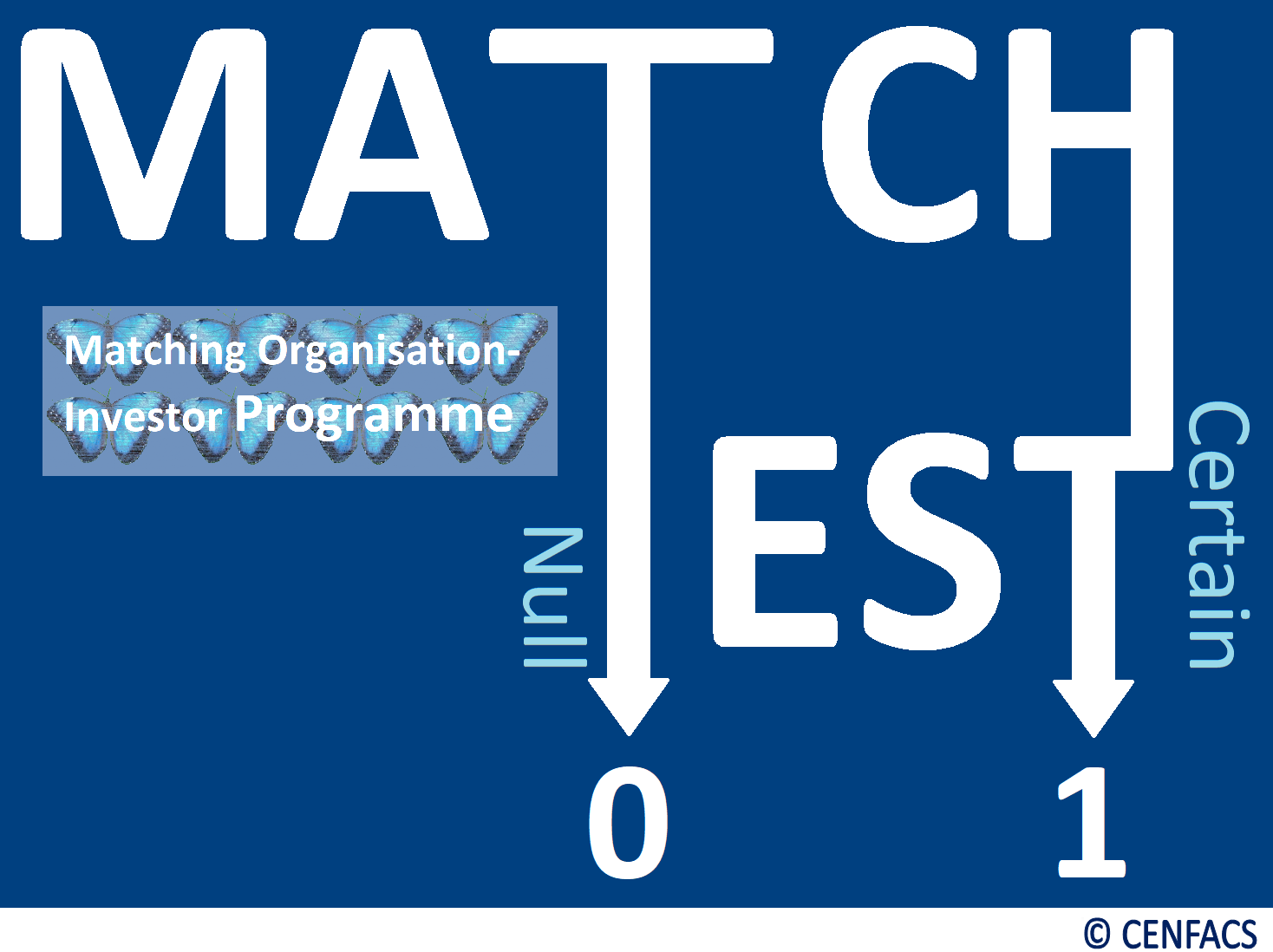
• • The Match or Fit Test Service
As part of the match or fit test, the contents of ASCO’s Operation and Monitoring Stage must be matched with n-f-p impact investor’s view on Implementation and Operation Phase.
The match test (or matched sampling) will help to increase the accuracy and statistical efficiency of the study of the SLS by carefully selecting subjects for comparison. The purpose here will be to increase the statistical efficiency of the study on SLS by controlling for confounding variables when forming a sample.
The fit test will assist in determining how well the observed sample data matches a specified theoretical distribution. The fit test will check if the data collected fits a model or an assumed population distribution. So, the purpose of the fit test is to validate or invalidate the statistical model by checking if the sample data follows an expected distribution.
The match can be perfect or close (that is, when every unit is paired with an equivalent unit) in order to reach an agreement. If there is a huge or glaring difference between the two (i.e., between what the impact investor’s approach to Implementation and Operation Stage and what ASCOC is saying about its Operation and Monitoring Stage, between what the investor would like the Operation and Monitoring Stage to indicate and what ASCOC’s Operation and Monitoring Stage is really saying), the probability or chance of having an agreement at this Second round of negotiations could be null or uncertain.
• • Impact Advice to ASCOC and Guidance to n-f-p Impact Investor
Where there could be a disagreement, CENFACS can impact advise ASCOC to improve the contents of its Operation and Monitoring Stage. CENFACS can as well guide n-f-p impact investors with impact to work out their expectations in terms of Implementation and Operation Phase to a format that can be agreeable by potential ASCOCs.
CENFACS’ impact advice for ASCOCs and guidance on impact investing for n-f-p impact investor, which are impartial, will help each of them (i.e., investee and investor) to make informed decisions and to reduce or avoid the likelihood of any significant losses or misunderstandings or mismatches.
• • The Rule of the Matching Game
The rule of the game is the more impact investors are attracted by ASCOCs’ Operation and Monitoring Stage the better for ASCOCs. It means that ASCOCs’ process must pass the attractiveness test (that is, the evaluation of market’s appeal). Likewise, the more ASCOCs can successfully respond to impact investors’ level of enquiries and queries about the SLS the better for investors. In this respect, the matching game needs to be a win-win one to benefit both players (i.e., investee and investor).
The above is the second Activity of the Matching Organisation-Investor via SLS.
Those potential organisations seeking investment to set up a SLS and n-f-p lottery investors looking for organisations that are interested in their giving, they can contact CENFACS to be their matchmaker to find their perfect investee or investor.
• • CENFACS as a Matchmaker
As a Matchmaker, CENFACS can streamline your search process, save time, money and resources to help you find the perfect match in the world of impact investing.
CENFACS platform will help facilitate the matching process between investees and investors. By leveraging the power of AI tools, CENFACS’ Matching Organisation-Investor Programme can streamline the search process for funding opportunities, connecting African charities and impact investors/funders.
Briefly speaking, CENFACS can work with matching applicants and use AI to match organizations with the right impact investors, filtering profiles based on development stages, sectors, and aims.
In this matching process, CENFACS can arrange the match or fit test for them. They can have their fit test carried out by CENFACS’ Hub for Testing Hypotheses.
• • CENFACS’ Hub for Testing Hypotheses
The Hub can help use analysis tools to test assumptions and determine how likely something is within a given standard of accuracy. The Hub, which can serve as a learning or reference place for those who would like to understand and apply statistical hypothesis testing, can assist to
√ clean, merge and prepare micro-data sources for testing, modelling and analysis
√ conduct data management and administration
√ carry out regression analysis, estimate and test hypotheses
√ interpret and analyse patterns or trends or insights in data or results.
In this respect, CENFACS’ H-tests Hub is knowledge repository designed to demystify the process of using data to make informed decisions and move beyond intuition and guesswork.
Those who would like to apply hypothesis testing in fields of economic development or to deal with poverty reduction, they are welcome to use CENFACS’ H-tests Hub.
For any queries and/or enquiries about this second stage/phase/activity of Matching Organisation-Investor via SLS, please do not hesitate to contact CENFACS.
_________
• References
(1) cenfacs.org.uk/2025/01/08/2025-light-seasons-resources-projects-and-programmes/ (accessed in December 2025)
(2) https://pmstudycircle.com/project-vs-operation (accessed in December 2025)
(3) https://plane.so/blog/what-is-project-monitoring (accessed in December 2025)
(4) https://www.therrc.co.uk/monitoring-planner (accessed in December 2025)
(5) https://www.projectmanagertemplate.com/post/what-is-project-implementation-a-complete-guide (accessed in December 2025)
_________
• Help CENFACS Keep the Poverty Relief Work Going This Year
We do our work on a very small budget and on a voluntary basis. Making a donation will show us you value our work and support CENFACS’ work, which is currently offered as a free service.
One could also consider a recurring donation to CENFACS in the future.
Additionally, we would like to inform you that planned gifting is always an option for giving at CENFACS. Likewise, CENFACS accepts matching gifts from companies running a gift-matching programme.
Donate to support CENFACS!
FOR ONLY £1, YOU CAN SUPPORT CENFACS AND CENFACS’ NOBLE AND BEAUTIFUL CAUSES OF POVERTY REDUCTION.
JUST GO TO: Support Causes – (cenfacs.org.uk)
Thank you for visiting CENFACS website and reading this post.
Thank you as well to those who made or make comments about our weekly posts.
We look forward to receiving your regular visits and continuing support until the end of 2025 and beyond.
With many thanks.