Welcome to CENFACS’ Online Diary!
11 March 2026
Post No. 447

The Week’s Contents
• Matching Organisation-Investor via a Sustainable Water Project – Activity 3 (from 11 to 17/03/2026): Matching Organisation’s Project Design and Action Planning with Not-for-profit Impact Investor’s Project Financing and Capital Allocation
• Climate Action 2 – In Focus from 09 to 15/03/2026: Advocate for Science-based Policies
• Activity/Task 3 of the “A” Project: Replace High-emission Systems with Low-carbon, Sustainable Alternatives
… And much more!

Key Messages
• Matching Organisation-Investor via a Sustainable Water Project –
Activity 3 (from 11 to 17/03/2026): Matching Organisation’s Project Design and Action Planning with Not-for-profit Impact Investor’s Project Financing and Capital Allocation
Both African Charity Investee (ACI)/Africa-based Sister Charitable Organisation (ASCO) and Not-for-profit (NFP) Impact Investor scored enough points in the Second Activity of the Matching Organisation-Investor via a Sustainable Water Project. They managed to overcome the stumbling block which was revolving around conceptual design for ACI/ASCO and technical design for NFP Impact Investor. They aligned their positions as ACI/ASCO agreed and will commit to translate the idea of SWP into a viable technical roadmap that will satisfy the NFP Impact Investor demands for risk mitigation, scalability, and market readiness. To that effect, ACI/ASCO will employ a number of strategies (such as aligning with investment milestones, conducting rigorous technical due diligence, and utilizing prototyping) to validate technical feasibility. They would like to continue their talks and move to the third round of negotiations, which is Activity 3.
This third round of talks consists of agreeing on Project Design and Action Planning to be presented by ACI/ASCO, and on Project Financing and Capital Allocation to be argued by the NFP Impact Investor before the start of any water works that deem necessary for the Sustainable Water Project (SWP).
Regarding the Project Design and Action Planning to be presented by ACI/ASCO, Project Design will be about establishing SWP’s goals, structure, and overall plan before execution begins while Action Planning will show how ACI/ASCO will translate it into a business plan.
Concerning Project Financing and Capital Allocation, Project Financing will be about the funds or capital to be raised for SWP and to be provided by NFP Impact Investor whereas Capital Allocation will be about how capital is distributed within ACI/ASCO and how will it be for SWP.
Both ACI/ASCO and NFP Impact Investor would like to reach an agreement through Project Design and Action Planning for ACI/ASCO and Project Financing and Capital Allocation for the NFP Impact Investor. In other words, they need to align their positions. Aligning ACI’s/ASCO’s Project Design and Action Planning with NFP Impact Investor‘s Project Financing and Capital Allocation involves creating a milestone-based, transparent framework where capital is released in stages upon the achievement of verifiable, agreed-upon technical and water poverty-relieving targets. This alignment will turn capital or funds received or raised into investment-related actions by bridging the gap between SWP strategic goals, project management, and SWP reporting.
To reach an agreement, each side of this Activity 3 needs to clarify what they are offering in the negotiation to meet the matching terms and conditions. If this Activity 3 is successful, they will move to the next activity – Activity 4. Where the two (i.e., investee and investor) need support, CENFACS will work with each party to fill the gap.
More about Activity 3 can be found under the Main Development section of this post.
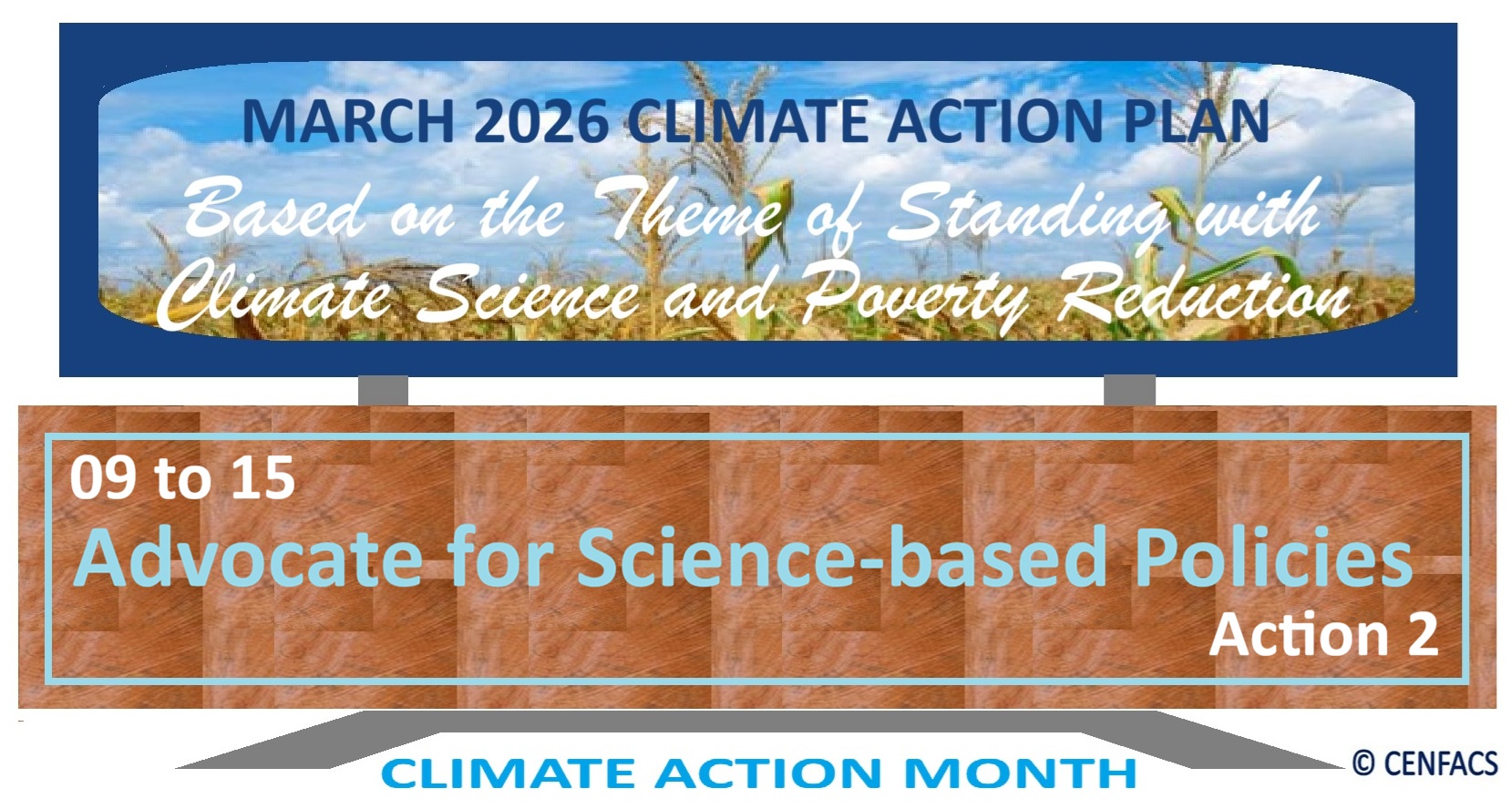
• Climate Action 2 – In Focus from 09 to 15/03/2026: Advocate for Science-based Policies and the Reduction of Climate Poverty
This Second Climate Action is Advocating for Science-based Policies. Advocating for Science-based Policies is essential for reducing climate risks and accelerating the transition to low-carbon and resilient economy. It ensures that policies are effective, reducing the chance of investing in suboptimal or ineffective solutions. Also, such advocacy helps build trust in both government and scientific institutions.
In order to take this action, we are going to cover the following points:
~ What is climate advocacy?
~ What is a science-based climate policy?
~ The links between Advocating for Science-based Policies and Climate Poverty Reduction
~ Working with CENFACS Community members to advocate for science-based climate policies.
Let us uncover each of these headings.
• • What Is Climate Advocacy?
The meaning of climate advocacy used here comes from ‘meegle.com’ (1) which explains that
“Climate advocacy refers to the concerted efforts to influence public opinion, policy decisions, and industry practices towards sustainable environmental stewardship. It encompasses a wide range of activities aimed at raising awareness about climate change, promoting environmental policies, and encouraging sustainable practices at the individual and organizational levels. At its core, climate advocacy seeks to bridge the gap between scientific understanding and actionable change, empowering communities and stakeholders to take meaningful steps towards reducing their carbon footprint”.
Climate advocacy is part of some the works we do within CENFACS, notably with our initiative known as Climate Protection and Stake for African Children; initiative which features the Climate Action Month within CENFACS.
• • What Is a Science-based Climate Policy?
On the website ‘corpgov.law.harvard.edu’ (2), it is stated that
“Science-based policy aligns policy efforts with the latest climate science to limit global average temperature increase to 1.5°C above pre-industrial levels, with immediate and rapid emissions reductions in every sector of the economy, halving emissions by 2030 and achieving ‘net-zero’ emissions in the US and other industrialized nations by 2050 at the latest”.
Our Climate Action 2 falls within the scope of this statement.
• • The Links between Advocating for Science-based Policies and Climate Poverty Reduction
Advocating for science-based policies and reducing climate-driven poverty are deeply interconnected, as the most vulnerable populations often bear the heaviest and direct burden of adverse climate change. Science-based policies provide the evidence necessary to create targeted and effective strategies that simultaneously mitigate environmental damage, foster sustainable development, and build resilience in low-income communities.
Science-based policies can help…
# Identify risks of climate change
# Develop ‘triple win’ solutions (i.e., reducing emissions, enhancing resilience to climate change, and promoting economic development)
# Create inclusive green economies
# Prevent ‘lock-in’ to vulnerability or fossil fuel dependence
# Strengthen resilience by reducing both poverty and climate vulnerability.
So, Advocating for Science-based Policies can ensure that climate action is not just an environmental imperative, but a direct and effective strategy for eradicating poverty.
• • Working with the Community on Advocating for Science-based Policies
The all-purpose of writing this note is to guide our action. In other words, what is key here is to take action. The note is only a guided principle.
Working with our members to advocate for science-based climate policies can be done by bridging the gap between complex climate science and actionable, locale or mission-aligned steps. This will involve the following:
# Educating and building capacity of our members on the links between climate change and CENFACS’ mission (this can be done via workshops, raising awareness, newsletter information and advice, etc.)
# Providing or signposting them to training (e.g., carbon literacy training) for political advocacy
# Leveraging digital tools to organize collective action
# Mobilizing members for action (e.g., digital mobilization) to combat misinformation
# Co-creating and engaging together through community events
# Collaborating and networking to share resources
Etc.
We can work together with them to transform their passive support into active, informed and effective advocacy that drives both community-level and structural climate action.
Those members of our community in the UK and Africa-based Sister Organisations willing to work with CENFACS on Advocating for Science-based Policies as well as on Climate Poverty Reduction; they can take climate actions with us.
For any queries or enquiries about Climate Action 2 and Climate Actions Month, please do not hesitate to contact CENFACS.

• Activity/Task 3 of the “A” Project: Replace High-emission Systems with Low-carbon, Sustainable Alternatives
Both Year of Alternatives and Climate Action Month within CENFACS have some relationships. Their relationships can be explained through the link between climate action and alternatives.
Indeed, climate action and alternatives are linked by the need to replace high-emission systems (like fossil fuels) with low carbon and sustainable options (such as renewable energy, ethical consumption, and active green travel) to reduce emissions, improve public health, and drive economic, social and environmental benefits. These alternatives often provide eco-benefits – positive impacts beyond climate, such reduced poverty, better air quality, and stronger ecosystems.
There are many usage examples of Replacing High-emission Systems with Low-carbon, Sustainable Alternatives, like the following ones:
~ Replacing coal and oil with solar, wind, or nuclear power
~ Switching to plant-based diets, reducing energy consumption, buying ethical products
~ Restoring wetlands and forests as natural carbon sinks rather than relying solely on engineered solutions.
The above makes up Activity/Task 3 of the “A” Project.
• • What Does This Activity/Task 3 of the “A” Project Consist of?
It involves transforming infrastructure to rely on renewable energy, improving energy efficiency, and shifting from fossil fuels (e.g., coal, oil, gas) to cleaner alternatives. These changes do not happen by themselves or by chance. An engagement is required.
• • Engaging with Activity/Task 3 of the “A” Project
To engage with it, there are both individual and organizational actions. By focusing on individual actions, the following ones can be taken:
~ Adopting renewable energy sources
~ Enhancing energy efficiency
~ Leveraging circular economic practices to reduce, reuse, and recycle materials.
Those who would like to engage with this Activity/Task can go ahead with it.
For those who need some help before embarking on this Activity/Task, they can speak to CENFACS.
For any other queries and enquiries about the ‘A’ Project and this year’s dedication, please contact CENFACS as well.

Extra Messages
• AI-powered Financial Tracking, Monitoring and Controls for Households’ Financial Capacity and Capability Building Experiences – In Focus on Wednesday 11/03/2026: Fraud Detection
• All-Year-Round Projects Lifecycle – Step/Workshop 4: Appraising Your Play, Run and Vote Projects; and Integrating Triple Value Initiatives into Your All-Year-Round Projects Appraisal
• Wednesday 11/03/2026: Key Activity 4 of CENFACS Financial Capacity and Capability Campaign: Financial Tracking Tools and Apps

• AI-powered Financial Tracking, Monitoring and Controls for Households’ Financial Capacity and Capability Building Experiences – In Focus on Wednesday 11/03/2026: Fraud Detection
The third AI-powered financial tracking, monitoring and control tool of our work with households making the CENFACS Community is on Fraud Detection. To start with Fraud Detection, let us first provide its meaning and explain how AI-powered tools and techniques can intervene as part of Fraud Detection and how CENFACS can work with households on it.
• • What Is Fraud Detection?
Fraud Detection can be explained in many ways. According to ‘spiceworks.com’ (3),
“Fraud detection is a process that detects and prevents fraudsters from obtaining money or property through false means. It is a set of activities undertaken to detect and block the attempt of fraudsters from obtaining money or property fraudulently”.
Another definition of Fraud Detection comes from ‘ibm.com’ (4),
“Fraud detection is the process of identifying suspicious activity that indicates criminal theft of money, data or resources might be underway. It is commonly performed by fraud detection software that monitors transaction, applications, APIs and user behaviour”.
Examples of Fraud include credit card theft to investment scams, account takeovers, money laundering, etc.
• • Techniques to Detect Fraudsters
There are many techniques to detect frausters. Among these techniques are data analysis-based techniques and AI (Artificial Intelligence) or AI-based techniques. In these Financial Capacity and Capability Building Experiences for Households, we will consider AI-based fraud detection techniques only.
• • Households’ AI-powered Financial Tools to Detect Fraud
Households can use AI-powered financial tools to detect fraud by leveraging real-time monitoring, behavioural analysis, and automated alerts to catch suspicious activity faster than traditional methods. These tools analyze spending habits, location, and transaction velocity to identify anomalies – such as unusual purchases in a foreign country – and can automatically trigger alerts or freeze amounts to prevent further loss.
Households can implement and use AI-powered fraud detection in a number of ways like the following ones:
a) Real-time Transaction Monitoring and Alerting
Households can implement Instant Anomaly Detection (AI-powered tools monitoring bank accounts and credit cards in real-time), Immediate Notifications (AI can immediately alert households for suspicious transactions), and Account Freezing (AI systems can freeze accounts when high-risk and unusual activity is detected).
b) Behavioural Analytics for Identity Protection
Households can use Behavioural Baselining (AI learns the normal spending habits of household members to identify deviations from these habits), Account Takeover Detection (AI can prevent unauthorized access from login attempt), and Biometrical Verification (AI can use facial recognition or voice patterns to verify identity).
c) Protection against Specific Fraud Types
Households can implement Authorized Push Payment Scams (AI can monitor for signs of coercion), Credi Card Fraud (AI can analyze transaction patterns to detect stolen card usage), and Phishing Detection (AI can analyze email and chat messages to identify phishing attempts).
d) Implementing and Using Tools
Households can instead implement and use Fintech Apps and Bank Toos (Households can enable the features of these apps and tools to protect them), Third-party AI Tools (Specialized tools like Sift or Feedzai can also be used), and Data Integration (Households can link their financial accounts – bank, credit cards and investment – to a central AI-powered tracking tool).
By implement and using the above-mentioned AI-powered tools, households can continuously track, monitor, and control their finances and accounts.
• • Working with Households on Fraud Detection in Financial Tracking, Monitoring and Controls with AI-powered Tools
CENFACS is not a bank or building society or a financial institution that can provide facilities to its members to detect and protect against fraud. CENFACS can – under some circumstances – work with households through the integration of AI-powered tools to detect fraud in the financial tracking, monitoring and controls of their accounts.
CENFACS can work together with them to enhance the financial management of their accounts, providing them with the necessary support to navigate their financial challenges and achieve their financial goals.
CENFACS can work with them to identify suspicious activity that may result in their money, data or resources being stolen.
CENFACS can encourage them to use these AI-powered and life-saving tools, to move beyond passive budgeting spreadsheets to actively monitoring their financial transactions, to interact with them to prevent overspending and theft, manage debt and optimize savings to reduce poverty as the lack of knowledge about AI-powered tools and capabilities.
For any queries and/or enquiries about Fraud Detection in Financial Tracking, Monitoring and Controls with AI-powered Tools, please do not hesitate to contact CENFACS.
Likewise, those who want further information or clarification about AI-powered Financial Tracking, Monitoring and Controls for Households’ Financial Capacity and Capability Building Experiences; they are welcome to communicate with CENFACS.
In addition, if you have financial planning problems, you can speak to CENFACS so that we can work together on your financial planning needs and help you stay financially stronger.

• All-Year-Round Projects Lifecycle –
Step/Workshop 4: Appraising Your Play, Run and Vote Projects; and Integrating Triple Value Initiatives into Your All-Year-Round Projects Appraisal
To carry out this step/workshop 4, we are going to deal with the two main items of it, which are
a) Appraising Your Play, Run and Vote Projects (4.1)
b) Integrating Triple Value Initiatives into Your All-Year-Round Projects Appraisal (4.2).
• • Appraising an All-Year-Round Project (AYRP)
An AYRP Appraisal is a continuous and ongoing process of assessing a project’s viability, performance, and strategic alignment throughout its entire lifecycle, rather than just at the beginning.
While traditional appraisal often happens once before a project starts (pre-feasibility) or once after it ends (post-mortem), an all-year-round approach ensures that the project remains aligned with your goals, stays within budget, and meets its objectives as circumstances change.
The key components of your AYRP Appraisal will include ongoing monitoring and evaluation, formative evaluation, and re-forecasting and alignment.
Techniques to be used in this case will be regular milestones review, real-time dashboards, key stakeholder check-ins, financial and operational re-evaluation.
In short, AYRP Appraisal transforms the process from a passive, one-off bureaucratic exercise into an active and strategic project management tool.
• • • Appraising Your Play, Run and Vote Projects
It is about assessing the feasibility, viability and potential impact of a proposed project. It means that an all-year-round project user will proceed with the following:
identify the project, screen it, scope it, analyse its market, technically study it as feasible, assess its financial viability and its economic impact, analyse risks, examine environmental and social impact and report its appraisal.
Because All-year Round Projects are such small and practical initiatives, there is a need to simplify the appraisal relating to it. To simplify the matter, we are going to limit to financial appraisal.
• • • Example of Financial Appraisal: Your Project about Running for Poverty Reduction
Let say you want to run 4 km.
You have two options.
~ Option 1
You could simply dress and get out your home start running without thinking of any financial appraisal.
~ Option 2
You can conduct a basic financial appraisal by asking yourself if you need to buy a bottle of water, a pair of trainers, a clock or watch to time yourself and monitor your health, the frequency of your run activity (e.g., once a week or every particular day of the week), decide whether you want to run alone or as a group or even join a local group of runners where you live, etc.
You can even work out how much it costs to run in open space like a park compared to a close space such as a gym. As part of the costs of running, you could include the costs of a pair of running shoes, appropriate clothes, a watch, earphones, gels, water bottles, etc.
You can as well assess the benefit of running in terms of your health and general wellbeing. The benefits of physically running in terms of health could be improved cardiovascular health, weight management, increase bone density, enhanced mood, stress reduction, etc. The benefits of physically running relating to wellbeing would be an improvement in brain, confidence boost, stress management, mindfulness, etc.
You can even include a fundraising element so that money to be raised through your running hobby goes to good causes such as CENFACS’ noble and beautiful ones. To include this element into your physically running activity, you need to define your goals and narrative, engage your network and friends, and use fundraising ideas (like running in fancy dress).
In this second option, you can carry out more appraisal and come out with a sort of financial plan in terms of basic costs and benefits of running. In project planning terms, it means you have financially appraised Your Project about Running for Poverty Reduction.
Although in the above examples/options we made as it looks like one-off exercise or once-for-all appraisal, one can adopt an AYR approach. Adopting such an approach it will help in improving decision-making process, proactively solving problems, increasing flexibility, as well as providing transparency and accountability.
For those who would like to dive deeper into the appraisal of their Play or Run or Vote project, they should not hesitate to contact CENFACS.
To complete your AYRP Appraisal, one needs to integrate TVIs into it.
• • Integration 4: TVIs into Your AYRP Appraisal
Integrating TVIs – encompassing social, environmental, and economic impact (People, Planet, Prosperity) – into an AYRP Appraisal requires embedding these pillars into the entire project lifecycle rather than treating them as a one-time check. This involves setting measurable goals, using consistent metrics, and engaging stakeholders continuously to ensure long-term value creation.
To integrate TVIs into an AYRP, one needs to follow some steps relating to each phase of project appraisal.
a) Pre-project and Concept Phase
At this phase, one needs to define Triple Bottom Line (i.e., People, Planet, Prosperity) in the project charter and requirement, actively engage stakeholders, and set measurable targets.
b) Appraisal Phase
This is the phase to integrate decision-making by using tools like Local Needs Analysis, embed into procurement (tenders and contracts), and balance priorities.
c) Implementation and Monitoring
It is the phase of tracking social and environmental key performance indicators of your AYRP, adopting frameworks (like Social Value Measurement or Economic-Social-Governance metrics), and creating a steering group.
d) Review and Evaluation
In this phase, an AYRP user will regularly report on their projects, review them against long-term goals, adopt a ‘comply or explain’ approach to ensure transparency in their reporting.
By following these steps, an AYRP user will show that they are taking sustainability seriously in the implementation of their projects.
• • Working with AYRP Users on TVI integration
CENFACS can work with AYRP users to integrate these initiatives into their project tools and lifecycle thinking processes. This will stop these TVIs being ‘add-on’ and enable them become part of the appraisal of their AYRP success.
For those who are not familiar with project appraisal and the integration of Triple Value Model into their AYR project, they should not hesitate to contact CENFACS if they need support.
They can contact CENFACS by
phoning, texting, e-mailing and completing the contact form on this website.
We can together discuss in detail your/their proposals about either your/their Run or Play or Vote projects, as well as the integration of TVIs into these projects.
For any queries and/or enquiries about All-Year-Round Projects Lifecycle and Appraisal as well as about the Integration of Triple Value Initiatives into Project Appraisal, please contact CENFACS.

• Wednesday 11/03/2026: Key Activity 4 of CENFACS Financial Capacity and Capability Campaign: Financial Tracking Tools and Apps
To start this week’s campaign, let us first explain Financial Tracking Tools and Apps for Households, and provide some usage examples of these tools.
• • What Are Financial Tracking Tools and Apps?
Financial Tracking Tools and Apps for Households are digital solutions – apps, software, and spreadsheets – that automate expenses tracking, budget creation, and net worth monitoring by securely linking to bank accounts. In other words, they are digital platforms – like Euna, Plum, and Monzo – that automate personal finance management by connecting to bank accounts to monitor income, categorize expenses, and track savings goals.
They provide real-time insights into spending habits, enabling users/households to create budgets, analyze financial health, and optimize saving and investing, and replacing manual spreadsheets. They help households effectively manage their finances.
There are plenty resources or solutions for households to use depending on household interest and budget.
• • Usage Examples of Financial Tracking Tools and Apps
Among these usages, it is worth mentioning the following ones:
Automated budgeting, savings automation, envelope-style budgeting, net worth and investment tracking, manual tracking or spreadsheets.
Within these usages, there are particular financial tools.
For instance, for a household wanting to automate their budget, they can use apps like Emma or Monarch Money sync with bank accounts to automatically categorize their spending and allow them to track expenses against set monthly limits.
In this campaign, the focus is on modern financial tools, like the following:
# Open Banking Integration: Securely connects to bank accounts for real-time transaction updates
# AI-powered Insights: There are apps that provide personalized suggestions to save money and reduce spending (e.g., Snoop)
# Joint Account Functionality: Allows a couple to track share household expenses
# Goal Setting: Helps track progress towards savings, debt repayment, or investment targets.
To find the right tools and apps to track their finances, households need to consider their features, usability, cost and security. This campaign is about working with them to make the right choice for the right tool and apps.
Those may be interested in this Key Activity 4 and need some Financial Tracking Tools and Apps, they can contact CENFACS.
Those who have any queries and/or enquiries about 2026 Financial Capacity and Capability Campaign, they can also communicate with CENFACS.

Message in French (Message en français)
• Objectif du Mois : Réduction de la Pauvreté Écologique
Pour comprendre cet objectif, laissez-nous vous l’expliquer.
• • Qu’est-ce que la pauvreté écologique ?
Dans les travaux sur la pauvreté, la pauvreté écologique désigne une situation où des communautés humaines sont piégées dans la pauvreté en raison d’un environnement dégradé, caractérisé par un manque de ressources naturelles essentielles telles que l’eau potable, les terres fertiles et la biodiversité. Il s’agit souvent d’un cercle vicieux où la dégradation de l’environnement freine la croissance économique, entraînant une raréfaction accrue des ressources. La pauvreté écologique se manifeste par un manque de besoins fondamentaux comme l’accès à une alimentation saine, à des soins de santé adéquats et à un environnement sain.
Les populations peuvent se retrouver prises au piège de la pauvreté écologique, situation dans laquelle les régions à faibles revenus, aux ressources biologiques épuisées, n’ont plus les moyens d’importer des ressources, ce qui entraîne un déclin économique et environnemental continu.
Pourtant, la pauvreté écologique, tout comme le piège de la pauvreté écologique, peut être réduite. C’est notre objectif pour le Mois de l’Action Climatique – mars 2026.
• • Réduire la pauvreté écologique
Réduire le manque d’accès aux ressources naturelles propres et la vulnérabilité à la dégradation de l’environnement exige d’intégrer le développement durable aux efforts de réduction de la pauvreté, notamment par la promotion des emplois verts, l’investissement dans les énergies renouvelables et le renforcement de la résilience climatique des communautés vulnérables. Parmi les stratégies pouvant servir à cette fin figurent la gestion durable et localisée des ressources, la réduction de la consommation à fortes émissions et la transition vers une économie circulaire. Ces stratégies peuvent contribuer à atteindre l’objectif du mois.
• • Implications du choix de l’objectif du mois
Après avoir choisi l’objectif du mois, nous concentrons nos efforts et notre attention sur celui-ci en veillant à l’appliquer concrètement dans notre vie quotidienne. Nous attendons également de nos donateurs/rices qu’ils/elles s’engagent pour cet objectif en y contribuant et en soutenant les personnes susceptibles de souffrir du type de pauvreté lié à l’objectif du mois (par exemple, mars 2026).
Pour plus d’informations sur l’objectif du mois, sa procédure de sélection, les moyens de le soutenir et comment y contribuer, veuillez contacter le CENFACS.

Main Development
• Matching Organisation-Investor via a Sustainable Water Project –
Activity 3 (from 11 to 17/03/2026): Matching Organisation’s Project Design and Action Planning with Not-for-profit Impact Investor’s Project Financing and Capital Allocation
This third round of talks consists of agreeing on Project Design and Action Planning to be presented by ACI/ASCO, and on Project Financing and Capital Allocation to be argued by the NFP Impact Investor before the start of any water works that deem necessary for the Sustainable Water Project (SWP).
Regarding the Project Design and Action Planning to be presented by ACI/ASCO, Project Design will involve establishing SWP’s goals, structure, and overall plan before execution begins while Action Planning will show how ACI/ASCO will translate this planning into a business plan.
Concerning Project Financing and Capital Allocation, Project Financing will be about the funds or capital to be raised for SWP and to be provided by NFP Impact Investor whereas Capital Allocation will be about how capital is distributed within ACI/ASCO and how will it be for SWP.
To summarise what is going to happen at the level of this Activity 3, we have organised our notes around the following headings:
σ Activity 3 Matching Concepts
σ Africa-based Sister Charitable Organisation’s Project Design and Action Planning (PD & AP)
σ Not-for-profit Impact Investor’s Project Financing and Capital Allocation (PF & CA)
σ Reaching an Agreement
σ The Match or Fit Test.
Let us look at each of these headings.
• • Activity 2 Matching Concepts
There are four key concepts making this Activity 3, which are: project design, action planning, project financing, and capital allocation.
Concerning design, both ACI/ASCO and NFP Impact Investor sorted their difference on it in Activity 2 when the former argued for conceptual design and the latter for technical design. Consequently, ACI/ASCO will simply speak about project design in this Activity 3.
Let us now explain the four concepts.
• • • Project Design
Project design can be approached from various ways. The website ‘asana.com’ (5) argues that
“Project design is an early phase of the project lifecycle where ideas, processes, resources, and deliverables are planned out. A project design comes before a project plan, as it is a broad overview whereas a project plan includes more detailed information”.
Approaching it from the perspective of project management, ‘plaky.com’ (6) explains that
“Design in project management refers to establishing the project’s goals, structure, and overall plan before the execution begins”.
The same ‘plaky.com’ adds that
“The required elements of project design can vary depending on the project scope, nature, and complexity, but the following core ingredients are generally present in most cases: Project goals, Stakeholder identification, Resource planning, Timeline and milestones, Risk management plan, and monitoring approval”.
These approaches to project design will be included in the matching talks.
• • • Action Planning
The definition used here for action planning comes from ‘england.nhs.uk’ (7) which argues that
“Action planning is the process that guides the day-to-day activities of an organisation or project. It is the process of planning what needs to be done, when it needs to be done, by whom it needs to be done, and what resources or inputs are needed to do it. It is the process of operationalizing your strategic objectives. That is why it is also called operational planning when an action plan or an operational plan are presented as the basis for a funding proposal, or for a loan application, or to get others to buy into a process or project in some way, they are referred to as business plan”.
Various elements of this definition of action planning will be featured in the negotiating talks between ACI/ASCO and NFP Impact Investor.
• • • Project Financing
The definition of financing is given by ‘thefreedictionary.com’ (8) which states that
“Financing is the act of providing or raising funds or capital, or funds or capital provided by investors or lenders”.
Talking about project finance, the website ‘pw.live’ (9) goes further by arguing that
“At its core, project finance is the arrangement of financing based on the projected cash flows of a particular project, rather than the balance sheet of the project sponsor. The project is structured as a separate legal entity, a special purpose vehicle, which is responsible solely for the project’s development, construction, and operation. Lenders look primarily to the project’s future revenue as the source of repayment, with project assets and contracts serving as collateral”.
Types of project financing include debt financing, equity financing, funding, crowdfunding, sponsorship, venture capital, etc. In the SWP, what ACI/ASCO is looking is funding or crowdfunding.
There are metrics that are used to deal with project finance for charity which can be employed in matching negotiations. These metrics focus on measuring the financial sustainability, efficiency and impact of specific and time-bound initiatives rather than just the overall organisation. Among these metrics, it is worth mentioning these below:
Fundraising Return on Investment, Programme Expense Ratio, Cost Per Beneficiary, Restricted versus Unrestricted Funding Ratio, etc.
In the context of the SWP, ACI/ASCO can monitor these metrics by using a dashboard and take data-driven decisions on the SWP.
• • • Capital allocation
To explain capital allocation, we can refer to its definition in the context of not-for-profit organisations as provided by ‘fastercapital.com’ (10). According to the latter,
“Capital allocation refers to the strategic distribution of resources across various initiatives, programmes, and activities to achieve the maximum return on investment (ROI). This involves balancing the need for equity, growth, and continuity with limited financial resources, making it an essential aspect of any nonprofit’s financial management strategy”.
Capital allocation also involves directing financial resources towards projects, programmes, or investments that maximize social impact while maintaining financial sustainability.
There are metrics to deal with charity capital allocation which can be used in these matching talks; metrics which are:
a) Financial Health and Efficiency Metrics (FHEMs)
FHEMs ensure that the charity has the capacity to operate and is using funds effectively. Amongst these metrics, we can mention the following ones:
Programme Efficiency Ratio, Working Capital divided by Reserve Ratio, Fundraising Efficiency, Revenue Reliability divided by Composition, Cash Flow from Operations, Liabilities to Assets Ratio, etc.
b) Investment and Asset Management Metrics (IAMMs)
IAMMs will be useful for ACI/ASCO if the latter has endowments or long-term investments. Among IAMMs, we can retain these ones below:
Total Return on Investment, Inflation-adjusted Returns, Sharpe Ratio, Cash-on-Hand by Liquidity Ratio, Asset Allocation, etc.
c) Impact and Performance Metrics (IPMs)
IPMs help allocate capital to the most effective programmes. Examples of IPMs are as follows:
Cost-Effectiveness, Programme Expense Growth, Donor Retention Ratio, Impact Return, etc.
ACI/ASCO can use the above-mentioned metrics to create its Investment Policy Statement.
• • Africa-based Sister Charitable Organisation’s Project Design and Action Planning (PD & AP)
At this stage, we can go back to Lifecycle Thinking Tools as explained by Jennifer R. McConville and James R. Miheleic (11) to state that PD & AP uncover logistical constraints that affect the feasibility of the selected design. PD & AP stage is also of finalisation of the details for the technical design and implementation plan.
Concerning PD, ACI/ASCO needs to create the best possible project design to increase its chance of winning any NFP Impact Investor. It is required to have clear, measurable social and environmental key performance indicators, and map them directly to the NFP Impact Investor‘s financial risk and impact goals. It also has to adopt blended finance models, use impact reporting to demonstrate accountability, and integrate ESG (Environmental, Social and Governance) criteria into the SWP design.
For instance, ACI’s/ASCO’s project design can follow the steps recommended by ‘charityvillage.com’ (12), which are:
Step 1: Conduct a needs assessment
Step 2: Conduct a stakeholder analysis
Step 3: Conduct a problem analysis
Step 4: Document project design.
Additionally, ASCO has to demonstrate that it has a project design framework. It can use key metrics for SWP design in Africa, such as water-borne disease incidence, water access and coverage, community ownership and participation, willingness to pay for water, etc.
Regarding AP, ACI’s/ASCO’s action planning is, in fact, a business plan for SWP. ACI/ASCO will need to show how it is going to convert its action planning into a business plan. Its action plan will consist of the following pieces:
A statement (of what must be achieved), a spelling of the steps that have to be followed, a schedule for each step and timing, a clarification of responsibilities and the inputs/resources needed.
ACI/ASCO can as well refer to action planning metrics such as increased access to basic water sanitation, reduced water-related diseases, and improved water-use efficiency. These metrics will show that SWP will focus on enhancing water security (as part of the United Nations Sustainable Development Goal 6), improving infrastructure, and increasing financial investment.
The NFP Impact Investor will study ACI’s/ASCO’s basic model for building up action plan. He/she will look at how ACI/ASCO will translate its action plan into a business plan.
• • Not-for-profit Investor’s Project Financing and Capital Allocation (PF & CA)
The NFP Impact Investor will provide the necessary capital in the form of blending philanthropic grants with social investment to make the project bankable. This involves securing funding not just for the construction of water infrastructure but also for long-term operational costs to ensure the infrastructure does not fall.
As far as PF is concerned, the NFP Impact Investor will study the SWP cash flows, structure, fundraising strategy, future revenue, assets and contracts. He/she can use its capital to de-risk the SWP, making it attractive for further investment while ensuring ACI’s/ASCO’s mission is upheld.
At this stage, there could be a combination of grants and investments through the use of donor-funded grants (from ACI/ASCO) to fund the risky early-stage feasibility studies or initial infrastructures, while impact capital funds the operational phase.
With regards to CA, the NFP Impact Investor will study ACI’s/ASCO’s distribution, re-distribution and investment of financial resources to further its charity objects or mission. He/she will check if this distribution allows ACI/ASCO to build a strong foundation, adapt to changing water market conditions as well as increase its resilience.
In these negotiations, ACI/ASCO needs to demonstrate that its capital allocation will enable this distribution to happen. ACI/ASCO can provide or explain its Investment Policy Statement, aligning capital allocation with ACI’s/ASCO’s mission, risk tolerance and liquidity needs.
• • Reaching an Agreement
Reaching an agreement in the water sector between ACI/ASCO (focused on community impact, water access and water poverty reduction) and NFP Impact Investor (concentrated on sustainable and scalable solutions) requires bridging the gap between grant-based, mission-driven work and market-based financial sustainability. It also means aligning metrics on sustainability. In other words, the NFP Impact Investor requires financial sustainability while ACI/ASCO needs social impact. Both parties should adopt standardized frameworks to measure both social outcomes (water access) and financial results.
They should as well shift from purely charitable and free-water models to sustainable and low-cost user-free models that allow for maintenance and replacement of infrastructure, reducing dependance on foreign aid.
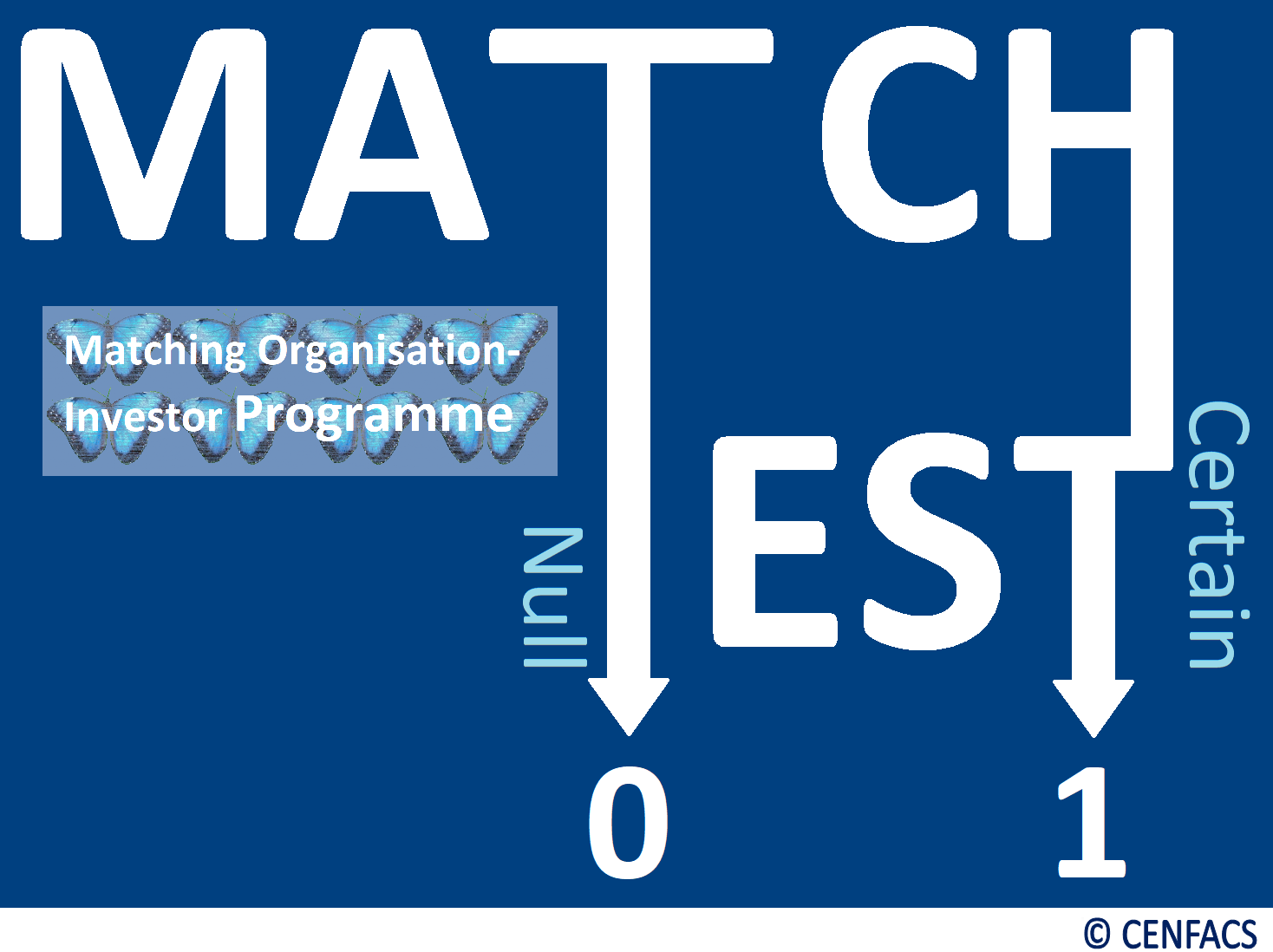
The two sides (ASCO and the NFP Impact Investor) need to reach an agreement on the contents of PD & AP for the former and on those of PF & CA for the latter. If there is a disagreement between ASCO and NFP Impact Investor, this could open up the possibility for a match/fit test. The match/fit test can be carried out to try to help the two sides of the matching process. The match/fit test can also be undertaken if there is a disagreement on any of aspects of SWP.
• • The Match or Fit Test Service
As part of the match or fit test, the contents of ASCO’s PD & AP Stage must be matched with NFP Impact Investor’s view on PF & CA. The match test (or matched sampling) will help to increase the accuracy and statistical efficiency of the study of the SWP by carefully selecting subjects for comparison. The purpose here will be to increase the statistical efficiency of the study on SWP by controlling for confounding variables when forming a sample.
The fit test will assist in determining how well the observed sample data matches a specified theoretical distribution. The fit test will check if the data collected fits a model or an assumed population distribution. So, the purpose of the fit test is to validate or invalidate the statistical model by checking if the sample data follows an expected distribution.
The match can be perfect or close (that is, when every unit is paired with an equivalent unit) in order to reach an agreement. If there is a huge or glaring difference between the two (i.e., between what the NFP Impact Investor’s approach to PD & AP Stage and what ACI/ASCOC is saying about its PD & AP Stage, between what the investor would like the PD & AP Stage to indicate and what ASCO’s PD & AP Stage is really saying), the probability or chance of having an agreement at this Third round of negotiations could be null or uncertain.
• • • Impact Advice to ASCO and Guidance to NFP Impact Investor
Where there could be a disagreement, CENFACS can impact advise ACI/ASCO to improve the contents of its PD & AP Stage. CENFACS can as well guide NFP Impact Investors to work out their expectations in terms of PD & AP Phase to a format that can be agreeable by potential ASCOs.
CENFACS’ impact advice for ASCOs and guidance on impact investing for NFP Impact Investor, which are impartial, will help each of them (i.e., investee and investor) to make informed decisions and to reduce or avoid the likelihood of any significant losses or misunderstandings or mismatches.
• • • The Rule of the Matching Game
The rule of the game is the more impact investors are attracted by ACI’s or ASCOs’ PD & AP Stage the better for ACIs or ASCOs. It means that ACI’s or ASCOs’ process must pass the attractiveness test (that is, the evaluation of market’s appeal). Likewise, the more ACIs or ASCOs can successfully respond to impact investors’ level of enquiries and queries about the SWP the better for investors. In this respect, the matching game needs to be a win-win one to benefit both players (i.e., investee and investor).
The above is the Third Activity of the Matching Organisation-Investor via SWP.
Those potential organisations seeking investment to set up a SWP and NFP Impact Investors looking for organisations that are interested in their giving, they can contact CENFACS to be their matchmaker to find their perfect investee or investor.
• • • CENFACS as a Matchmaker
As a Matchmaker, CENFACS can streamline your search process, save time, money and resources to help you find the perfect match in the world of impact investing.
CENFACS platform will help facilitate the matching process between investees and investors. By leveraging the power of AI tools, CENFACS’ Matching Organisation-Investor Programme can streamline the search process for funding opportunities, connecting African charities and impact investors/funders.
Briefly speaking, CENFACS can work with matching applicants and use AI to match organizations with the right impact investors, filtering profiles based on development stages, sectors, and aims.
In this matching process, CENFACS can arrange the match or fit test for them. They can have their fit test carried out by CENFACS’ Hub for Testing Hypotheses.
• • • CENFACS’ Hub for Testing Hypotheses
The Hub can help use analysis tools to test assumptions and determine how likely something is within a given standard of accuracy. The Hub, which can serve as a learning or reference place for those who would like to understand and apply statistical hypothesis testing, can assist to
√ clean, merge and prepare micro-data sources for testing, modelling and analysis
√ conduct data management and administration
√ carry out regression analysis, estimate and test hypotheses
√ interpret and analyse patterns or trends or insights in data or results.
In this respect, CENFACS’ H-tests Hub is knowledge repository designed to demystify the process of using data to make informed decisions and move beyond intuition and guesswork.
In the current case of Matching Organisation’s Project Design and Action Planning with Not-for-profit Impact Investor’s Project Financing and Capital Allocation, hypotheses can be tested around de-risking, revenue modeling and stakeholder engagement. Key testable hypotheses will focus on whether community-led design, blended finance structures, and sustainable, revenue-generating models (e.g., water kiosks) will attract more capital, improve long-term viability and deliver measurable, sustainable social impact compared to traditional aid models.
Those who would like to apply hypothesis testing in fields of economic development or to deal with poverty reduction, they are welcome to use CENFACS’ H-tests Hub.
For any queries and/or enquiries about this Third Stage (or Phase) Activity of Matching Organisation-Investor via SWP, please do not hesitate to contact CENFACS.
_________
• References
(1) https://www.meegle.com/en_us/topics/carbon/climate-advocacy (accessed in March 2026)
(2) https://corpgov.law.harvard.edu/2020/08/03/blueprint-for-responsible-policy-engagement-on-climate-change/#:~:text=… (accessed in March 2026)
(3) https://www.spiceworks.com/security/what-is-fraud-detection/ (accessed in March 2026)
(4) https://www.ibm.com/think/topics/fraud-detection (accessed in March 2026)
(5) https://asana.com/resources/project-design (accessed in November 2025)
(6) https://plaky.com/blog/project-design/ (accessed in March 2026)
(7) https://www.england.nhs.uk/improvement-hub/wp-content/uploads/sites/44/2018/06/An-Overview-of-Action-Planning.pdf (accessed in March 2026)
(8) https://www.thefreedictionary.com/financing (accessed in March 2026)
(9) https://www.pw.live/finance-courses/exams/project-finance (accessed in March 2026)
(10) https://fastercapital.com/articles/Capital-Allocation-Strategies-for-Nonprofit-Organizations.html (accessed in March 2026)
(11) McConville, J. R. & Miheleic, J. R., (2007), Adapting Lifecycle Thinking Tools to Evaluate Project Sustainability in International Water and Sanitation Development Work, Environmental Engineering Science, Volume 24, Number 7, 2007@Mary Ann Libert, In. DOI: 10.1089/ees.2006.0225
(12) https://resources.charityvillage.com/project-design-a-brief-how-to-guide-for-nonprofits-and-charities/ (accessed in March 2026)
_________
• Help CENFACS Keep the Poverty Relief Work Going This Year
We do our work on a very small budget and on a voluntary basis. Making a donation will show us you value our work and support CENFACS’ work, which is currently offered as a free service.
One could also consider a recurring donation to CENFACS in the future.
Additionally, we would like to inform you that planned gifting is always an option for giving at CENFACS. Likewise, CENFACS accepts matching gifts from companies running a gift-matching programme.
Donate to support CENFACS!
FOR ONLY £1, YOU CAN SUPPORT CENFACS AND CENFACS’ NOBLE AND BEAUTIFUL CAUSES OF POVERTY REDUCTION.
JUST GO TO: Support Causes – (cenfacs.org.uk)
Thank you for visiting CENFACS website and reading this post.
Thank you as well to those who made or make comments about our weekly posts.
We look forward to receiving your regular visits and continuing support until the end of 2026 and beyond.
With many thanks.