Welcome to CENFACS’ Online Diary!
18 February 2026
Post No. 444
The Week’s Contents
• All-Year-Round Projects Lifecycle – Step/Workshop 1: Project Identification and Integration of Triple Value Initiatives into This Project Identification
• Ecological and Biological (EcoBio) Days – In Focus: The Inseparability of Ecological and Biological Issues from Poverty Reduction Efforts
• 2026 Financial Capacity and Capability Campaign
… And much more!
Key Messages
• All-Year-Round Projects Lifecycle – Step/Workshop 1: Project Identification and Integration of Triple Value Initiatives into This Project Identification
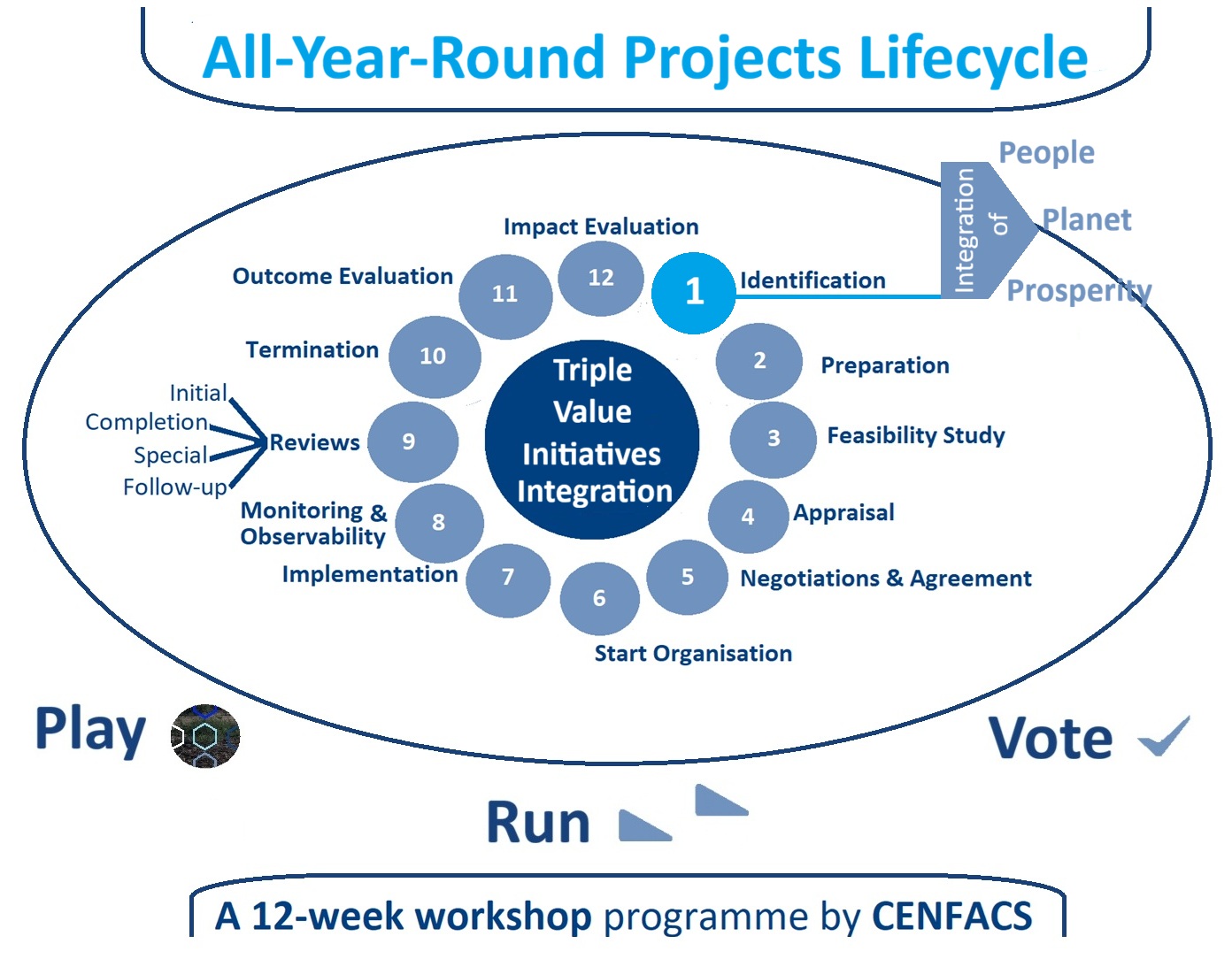
The planning process for All-Year-Round Projects, which is under way, includes the different steps of project lifecycle, which are:
Identification, preparation, feasibility study, appraisal, negotiations and agreement, start, implementation, monitoring and observability, reviews, termination, outcome evaluation and impact evaluation.
These steps of All-Year-Round Projects Lifecycle will be completed in 12 weeks under a 12-week workshop programme. At each of these steps, it is possible to integrate Triple Value (that is, People, Planet and Prosperity) Initiatives.
This week, we are starting with Project Identification as the first step or workshop for our project lifecycle, and the first integration of Triple Value Initiatives into this first step.
• • All-Year-Round Project Identification and the Integration of Triple Value Model into This Identification
• • • All-Year-Round Project (AYRP) Identification
To understand All-Year-Round Project Identification, it is better to start with the meaning of project identification. What is project identification?
Project identification can be defined in various. If we consider the website ‘theintactone.com’ (1), this site explains that
“Project identification is the initial phase in the project management process, where potential projects are recognized and defined based on organisational needs, opportunities, or challenges. It involves identifying problems, goals, or opportunities that warrant attention and align with the organisation’s strategic objectives”.
There is a reason or purpose when one tries to identify a project. The website ‘scribd.com’ (2) provides the purpose of project identification in the following terms:
“The purpose of project identification is to develop a preliminary proposal for the most appropriate set of interventions and course of action, within specific time and budget frames, to address a specific development goal in a particular region or setting.”
The website ‘techno-pm.com’ (3) goes further by giving the stages of project identification, which are initiation, feasibility, project schedule, risk analysis, identification close out, and approval.
It emerges from these three views that project identification is the initial, foundational stage in the project lifecycle that involves identifying, assessing, and selecting the best ideas, needs, or opportunities to solve problems or create value.
However, project identification can be slightly perceived differently in the context of All-Year-Round Projects lifecycle. This is because AYRPs are initiatives or activities to be continuously run throughout the entire year rather than being restricted to a single season, short-term period or specific or temporary or seasonal event. They are designed for longevity, providing consistent engagement, support, and production over a 12-month period.
Because of that, an All-Year-Round Project Identification refers to the continuous, proactive, and systematic process of identifying, scouting, and assessing your Play or Run or Vote projects throughout the entire year, rather than limiting this activity to specific, periodic planning season (like Winter 2026). It involves scanning the internal and external environment to detect needs, problems or opportunities to maintain your Play or Run or Vote project hopper or pipeline. This identification will be supported by the Integration of Triple Value (that is, People, Planet, Prosperity) Initiatives.
• • • The Integration of Triple Value Model into AYRP Identification
Integrating the Triple Value Model into your project identification consists of bringing the Triple Bottom Line (that is, People, Planet, Prosperity or the Value Toolkit’s Social, Environmental, and Economic Value) into project identification. This integration requires shifting from a focus solely on cost or time to a broader assessment of long-term benefits. This approach ensures projects are selected not just for financial viability, but for their positive impact on society and the environment.
In practical terms, each All-Year-Round Project (that is, Play, Run and Vote projects) will contain this Triple Value Model. Likewise, each step of your All-Year-Round Projects Lifecycle needs to reflect the Triple Bottom Line. In the context of this post, the step of project identification will be made with the Triple Value Model.
More on All-Year-Round Project Identification and the Integration of Triple Value Initiatives into it can be found under the Main Development section of this post.

• Ecological and Biological (EcoBio) Days – In Focus: The Inseparability of Ecological and Biological Issues from Poverty Reduction Efforts
This year, CENFACS’ EcoBio Days, which will be held between 23 and 28 February 2026, will be on The Inseparability of Ecological and Biological Issues from Poverty Reduction Efforts.
Indeed, the inseparability of these issues from poverty reduction efforts creates a vicious cycle where environmental degradation accelerates poverty and poverty forces unsustainable exploitation of natural resources.
These issues include climate-related disasters, biodiversity loss, land degradation, and water scarcity, which predominantly affect the 70% of the world’s poor relying on natural resources for their households.
The ecological and biological issues in relation to poverty reduction include the following:
a) Climate change as a threat multiplier
b) Biodiversity loss and ecological degradation
c) Water and food insecurity
d) Health and biological factors
e) The ecological poverty trap.
These issues and their relations with poverty reduction will make our EcoBio Days. Besides that, we shall look at strategies to address the nexus about nature-based solutions, empowering women and the integration of knowledge and new technology like AI.
For further details or to engage with these EcoBio Days, please contact CENFACS.
• 2026 Financial Capacity and Capability Campaign
Financial Capacity and Capability Campaign (FC&CC) is one of CENFACS seasonal initiatives falling within the Season of Light, which is from 21 December in the preceding year (e.g., 2025) to 21 March in the following year (e.g., 2026).
It is also a strategic marketing effort that CENFACS undertakes to align this campaign with the specific time of Winter when supporters’ interest and willingness to give are high. In this respect, it is conceptualised to tap into heightened fundraising activities and emotions associated with the continuation of the giving moments.
Let us further explain it.
• • What Is FC&CC?
To understand FC&CC, it is better to explain financial capacity and financial capability separately.
Indeed, financial capacity is, according to ‘cobrief.app’ (4),
“An individual’s or organisation’s ability to meet financial obligations, such as paying debts, funding operations, or investing in new opportunities”.
As to financial capability, the World Bank (5) argues that
“It is the internal capacity to act in one’s best financial interest, given socioeconomic and environmental conditions. It encompasses the knowledge (literacy), attitudes, skills, and behaviour, of consumers with respect to understanding, selecting, and using financial services, and the ability to access financial services that fit their needs”.
From these two definitions, it can be argued that FC&CC is designed to equip CENFACS Community members and households with the knowledge, skills, confidence, and motivation to manage their money effectively and build financial resilience. FC&CC aims to improve financial wellbeing, reducing stress and anxiety linked to money worries, by helping campaign beneficiaries handle day-to-day finances, plan for the future, and manage unexpected financial difficulties.
• • What Are the Components of FC&CC?
Like for any FC&CC, CENFACS FC&CC is made of the following elements: financial capability, financial capacity, preventative support, and targeted outreach. Let us summarise these components.
a) Financial Capacity
It is about providing resources and access to ensure our members have access to the necessary tools (such as bank accounts) and the ability to effectively use financial services.
b) Financial Capability
It involves working with our members to change financial behaviour and improve skills, like budgeting, saving, understanding credit, and managing debt.
c) Preventative Support
It is about acting early to prevent our members get into financial crises rather than just managing these crises.
d) Targeted Outreach
CENFACS FC&CC is tailored to the most vulnerable members of our community and sister communities who lack both financial capacity and financial capability.
The above-mentioned components will be delivered through a number of activities.
• • CENFACS FC&CC Key Activities
We are going to use the following methods to deliver CENFACS FC&CC: workshops, educational resources, one-to-one guidance, provision of digital tools and apps. Table 1 provides the information about these Key Activities.

• • Wednesday 18/02/2026: CENFACS FC&CC Key Activity 1: Workshop on the Cost-of-living Advice
We are planning to run two workshops: one on the cost-of-living advice and the other on understanding benefits system. The first one is on cost-of-living advice.
The Workshop on the Cost-of-living Advice is about ensuring that participants are receiving enough information about the cost of living and any support relating to it. The workshop will help them to bridge gap in information and knowledge as well as to mobilise the tools and support they need to mitigate the adverse effects of the cost-of-living crisis.
Those may be interested in the workshop, they can contact CENFACS. Those who have any queries and/or enquiries about 2026 Financial Capacity and Capability Campaign, they can also communicate with CENFACS.
Extra Messages
• Graduation and Livelihood Programme 2: Workshop on Skill Training and Technical Support (Wednesday 18/02/2026)
• Week Beginning Monday 16/02/2026 of 2026 Sustainable Development Month – In Focus: Transition Risks to Households Resulting from Biodiversity Loss
• E-discussion on the Benefits of the Win-win Approach in the Context of the Double Transfer of Climate Technology and Finance to Africa

• Graduation and Livelihood Programme 2: Workshop on Skill Training and Technical Support (Wednesday 18/02/2026)
Our work on Economic Inclusion Programme for Households continues with Graduation and Livelihood Programme 2. This Programme 2 will be run as a workshop that will focus on Skill Training and Technical Support that our members are looking for.
To clarify the topic of this Programme 2, let us briefly explain skill training and technical support.
• • What Is Skill Training?
According to Talent LMS (6),
“Skills training is developing specific skills (hard skill or soft skills) for work or any activity through dedicated programmes. In the workplace, skills training is a structured approach to improving specific employee capabilities, directly tied to business objectives. It is a deliberate investment in your human capital’s most valued abilities”.
During the workshop, we shall refer to this definition and other ones to explore how skills training can help participants to graduate from poverty.
• • What Is Technical Support?
Technical support can be explained in various manners. One of its explanations comes from ‘amazingalgorithms.com’ (7), which states that
“Technical Support (Tech Support) refers to assistance provided to users of technology products and services, including troubleshooting hardware and software issues, answering questions, and providing technical guidance. It can be offered through various channels such as phone, email, or online chat”.
Again, during our workshop we shall figure out if participants to the workshop received timely assistance, the downtime was minimized and their experience was optimized.
• • What Is Workshop on Skill Training and Technical Support?
It is a training or learning event that will explore the benefits of skills training and technical support in terms of poverty reduction. The workshop will provide recommendations for actions with options and opportunities for the participants.
• • What Is the Aim of Workshop on Skill Training and Technical Support?
The workshop aims to educate participants about economic inclusion from the perspective of skills training and technical support. In other words, not being trained to acquire the skills one needs to escape from poverty and not having the technical support to operate some types of technology or equipment can keep people in poverty for a long time.
The objective of the workshop is to ensure that participants receive the necessary know-how, experience, and equipment to graduate from poverty.
• • For Whom the Workshop on Skill Training and Technical Support Is for?
The workshop aims at supporting those who require training with the possibility that this training will provide them with the skills they need to graduate from poverty. Those who need in-depth skills and knowledge about the beneficial effects of training and tech support can also participate.
Those who may be interested in the workshop can let CENFACS know.
Those members of the CENFACS Community who would like to get involved in the workshop can contact CENFACS.
For any other queries and or enquiries about this workshop or Economic Inclusion Programme for Households, please communicate with CENFACS.
• Week Beginning Monday 16/02/2026 of 2026 Sustainable Development Month – In Focus: Transition Risks to Households Resulting from Biodiversity Loss
Governments and companies can react to the biodiversity crisis or loss with new regulations and rules. This reaction can impact household savings and wealth. This can lead to transition risks for households.
• • What Are Transition Risks?
There are various definitions on Transition Risks that convey the same meaning. One of these definitions come from the website ‘sustainability-directory.com’ (8) which states that
“Transition risk is the financial risk that arises from the process of adjusting to a low-carbon economy. This includes risks from policy changes (e.g., carbon pricing), technological shifts (e.g., renewable energy replacing fossil fuels), market changes, and reputational shifts”.
Another definition is from ‘wallstreetmojo.com’ (9), which contends that
“Transition risks refer to the risks related to transitioning an economy into a low-carbon economy or embracing changes to withstand climate change”.
From these two definitions, it can be concluded that transition risks are financial and socioeconomic costs that arise as governments, businesses, and society adjust to a nature-positive economy to stop further damage. These risks, similar to the transition costs of climate change, are often driven by policy changes, new technology, or changing consumer habits. These risks are summarised below.
• • Key Transition Risks to Households
They are higher consumer costs, stranded assets and reduced asset values, change in job market and livelihoods, limited access to goods (or consumer shift), increased insurance and financial costs. Let us summarise these costs.
~ Higer consumer costs (felt through inflationary pressure)
As companies are required to pay for their environmental impact, they often pass these costs onto consumers. Similarly, stricter rules on chemical use, water consumption, and land-use change in agriculture could raise the cost of agricultural products and food prices. Additionally, increased regulation on logging and mining may raise the cost of material costs, furniture, and clothing.
~ Stranded assets and reduced asset values
Assets that are highly dependent on degraded natural capital many lose value. For instance, homes or land located in areas that become strictly protected (e.g., wetlands, forests) might face tighter regulations, hindering development or decreasing resale value. Likewise, household savings or pension funds invested in industries with large biodiversity footprints may suffer as those industries face regulating penalties.
~ Changes in job market and livelihoods
Households relying on resource-intensive industries (like extractive ones) may experience financial instability. Households working in sectors like conventional fishing, forestry, or pesticide-intensive farming may face job losses or the need for retraining as sectors transition towards sustainable practices. Sectors heavily dependent on nature (such as tourism, forestry, and fishing) may see rapid declines in employment as resources are depleted.
~ Limited access to goods
As companies phase out products deemed harmful to biodiversity, consumers may have to transition to alternatives, sometimes more expensive or less accessible, sustainable options. Households may end up shifting their consumption from goods and services linked to deforestation.
~ Increased insurance and financial costs
As biodiversity loss leads to higher physical risks, the cost of insuring homes and property will likely and significantly increase, reducing household disposable income.
So, these transition costs could be higher depending on households’ circumstances. What matters for these households could their ability to reduce poverty and hardships linked to transition risks resulting from biodiversity loss or crisis.
• • How CENFACS Can Work with Those in Need of Reducing Poverty Linked to Transition Risks from Biodiversity Loss
CENFACS can work with them to reduce transition risks resulting biodiversity loss, particularly inflationary pressures, the reduction of their assets value, threats to their job or occupational activities, limited access to goods and services, and the reduction of their disposable income. This work will help them reduce poverty linked to transition risks from biodiversity loss.
For those members of our community who may be interested in tackling Transition Risks associated with biodiversity loss, they are free to contact CENFACS.
For any queries or enquiries about Sustainable Development Month and Biodiversity Loss as a Systemic Financial Risk; please also communicate with CENFACS.

• E-discussion on the Benefits of the Win-win Approach in the Context of the Double Transfer of Climate Technology and Finance to Africa
We are continuing to work on issues raised in the 90th Issue of FACS of this Winter 2026. This Issue was/is titled ‘Local African Charities, the Double Transfer (of Climate Technology and Finance) and Poverty Reduction – Approaching Charitable Transfers from a Win-win Perspective’.
One of the issues raised was the benefits of win-win approach regarding finance and technology transfers. We would like to organise an e-discussion to deal with this issue.
This e-discussion or online dialogue will be on…
the benefits of win-win approach for Local African Charities and Multinational Charities in the context of the double transfer of climate technology and climate finance to Africa.
It is about shifting power dynamics and embracing genuine partnership and how they can effectively drive sustainable development and climate resilience in Africa by benefiting all stakeholders.
For those of our members who may have any views or thoughts or even experience to share with regard to this matter, they can join our e-discussion to exchange their views or thoughts or experience with others.
To e-discuss with us and others, please contact CENFACS.

Message in French (Message en français)
• Perspectives 2026 pour l’Investissement à Impact dans le Secteur à But Non Lucratif en Afrique –
Point de Mire : Organisations Caritatives Sœurs et Causes Basées en Afrique Oeuvrant pour l’Énergie Durable et la Réduction de la Précarité Énergétique
L’édition 2026 de Perspectives des Organisations à But Non Lucratif en Afrique en Matière d’Investissement à Impact (POBNLAMII) traite des Organisations et Causes Caritatives Sœurs Basées en Afrique (OCCSBA) travaillant dans le domaine de l’énergie durable. Ces organisations sont à but non lucratif, à mission, opérant localement ou régionalement en Afrique et visant à faciliter l’accès à une énergie abordable, fiable et renouvelable ou à promouvoir le développement social et économique.
L’Édition 2026 de POBNLAMII couvre également les OCCSBA travaillant sur la réduction de la précarité énergétique. Ce second type d’organisations est à but non lucratif, axé sur la communauté ou philanthropique, opérant en Afrique pour atténuer le manque d’accès à des services énergétiques abordables, fiables, durables et modernes.
Les deux types d’organisations (c’est-à-dire celles travaillant sur l’énergie durable et celles traitant de la pauvreté énergétique) composent cette édition 2026 de POBNLAMII. La plupart des organisations couvertes dans l’édition de cette année traiteraient les deux aspects (énergie durable et pauvreté énergétique). Leur travail s’entrecroise ou se rejoint, tout comme il existe des différences clés entre elles en termes de moteur principal, d’objectif, de zone cible et de but.
L’édition 2026 de POBNLAMII fournit leur mission et leur orientation, leur champ opérationnel, leurs actions en tant que générateurs de capacités, etc. Leur travail va au-delà de l’apport de lumière, car elles offrent des solutions énergétiques et de lutte contre la pauvreté de manière holistique.
L’édition 2026 de POBNLAMII inclut des tendances et des analyses sur le travail des OCCSBA en matière d’énergie durable et de réduction de la pauvreté énergétique. Elle fournit également certains domaines sur lesquels se concentrer tout en mettant en évidence les défis auxquels les OCCSBA sont confrontées dans leur travail. Cependant, elle ne traite pas des organismes de financement de l’énergie et des installations, bien que certains des principaux acteurs de l’énergie puissent fournir des fonds pour soutenir l’action locale.
Comme pour les éditions précédentes, l’édition 2026 de POBNLAMII doit être comprise comme une extension du programme d’orientation de CENFACS pour ceux ou celles qui souhaitent investir à but non lucratif à impact en Afrique. L’édition 2026 de POBNLAMII ne remplace cependant pas l’orientation pour investir en Afrique. Elle y ajoute simplement de la valeur.
En raison de sa contribution unique au secteur de l’investissement à but non lucratif, l’édition 2026 de POBNLAMII présente les informations que les investisseur(e)s à but non lucratif pourraient souhaiter, de manière simple mais concise. En particulier, elle met en évidence les types de services offerts par les OCCSBA dans les domaines de l’énergie durable et de la réduction de la précarité énergétique.
Plus d’informations sur l’édition 2026 de POBNLAMII, veuillez contacter le CENFACS.
Main Development
• All-Year-Round Projects Lifecycle –
Step/Workshop 1: Project Identification and Integration of Triple Value Initiatives into This Project Identification
The planning process for All-Year-Round Projects, which is under way, includes the different steps of project lifecycle, which are:
Identification, preparation, feasibility study, appraisal, negotiations and agreement, start, implementation, monitoring and observability, reviews, termination, outcome evaluation and impact evaluation.
These steps of All-Year-Round Projects Lifecycle will be completed in 12 weeks under a 12-week workshop programme. At each of these steps, it is possible to integrate Triple Value (that is, Environmental, Social and Economic Value or People, Planet, Prosperity) Initiatives.
This week, we are starting with Project Identification as the first step or workshop for our project lifecycle, and the first integration of Triple Value Initiatives into this first step. Let us see what potential users of All-Year-Round Projects (AYRPs) can undertake in this first workshop/step and integrate Triple Value Initiatives (TVIs) at each step for each project.
The following sub-headings cover this identification and integration:
σ What Is AYRP Identification? What Is TVI Integration?
σ Workshop 1: Identifying Your Run or Play or Vote Project
σ Integration 1: Integrating Triple Value Initiatives into Your Project Identification
σ Working with AYRP Users to Facilitate TVI Integration.
Let us uncover each of these sub-headings.
• • What Is AYRP Identification? What Is TVI Integration?
AYRPs can be identified and TVIs can be integrated into them.
• • • What is AYRP Identification?
An All-Year-Round Project Identification refers to the continuous, proactive, and systematic process of identifying, scouting, and assessing your Play or Run or Vote projects throughout the entire year, rather than limiting this activity to specific, periodic planning season (like Winter 2026). It involves scanning the internal and external environment to detect needs, problems or opportunities to maintain your Play or Run or Vote project hopper or pipeline.
If we consider each of these projects (that is, Play, Run, and Vote projects), we can explain the identification for each of them as follows:
~ AYRP Identification for Your Play refers to the continuous process of identifying, evaluating, and launching your small, manageable Play or Game-related project throughout the year rather than focusing solely on one long-term, high-risk, multi-year project. This approach helps you as creator or researcher analysing player behaviour – maintain momentum, refine skills, and adapt to feedback without the pressure of a single ‘make-or-break’ release.
~ AYRP Identification of Your Run refers to the continuous process of planning, defining, and selecting running-related goals throughout the entire year rather than setting a single, annual goal. This approach ensures consistent performance, health maintenance, and structured progression in running, such as base building, strength training, and racing.
~ AYRP Identification of Your Vote is a continuous, strategic process of scouting for, evaluating, and matching potential 2026 Poverty Reduction and Development Manager to organisational needs, rather than waiting for a crisis or project kick-off to find someone. It treats project management as a specialised, continuous leadership role rather than an ‘ad-hoc’ assignment based on availability.
These three dimensions of identification will be supported by the integration of Triple Value (that is,People, Planet, Prosperity) Initiatives into them.
• • • What is TVI Integration?
Integrating the Triple Value Model into your project identification consists of bringing the Triple Bottom Line (that is, People, Planet, Prosperity or the Value Toolkit’s Social, Environmental, and Economic Value) into project identification. This integration requires shifting from a focus solely on cost or time to a broader assessment of long-term benefits. This approach ensures projects are selected not just for financial viability, but for their positive impact on society and the environment.
In practical terms, each All-Year-Round Project (that is, Play, Run and Vote projects) will contain this Triple Value Impact. Likewise, each step of your All-Year-Round Projects Lifecycle needs to reflect the Triple Bottom Line.
The following notes on workshop 1 and integration 1 explain how this can be achieved/done.
• • Workshop 1: Identifying Your Run or Play or Vote Project
In this first step of the project lifecycle, those who would like to undertake a Run or Play or Vote activity need to identify their Run or Play or Vote project. What do we mean by that?
They need to develop a preliminary proposal for the most appropriate course of actions, within specific time and budget frames, to say how they are going to achieve the goal of Running or Playing or Voting.
For example, let us take Running. You could say you want to run 4 miles every Friday of the week in the morning in the local park and you plan to spend some few pounds on water bottles to refresh yourself, etc. You could also be specific whether you want to run alone or as a group of people.
This identification will involve the following: review of alternative approaches or options, definition of your project objectives, and identification of major issues.
Let us consider each of the project identification items through the example of Running.
σ Reviewing alternatives approaches or options for addressing any problems with your Running or Playing or Voting activity
For instance, if we take Running, you may consider other options such as swimming, cycling, walking, skipping rope, playing football, etc. You could as well include opportunity cost in the reviewing process of alternative approaches or options (how much it costs to run compared to cycling).
σ Defining the objectives of your Run or Play or Vote project/initiative to justify the resources to be committed
Let take the example of Running. Your objectives could be to improve your cardiovascular health, bone health, mental health, brain function, respiratory function, etc. They could also be to learn other skills while running, achieve personal goals, being flexible, support CENFACS’ all-year-round running project, raise funds for CENFACS noble and beautiful cause of poverty reduction, etc.
σ Identification of any major issues before implementing the Run or Play or Vote project
Let us once more consider Running. You could review issues linked to the consequences of Running and how you are going to resolve them. These issues could be the impact on your body: join pain, muscle strains, back pain, stress fractures, etc. You could also check if the park will be open according to your running plan.
So, it is better to review alternatives approaches or options, define your objectives, and identify any major issues before implementing the Run or Pay or Vote projects.
The above is a basic starting point for project identification. However, identifying your project does not stop there. You need to integrate a Triple Value Initiative into your Running.
• • Integration 1: Integrating Triple Value Initiatives into Your Project Identification
Integrating the Triple Value Initiatives (conceptualised as Triple Bottom Line: People, Planet, Prosperity or the Value Toolkit’s Social, Environmental, and Economic Value) into project identification requires shifting from a focus solely on cost or time to a broader assessment of long-term benefits. This approach ensures projects are selected not just for financial viability, but for their positive impact on society and the environment.
To integrate Triple Value Initiatives into Project Integration, there are steps to follow, which are given below.
• • • Steps to Integrate Triple Value Initiatives into Your Project Identification
Here are the steps.
1) Reframe your AYRP objectives early
Move beyond the ‘Iron Triangle’ by broadening AYRP objectives to include social, environmental, and economic outcomes, not just scope, budget, and time. It implies defining ‘value’ early by utilising frameworks like the Value Toolkit to determine what success looks like in terms of environmental, social, and economic outcomes before detailed planning begins.
2) Identify Triple Value Stakeholders
It is about engaging with adverse range of stakeholders (community, friends, families, colleagues) to understand their needs regarding the social and environmental value. It is also about setting SMART (that is, Specific, Measurable, Achievable, Relevant, and Time-bound) value objectives that cover all the three pillars.
3) Incorporate TVI into feasibility study and not-for-profit case
This involves enhancing the not-for-profit case in the project identification by including a value-based assessment rather than just a cost-benefit analysis. This also implies using a multicriteria analysis that evaluates AYRP option against Triple Value criteria rather than just financial return on investment.
4) Use tools for measuring value
This encompasses the adoption of specialised tools (like the UK’s Social Value Model) which mandate the consideration of social, environmental, and economic factors. It includes as well developing a Benefits Realisation Plan (i.e., creating a plan early to track how your AYRP will deliver these benefits throughout its lifecycle including the post-implementation).
5) Have an alignment with strategy
You need to ensure that your AYRP directly supports the United Nations Sustainable Development Goals. It is also good to have a strategic fit review by foreseeing your long-term vision, social and environmental goals.
6) Process integration
You are required to include environmental and social impacts as mandatory screening questions during the brainstorming (or initial idea generation) of your AYRP. It means including community impact analysis alongside feasibility studies, and prioritising AYRPs that rank high in all three areas of the Triple Value Model.
By integrating these steps, your AYRPs will be designed to deliver not-for-profit value, by creating lasting impact on you, society and the environment.

• • Working with AYRP Users to Facilitate TVI Integration
Integrating Triple Value (that is, Environmental, Social and Economic or People, Planet, Prosperity) Initiatives into project identification with AYRP users requires moving from ‘compliance’ mindset to a ‘value creation’ mentality. Since these users would constantly manage their AYRPs, the key is to make the process simple, rewarding, and integrated into their existing workflow or plan.
To facilitate this integration, one needs to adopt a structured approach which can be expressed as follows:
a) Simplify and reframe the language by avoiding technical jargon (for instance, instead of saying Triple Bottom Line, one could speak about a long-term impact).
This can also be done by
– connecting to AYRP users’ motivation (for example, showing them that environmental savins = energy efficiency = lower costs)
– developing a 3 Value check prompt by integrating a simple mandatory question (like Which environmental, social and economic benefits would your AYRP contribute to?).
b) Embed into existing tools
This embedment can be achieved by updating the project identification through, for instance, adding a checkbox section for sustainability and/or automating prompts (e.g., creating a field for TV contribution for their AYRP).
c) Create ‘Plug-and-Play’ Resources
This approach can consist of developing a decision matrix to help AYRP users assess the potential TV impact of different options.
d) Foster culture and education
TV Model is about continuous education rather than one-off training. It also involves empowering AYRP Champions (e.g., Sustainability Champions).
e) Incentivize and measure
It involves recognizing value over budget (e.g., celebrating AYRP completions that achieved high TV, not just those under budget), showcasing success stories (by sharing impact-driven stories), and aligning performance metrics with success
f) Start early
This implies holding or participating to a value mapping session or a pre-identification workshop.
By working with AYRP users to integrate these initiatives into their tools and thinking processes, this will stop these TVIs being ‘add-on’ and enable them become part of the definition of their AYRP success.
For those who are not familiar with project identification and the integration of Triple Value Model into their AYR project, they should not hesitate to contact CENFACS if they need support.
They can contact CENFACS by
phoning, texting, e-mailing and completing the contact form on this website.
We can together discuss in detail your/their proposals about either your/their Run or Play or Vote projects.
For any queries and/or enquiries about All-Year-Round Projects Lifecycle and Identification as well as about the Integration of Triple Value Initiatives into Project Identification, please contact CENFACS.
_________
• References
(1) https://theintactone.com/2019/pm-u1-topic-1-project-identification (accessed in February 2026)
(2) www.scribd.com/document/833650445/what-is-project-identification (accessed in February 2026)
(3) https://www.techno-pm.com/blogs/project-management-concepts/project-identification (accessed in February 2026)
(4) https://www.cobrief.app/resources/legal-glossary/financial-capacity-overview-definition-and-example/ (accessed in February 2026)
(5) https://documents1.worldbank.org/curated/en/693871468340173654/pdf/807670WPOP14400Box0379820BOOPUBLICO.pdf (accessed in February 2026)
(6) https://www.talentlms.com/blog/skills-training/ (accessed in February 2026)
(7) https://amazingalgorithms.com/definitions/technical-support-tech-support/ (accessed in February 2026)
(8) https://esg.sustainability-directory.com/learn/waht-is-a-transition-risk-and-how-is-modeled-in-a-climate-scenario/ (accessed in February 2026)
(9) https://www.wallstreetmojo.com/transition-risks/ (accessed in February 2026)
_________
• Help CENFACS Keep the Poverty Relief Work Going This Year
We do our work on a very small budget and on a voluntary basis. Making a donation will show us you value our work and support CENFACS’ work, which is currently offered as a free service.
One could also consider a recurring donation to CENFACS in the future.
Additionally, we would like to inform you that planned gifting is always an option for giving at CENFACS. Likewise, CENFACS accepts matching gifts from companies running a gift-matching programme.
Donate to support CENFACS!
FOR ONLY £1, YOU CAN SUPPORT CENFACS AND CENFACS’ NOBLE AND BEAUTIFUL CAUSES OF POVERTY REDUCTION.
JUST GO TO: Support Causes – (cenfacs.org.uk)
Thank you for visiting CENFACS website and reading this post.
Thank you as well to those who made or make comments about our weekly posts.
We look forward to receiving your regular visits and continuing support until the end of 2026 and beyond.
With many thanks.