Welcome to CENFACS’ Online Diary!
14 January 2026
Post No. 439

The Week’s Contents
• 2026 Light Season’s Activities, Projects, Programmes and Resources
• 2026 as a Year of Alternatives
• Giving Alternative and Hope to the Humanitarian Needy of the Border between Burundi and DR Congo in 2026
… And much more!


Key Messages
• 2026 Light Season’s Activities, Projects, Programmes and Resources
Last week, we listed projects and programmes to be carried out in January 2026. This week, we are unveiling more projects and programmes including activities and resources. The last week’s listed projects and the ones to be unveiled below will all make our Light Season 2026. It is better to briefly explain these initiatives making Light Season and their types.
• • What Are 2026 Light Season’s Activities, Projects, Programmes and Resources?
They are initiatives that incorporate light as a theme or tool and designed to tackle poverty during the Season of Light.
The light theme in these poverty reduction initiatives refers to a high-level, foundational area of focus or strategic pillar that guides CENFACS’ work with those in need. It acts as a categorisation for the types of efforts we will be deploying to tackle multifaceted poverty during this Spring 2026.
• • Types of 2026 Initiatives
In both last weeks and this week’s listings, there are three types of initiatives, which are: a) Specifically designed b) Thoughtfully planned c) Seasonal initiatives.
• • • Specifically designed (or strategic) initiatives
They are planned to drive considerable change and create poverty reduction value for beneficiaries and CENFACS. They are focused efforts to be undertaken by CENFACS to develop and achieve clear poverty reduction goals. They align with CENFACS’ overall strategy. They vary in scope and complexity, but all share the common goal of driving significant impact and creating poverty reduction value for beneficiaries and CENFACS.
Amongst the examples of these initiatives are humanitarian appeals which feature CENFACS’ Light Campaign/Advocacy to bring and carry the message of hope through a Blaze of Hope
• • • Thoughtfully planned initiatives
They aim to achieve CENFACS’ strategic objectives while helping to bridge planning and execution. They are meant to be clearly measurable, action-oriented, proactive, and aligned with the overall CENFACS strategy while taking into account the environmental impact of any choices made. In this respect, they express the Energy or Light Season as they enable the shift to renewable energy sources.
• • • Seasonal initiatives
They are those that Just Fall Within the Season of Light, which is from 21 December in the preceding year (e.g., 2025) to 21 March in the following year (e.g., 2026). They are also strategic marketing efforts that CENFACS undertakes to align its campaigns with the specific time of Winter when there is a surge in charitable giving and community engagement, inspired by the themes of light, hope and good will. In this respect, they are conceptualised to tap into heightened fundraising activities and emotions associated with the continuation of the giving moments.
These three types of initiatives (that is, All Specifically Designed, Thoughtfully Planned and Seasonal ones) will help enhance donor engagement, increase funding opportunities and create seamless memorable experience that will resonate with our audience. They will be implemented side by side as we move throughout the Season of Light.
Under the Main Development section of this post, we have provided further details about the 2026 Light Season’s Activities, Projects, Programmes and Resources.

• 2026 as a Year of Alternatives
This year, we will be considering different alternative solutions to poverty and unsustainable development. These different alternative solutions or alternatives will constitute the Year 2026 as of Alternatives.
Indeed, we started with alternatives in 2025 with Alternative Funding Sources (as a result of international/foreign aid cuts), Alternative Economies (like the Social and Solidarity Economy), Alternative Income Streams for Poor Households, and Alternative Climate Technologies and Finance. We are going to continue this process of dealing with alternatives or alternative solutions by linking them to our yearly development calendar. To do that, let us explain the meanings of alternative, 2026 as a Year of Alternatives, and the project attached to this year’s dedication (or ‘Alternatives’ Project or ‘A’ Project).
• • What Is Alternative?
To define alternative, let us refer to its dictionary definition. According to ‘dictionary.cambridge.org’ (1),
“Alternative is something that is different from something else, especially from what is usual, and offering the possibility of choice”.
The same online dictionary adds that
“An alternative plan or method is one that you can use if you do not want to use another one”.
Still the same online dictionary states that
“Alternative solutions refer to different methods or approaches to address a problem or achieve a goal, often differing from conventional or typical methods”.
Taking the same line of reasoning, the website ‘letsupdateskills.com’ (2) argues that
“Alternative refers to a substitute or option that serves as a different choice in various situation. It provides another route or solution when the primary option is not viable, suitable, or preferred”.
Knowing what alternative and alternative solutions are, it is possible to explain the meaning of 2026 as a Year of Alternatives.
• • 2026 as a Year of Alternatives
It is a year of emerging trends in poverty reduction and development, of sometimes challenging established ways of reducing poverty if they became irrelevant or obsolete in today’s and tomorrow’s development landscapes. To make the Year of Alternatives to materialise, it requires meeting three features: innovation, disruption and growth.
Innovation is about finding new ways of doing things as new needs emerge.
Disruption refers to challenging traditional systems that became obsolete and unworkable.
Growth in alternatives implies increasing interest and investment in non-traditional options.
As the website ‘letsupdateskills.com’ (op. cit.) puts it,
“Alternatives exist in almost every aspect of life, from lifestyle choices to technology. They offer new ways to approach common problems and can enhance our lives by providing diverse options and solutions”.
In the context of CENFACS 2026 Year of Alternatives, we are going to deal with alternatives by considering the 12 months of CENFACS Development Calendar, which will make the 12 Alternative Project Episodes.
However, in order to deliver the Year of Alternatives, we need a project. This project is Alternatives or ‘A’ project.
• • Alternatives (A) Project
The dedication of 2026 as a Year of Alternatives comes with a project to carry out this dedication or this mission. The project to execute this dedication is the Alternatives or ‘A’ Project, which is one of the new initiatives for 2026. The following two elements help to understand this project: its meaning and its activities.
• • • What is ‘A’ Project?
It is a series or set of interconnected tasks or activities planned for the execution of CENFACS dedication of year 2026 as of Alternatives. These tasks or activities, which aim at reducing poverty, will be undertaken throughout 2026 within the requirements and limitations of CENFACS existing and acquirable resources and assets.
‘A’ Project involves exploring options for poverty reduction that offer different approaches to people’s empowerment. It focuses on options beyond the standard path by defining clear monthly activities/tasks, researching options, and planning implementation. It is indeed about choosing a path different from the usual, evaluating choices like alternative solutions to poverty and unsustainable development.
Like any project, ‘A’ Project has a goal (which is or could be finding the best alternative for project beneficiaries) like develop new skills. The project also has various options, a plan and budget; just as it embraces innovation.
Through this project, we hope to continue to help reduce poverty by working with project beneficiaries as they move through and out of poverty. We will help them find alternative solutions to poverty and unsustainable development. We are going to do it through alternative activities.
‘A’ Project uses the theory of alternatives that emphasizes the importance of considering other possibilities and determine which of those alternatives are relevant or plausible in a given context.
In short, ‘A’ Project is about actively choosing and pursuing a non-traditional path to reduce poverty and has a self-direction with multiple potential routes (alternatives) to success.
This year, we shall have alternative activities which are mainly based on the allocation of resources to meet the outcomes of those in need through options that serve as different choices in various situations.

• • • Activities and tasks relating to the ‘A’ Project
There will be twelve activities, one activity or task every month. Each ‘A’ activity will be announced at the beginning of each month. Through this project and each task, we will engage with project beneficiaries on the types of alternative solutions they need to undertake in order for them to move out of poverty or any hardships they are facing and enhance sustainable development.
These activities can also be considered as alternative ones. An alternative activity can be defined as a different, often healthier or more productive, option chosen to replace an undesirable habit. It is about consciously redirecting time and energy from less beneficial pursuits (like digital dependency) to activities that are more grounding, constructive and fulling.
The first ‘A’ activity is about working with those in need to find alternatives to unsustainable consumption.

• • • Activity/Task 1 of the ‘A’ Project: Work with those in need to find Alternatives to Unsustainable Consumption
• • • • What does this Activity 1 consist of?
It consists of taking action or undertaking a process to find alternative solutions to a way of consuming goods and services that is unsustainable.
Perhaps, to better approach this activity or task it matters to explain sustainable consumption, then to find ways or alternatives to unsustainable consumption.
• • • • • What is sustainable consumption?
‘Sustainability-directory.com’ (3) explains that
“Sustainable consumption means reducing, reusing and rethinking our choices for a healthier planet and future”.
The same ‘sustainability-directory.com’ (4) adds that
“Sustainable consumption alternatives represent a fundamental shift in how we perceive our needs and interact with the planet’s resource… At its core, sustainable consumption is about minimizing environmental impact while maintaining or improving quality of life”.
Consumption can also be unsustainable. According to ‘sustainability-directory.com’ (op. cit.),
“Unsustainable consumption characterised by the overuse of natural resources and the generation of excessive waste, poses a significant threat to the environment and future. Addressing this issue requires a shift towards more responsible and sustainable practices”.
• • • • • Alternatives to unsustainable consumption
From these definitions, it is possible to take actions or work with those in need of sustainable consumption to find alternatives to unsustainable consumption. Actions with them to find alternatives can include the following:
~ Reduce, Reuse, Repair, Recycle and Rot (the 5 Rs) by considering if an item is truly necessary before buying.
~ Conscious purchase: Consists of supporting businesses that use sustainably sourced materials
~ Dietary shifts: Adopting a more plant-based diet that can lower one’s environmental impact
~ Sustainable transportation: Minimizing car usage by walking
~ Energy conservation: Conserving water and electricity at home.
The above-mentioned actions can help those in need to find alternatives to unsustainable consumption.
This can involve a fundamental rethinking of how we produce, consume, and dispose of goods and services. In other words, it is about consuming mindfully and thoughtfully.
For those who need any help before embarking on this task, they can speak to CENFACS.
For any other queries and enquiries about the ‘A’ project and this year’s dedication, please contact CENFACS as well.

• Giving Alternatives and Hope to the Humanitarian Needy of the Border between Burundi and DR Congo in 2026
Our Season of Giving and Sustaining Hope for a better future continues as we appeal for the people of the eastern part of the Democratic Republic of Congo who need support to cope humanitarian crisis they are facing. As we explained in the last week’s post, our priorities or areas of work or need in 2026 include the Central African Countries (i.e., Burundi and DR Congo). This appeal is about the conflict in eastern part of the Democratic Republic of Congo with ramifications in neighbouring countries like Burundi.
• • What Is This Appeal?
This is an emergency appeal to respond to the ongoing conflict in North and South Kivu (DR Congo) which continues to displace hundreds of thousand people, to worsen humanitarian crisis and to strain scarce resources.
The appeal, which will offer alternatives and hope, involves humanitarian aid (in the form of food, shelter and medicine), psychological support (through mental health), long-term resilience programmes (like education and peace-building initiatives), promoting peace and justice as well as empowering conflict-stricken communities to rebuild themselves.
The impact of worsening conflict means disruption of livelihoods, markets and high food prices. Whatever the reason surrounding this worsening conflict, the innocent victims of this situation need help, and they are demanding for life-saving support.
They need help as the following figures and facts speak for them.
Vatican News (5) reported on 07 January 2026 this:
“Tens of thousands of Congolese have fled renewed fighting in eastern DR Congo, with more than 80,000 people crossing into Burundi in recent weeks. Violence in South Kivu province has displaced at least half a million people, and the humanitarian situation continues to deteriorate”.
Similarly, ‘reliefweb.int’ (6) states that
“Food assistance needs are expected to rise in early 2026, amid limited humanitarian resources, driven by the influx of nearly 90,000 new refugees from the DR Congo in December 2025, the anticipated return of 93,000 Burundian refugees, and rising needs among poor households in the Northern and Eastern lowlands livelihood zones due to the poor 2026 Season A harvest”.
The Humanitarian Needy of the Border between Burundi and DR Congo in 2026 Want Your Assistance.
Your Assistance Will Offer Alternatives and Help Plant Seeds of Hope in Fractured Communities of This Border.
• • Donate to Support Them
You could donate to support them. You can give either your influence or money or both to support them.
If you decide to provide influence, you could put positive influence on those who have the key to their humanitarian crisis or the factors feeding this crisis so that the Congolese and Burundian victims of this crisis can move out of the humanitarian crisis.
If you choose instead to donate money, you can give £7 or any amount above. Your money will be allocated as follows:
£3 from your £7 can be used to hopefully support security for the internally displaced Congolese and £4 can alternatively assist in buying food or medicine.
Your donation can restore dignity and agency to these humanitarian needy on whose behalf this appeal is made.
Please, let us give alternatives and hope to these victims of humanitarian crisis.
To support and or enquire about this appeal, please contact CENFACS.

Extra Messages
• Digital and Social Media Campaign: Level 10 – Digital Climate Technologies
• Support CENFACS International
• AI-enabled Connected Finance Structured Micro-projects for Households’ Finance Capacity and Capability Building Experiences

• Digital and Social Media Campaign: Level 10 – Digital Climate Technologies
We are continuing to work with our users or Africa-based Sister Organisations (ASOs) on technology matter so that they find the right technology and technology-based solutions to poverty. In working together, we hope that they will be able to access the technology services and goods they require to reduce or end poverty.
In this model of working together, they are different levels. We have now reached level 10. In this level 10 of our campaign, we shall work with users and ASOs so that they can develop the skills linked to Digital Climate Technologies. The focus will be on how Digital Climate Technologies can help poor people, including the members of the CENFACS Community. Before explaining how these technologies can help them, let try to understand these technologies.
• • What Are Digital Climate Technologies (DCTs)?
Literature review of DCTs suggests that DCTs refer to the application of digital tools and innovations – such as artificial intelligence (AI), the Internet of Things (IoT), big data analysis, and remote sensing – to address climate-related challenges.
DCTs encompass a range of digital tools and innovations that help mitigate and adapt to climate change by reducing greenhouse gas emissions and enhancing climate resilience.
Despite the fact that DCTs need a large amount of energy resources and have the potential for increased emissions from the digital sector, DCTs play an important role in transforming the way we monitor, manage and respond to climate change. In doing so, they enable more efficient resource use and better decision-making across various sectors.
DCTs are vital tools in the fight against climate change, offering innovative solutions to reduce emissions and enhance resilience of poor people.
• • How Can DCTs Help Poor People?
DCTs can help them by providing access to information, resources, and support systems that can improve their lives. DCTs can help them with the following:
σ Early Warning Systems: Digital Technologies (DTs) can alert population (including the poor among this population) when storms are looming, helping them prepare and safely evacuate
σ Drought-resistant Seed Apps: Apps can assist farmers (including the poor ones) in choosing drought-resistant seeds
σ Climate-proof Infrastructure: It is about ensuring that infrastructure is built to withstand climate impacts
σ Energy Efficiency and Renewable Energy: DTs can drive households to improve in energy efficiency and use of renewable energy
σ Climate Action Strategy: DCTs can empower poor people with tools and information they need to adapt to climate change and improve their living conditions.
To work with CENFACS on DCTs, please communicate with CENFACS.
To enquire and or to support the level 10 of our Digital and Social Media Campaign, please contact CENFACS.

• Support CENFACS International
As part of the giving season 2026, you can donate to support CENFACS International. But what is CENFACS International?
• • Brief Explanation of CENFACS International
CENFACS International is one of three domains making CENFACS. The other two domains are CENFACS FUND and CENFACS Community. CENFACS International deals with most of our African Sustainable Development Programmes and our International Child Protection Advocacy Programme.
To understand the role that CENFACS International plays within CENFACS, let us give its focus, functions and activities.
• • • The Focus of CENFACS International
CENFACS International focuses on the following:
σ Programmes Implementation
σ Advocacy and Appeals
σ Capacity Building
σ Fundraising and Resource Mobilisation
σ Partnership Development
σ Research and Data Analysis
Etc.
Through this focus, CENFACS engage with local people and Africa-based Sister Organizations to develop sustainable initiatives.
• • • The Functions of CENFACS International
CENFACS International’s functions are designed to address poverty issues with ASOs and effect sustainable change by leveraging international resources and expertise, while respecting and empowering local organizations as well as ensuring that ASOs own the process.
• • • The Activities of CENFACS International
They include the following:
σ Project Implementation and Support including project funding and oversight, capacity development, direct service projects, etc.
σ Advocacy and Awareness involving raising awareness, policy advocacy, amplifying local people’s voices, etc.
σ Partnership and Networking comprising of building partnerships, networking and information sharing, diaspora engagement, etc.
σ Fundraising and Resource Mobilisation consisting of targeted fundraising, grant applications, volunteer mobilisation, etc.
σ Project Planning and Development involving the handling of project lifecycle from conception to monitoring and evaluation.
CENFACS International creates measurable impact by leveraging its agility and focusing on CENFACS to enhance the quality of lives of service users and project beneficiaries.
• • Supporting CENFACS International
You can support CENFACS International to continues its focus, functions and activities as well as to streamline its international process while improving its services to those in need in Africa.
To enquire and /or support, please contact CENFACS.
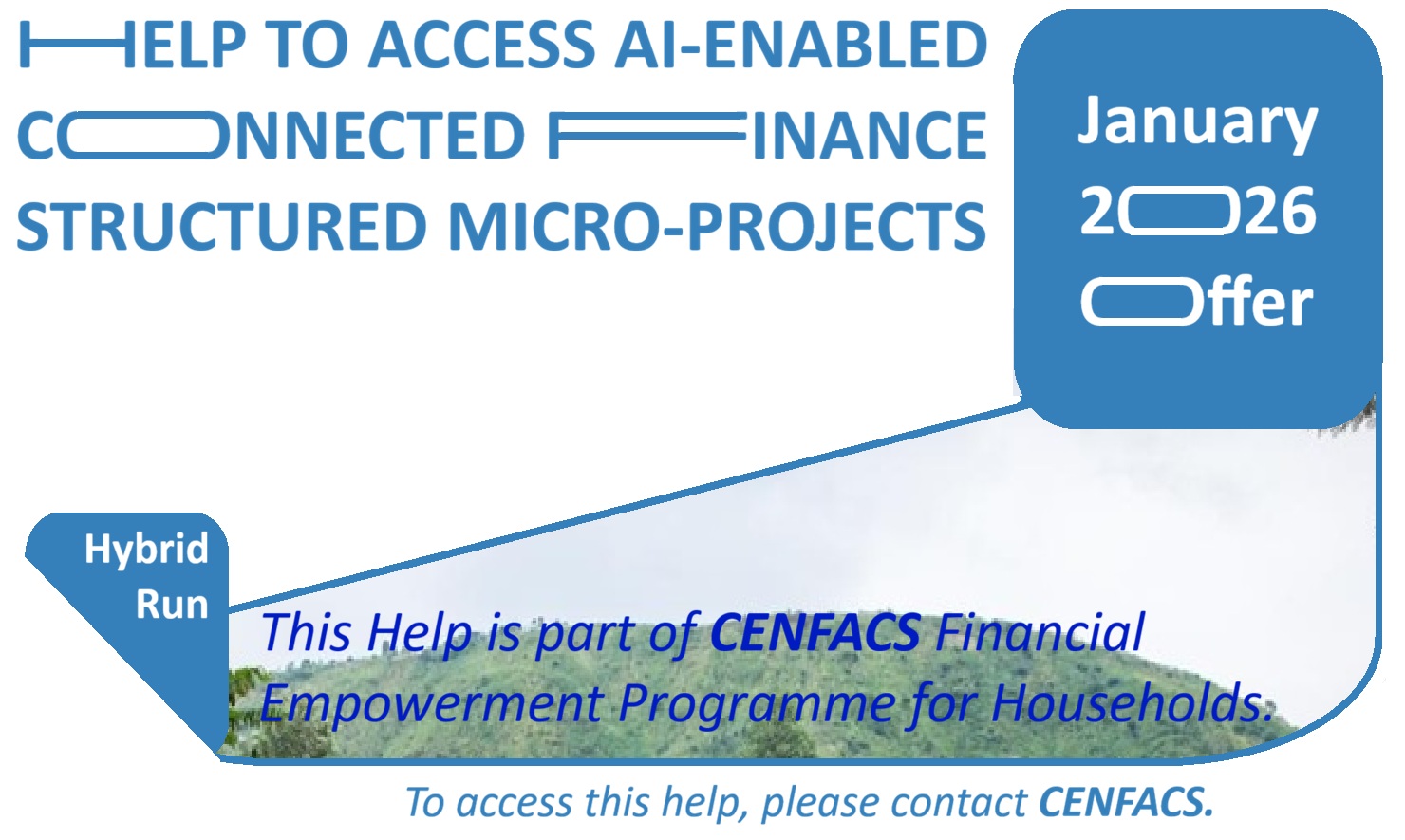
• AI-enabled Connected Finance Structured Micro-projects for Households’ Finance Capacity and Capability Building Experiences
We are resuming Financial Capacity and Capability Building Programme and Financial Empowerment Programme, which we started in December 2025. We are available to work in hybrid mode with users via these programmes so that they can start or be stronger in this New Year. These programmes will help beneficiaries to reduce risks linked to financial incapacity and incapability while improving their intergenerational income and transfers.
To kick off these programmes, we are running from 12 to 17 January 2026 the first activity of these programmes which is Helping Households to Access AI-enabled Connected Finance Structured Micro-projects.
In order to work with households to access AI-enabled connected finance structured micro-projects, it is better to know what they include.
• • What Do AI-enabled Connected Finance Structured Micro-projects for Households Include?
They include the following:
~ AI-driven financial insights assistants that provide personalised financial advice and support, helping households make informed decisions
~ Automated loan processing and credit scoring models that streamline the application process and improve access to credit for underserved households
~ Personalised financial education through AI-driven platforms that offer tailored financial advice and resources to help households manage their finances effectively
~ Fraud detection systems that analyse transaction patterns to identity and prevent fraudulent activities, while ensuring the safety of household finances.
These micro-projects can enhance financial literacy, improve access to credit, and empower households to build their financial capacity and capabilities.
• • 12 to 17 January 2026: Working with Households to Access AI-enabled Connected Finance Structured Micro-projects for Their Finance Capacity and Capability Building (Structured Finance Activity 1)
This first Structured Finance Activity, which is part of Financial Capacity and Capability Building Programme and Empowerment Programme, will be run in the form direct questions/answers on Access AI-enabled Connected Finance Structured Micro-projects. We can answer questions on dealing with the following matters: Chatbots, fraud detection, impact measurement, grant writing and proposal assistance.
Answers to chatbots questions will cover how AI chatbots can provide 24/7 support by answering financial questions and reducing the workload on households.
Answers to fraud detection will around AI systems on detecting suspicious financial transactions.
Answers to impact measurement will be on how AI-driven tools can analyse the data coming from households and enable us to get more impact in terms of our projects with them.
Answers to funding applications will revolve around how AI tools can help draft, refine and optimize their funding applications.
If any of our users have questions to ask about Access AI-enabled Connected Finance Structured Micro-projects, they can ask CENFACS for answers.
Have a question about your Access AI-enabled Connected Finance Structured Micro-projects, please do not hesitate to contact CENFACS.
In additions, if you have financial planning problems, you can communicate with CENFACS so that we can work together on your financial planning needs and help you stay stronger in this New Year.

Message in French (Message en français)
• Objectif du Mois : Réduction de la Pauvreté Liée à la Consommation Irréfléchie
Pour atteindre cet objectif, il est préférable d’expliquer la consommation irréfléchie et de fournir des moyens de réduire ce type de pauvreté.
• • Qu’est-ce que la consommation irréfléchie ou une mauvaise habitude de dépenses ?
Il ressort de la littérature sur la consommation que la consommation irréfléchie est utilisée pour décrire un comportement pouvant conduire à des difficultés financières. À partir de cette constatation, la pauvreté sera abordée du point de vue de la théorie individuelle de la pauvreté, qui attribue la pauvreté à un choix personnel ou à un manque d’effort.
En effet, il est connu que les choix de consommation peuvent réduire ou exacerber la pauvreté. Les ménages disposant de ressources limitées peuvent rester au-dessus du seuil de pauvreté s’ils consomment de manière réfléchie. En raison de cette possibilité de rester au-dessus du seuil de pauvreté, cela suggère qu’il est possible de réduire la pauvreté liée à une consommation irréfléchie.
• • Actions pour réduire la pauvreté liée à la consommation irréfléchie ou inconsidérée
Il existe des actions qui peuvent être entreprises aux niveaux systémique et politique, ainsi qu’au niveau individuel, pour réduire la pauvreté liée à la consommation inconsidérée. En se concentrant sur des solutions au niveau individuel, la théorie sur ce sujet recommande les actions clés suivantes :
∝ Pratiquer la consommation consciente
∝ Acheter d’occasion ou emprunter
∝ Réduire la consommation de viande et d’énergie
∝ Soutenir les entreprises durables
∝ Planifier et éviter le gaspillage
∝ Plaider pour le changement
Etc.
En prenant ces mesures, on peut sortir de la pauvreté liée à la consommation inconsidérée ou en éloigner.
• • Implications pour le choix de l’objectif du mois
Après avoir choisi l’objectif du mois, nous concentrons nos efforts et notre mentalité sur l’objectif sélectionné en veillant à ce qu’il soit appliqué dans notre vie réelle. Nous attendons également de nos soutiens qu’ils poursuivent l’objectif du mois en travaillant sur le même objectif et en soutenant ceux ou celles qui pourraient souffrir du type de pauvreté lié à l’objectif du mois dont nous parlons pendant le mois donné (par exemple, janvier 2026).
Pour plus de détails sur l’objectif du mois, sa procédure de sélection, y compris son soutien et comment y participer, veuillez contacter CENFACS.

Main Development
• 2026 Light Season’s Activities, Projects, Programmes and Resources
The following highlights the 2026 Light Season’s Activities, Projects, Programmes and Resources:
∝ What Are Light Season’s Activities, Projects, Programmes and Resources?
∝ Types of Light Season’s Initiatives
∝ Basic Implementation Plan for the Light Season’s Initiatives.
We can now consider each of the three items.
• • What Are Light Season’s Activities, Projects, Programmes and Resources?
They are a stock of assets (resources) together with a set of interdependent tasks (sustainable projects) and related activities (sustainable programmes) designed to help meet the aim of poverty reduction either within the Lights Season and/or beyond it depending on the types of a given resource, project and programme. In other words, whether it is about activities or resources or projects or even programmes, the unified aim is to help reduce poverty and enhance sustainable development by working with local people and Africa-based Sister Charitable Organisations.
These components of Light Season’s initiatives can be explained as follows.
~ Resources
Resources are online and print guides and information related to poverty reduction, well-being and community action during this Spring 2026. They also include digital tools and information packs designed to support CENFACS Community members in their development and poverty-relieving efforts. They help as well provide materials or supplies to facilitate involvement to CENFACS work and giving during the Light Season.
~ Programmes
Programmes are annual development cycles that encourage a positive change and brighter futures in communities. They also include capacity building plans of action focusing on helping our members and ASOs to manage their own projects and improve poor people’s living conditions. They help maximize impact and engagement.
~ Projects
Projects are community-based initiatives that may involve local engagement, skills sharing or small-scale development efforts within a specific time frame. They are temporary efforts with a defined beginning and end, undertaken to reduce poverty. They involve a series of planned tasks and resources to achieve poverty reduction and light project goals within certain constraints or limitations.
~ Activities
Activities are any actions or tasks to be undertaken that focus on community support, fundraising, and spreading cheer to those in need during the Light Season. They are specific, scheduled steps or actions to be completed to achieve light project goals. They form the lowest level of work breakdown structure, consisting of tasks and subtasks, having a defined start, end, and duration.
These components incorporate light as a theme or tool and designed to tackle poverty during the Season of Light.
The light theme in these poverty reduction initiatives refers to a high-level, foundational area of focus or strategic pillar that guides CENFACS’ work with those in need. It acts as a categorisation for the types of efforts we will be deploying to tackle multifaceted poverty during this Spring 2026.
• • Types of Light Season’s Initiatives
There are three types of initiatives, which are:
a) Specifically designed initiatives (SDIs)
b) Thoughtfully planned initiatives (TPIs)
c) Seasonal initiatives (SIs).
These three types of initiatives (that is, specifically designed, thoughtfully planned and seasonal ones) will help enhance donor engagement, increase funding opportunities and create seamless memorable experience that will resonate with our audience. They will be implemented side by side as we move throughout the Season of Light.
Let us explain these initiatives.
• • • Specifically designed (strategic) initiatives to bring message of hope or a Blaze of Hope
• • • • What are specifically designed (or strategic) initiatives?
SDIs are planned to drive considerable change and create poverty reduction value for beneficiaries and CENFACS. They are focused efforts to be undertaken by CENFACS to develop and achieve clear poverty reduction goals. They align with CENFACS’ overall strategy. They vary in scope and complexity, but all share the common goal of driving significant impact and creating poverty reduction value for beneficiaries and CENFACS.
Amongst the examples of these SDIs are humanitarian appeals which feature CENFACS’ Light Campaign/Advocacy to bring and carry the message of hope through a Blaze of Hope.
The Light Campaign focuses on the themes of light, luminosity, and general positive uplighting energy. The Campaign uses the concept of light as a general theme which is applied to Spring. The Campaign evokes positive emotions like joy, hope, optimism and well-being. The use of light imagery (e.g., a candle) and messaging help CENFACS brand connect with its audiences both on emotional and poverty-relieving levels.
• • • • What do these SDIs include?
They include two waves of intervention or Blazes of Hope, which are:
(a) Appeals to deal with the unfinished business of previous destruction and disruption brought by crises/shocks, wars, natural disasters and the current high costs of living
(b) Appeals linked to seasonally erupted events or effects from health disasters, armed conflicts, geo-economic crises, climate change and natural disasters.

As table no.1 indicates where there may be need of a Blaze of Hope, we will be launching Humanitarian Relief Appeals for Six Identified Areas of Priority that May Need Lighting a Blaze of Hope (as announced last week) to help address unfinished businesses or potential crises or tension hotspot places
• • • Thoughtfully planned initiatives to express Energy or Light Season
• • • • What are TPIs?
They are those that aim to achieve CENFACS’ strategic objectives while helping to bridge planning and execution. They are meant to be clearly measurable, action-oriented, proactive, and aligned with the overall CENFACS strategy while taking into account the environmental impact of any choices made. In this respect, they express the Energy or Light Season as they enable the shift to renewable energy sources.
• • • • What do TPIs consist of?
They consist of featuring the season of light like light (or energy) and voluntary energy transition projects. They are particularly those to shift from fossil fuels to renewable energy sources. They also include financial and policy frameworks to enable transitions to happen.
Briefly, this type of initiatives will be about moving from fossil-based energy system towards zero carbon alternatives. They are given below.
• • • • • Project to Combat Disinformation (PCD)
PCD aims to build resilience amongst our community members against misinformation through transparency, research, and public education. It is about educating our community members on how to critically evaluate information about climate change, spot fake climate news, and understand manipulative techniques and tricks. It is also about building trust in climate poverty reduction.
This will involve collaborating with other organisations working on similar climate disinformation issues, checking facts, researching, detecting and exposing falsehoods, analysing threats from disinformation, while improving media literacy within the community.
• • • • • Project for Finance Mobilisation Roadmap (PFMR)
PFMR is a strategic plan that will outline the necessary steps, policies, and financial instruments required to raise and deploy capital from various sources (public, private, voluntary, and institutional) to achieve specific goals like the mobilisation of funds for climate change.
The aim of PFMR is to bridge the gap between planning and implementation by identifying bottlenecks, de-risking projects, and creating ‘bankable’ investment opportunities to attract sufficient funding, especially in the era of international aid cuts.
• • • • • Project for Long-term Energy Poverty Reduction (PLtEPR)
Within the energy literature, a long-term energy poverty refers to a household consistently cannot afford or access essential energy services (like heating, cooling, lighting, and appliances), forcing them to reduce consumption to levels that harm health, well-being, and basic living standards, often due to low income, high-energy prices, and inefficient homes, creating a persistent cycle of deprivation and vulnerability, particularly in vulnerable populations.
PLtEPR aims to provide energy advice to empower households making the CENFACS Community with knowledge on low-cost measures to reduce energy consumption and help to avoid energy poverty becoming intergenerational. PLtEPR will help the following low-income households:
~ In persistent deprivation (that is, those experiencing a chronic inability to meet basic energy needs over extended periods)
~ With inadequate heating and hard health problems because of energy poverty
~ With high energy costs living in poor housing
~ Spending a large chunk of income on energy or fall into arrears bills, impacting their overall financial stability
etc.
In short, PLtEPR is about accessing modern energy, transitioning away from biomass for cooking, stopping indoor air pollution and improving health risks, particularly but not exclusively in Africa.
• • • • • Zero-waste Skills Development Project (ZwSDP)
ZwSDP is about teaching practical skills (like repair, composting, upcycling, cooking with leftovers) and promoting a waste-reduction mindset (reduce, reuse, recycle) to empower the community to minimise landfill waste, foster sustainable habits, and creating circular economies.
ZwSDP involves training, workshops, community engagement, and creating alternative models for waste management.
ZwSDP is finally about transforming waste management from disposal problem into a resource opportunity.
The above-mentioned initiatives are of our Climate Programme.
• • • Seasonal initiatives or initiatives falling within the Season of Light
• • • • What are SIs?
They are those that Just Fall Within the Season of Light, which is from 21 December in the preceding year (e.g., 2025) to 21 March in the following year (e.g., 2026). They are also strategic marketing efforts that CENFACS undertakes to align its campaigns with the specific time of Winter when supporters’ interest and willingness to give are high. In this respect, they are conceptualised to tap into heightened fundraising activities and emotions associated with the continuation of the giving moments.
• • • • What do SIs include?
They include
√ Consume to Reduce Poverty and Climate Change (Edition No. 14) with a Focus on Thoughtful Consumption and Poverty Reduction
√ Financial Empowerment Programme for Households (which includes these initiatives: 2026 Financial Monitoring and Controls as Tools for Poverty Reduction, Guidance on Year-end Accounts for Households, and Access to AI-enabled Connected Finance Structured Micro-projects)
√ Household- and Area-focused Programmes for Assets and Economy Building Processes
√ Financial Capacity and Capability Campaign 2026
√ Africa Not-for-profit Outlook for Impact Investing in 2026.
The above-mentioned initiatives are amongst the ones we have selected to kick-start 2026. Apart from them, we are continuing to reflect on the poverty reduction landscape of 2025 by taking stock and charge of what happened in 2025, and how we can move forward in 2026.
As part of this thinking process, we will be post-reviewing and working together with beneficiaries on the following:
√ Post Year in Review of Matching Organisation-Investor Programme and Reflection on New Projects that Will Make This Programme in 2026
√ Monitoring, Evaluation and Learning of the Themes Discussed in 2025 in the Context of CENFACS’ be.Africa Forum and Prospects for Africa in 2026
√ Ways of Implementing the Takeaways from Volunteering Winter e-discussion (or Action Plan for 2026) to keep pace with our volunteering action and poverty reduction work.
√ Climate Actions 2026 to keep pace with net zero path and poverty reduction.
All the above-mentioned initiatives are not the only ones for the Season of Light. During the season, we may cancel or reduce the scope of some initiatives if we realise that the problems they were supposed to resolve are no longer there. Likewise, we may add new or recurring initiatives depending on the events within the community we serve. The worksheet below provides some indication in terms of initiatives implementation plan.
• • Basic Implementation Plan for 2026 Light Season’s Initiatives
As we go along the Light Season, the following implementation plan consisting of twelve initiatives will be effective.

The above-mentioned initiatives on the work sheet are 12 ones to implement the Light Season 2026. They are also 12 Essential Ways to Bring and Sustain Hope for Those in Need This Winter 2026.
This initial implementation plan for the Light Season’s initiatives can change depending on the circumstances, events and conditions of the season. If one notices that some of the initiatives inserted in the plan/worksheet are not listed under Types of Light Season’s Initiatives, this is not a big issue. What is important is the deliverables of those scheduled within the plan.
For those who would like to discuss any of these planned initiatives or any aspects of the plan; they can contact CENFACS.
To support and or enquire the Light Season’s Activities, Projects, Programmes and Resources for 2026, please contact CENFACS.
_________
• References
(1) https://dictionary.cambridge.org/dictionary/english/alternative (accessed in January 2026)
(2) https://www.letsupdateskills.com/article/what-are-alternatives-understanding-their-meaning-and-importance (accessed in January 2026)
(3) https://pollution.sustainability-directory.com/question/what-are-alternatives-to-unsustainable-consumption/ (accessed in January 2026)
(4) https://climate.sustainability-directory.com/question/what-are-sustainable-consumption-alternatives-available (accessed in January 2026)
(5) https://www.vaticannews.va/en/world/news/2026-01/thousands-flee-renewed-violence-in-eastern-dr-congo-as-crisis-sp.html (accessed in January 2026)
(6) https://reliefweb.int/report/burundi/burundi-food-security-outlook-update-influxes-refugees-and-returning-burundians-add-pressure-amid-stressed-conditions (accessed in January 2026)
_________
• Help CENFACS Keep the Poverty Relief Work Going This Year
We do our work on a very small budget and on a voluntary basis. Making a donation will show us you value our work and support CENFACS’ work, which is currently offered as a free service.
One could also consider a recurring donation to CENFACS in the future.
Additionally, we would like to inform you that planned gifting is always an option for giving at CENFACS. Likewise, CENFACS accepts matching gifts from companies running a gift-matching programme.
Donate to support CENFACS!
FOR ONLY £1, YOU CAN SUPPORT CENFACS AND CENFACS’ NOBLE AND BEAUTIFUL CAUSES OF POVERTY REDUCTION.
JUST GO TO: Support Causes – (cenfacs.org.uk)
Thank you for visiting CENFACS website and reading this post.
Thank you as well to those who made or make comments about our weekly posts.
We look forward to receiving your regular visits and continuing support until the end of 2026 and beyond.
With many thanks.