Welcome to CENFACS’ Online Diary!
01 April 2026
Post No. 450

The Week’s Contents
• Protection Month with Protection through Alternative Income Sources for Low Income Households
• Goal of the Month: Reduction of Poverty as a Lack of Protection
• Activity/Task 4 of the ‘A’ Project: Find Alternatives to Protection for Those in Need
… And much more!

Key Messages
Our Year of Alternatives continues its course as we are kicking off April 2026 with the theme of Protection through Alternative Income Sources for Low Income Households.
Indeed, low-income households are particularly vulnerable to income shocks (that is, a sudden or unexpected drop in household’s income caused by various factors which restricts the ability to pay regular bills and leading to financial difficulties) because they often have limited savings and high living costs. They cannot rely on statutory sick pay or insufficient savings. They need to find other alternative income sources for protection. But what is Protection through Alternative Income Sources for Low Income Households (PtAIS4LWHs)?
• • Understanding PtAIS4LWHs
PtAIS4LWHs refers to strategies, products, and support systems designed to replace, supplement, or protect a primary salary if it is lost due to illness, injury, or unexpected crises. It aims to build financial resilience, prevent poverty, and ensure that essential living costs like rent and food are covered when the main wage earner cannot work.
To protect low-income households through alternative income sources, there are methods.
• • Methods for Protection via Alternative Income Sources
They include income protection insurance, critical illness cover, local welfare assistance scheme, alternative income generation, government benefits and grants. Although all these sources are relevant, this year’s Month of Protection will mostly focus on alternative income generation. The latter involves creating secondary income streams through “side hustles”, selling unused items, or taking on part-time freelance work, etc.
During this Month of Protection, we shall work with low-income households in finding out the best way of protecting themselves through alternative income streams. To do that, we need to have an action plan for work the Protection Month, which will involve four phases as follows:
Phase 1: Assessment and Safe Targeting
Phase 2: Planning and Skill Development
Phase 3: Implementation and Support
Phase 4: Protection Mainstreaming, Monitoring and Evaluation.
In our work with them, we shall also include the common strategies for income protection like building an emergency fund, utilizing government support, affordable credit and leveraging assets.
We shall as well explore ways of reducing alternative income poverty, that is the lack of suitable additional sources or streams besides the main source to generate extra income to meet or complement their basic needs for a period of time. Reducing alternative income poverty is about decreasing or ending the lack of alternative income streams that could offer low-income households additional financial protection against unforeseen events like job loss, illness, or injury.
This Month of Protection is finally of dealing with other areas of links between protection and alternative sources, such as environmental and conservation protection. In the context of conservation, providing alternative income is a strategy to protect natural resources by offering communities and households an alternative to unsustainable, resource-damaging practices. This can help protect fauna, flora and funga.
Likewise, in humanitarian crises, alternative livelihood can protect people from devastating choices and risks to their personal safety. This is without forgetting protection against the adverse impacts of climate through our Climate Follow-up Talks Project known as Taking Climate Protection and Stake for African Children.
The above-mentioned areas of work for this month are summarized in CENFACS’ Action Plan for April 2026. To find more about this action plan and what is likely to be the Month of Protection within CENFACS, please read under the Main Development section of this post.

• Goal of the Month: Reduction of Poverty as a Lack of Protection
To approach this goal, let us first explain what it means.
• • What Does Mean Reducing Poverty as a Lack of Protection?
It is about protecting people from insecurity, inequality, and inability to access basic rights, with social protection systems serving as the key pillar for doing so. It involves shielding individuals from risks, vulnerabilities, and exploitation.
Reducing poverty by addressing a ‘lack of protection’ also means focusing on building resilience, stability, and security for vulnerable populations rather than just increasing income. This goal of the month is aligned with the United Nations Sustainable Development Goal 1 – formulated as No Poverty – (1) and includes creating “social protection floors”.
For instance, for vulnerable populations, social protection can stem from social safety net programmes that offer alternative sources of income like financial aid and grants, which can provide protection against poverty and income shocks.
Reducing poverty as a lack of protection as a main goal can encapsulate other goals or sub-goals, which can be
σ Implementation of universal social protection systems
σ Building resilience to disasters and shocks
σ Ensuring access to basic services and resources
σ Preventing destitution and chronic poverty
σ Extending social safety nets
σ Integrating ‘cash plus’ ‘ approaches
σ Promoting gender-based protection
Etc.
There are implications for selecting the Goal of the Month.
• • Implications for Selecting the Goal for the Month
Implications for poverty reduction under this framework mean focusing on preventive social systems, risk mitigation, and rights-based interventions rather than just post-hoc relief.
Key implications include the following:
a) Shifting from income support to risk management: This involves preventing vicious circles by strengthening resilience, protection against ill-health, social protection as a structural tool
b) Addressing multi-dimensional vulnerabilities: It encompasses going beyond monetary poverty, mitigating environmental and market shocks, and child-centred protection
c) Reversing structural barriers and exploitation: It includes breaking labour exploitation, eliminating social discrimination, and countering stigma
d) Enhancing social cohesion and trust: It is about restoring trust and using participatory approach.
Besides these implications, there are expectations from our Goal of the Month.
• • What We Expect from Our Supporters Regarding the Goal of the Month
After selecting the goal for the month, we focus our efforts and mind set on the selected goal by making sure that in our real life we apply it. We also expect our supporters to go for the goal of the month by working on the same goal and by supporting those who may be suffering from the type of poverty linked to the goal for the month we are talking about during the given month (e.g., April 2026).
For further details on the goal of the month, its selection procedure including its support and how one can go for it, please contact CENFACS.

• Activity/Task 4 of the ‘A’ Project: Find Alternatives to Protection for Those in Need
To deal with Activity/Task 4, it is better to explain it and provide some clues on ways of engaging with it.
• • What Is This Activity/Task about?
Activity/Task 4 of the ‘A’ Project is about finding or using substitutes (whether in poverty reduction, sustainable development or other matters) or legal scenarios to reduce risk, enhance security, and increase resilience against potential harm or loss. Alternatives can act as ‘a safety net’ that can allow for navigation around dangers, market volatility, or hazards.
For instance, in terms financial portfolio protection (or alternative investments), alternatives can provide protection as a diversifier against traditional market volatility.
• • Engaging with Activity/Task 4 of the “A” Project
Engaging with the Activity/Task of finding alternatives to traditional protection (such as passive welfare or in-kind aid) for poverty reduction requires a shift towards empowerment, livelihood development, and community-led solutions. This approach focuses on building capabilities, agency, and assets, allowing those in need to escape poverty sustainably rather than relying on safety nets.
There are strategies to engage with this Activity/Task.
• • • Strategies to Engage with Activity/Task 4
These strategies include the following ones:
a) Adopt an empowerment and asset framework
It is about moving from a ‘needs-based’ approach (providing for people) to an asset-based approach (enabling people).
It includes
~ viewing people as agents, not recipients
~ focusing on autonomy-oriented help
~ utilizing community-led development approaches.
b) Implement economic empowerment strategies
These approaches, which aim at directly increasing incomes and assets, encapsulate promoting agriculture and markets, facilitating access to finance, investing in skills and vocational training, fostering entrepreneurship, etc.
c) Tackle structural and systemic causes
Alternatives need to address the root causes of poverty by
~ improving access to basic services
~ promoting gender equality
~ securing land and property rights.
d) Create graduation programmes
These programmes include ‘cash-plus’ models or approaches (like cash with coaching, training, or access to health services) and livelihood diversification.
e) Engage through participatory methods
It is about using structural methods (like See-Judge-Act) for effective strategy.
The above-mentioned strategies will help those in need of reducting poverty as protection lacking to transition from ‘needing protection’ to ‘having the power and resources to thrive’.
So, engaging with the Activity/Task 4 of finding alternatives requires a shift towards empowerment-based, promotive, and structural approaches. The goal here is to move from simply mitigating the symptoms of poverty to enabling our members and other community members to build resilience and create their own pathway out of poverty as a lack of protection.
Those who would like to engage with this Activity/Task can go ahead with it.
For those who need some help before embarking on this Activity/Task, they can speak to CENFACS.
For any other queries and enquiries about ‘A’ Project and this year’s dedication, please contact CENFACS as well.

Extra Messages
• ReLive Issue No. 18, Spring 2026: People with Acute Needs in Africa Want to Rebuild and Renew Their Lives, Can You Help?
• All-Year-Round Projects Lifecycle – Step/Workshop 7: Implementing Your Play, Run and Vote Projects; and Integrating Triple Value Initiatives into Your All-Year-Round Projects Implementation
• Household- and Area-focused Programmes for Assets and Economy Building for Families – In Focus from 01/04/2026: Asset-building Project for Families

• ReLive Issue No. 18, Spring 2026: People with Acute Needs in Africa Want to Rebuild and Renew Their Lives, Can You Help?
• • What is ReLive?
ReLive is one of CENFACS’ Spring campaigns and a bridge between CENFACS’ Winter Lights and Spring Relief seasons.
ReLive advocacy is designed to plead for help to the peoples and communities whose lives and livelihoods have been destroyed to rebuild themselves. The current appeal will try to achieve this for the People with Acute Needs in Africa this Spring 2026.
Although this appeal is a seasonal appeal related to Spring, it is also a consolidated one following our Winter Light appeals.
• • What Is the Focus for ReLive in 2026?
The 18th issue of CENFACS’ Once-a-year Spring Appeal for Renewing Lives (ReLive) will focus on advocating for the support of People in Acute Needs or Those in the Most Serious Humanitarian Crises in Africa who require help to rebuild and renew their lives this Spring 2026.
Indeed, this Spring 2026 humanitarian needs in Africa are at record highs with millions of lives/people requiring urgent rebuilding and renewal due to the intensification of civil wars, regional armed conflicts, severe climate shocks, and resulting famine conditions.
The most acute crises are centred in Sudan, the Sahel, the Eastern Democratic Republic of Congo, and the Horn of Africa.
• • What Is ReLive in 2026 about?
It is about working with those in the most serious humanitarian crises in Africa to create enhanced relief so that they can rebuild and renew their lives. They need rebuilding, renewal and support due to the convergence of armed conflict, climate-induced disasters, and economic distress.
• • Who Needs Rebuilding, Renewal and Support (RR&S)?
This appeal will cover all those needing RR&S, particularly but not specifically the following affected populations:
σ Those who were forcibly displaced and under famine conditions in cities like El Fasher (in Sudan)
σ Affected populations in Mali, Burkina Faso, and Niger where violence has triggered massive displacement
σ Women and children requiring nutritional assistance in the region surrounding Uvira and Bukavu in Eastern Democratic Republic of Congo
σ Communities in Tigray, Amhara, Oromia in Northern Ethiopia where they are enduring continued displacement
Etc.
The People with Acute Needs in Africa require support of all kinds as they face high vulnerabilities.
• • Key Vulnerabilities They Face
They include the following:
σ Women and girls face high risk of gender-based violence and lack of maternal health services, particularly in Mali and the Democratic Republic of Congo (DRC)
σ Refugees and Internally Displaced Persons are trapped in temporary settlements with limited protection
σ Health and school facilities have been catastrophically destroyed and are requiring long-term rehabilitation
σ Communities in Southern Africa affected by extreme flooding between late 2025 and January 2026 need urgent infrastructure and agricultural recovery
σ Rural pastoralists and farmers in the Horn of Africa facing La Niña-induced drought need to manage crop failure and livestock losses.
Etc.
• • What ReLive Campaign Will Bring to the People with Acute Needs
The Campaign will help meet rebuilding and renewal needs like
σ Healthcare facilities, water systems, and local food production in Sudan
σ Reconstruct razed villages, damaged schools, and transport infrastructure in the Sahel
σ Re-establish health and create special protections from gender-based violence in the Eastern DRC
σ Rebuild economic base for pastoralists and farmers
σ Provide clean water, education, and healthcare to the Internally Displaced Persons
σ Rebuilding destroyed homes for communities in South Kivu (DRC)
σ Restoration of basic services and civilian infrastructure for communities in the Central Sahel
σ In brief, rebuild and renew lives in a gradual, safe and sustainable way.
Like before, the Campaign is done through Gifts of Renewing Lives or Life-renewing Projects.
• • What Are Gifts of Renewing Lives (GoRLs) and Life-renewing Projects (LRPS)?
• • • Gifts of Renewing Lives
In terms of poverty reduction, Gifts of Renewing Lives (GoRLs) refer to charitable initiatives, often in the form of vocational training, income-generating assets, or direct cash transfers, designed to move people from a state of dependance and extreme poverty to one of sustainability, self-reliance, and dignity.
This approach focuses on breaking the cycle of poverty by providing the necessary resource for families to change their circumstances permanently, rather than solely relying on continuous emergency aid.
Examples of GoRLs include the following:
Income-generating assets (e.g., providing tools), asset upgrading (e.g., giving materials), direct cash transfers (e.g., to purchase tools or start a business), restoring dignity and agency (e.g., empowering people with skills), lasting impact (e.g., creating long-term stability), capacity building and training (e.g., to gain skills to find job or start a business), community-led development (e.g., to identify their own problems and execute local solutions).
In brief, GoRLs are the presents to break the generational cycle of poverty. They are an investment that enables those who receive them to transition from survival mode to thriving.
• • • Life-Renewing Projects
Life-renewing Projects (LRPs) refer to focused initiatives designed to restore, improve, or fundamentally change the quality of life, environment or community for the better. The term is mostly used in the contexts of community-powered residential retrofitting (such as the European Union’s ‘LIFE Renew-it’ project) and of biodiversity/environmental restoration (such as ‘RENEW’).
LRPs have core principles, which are:
σ Participatory: It involves the people are directly impacted by the change
σ Sustainable: It focuses on long-term ecological or social viability
σ Transformative: It moves beyond mirror repairs to fundamentally battering conditions.
In the context of poverty reduction, there is a difference between LRPs and GoRLs.
• • • The Difference between GoRLs and LRPS
The difference between a gift of renewing lives (often conceptualized as direct, sometimes faith-based, relief, or life-changing gifts) and a life-renewing project (structured, systemic, and community-driven initiatives) lies in the scope, duration, and approach to empowerment.
A GoRL refers to direct, often one-time or tangible assistance (gifts) that provide immediate relief, such as emergency kits or microfinance funds that change an individual’s immediate circumstances.
A LRP refers to systemic, long-term programmes that involve community-driven, sustainable change, such as collective home retrofitting or comprehensive community rehabilitation aimed at changing the structure of poverty.
Although GoRL addresses immediate needs and provides hope, it can help beneficiary to develop LRP which builds systemic, lasting, and sustainable change.
So, LRPs are poverty relief and Spring like gifts designed to materialise ReLive advocacy by helping people to set free from multi-dimensional deprivations and hardships so that they can start up again, renew and rebuild their lives with hope.
LRPs are part of CENFACS’ African Rebuilding and Sustaining Infrastructures and Lives Programme. Spring Gifts of Renewing Lives are about bringing renewal, joy and hope to needy people. These Spring 2026 Gifts will be about bringing the same benefits to the People with Acute Needs in Africa Desperately Wanting to Rebuild and Renew Their Lives in Africa.
• • What Are These Ways or Gifts of Renewing Lives?
This Spring, we are running 14 Gifts in a world of 20 Reliefs or Helpful Differences. What does this mean?
It means donors or funders have 14 Gifts of Renewing Lives or materials to choose from and enable the creation of 20 Reliefs (impacts or values) to select from to make helpful differences to the acute needy.
In total, our Spring Relief 2026 Campaign is providing to potential supporters 14 GIFTS of rebuilding acute needy’s lives in Africa in 20 RELIEFS to make this happen.
For this rebuilding or renewal to happen, support is needed towards LRPs.
To support, please contact CENFACS at http://cenfacs.org.uk/contact-us/

• All-Year-Round Projects Lifecycle – Step/Workshop 7: Implementing Your Play, Run and Vote Projects; and Integrating Triple Value Initiatives into Your All-Year-Round Projects Implementation
After making the organisational structure of your chosen Play, Run and Vote Projects, it is now the time to proceed with the Implementation Step.
This step can be broken into two sub-steps:
a) Implementing your Play, Run and Vote Projects
b) Integrating Triple Value Initiatives (TVIs) into your Play, Run and Vote Projects.
Let us cover these sub-steps.
• • Implementing Your Play, Run and Vote Projects (7.1)
• • • What Is an Implementation Step?
There are many definitions within the literature about project implementation. One of them comes from ‘taskmanagementguide.com’ (2) which states that
“Project implementation is a practice of executing or carrying out a project under a certain plan in order to complete this project and produce desired results”.
The above definition indicates that one needs an implementation plan. As an all-year-round project implementor, you can draw up your implementation plan that shows the way you would like to execute and carry out your project.
Having said that Project Implementation is the step you put your project plan into action. This step can be broken into exploration, installation, initial implementation and full implementation. Before breaking this step, it may be wise to understand AYRP (All-Year-Round Project) implementation, not just project implementation.
• • • What Is an AYRP Implementation?
The literature survey on AYRP Implementation indicates that AYRP Implementation refers to a structured, continuous approach to executing project activities, maintaining momentum, and delivering results over a 12-month period. Instead of a short-term sprint, this method involves consistent, often cyclical, planning and execution that aligns with annual charity goals/objects, ensuring project work is sustained without stalling.
Key aspects of AYRP Implementation include a 12-month focus, continuous execution, structured resource management, adaptive planning, and overcoming resilience. To success, an AYRP Implementation needs to have clear goals, a plan (implementation plan), monitoring and control.
Because all-year round projects are such small initiatives, you will not need to break this step.
You want your all-year-round project to fulfil and accomplish the goals and objectives you have set up for it. It is also the phase during which you can register, review and approve/reject any changes and variations. As an all-year-round project manager of your project, you need to coordinate all project aspects and resources to meet the objectives of the project plan. One of the aspects of the project implementation is change control.
• • • What Is Change Control in a Project implementation Process?
The website ‘ecampusontario.pressbooks.pub’ (3) states that
“Change control is a set of procedures that lets you make changes in an organised way”.
The same ‘ecampusontario.pressbooks.pub’ explains this:
“If you find a problem… you will need to look at how it affects the triple constraint (time, cost, scope) and how it impacts the project quality… If you evaluate the impact of the change and find it won’t have an impact on the project triple constraint, then you can make the change without going through change control”.
• • • An Example of Implementing Your All-year Round Projects
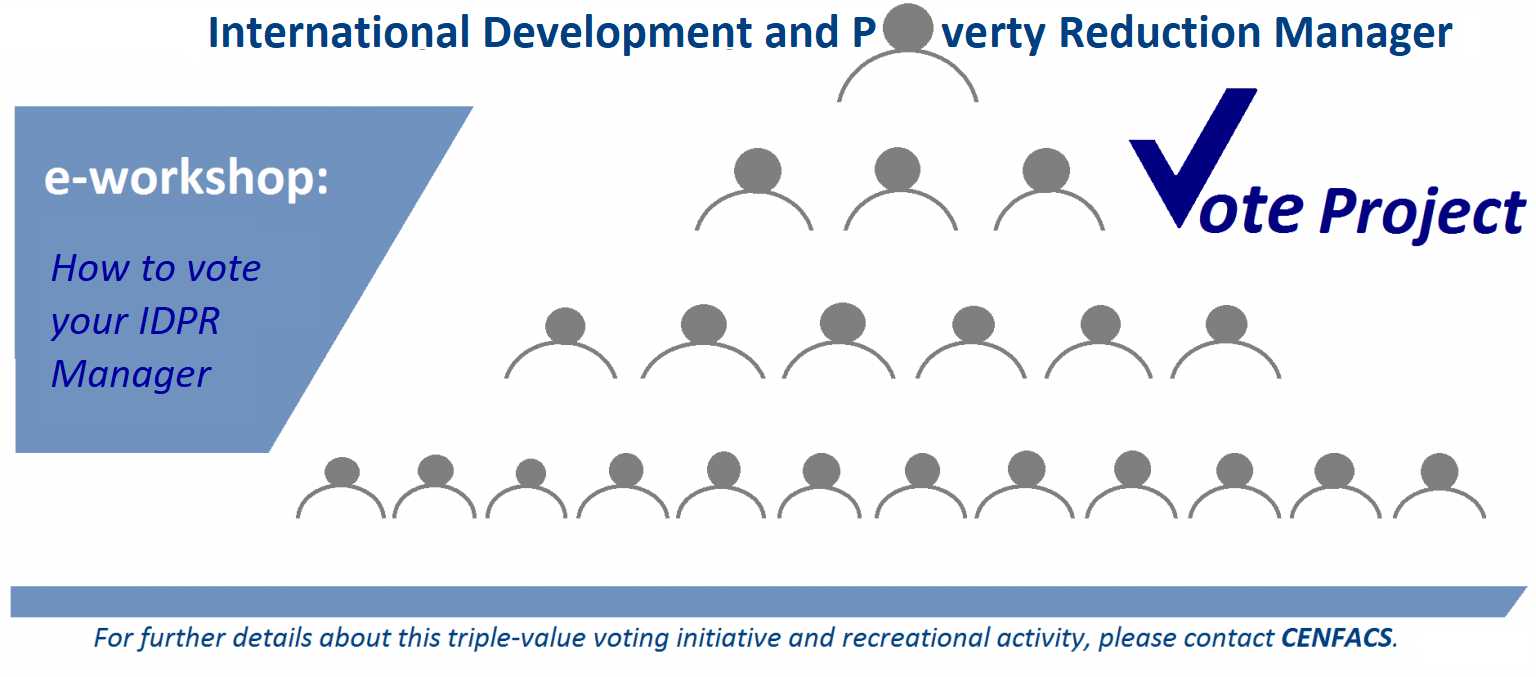
Let us take the example of Voting Your 2026 International Development and Poverty Reduction Manager.
Your goal is to find a person who will meet the managerial qualities of such a position. Amongst the objectives are the design of a job description and person specification that match with the profile of your ideal International Development and Poverty Reduction Manager of the Year.
In project implementation jargon, you will put approved plan into practice to proceed with the selection of your International Development and Poverty Reduction Manager of the Year. He/she must meet your selection criteria. If you are voting as a group, you could set up a selection panel or recruitment board like you will do it for real job interview. You can start by shortlisting 12 candidates, cutting down your list to 6, then to 3 until you reach/vote the last one, who has scored the best and most results of your jury questions and responded to most criteria.
You can decide to add a fundraising feature to your voting activity.
• • • Fundraising during the Vote of International Development and Poverty Reduction Manager of the Year
You can invite the members of the public pay to participate in voting and/or to participate in the selection procedure. Their payment will be the money you will raise for good causes like CENFACS‘ noble and beautiful ones. The money raised will help to make a difference in the lives of those we serve.
However, your selection process will not be enough unless you incorporate TVIs in it.
• • Integrating Triple Value Initiatives into Your All-Year-Round Projects Implementation (7.2)
Integrating TVIs – environmental (planet), social (people), and economic (prosperity) – into year-round project implementation requires shifting from ad-hoc CSR (Corporate Social Responsibility) activities to embedding sustainability into the core project lifecycle. This involves extending strategic planning, setting measurable goals and fostering continuous engagement throughout the year.
There are guides in order to integrate TVIs throughout your project management lifecycle. In this context, the guide is as follows.
a) Conceptualisation and Planning Phase
It involves embedding value in project scope, conducting local needs analysis, and extending strategic timeframes.
b) Implementation and Execution Phase
It includes green procurement, the operationalization of social value, and the implementation of circular economy.
c) Monitoring and Reporting Phase
It encompasses the use of data-driven Key Performance Indicators (KPIs), the holding of transparent reporting, and undertaking of monthly audits.
d) Continuous Improvement
It consists of establishing green meetings, having adaptive management, and reflecting on lessons learned.
Additionally, this integration does not happen by chance. It requires enablers. In this respect, the key strategic enablers would include support from senior leadership, collaboration with team members, and the use of digital tools for ESG (Environmental, Social, Governance) tracking capabilities.
These initiatives (that is, TVIs) will help build more resilient AYRPs leading to a personal and positive legacy. In other words, with these practices, your AYRP will transition from simply meeting a goal to delivering lasting integrated value (that is, People, Planet, and Prosperity) throughout the year.
CENFACS can work with AYRP users to integrate these initiatives into their project tools and lifecycle thinking processes. This will stop these TVIs being ‘add-on’ and enable them become part of the implementation of their AYRP success.
For those who are not familiar with project implementation and the integration of Triple Value Model into their AYR project, they should not hesitate to contact CENFACS if they need support.
They can contact CENFACS by
phoning, texting, e-mailing and completing the contact form on this website.
We can together discuss in detail your/their proposals about either your/their Run or Play or Vote projects, as well as the integration of TVIs into these projects.
For any queries and/or enquiries about All-Year-Round Projects Lifecycle and Implementation as well as about the Integration of Triple Value Initiatives into Project, please contact CENFACS.

• Household- and Area-focused Programmes for Assets and Economy Building for Families – In Focus from 01/04/2026: Asset-building Project for Families
Last week, we introduced Household- and Area-focused Programmes for Assets and Economic Building for Families (H&AfP4A&EB4Hs) as strategic approaches designed to foster wealth retention, economic resilience, and local ownership by focusing on specific geographic areas and individual household capacities.
This week, we are going to start one of the programmes making H&AfP4A&EB4Hs, in particular Household-Focused Programmes (HFPs).
• • What Are HFPs?
HFPs are initiatives that focus on increasing the financial security, skills, and tangible assets of individual families, and residents particularly in low-income scenarios.
Among HFPs, we have selected these four below to work with household families making the CENFACS Community from every Wednesday of April 2026 (as indicated by the dates pre-attached to them):
Wednesday 01/04/2026: Asset-building for Low-income Households
Wednesday 08/04/2026: Asset-based Community Development
Wednesday 15/04/2026: Financial Inclusion and Educational Programmes
Wednesday 22/04/2026: Affordable Housing and Energy Efficiency.
It is possible to work with the community so that they access and gain the benefits offered by this programme.
• • Working with the Community on HFPs
As part of supporting our community members in the process of building their assets and economy to reduce poverty we will be working with them on these programmes from this April. The first activity/project is on Asset-building for Low-income Households.

• • Wednesday 01/04/2026: Asset-building for Low-income Households
To start this Activity/Project, let first explain asset-building, then highlight areas that we can work together with household families making the CENFACS Community.
• • • What Is Asset-building?
To explain asset-building, we have selected two definitions. The first selected definition is the one given by Asset Funders Network (4) which argues that
“Asset building is how individuals, families, and communities gather the resources that will move them towards economic well-being, for now and for years to come”.
The second definition comes from ‘moneyfox.com’ (5) which states that
“Asset building is a proactive strategy aimed at increasing an individual’s, company’s, or country’s economic base by acquiring resources that offer potential future benefits. These resources, or assets, can range from tangible items like real estate and machinery to intangible ones as patents or copyrights. The essence of asset building lies in the expectation that these assets will provide economic returns, enhance wealth, or contribute to financial stability over time”.
There are steps to build assets, just as there are strategies for effective asset building. As part of working together with household families making the CENFACS Community, we are going to explore these steps and strategies with them.
• • • Working with the CENFACS Community on Asset-building
It involves the following:
σ Shifting from a deficit-based model to a strengths-based approach
σ Focusing on building long-term financial security through savings, education, and investment
σ Fostering financial literacy through open family conversations
σ Supporting families to implement individual/family development accounts
σ Encouraging them to learn financial literacy and numeracy skills
σ Signposting them to community-based networks
σ Focusing on their strengths and capabilities instead of their weaknesses and incapacities
σ Promoting savings mentality among them for their financial security
σ Finding ways of facilitating accessible financial support and services for them
Etc.
Those who may be interested in working with us on Asset-building for Low-income Households, they can contact CENFACS.
Those who may have any queries and/or enquiries about Asset-building for Low-income Households or H&AfP4A&EB4Hs, they should not hesitate to communicate with CENFACS.

Message in French (Message en français)
À paraître ce printemps 2026 : le numéro 91 de FACS, qui s’intitulera comme suit:
« Les Organisations Caritatives Africaines qui Promeuvent des Alternatives à l’Industrialisation à fortes Émissions et Luttent contre la Pauvreté Induite par la Pollution en Afrique »
Les Organisations Caritatives Africaines (OCA) ou Oeuvres de Charité Africaines peuvent promouvoir des alternatives à l’industrialisation traditionnelle, fortement polluante. Elles peuvent y parvenir en encourageant les énergies vertes, l’économie durable et l’économie circulaire, plutôt que les méthodes industrielles traditionnelles et polluantes. Elles peuvent également aider les communautés appauvries par la dégradation de l’environnement (par exemple, la perte de ressources halieutiques ou agricoles due à la pollution, ou encore les coûts élevés des soins de santé liés à des environnements toxiques).
Les statistiques relatives à l’industrialisation fortement polluante et à la pauvreté induite par la pollution sont révélatrices de l’ampleur de ces émissions et de la nature de cette pauvreté.
Les statistiques relatives à l’industrialisation à fortes émissions indiquent que, malgré les efforts des organisations caritatives et des innovateurs africains pour promouvoir des alternatives industrielles vertes et à faibles émissions – telles que l’agriculture solaire, la mobilité électrique et les foyers de cuisson propres –, leur impact est limité par les progrès du changement climatique. Les principaux constats concernent les alternatives vertes, notamment les énergies renouvelables et l’agriculture, la cuisson propre et la mobilité électrique, l’innovation verte, etc. Les principales tendances statistiques portent sur les contraintes financières, la forte dépendance aux émissions, les limitations du marché du carbone, etc. Par exemple, le site « furtherafrica.com » (6) souligne que :
« Avec 60 % du potentiel mondial d’énergie solaire, mais ne recevant que 2 % des investissements mondiaux dans ce secteur, le continent africain est idéalement placé pour jouer un rôle central dans la transition énergétique mondiale.»
De même, le site « africaclimatereports.org » (7) indique que :
« Le continent africain abrite 20 % des puits de carbone mondiaux et contribue à moins de 4 % des émissions mondiales de gaz à effet de serre. Pourtant, il ne reçoit que moins de 10 % des financements destinés à l’adaptation et seulement 3 % du financement total pour le climat. Ce manque de ressources a des conséquences existentielles. »
Concernant les statistiques relatives à la pauvreté induite par la pollution, il convient de souligner qu’il s’agit d’une crise grave et interconnectée. Les principales statistiques sur ce sujet sont liées à des indicateurs tels que le nombre de décès et le coût économique associés à la pollution atmosphérique, l’exposition à la pauvreté résultant de la vie dans des zones où les niveaux de pollution aux particules fines (PM2,5) sont dangereux, la perte annuelle de produit intérieur brut liée aux impacts de la pollution et la précarité énergétique due au manque d’accès aux services énergétiques modernes.
Pour illustrer cette pauvreté, la Banque mondiale (8) estime que :
« 716 millions de personnes vivant dans l’extrême pauvreté, définie comme un revenu inférieur à 1,90 $ par jour, sont directement exposées à des concentrations dangereuses de particules fines PM2,5 ; parmi elles, 405 millions, soit 57 %, vivent en Afrique subsaharienne.»
De même, ‘greenpeace.org’ (9) mentionne 1,1 million de décès annuels dus à la pollution atmosphérique.
Le 91e numéro de FACS, qui s’inscrit dans l’Année des Alternatives du CENFACS et de la recherche de modèles et de systèmes alternatifs pour la réduction de la pauvreté, portera sur les alternatives en matière de développement industriel et d’industrialisation. Il s’agira de développer, de promouvoir et de déployer à grande échelle des modèles économiques, des technologies et des méthodes de production qui s’écartent des approches industrielles conventionnelles, fortement émettrices de carbone et extractives. L’accent sera mis sur la création d’alternatives durables, inclusives et localisées – telles que l’économie circulaire, la propriété collective ou la production communautaire – pour lutter contre la dégradation de l’environnement, les inégalités sociales et les limites de la croissance traditionnelle, gourmande en ressources, sans oublier la réduction et l’éradication de la pauvreté induite par la pollution.
Le 91e numéro de FACS examinera les principales théories relatives à l’industrialisation à fortes émissions en Afrique, notamment : l’hypothèse du refuge de la pollution/l’effet de halo de la pollution, la courbe de Kuznets environnementale, le modèle IPAT (Impact = Population x Abondance x Technologie), la théorie de l’inertie réglementaire et la théorie économique néoclassique du lien entre pollution et économie. Ce numéro abordera ces théories non seulement sous l’angle de leurs explications sur l’industrialisation à fortes émissions en Afrique, mais aussi sous celui de la pauvreté induite par la pollution sur le continent.
Le 91e numéro de FACS sera consacré aux OCA œuvrant pour la justice climatique, c’est-à-dire celles qui reconnaissent que les populations les plus pauvres sont souvent les plus touchées par la pollution industrielle. Ce numéro s’intéressera également aux organisations de développement, qui promeuvent des moyens de subsistance propres, durables et locaux, plutôt que de dépendre d’industries fortement polluantes. Enfin, il s’intéressera au travail des OCA impliquées dans le droit ou les politiques environnementales, notamment celles qui militent pour enrayer la pollution à la source afin d’éviter qu’elle n’entraîne des difficultés économiques.
Le 91e numéro de FACS retracera également le lien entre l’industrialisation à fortes émissions et la pauvreté induite par la pollution, et expliquera comment les OCA s’efforcent de contribuer efficacement à la réduction de cette forme de pauvreté en Afrique.
Loin de se limiter à un constat négatif sur les émissions et la pollution, ce numéro présentera des exemples concrets d’alternatives écologiques dans les domaines des énergies renouvelables, de l’agriculture régénératrice, de l’autonomisation des petits exploitants agricoles, de la valorisation des déchets, des modes de cuisson propres et de la mobilité électrique, et de l’innovation verte. Il démontrera ainsi que les OCA s’engagent auprès des communautés locales pour transformer les processus polluants et fortement émetteurs. Malgré les obstacles, elles impulsent le changement en aidant les populations et les communautés locales à abandonner les modèles polluants et fortement émetteurs pour s’orienter vers un développement durable à long terme.
Pour en savoir plus sur ce nouveau numéro, veuillez consulter régulièrement les publications de CENFACS au printemps 2026. Pour réserver un exemplaire papier de ce 91e numéro de FACS, veuillez contacter CENFACS en indiquant vos coordonnées postales.

Main Development
• Protection Month with Protection through Alternative Income Sources for Low Income Households
Protection through Alternative Income Sources for Low Income Households (AIS4LIHs) refers to strategies designed to maintain financial stability, cover essential living expenses, and avoid debt when a primary employment income is lost or interrupted due to long-term illness, injury, or disability.
The following contents will help approach these strategies, as well as the other elements constituent of AIS4LIHs:
≈ What Is Protection through AIS4LIHs?
≈ Methods for Protection via Alternative Income Sources
≈ Strategies for Protecting Poor Households through AIS
≈ Types of Poor Households Needing Protection via AIS
≈ Metrics for Measuring Protection through AIS
≈ Action Plan for the Implementation of Protection through AIS This April 2026
≈ From Wednesday 01/04/2026: Assessment and Safe Targeting
≈ Other Areas of Protection.
Let us look at each of these contents.
• • What Is Protection through AIS4LIHs?
It refers to strategies, products, and support systems designed to replace, supplement, or protect a primary salary if it lost due to illness, injury, or unexpected crises. It aims to build financial resilience, prevent poverty, and ensure that essential costs like rent and food are covered when the main wage earner cannot work.
To protect low-income households through alternative income sources, there are methods.
• • Methods for Protection via Alternative Income Sources
They include income protection insurance, critical illness cover, local welfare assistance scheme, alternative income generation, government benefits and grants. Although all these sources are relevant, this year’s Month of Protection will mostly focus on alternative income generation. The latter involves creating secondary income streams through “side hustles”, selling unused items, or taking on part-time freelance work, etc.
There are also strategies to do it.
• • Strategies for Protecting Poor Households through AIS
Protecting households through alternative income sources involves diversifying revenue streams beyond primary salary to create resilience against job loss, inflation, or unexpected emergencies.
Alternative income strategies involve the combination of the following:
a) Promoting alternative livelihoods and diversification
It includes agricultural diversification (e.g., encouraging farmers to adopt diverse income streams), small-scale entrepreneurship (e.g., stimulating the development of trading and service provision like repair services), and the graduation approach (e.g., productive asset transfers like livestock).
b) Financial inclusion and asset protection
It involves microinsurance (e.g., providing low-income households with affordable insurance), microfinance and savings group (e.g., self-help groups), ‘wheels to Work’ schemes (e.g., providing affordable transport).
c) Skill development and formalisation
It encompasses vocational training and apprenticeships (e.g., offering targeted skills), digital skills training (e.g., developing literacy skills), and support for the self-employed.
d) Community-led approaches
It involves community-led housing and development and promoting local ‘Anchora’.
e) Policy-level support
It includes adaptive social protection and strengthening local economies.
The above-mentioned strategies provide the best protection against falling into deep poverty.

• • Types of Poor Households Needing Protection via AIS
Poor Households Needing Protection via AIS are those with high risks of severe poverty, low income-generating capacity, or high dependency ratios.
Among these vulnerable households requiring such protection are the following:
σ Lone-parent families
σ Large families (with more than 3 children)
σ Low-income working households
σ Disabled individuals and households with disabled members
σ Workless households
σ Self-employed individuals with low earnings
σ Elderly or pensioner households
σ Younger renters (16 to 24 years old)
σ Households in rented accommodation
σ Migrant households or undocumented workers.
• • Metrics for Measuring Protection through AIS
These metrics for low-income households focus on assessing how diversified income streams, assets, and non-traditional earnings reduce vulnerability to poverty. They involve evaluating the ratio of alternative income to total income, the stability of these sources, and their effectiveness in covering inescapable costs.
Among these metrics the following ones can be mentioned:
a) Income Composition and Diversification Metrics (IC&DMs)
IC&DMs include
~ Share of Alternative Income
~ Income Diversification Index
~ Net Disposable Income (Post-Tax and Transfers)
b) Vulnerability and Safety Net Metrics (V&SNMs)
V&SNMs involve
~ Low Income Gap (Shortfall)
~ Material Deprivation Measure
~ Liquid Asset Availability
c) Cost-Adjusted Income Metrics (CAIMs)
CAIMs encompass
~ Residual Income
~ Disposable Income after Housing Costs
d) Sustainability and Stability Metrics (A&SMs)
A&SMs include
~ Alternative Income Stability Index
~ Access to Financial Services
e) Coping Strategy Indicators (CSIs)
An example of CSIs is Incidence of Negative Coping Strategies.
The above-mentioned metrics are often aggregated into a ‘basket of measures’ rather than relying on a single indicator to capture the complex nature of low-income financial resilience.
• • Action Plan for the Implementation of Protection through AIS This April 2026
To implement Protection through Alternative Income Sources for Low Income Households this April 2026, we have selected four key notes, which are given in the table below.

These notes will be developed and published from every Wednesdays of April 2026 as scheduled above.
Also, this plan of protection needs to be combined with the Spring Relief 2026 Activities, Projects and Programmes(which we released on the 25 March 2025 in our Post No. 449).
Besides these selected notes and areas of protection, we would like to keep on working on other areas that need particular attention, like protection of flora, fauna, funga and amphibian species; and climate protection.
Before summarising these other areas of protection, let us look at the first selected key note of our plan, which is Assessment and Safe Targeting.

• • From Wednesday 01/04/2026 – Phase 1: Assessment and Safe Targeting in the Context of Protection through Alternative Income Sources for Low Income Households
To kick off this Phase 1 of protection, let us first explain assessment and safe targeting, then provide what this Phase contains.
• • • What are assessment and safe targeting
Assessment and safe targeting in this context are processes used to identify, evaluate, and provide financial support to vulnerable populations (here households) while minimizing risks like fraud, exclusion of the needy or unintended negative consequences. They are important for designing effective, non-contributory, or complementary programmes.
In this context, assessment is the data-driven process of identifying who is poor and vulnerable, while safe targeting refers to the methodology used to select those individuals without causing social conflict, stigma, or exclusion errors. In this respect, ‘gsdrc.org’ (10) quotes Devereux et al. as follows:
“Targeting refers to any mechanism to identify eligible individuals, households and groups, for the purpose of transforming resources or preferential access to social services (Devereux et al., 2025:7)”.
The understanding of assessment and safe targeting help to uncover what this Phase 1 contains.
• • • Assessment and safe targeting contents
Before launching income-generating activities, it is important to assess risks and household capacities. As part of this assessment, there will be 4 steps to take, which include protection-focused livelihoods assessment, vulnerability mapping, market analysis, and safety audit.
Let us summarize these steps.
Phase 1.1: Protection-focused livelihoods assessment
This assessment consists of identifying not just income gaps, but protection threats related to the existing income (e.g., child labour).
Phase 1.2: Vulnerability mapping
It is about targeting households based on specific criteria (such as families with no resource to public funds or households with disabilities).
Phase 1.3: Market analysis
It involves conducting a market survey to ensure the proposed alternative incomes (e.g., agriculture processing trading) have a local, accessible market.
Phase 1.4: Safety audit
It includes assessing potential risks of new activities to ensure they do not cause harm or increase vulnerability (e.g., women travelling long distance).
These steps can be used to work with the community.
• • • Ways in which CENFACS can work with the Community regarding Assessment and Safe Targeting
How to engage the community, particularly households or families making our community, in terms of protection using assessment and safe targeting
CENFACS can work with households making its community on Assessment and Safe Targeting of Alternative Income Sources by utilizing multi-layered, flexible, ad dignity-focused approaches. CENFACS can work with them on specific and non-specific strategies.
• • • • Specific strategies relating to assessment and safe targeting
CENFACS can help tackle issues relating to Protection through Alternative Income Sources for Low Income Households wanting to develop a protection plan. To be more specific, CENFACS can engage the community on the following strategies:
a) Assessment methods for identified need
To identify households need of alternative income sources, we shall use
~ Proxy means testing
~ Community-based targeting
~ Flexible application process
~ Iterative assessment
b) Safe targeting of alternative income
It is about ensuring that the support provided does not trigger negative behaviour. This strategy includes
~ Income maximisation advice sessions
~ Prioritize flexible support
~ Address the poverty premium
~ Transparent and consistent selection
c) Practical steps for collaborating with households
It involves
~ Building trust
~ Identify ‘Near-poor’ households
~ Focus on long-term resilience
~ Ensure data security.
The above-mentioned strategies will help households create alternative income sources.
Besides these specific strategies, there are also other initiatives we can take together with them to smooth their alternative income protection.
• • • • Non-specific strategies relating to assessment and safe targeting
These non-specific strategies or methods include the following:
√ Financial strategy to choose alternative income protection
√ Affordable alternative income protection sources to select from
√ Financial income protection sources they need to stay resilient to shocks and crises
√ How to use alternative income protection to have a greater control over their lives and opportunities
√ How to break the cycle of poverty through financial alternative income protection
√ Working out their net worth or wealth
√ Looking at their alternative income sources and evaluating them for protection purpose
√ Carrying out the analytics of their alternative income sources with them
√ Setting up a basic alternative income protection plan
√ Getting informed about financial income sources
√ Providing them with leads to alternative income protection for the poor
√ Guiding them on the best possible options to alternative income protection
√ Explaining them financial alternative income sources and tools for poor households
√ Adding an inflationary index-link to their alternative income protection plan
√ Helping them to read and understand alternative income protection literature and information
√ Advising them on how to react and prepare for alternative income sources news, warnings, notices and alert messages about alternative income protection
√ Developing the basic financial skills to interpret the impact of economic indicators (like inflation, interest rate, exchange rate, etc.) on alternative income protection
√ Building their financial literacy statistics and numeracy skills to enable them to read financial information pages about alternative income protection (e.g. charts, tables, in brief infographics about alternative income protection)
√ Organising activities or workshops to help them embrace alternative income protection in the handling of their household financial affairs and plans
√ Improving their knowledge in terms of the key alternative income protection dates to save in the calendar about key policy announcements
√ Motivating them to follow news and information about alternative income protection
√ Asking them to subscribe to free providers of alternative income protection information that touches their life (e.g. free subscription to magazines, papers and websites that provide information about alternative income protection for poor households)
etc.
All these ways of working with the community will help to protect them and their alternative income protection. This is because the more informed they are, the more they will find the tools, tips and hints they need in order to protect themselves through Alternative Income Sources for Low Income Households.
It is all about working with them to develop and improve the strategies and practices to safeguard their limited finances in order to prevent income loss due to unforeseen circumstances and unpredictability.
Those who may have some questions about Assessment and Safe Targeting, they should not hesitate to contact CENFACS.
• • Other Areas of Protection
There are other areas of protection that will be highlighted and on which we will be working. Two of them are:
≈ protection of flora, fauna, funga and beneficial micro-organisms
≈ climate protection and stake.
• • • Protection of Flora, Fauna and Funga
This month, we shall as well revisit progress made so far in protecting animals, plants and fungi. We shall do it by recalling our Save Flora, Fauna and Funga projects (where African Forest Elephant acts for Fauna, Marasmodes Genius represents Flora, and Afrithismia Fungiforanis symbolises Funga), which were one of our last XI Starting Poverty Reduction Campaign and Projects for Autumn 2026.
Indeed, we continue to advocate for the protection of animals (fauna) in Africa and elsewhere in developing world whereby animals get killed, traded and extinct to such extent that some species are at the brink of disappearing.
We are as well working on the safety of other species in danger like trees, plans and flowers (flora). The work on this matter is about building forward these species that are threatened with extinction.
We also included Funga in our Save Flora and Fauna. In short, we are working on saving animal, plants and fungi.
To advocate and raise your voice to protect and build forward better endangered plant, animal and fungi species, please contact CENFACS.
• • • Taking Climate Protection and Stake for African Children at the Implementation Level with Full Implementation Sub-phase (Phase 3.4)
We are continuing to work on the outcomes of COP30 (11) and how they can fit into CENFACS’ TCPSACI and its sub-phase 3.4, and how they can help us prepare for COP31 (12) which will be convened in Antalya, Türkiye.
Without anticipating what may happen at the climate talks in Belém, let us inform our supporters that the slogan for this follow-up is: Antalya Prioritizes Children!
To enquire about the working plan about this follow-up within CENFACS and to support CENFACS’ TCPSACI and its sub-phase 3.4, please contact CENFACS.
For any further details about CENFACS’ Month of Protection, please do not hesitate to contact CENFACS.
_________
• References
(1) https://sdgs.un.org/2030agenda (accessed in March 2026)
(2) https://www.taskmanagementguide.com/glossary/what-is-project-implementation.php (accessed in April 2023)
(3) https://ecampusontario.pressbooks.pub/projectmanagement/chapter/chapter-17-project-implementation-overview-project-management/ (accessed in April 2023)
(4) https://assetfunders.org/the-issue/what-is-asset-building/ (accessed in March 2026)
(5) https://moneyfox.com/asset-building-101/ (accessed in March 2026)
(6) https: //furtherafrica.com/2025/01/24/africa-poised-to-lead-global-green-industrialisation-with-renewable-energy-potential/(accessed in March 2026)
(7) https://africaclimatereports.org/2025/11/cop30-africa-looks-to-triple-adaptation-finance-by-2030/(accessed in March 2026)
(8) https://logs.worldbank.org/en/developmenttalk/air-pollution-kills-evidence-global-analysis-exposure-and-poverty#:~:text=… (accessed in March 2026)
(9) https://www.greenpeace.org/africa/en/press/55105/the-toxic-air-we-breathe-greenpeace-map-africas-air-pollution-hotspots/ (accessed in March 2026)
(10) https://gsdrc.org/topic-guides/social-protection/global-issues-and-debates-2/targeting/#:~:text=… (accessed in March 2026)
(11) https://www.weforum.org/stories/2025/12/what-happened-cop30-whats-next/ (accessed in March 2026)
(12) https://unfccc.int/cop31 (accessed in March 2026)
_________
• Help CENFACS Keep the Poverty Relief Work Going This Year
We do our work on a very small budget and on a voluntary basis. Making a donation will show us you value our work and support CENFACS’ work, which is currently offered as a free service.
One could also consider a recurring donation to CENFACS in the future.
Additionally, we would like to inform you that planned gifting is always an option for giving at CENFACS. Likewise, CENFACS accepts matching gifts from companies running a gift-matching programme.
Donate to support CENFACS!
FOR ONLY £1, YOU CAN SUPPORT CENFACS AND CENFACS’ NOBLE AND BEAUTIFUL CAUSES OF POVERTY REDUCTION.
JUST GO TO: Support Causes – (cenfacs.org.uk)
Thank you for visiting CENFACS website and reading this post.
Thank you as well to those who made or make comments about our weekly posts.
We look forward to receiving your regular visits and continuing support until the end of 2026 and beyond.
With many thanks.